When we tweeted about your interview we had some questions about what you think about how science is taught in schools and why children don’t seem to be that interested in it.
I am not sure about what happens in the US but I think there is a real problem in the UK with how education has been very much constrained by the national curriculum and endless targets and league tables, and I think that is a very great pity.
It is also rather sad that there is nothing like the moon landings going on because they turned on a generation of people to science. It was such a miraculous achievement. In fact we are now very close to finding other planets on which there might be life but unless we actually find life there won’t be a dramatic moment. You can’t predict when you are going to do something like that. And the enormous advances in gene technology and stem cells are actually quite subtle and getting more and more complicated. We are certainly making huge advances but they don’t make the headlines. And I think kids now are so keen on their computer games and they don’t find time to get stuck into science which is a great pity.
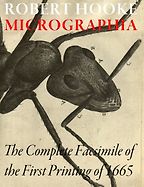
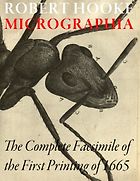
Your first choice, Micrographia by Robert Hooke, written in the 17th century, was the first scientific bestseller.
Yes, this is a fascinating book. Robert Hooke was a really interesting bloke. He was born on the Isle of Wight. He had no money. His dad died and left him a little bit and then he went and got himself educated at Westminster School in London. Then he was hired by Robert Boyle as a sort of assistant. He was working with him mainly in Oxford. Then Boyle went to London and when the Royal Society was founded in 1660 Hooke was around and he was absolutely brilliant with his hands and very clever at the same time. He became curator of experiments.
“When Stephen Hawking wrote A Brief History of Time he says that his publisher told him that every equation he left in would halve the number of readers, which is a bit of an exaggeration, but not far off.”
He was a sociable bloke but a little bit irascible and he had a terrible row with Newton. But he remained a great friend of Christopher Wren and Edmond Halley and they used to go together to coffee shops every day. In 1665 he produced this extraordinary book. I have a facsimile edition here, not an original. It is big, about a foot high and nine inches wide. It is beautifully printed – there is all this old-fashioned type with the long S and so on and it contains lovely pictures. He was, luckily for us, a very good draftsman. And some of the drawings are just the same as the pages and some of them pull out to make a picture about two foot square. The most famous of all is this picture of a flea. He was almost the first person to use a microscope as a scientific instrument and he looked at things like fleas and drew wonderful pictures of them – and showed people a new world.
A lot of it is all about the things he could see through his microscope.
Yes, and it is beautifully written and written in English. People before him had all written in Latin. Harvey had written about the circulation of the blood in Latin and Gilbert had written about magnetism in Latin, so to write in English was a big step forward. And Pepys said he sat up all night reading it, so that was lovely.
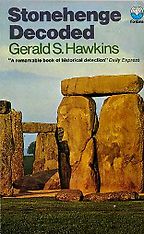
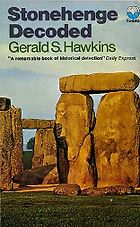
You only have to look at the busloads of tourist milling around Stonehenge to know that thousands of people around the world are fascinated with it. What does Gerry Hawkins’s book Stonehenge Decoded have to offer us?
Well, this book was really interesting for me because it was the first popular science book I had come across. It was published in 1965 originally. I was doing my PhD at the time and this book came to me because I had just joined one of those new-fangled books clubs! I was surprised that there were science books that were readable. I had heard about treatises on the electron or whatever it is but I had never come across a book like this.
And it was fascinating and fun. Computers were brand new and what he had done was use ‘the computer’ to analyse all the various sightings you can make across the stones at Stonehenge and tried to show that it was a great astronomical instrument. I think it’s not now largely believed. Some of things were right but many of them are clearly wrong. But the fact is that he used a computer, a scientific instrument to examine what was really a beautiful ancient building and this was a very odd and interesting thing. And it was certainly quite important to me to see that science could be made popular in this way and I think it influenced me quite a lot. I think it showed a lot of people science could be written for the layman.
I met Gerry Hawkins many years later at the Explorers’ Club in Washington DC; he is a very nice chap and I talked to him about the Nazca lines in the Atacama Desert.
What do you think makes a science book accessible?
Clear simple writing. It doesn’t want to be too heavy. It doesn’t want to go off into high-falutin’ stuff. When Stephen Hawking wrote A Brief History of Time he says that his publisher told him that every equation he left in would halve the number of readers, which is a bit of an exaggeration but it is not very far off.
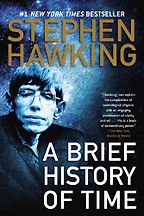
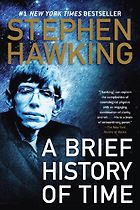
Well, let’s talk about A Brief History of Time by Stephen Hawking, which is another book on your list.
It was fascinating because when it came out I was working at Yorkshire Television and I saw a review in The Sunday Times. I went in the next morning to the library which was underneath our office and I said to the ladies there I would really like to see a copy of this. And Sheila, who was the boss, said, ‘I’ll have it on your desk in the morning’, which was actually quite unnecessary because I had just said I wanted to see a copy at some stage. But she then rang up her favourite suppliers and they had sold out. And she rang bookshop after bookshop but they had all sold out.
I know I am playing devil’s advocate here but don’t you think it is one of those books that people buy because they feel they ought to – but do they actually read it when they have it?
Well, I actually did read it. I got stuck in Chapter Six and I then read it again recently and it is a lovely book. It is very hard because he is trying to describe very complicated things, but he has actually done a very good job. I have started on his latest book, The Grand Design, which I think is rather easier. But this book is important not just because he is stuck in a wheelchair and is a brilliant cosmologist but also because it is a really difficult subject aimed at the general reader. This sort of cosmology, looking at whether or not black holes emit radiation, is a very esoteric sort of question. It is not like Stonehenge where people ask things that we can all understand, like, if you look through this gap can you see Capella.
Whether or not black holes emit radiation is a much more difficult question even to think about. So it was quite brave of him to try and I think he did a grand job. And, of course, it was enormously hyped because of his awful condition and that didn’t do that book any harm at all. And I think for anyone like me who is interested in science even if we can’t understand it all, it gives us some insight into what these chaps are thinking about. If someone asks me what cosmology is I haven’t a clue, but if I read this at least I have more of a clue. I may not get it all but I get some gist of what is going on in the minds of these physicists.
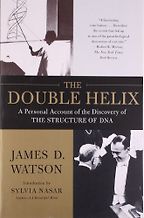
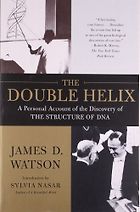
Francis Crick and James Watson revolutionised biochemistry and won themselves a Nobel Prize. Watson was only 24 at the time. Your next choice is his personal account of his work with DNA and one of the great scientific discoveries of the century – The Double Helix.
This was rather shocking when it came out and I have a copy here which I got him to sign. It is signed James Watson in rather small tiny writing. I also met Francis Crick just before he died. This is a really interesting story. The discovery of the double helix was fascinating because various people were working on it – Linus Pauling in California and Rosalind Franklin in King’s College London and she was very close. James Watson acquired her results without asking her, which I think was really bad news. And they went off and made this wild guess and they guessed right. And full marks – they were bright young men both of them – but they made a brilliant guess and the result was that they and Maurice Wilkins shared a Nobel Prize and Rosalind Franklin didn’t, which was very unfair.
James Watson was an enormously brash American and Francis Crick was hugely thoughtful, although I gather he had wild parties, but he was much the more sensible of the two. I don’t think they remained friends for very long because they were such different people. But the book itself is a vivid and fairly hilarious account of life in Cambridge in the middle of the last century, with some science thrown in. And it is Watson’s personal account.
Get the weekly Five Books newsletter
I once went to a grand dinner at the Guildhall and we milled around in the quadrangle beforehand in our dinner jackets and Jim Watson was there. This was the celebration of 50 years since the discovery of DNA and Francis Crick was sadly too ill to come. David Attenborough came up to me and said, with pride: ‘I had my picture taken with Jim Watson! I had to listen to him for 20 minutes, but I had my picture taken with him.’ I said: ‘For goodness sake, David, you are far more famous than Jim Watson.’ But he wouldn’t accept that. For him Jim Watson was a great hero and it was really nice to hear that!
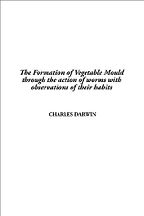
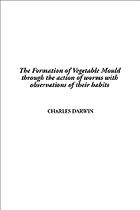
Tell me about your last book by Charles Darwin, The Formation of Vegetable Mould through the Action of Worms, with Observations on their Habits.
It’s a wonderful Victorian title. Of course his most famous book is On The Origin of Species and that is actually rather hard work because he was desperately trying to persuade people of his thesis and he collected an absolute mountain of data and you had to wade through this stuff. But he was actually rather a good writer if he was able to let his hair down. His account of the Voyage of the Beagle is lovely. It is a sort of travel book full of derring-do and wonderful adventures. But I love this book about earthworms, which wasn’t published until 1896, because it just shows what a lovely naturalist he was.
Let me read you one paragraph from page 26 on the observations and habits of worms:
‘Worms do not posses any sense of hearing. They took not the least notice of the shrill of a metal whistle which was repeatedly sounded near them. Nor did they hear the deepest and loudest tones of a bassoon. They were indifferent to shouts if care was taken that the breath did not strike them. When placed on a table near a piano which was played as loudly as possible they remained perfectly quiet.’
But he goes on to say that if you put them on the piano they jumped like mad because they could feel the vibrations. And can you imagine getting your kids to play the bassoon to an earthworm? It really is wonderful. Anyone could do that – you could do that now with children in primary school but the fact is it was the great Charles Darwin who actually did it. So it is a really delightful book. It is not a ground-breaking popular science book but it is a book I am so pleased to have. He was above all a naturalist who loved looking at nature and thinking about it and observing and maybe doing some little experiments and he didn’t want all the furore that was caused by his great thesis. He hated that and was only too glad to hand over to Huxley to defend him.
Five Books aims to keep its book recommendations and interviews up to date. If you are the interviewee and would like to update your choice of books (or even just what you say about them) please email us at [email protected]
Five Books interviews are expensive to produce. If you've enjoyed this interview, please support us by donating a small amount.