So the topic you’ve chosen is Enemies of Ancient Rome.
Yes, Rome is really hot right now: there are video games, TV series and lots of books out there about the Roman Empire. It was hard making a choice, so I’ve chosen some personal favourites and some that are off the beaten track.
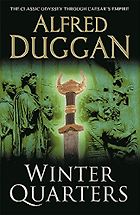
Your first choice is a work of fiction, Winter Quarters.
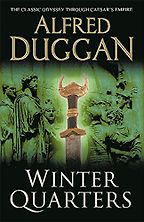
This is a historical novel written by Alfred Duggan. It came out in 1956, and it’s my favourite. I still have the battered paperback, held together with yellowing Scotch tape, that I read on my first trip to Greece 30 years ago, and really was my entry into the ancient world. It’s an odyssey about a warrior from Gaul, which had been recently conquered by Rome. And every time I reread it – and I do that every few years – I get swept up in it, this perspective of a former enemy of Ancient Rome, who decides to join the army of Julius Caesar. He leaves his village in the Pyrenees, and goes on Roman campaigns across Germany, France, Italy, Greece, and Asia Minor. Then they travel to the edges of the Steppes, to what is now southern Russia. Finally his Roman army is defeated in Parthia, now modern Iran, and our hero survives and decides to join the victorious Parthian army. He finds himself patrolling the borders of Afghanistan.
So he ends up once again as an enemy of Ancient Rome?
He’s an enemy of Rome again, but now he’s actually looking out towards the East, towards the raiders that are harassing Parthia. He is hoping to be rescued by the Romans, who will then reward him with citizenship, though it’s pretty hopeless. Duggan has got a deep knowledge of the first century BC, but what I really enjoy is his ability to write from the point of view of non-Romans. These are enemies of Rome, outsiders, former foes, who are drawn into Rome, this powerful magnetic force. The defeated Gauls were welcomed into Rome’s legions, but they experienced a lot of ambivalence. They’re wary, they’re proud. The hero is proud of being from the Pyrenees, but also feels pride in serving in the greatest army in the ancient world – and he struggles to understand the alien character and culture of Rome. This book allows you to peer at the Romans through their enemies’ eyes. It’s also a wonderful way to get a sense of the vast sweep of this rising Roman power, the incredible adventures and exotic sights that could be packed into one individual soldier’s lifetime. These were tumultuous times.
I also think it’s relevant today, because it shows how the wealth and military might of a great empire can become this inexorable force, that either destroys the enemy or it can attract them, sucking outsiders into its world view and drawing them in.
Yes, I can see why it could apply to America today, also in terms of the ambivalence. People love America but they also love to hate it.
They want to participate in the empire’s wealth and the power, but they’re really wary and cautious and adversarial and want to resist it too. And that tension really comes out in this novel.
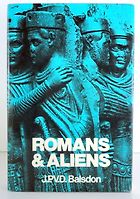
Your next choice is J P V D Balsdon’s 1979 book Romans and Aliens.
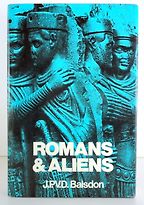
This is about Rome’s image problems among its enemies, its issues with bad PR. It’s a classic, and very entertaining. Balsdon was a British historian from Oxford, he also wrote novels. This is really a great source book on the way of life of the Romans, on their cultural attitudes towards their enemies and subjects, who were from so many different nationalities. He’s got well-documented chapters on every conceivable aspect of Rome’s relations with its neighbours and conquered peoples, from the early republic to the end of the empire, and it’s written in a wonderful narrative style.
What I like is that he juxtaposes Rome’s dominant outlook with examples of just how alien the Romans appeared to the rest of the world, which is a unique perspective. Some of the chapter titles and section titles give you a flavour: ‘Snobbery begins at Rome’, ‘Bad Press for Rome’, ‘Good Press for Rome’, ‘Bricks to Throw at the Romans’, ‘Skeletons in the Roman Closet’, ‘Rome’s Offensiveness Abroad’, ‘The Ghastly Bad Taste of the Romans.’
Five Books interviews are expensive to produce. If you're enjoying this interview, please support us by donating a small amount.
So, Balsdon really combed through the sources to give us a view of Rome and its enemies. It’s just jam-packed with lots of out-of-the-way information, fascinating material that is really hard to find in any other book.
Why aliens?
Rome considered non-Romans to be aliens, barbarians. It’s an old-fashioned book, very witty, but there might be a few politically incorrect things in there… But he’s presenting both sides of a mirror of cultural prejudice. One of the first chapters is ‘Romans – God’s Own People,’ and there’s also ‘Rome – Capital of the World.’ That’s Rome’s perspective, that they are the centre and everybody else is outside.
But didn’t some of these barbarians later become Roman emperors?
Yes, and that fits with what I was saying earlier with regard to Winter Quarters, about Rome’s extraordinary ability to absorb and co-opt its enemies.
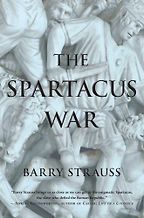
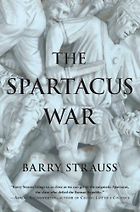
Your next choice is The Spartacus War – which is supposed to be a real page-turner.
Barry Strauss is a friend of mine, and I really admire his writing. This book is about the great slave revolt led by the gladiator slave Spartacus. The scholarship is impressive, but he also has this dramatic narrative style – leaving you in suspense at the end of each chapter. It’s also obvious that Strauss travelled extensively throughout Italy, visiting all these sites, and that really enhances it, it makes it really immediate because he’s been there, he’s able to absorb some of the spirit of it. I also chose this book because the cable TV show Spartacus: Blood and Sand is causing a big buzz in the States – everybody is watching it. People can now find out the real story in this book.
In what sense was Spartacus an enemy of Ancient Rome? Tell me a bit about him.
He was the enemy from within. He was created by Rome and then turned and attacked it. Spartacus was originally from Thrace, northeast of Greece, on the Black Sea. It was a land of warrior horsemen that had just been conquered by Rome. Spartacus survived and was welcomed into the Roman cavalry – he fought campaigns in Greece on Rome’s side. He learned Roman-style combat as a legionary in the Roman Empire. But somehow, and we don’t know how this happened, he lost his status. Maybe he was captured, or he was insubordinate, that would seem quite likely. Anyway, he was sold as a slave, and was such a good fighter that he was sent to gladiator school in Italy. There he was trained in brutal fighting skills and became a champion in them – and then he rebelled. He starts with 70 fellow gladiator slaves in Italy, and incites this rebellion which grows until he’s got an army of 60,000 – made up of slaves and farmers from southern Italy. They managed to take over southern Italy and were threatening Rome. So this is a deadly enemy that Rome itself created – from its policies of warfare and conquest and slavery and gladiators, and they had to really struggle to put it down.
What was Spartacus trying to achieve? Presumably he wasn’t trying to get slavery abolished at that early date?
That’s part of the legend. And that’s one of the reasons he’s become such a hero and martyr for Marxists and revolutionaries, inspiring revolutionaries and rebels for the past 2,000 years. Strauss goes into that – he analyses all the legends about Spartacus and comes out with a very rational, logical speculation on what Spartacus really wanted to achieve.
Which was?
Mostly, what he really wanted, was to go home. But he did have these noble ideals – everyone was treated equally within his army – and he certainly attracted people who had been oppressed and wanted to be free.
That theme of just wanting to go home, isn’t that Ridley Scott’s Gladiator?
Exactly. I think the movie Gladiator must have been inspired by the story of Spartacus, because in the end what he wants is to return to life and liberty.
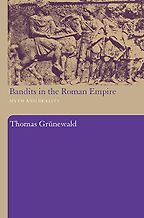
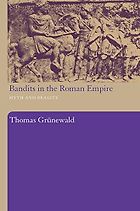
Your next book is Bandits in the Roman Empire by Thomas Grünewald.
This is the most scholarly book I’ve chosen. It was published in 1999 and translated from German, and goes all the way from the second century BC to the third century AD. It’s a little bit dry and dense but it’s a treasure trove of information on enemies and nonconformists in Rome, people who defy Roman law and order, and it’s impossible to find all this stuff in any other single book. The book is about a special, very broad class of enemies within the empire, people that Romans called latrones. The term refers to outlaws, bandits, robbers, pirates, criminals, fugitives from the law, runaway slaves and any other rebels against Roman authority. Some Roman politicians even began to use the term latrones metaphorically to insult and brand their political rivals as enemies of the state. And then, later, people who were underdogs or dissenters assumed the label of outsider as a badge of pride. They started calling themselves ‘noble outlaws’, as a way of idealising their anti-authoritarian activity. Spartacus was one of those people who was branded as an outsider and then took that on as a badge of pride.
Grünewald talks about everyday crime in the Roman Empire, individual renegades, criminal gangs, and bandits who hung out in caves on lonely roads and also the fleets of pirates that were preying on Roman shipping – pirates ruled the Mediterranean in the first century BC.
Does it have relevance to today?
Yes. I think Grünewald shows the many different ways that individuals and bands of latrones could defy and threaten Rome, and then he describes how Rome reacted. And I think that’s relevant for any very powerful state today: it can’t tolerate that kind of threat from within to security and to law and order. It was not a good idea to defy Rome, it’s dangerous to defy a forceful, powerful empire from either the inside or the outside.
So the message to any potential opponents is: you’ll lose eventually.
Rome hardly ever loses. They will come and get you. They will track you down and punish you and make an example of you.
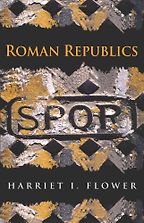
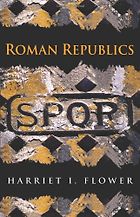
Finally, you’ve picked Harriet Flower’s Roman Republics.
This book shows how Rome itself could be its own worst enemy. Flower has a really original and striking interpretation of Roman history, and she explains it very clearly in this short book. Her thesis is that the Roman Republic is not a single, monolithic power from the very beginning, and then 450 years later it suddenly crumbles and falls to pieces in the first century BC. She says there were multiple republics.
So we’re talking about the period before Rome becomes an empire?
We’re talking about the Roman republican period, the 450 years before the empire began, in the first century BC, with Augustus as the first emperor. In 509 BC, after the overthrow of the monarchy, that’s when the republic began. And it’s a complex system of separation of powers, checks and balances, with a constitution, and a legislative body called the senate. It thrived for 450 years, but it wasn’t just one system. Flower argues that there were a series of republics, each form responding to the social and political needs of the time and then flourishing. And then cracks develop, or there are external threats, and then, it morphs, it changes as a result of those pressures, and a new republic rises like a phoenix from the previous one. She reveals the strength and the fault-lines of each reincarnation of the Roman Republic.
Why is that an enemy from within, then, when it’s really a strength, this flexibility and resilience?
It has to change over and over again because of the fault-lines that develop, that come from society itself, from the system itself. So frictions and weaknesses are inherent, there’s this constant tension throughout 450 years – overreaching expansion, expensive wars, they’ve got very serious social and class issues between the aristocrats and the plebeians, they have slave revolts, which were of their own making because they had such an insatiable and massive demand for slaves. Their occupied lands in Italy and Spain rise up and threaten them. All these tensions arise from within the Roman system and there’s constant pressure building from inside, all the political feuds that last for generations, for centuries, the ideological factions, the ultimate polarisation that finally, at the end of the first century BC, degenerates into horrifying gang violence and devastating civil war that ultimately tore the last republic apart. Flower describes the rise of the warlords of Rome in the first century BC and says that symbolises the end of the republic and the beginning of an age of personal power, which then leads to the destruction of the late republic. One of the warlords takes over – Augustus – and as we know, Rome doesn’t die. Instead this results in a radical new imperial government ruled by an emperor and Rome flourishes for another 400 years. So the strength and flexibility is important – but it’s interesting to realise that it’s not all strength, it wasn’t an invincible monolith – it was subject to fault-lines and cracks.
Get the weekly Five Books newsletter
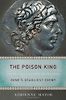
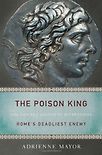
When I read it, I’d just written my own book on Mithradates, The Poison King: The Life and Legend of Mithradates, Rome’s Deadliest Enemy. Mithradates actually predicted this outcome, he liked to turn Rome’s famous foundation legend against it in his speeches. He often said that Rome was a vicious predator, just like a wolf, preying on weaker nations. He asked, ‘What can you expect from a nation whose founders were raised by a she-wolf? Sooner or later those sons of a wolf are going to turn on their own mother.’ And that’s what happened.
Don’t you argue, in your book, that Mithradates was the Osama Bin Laden of the ancient world?
I quoted some who have made that connection in the introduction of the book. It’s a tempting comparision. Mithradates began with a really terrifying act of genocide, which lured the Romans into a costly and very long war, an unwinnable war, in the Near East, and they never could capture him. They won battle after battle, but he was always able to find new recruits, he was able to find allies and surge back, which unnerved the Romans. And even though he would lose battles, more people would join him. So it was quite a wild goose chase he led them on. And they lost track of him at the end of the Third Mithradatic War. In 63 BC, he died old and free.
So is that one that Rome lost?
Well they won by default because he committed suicide, but they can’t really count it as a great victory.
I can see the parallels with the present.
Maybe that’s why the ancient world is so popular, because people are struggling to understand what’s happening in the [American] Empire – and of course we do have pressures from both within and without.
Five Books aims to keep its book recommendations and interviews up to date. If you are the interviewee and would like to update your choice of books (or even just what you say about them) please email us at [email protected]