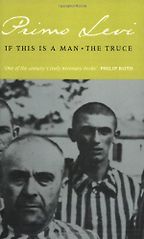
Can you describe Primo Levi’s If This Is a Man?
It’s called Survival in Auschwitz in the US to give it a positive spin – that’s the American publishing world: the Holocaust is all right as long as there are survivors. Primo Levi was an Italian Jew, arrested in 1944 after Italy capitulated and the Nazis took over. He was shipped off to Auschwitz, but because he had a chemical degree, or because he was lucky – which was how he saw it – he was working in the chemical factory in Auschwitz, which was a technological venture. So he managed to survive and see the end, and in fact the book also deals with the last ten days when the Nazis abandoned Auschwitz and the Russian troops had not yet arrived. Levi went back to Italy, indeed to the very same apartment where he was born, so his life was interrupted horribly. And then he wrote about his experiences, and eventually he committed suicide.
He bears witness to the Holocaust, but he’s a scientist, and he needs to understand the ethical system, as it were, behind those crimes. However perverted it is, he’s trying to understand how it works. So he talks about individual experiences, including his own. They’re always examples of a larger – I don’t want to say theory – but of a larger proposition or explanation. He unpacks the formula, as it were, behind it all. So it’s the victory of reason – or the proper kind of reason, as opposed to the Nazi kind of reason. The Holocaust was not madness: it was a technology, a system, and therefore rational. And Levi regains reason, by treating his experience in Auschwitz as something that is subject to rational analysis.
Your next book?
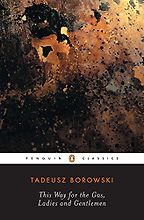
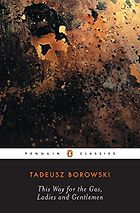
This is a book of stories which was originally published immediately after WWII, so they were very fresh, by Tadeusz Borowski: a young Pole who was a member of the Resistance, and who was arrested and incarcerated. He was an Auschwitz survivor. He killed himself while still in his 20s. The title story: This Way to the Gas, Ladies and Gentlemen, is about a group of inmates whose duties are to help unload the transport. It’s a horrifying story. It’s a horrifying book. He was not Jewish. So while Primo Levi talks from a superior moral position, from the point of view of a Jew, and someone for whom the starting point of the whole thing was the worthlessness of their life, Tadeusz Borowski could make choices, albeit under enormous moral and ethical pressures. He shows the dehumanisation of Auschwitz from a slightly different angle. It seems that the narrator makes the wrong choice: to go for survival at the expense of any respectful ethical choice. But that just shows how hard it was there. It’s not just suffering; it’s the violence and the ethics of it.
There’s another story where the inmates are playing football, and on the other side of the barbed wire fence is a transport. The narrator goes to get the ball when it goes out, and can see thousands of people lining up. Next time he goes to get the ball, there’s no one, and, he says, thousands of people perished between those two moments. So the narrator is not someone who wants to bear witness because it’s his ethical duty – which is Primo Levi’s position. The narrator in Borowski is someone who selfishly, so it seems, wants to protect himself from death and hunger – but at the same time he cannot but see what is happening: so he has this struggle which is horrifying in and of itself, and at the same time dehumanising and humanising. The struggle to stay a human being in a challenging situation is that if you want to stay a human being ethically, you have to stay a human being physically. And that’s what his struggle is, so it bears witness to the Holocaust in a different way.
Tell me about your next book Red Cavalry.
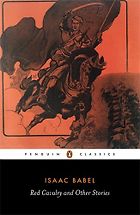
This is a fictionalised account of the expedition of the Red Cavalry – the Soviet expeditionary force – which in 1920 attacked Poland, hoping to reach Warsaw and establish a Soviet government. Babel was sent with the Red Cavalry as a reporter for a propaganda newspaper, and it’s based on his diaries. Red Cavalry begins with the Cossack troops crossing the River Zbrucz. After crossing, the narrator sees the sun rolling on the horizon like a lopped off head, and then you know that it’s not going to be comfortable. The book is made up of autonomous stories in which the central narrator is Lyutov, who’s obviously standing in for Babel, because he’s bookish and wears glasses. They are not always about Lyutov – sometimes he just reports or pretends to be reporting, and sometimes they are about how he works with the Cossack troops. Lyutov is Jewish – it is not always clear if the Cossacks know that. Cossacks, of course, practice the sport of killing Jews whenever they can. So Lyutov and Babel are in a very awkward position of at the same time being presumably loyal to the Revolution and to their comrades the Cossacks, and also to the tradition of Jews, and of non-violent engagement with the world. Lyutov does not adapt: he says he does not have that most basic of capabilities – to kill a man – and he fails as a Cossack in more ways than one.
It is an incredible piece of literature. Babel has an aesthetic that corresponds to not only his sensibility, but also to his awkward circumstance. You can sense the conflict between the sentences: they don’t flow smoothly, logically from each another; there’s a dialectic of narration, and you can sense the discipline. It was tricky for him: how to bear witness to things, how to talk about the fact that Cossacks were killing Jews, without being sent before a firing squad.
He failed that test?
Well, yes – although in the 1920s Babel apologised to the Cossack leader, Budyonny, and said the book was a mistake. But then he stayed put and never wrote anything like that again, vegetated as a writer, and was shot eventually. His last recorded words were to the NKVD agent who picked him up. Babel said to him, ‘You’re pretty busy these days.’
Next on your list is Blood Meridian.
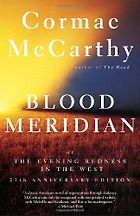
It’s possibly the greatest American novel of the past 25 years. It is unique. Blood Meridian is amazing, because it’s so rigid in its outlook, so committed to its vision, that it does not care about the conflict of the reader who, if sane, has to be uncomfortable. It is the most violent book I have read. This is a book about a bunch of scalp-hunters in Southwestern American territories before the Civil War, who were hired to hunt, kill, and scalp Native Americans. It follows them as they ride on and roam around killing Indians, committing horrible massacres. It is quite literally apocalyptic. There’s a stretch of about 60 pages, when the only subject is the group, and the most common sentence is ‘They rode on’.
What is most uncomfortable for the reader is that there’s no space in the book from which you can judge it, no space into which the reader could step to protect himself or herself from this world – there are no good guys. Of course, you can close the book and go away, but there’s one scene of a massacre of Indians that is one continuous sentence for a couple of pages. If the sentence ends, or if it’s broken up into little sentences you could quit after, you know, the 25th sentence, but they are strung together paratactically, and you ride on in the sentence.
There’s also to my mind the most amazing character in American fiction in the 20th century: the Judge, who provides theories that justify the world in which these men operate. Also what I like about it is that it entirely blocks the kind of reading that is based on empathy. You cannot identify ethically or morally, or even intellectually or psychologically, with any of the characters. There’s no expression of emotion, no interiority: those men act, and when they act, they act violently. It desensitises you; not because you don’t care, but because the violence is a part of a larger plan. It is not a question of individual agency but rather of the state of the world, or the underlying laws that govern the world.
Tell me about The Known World.
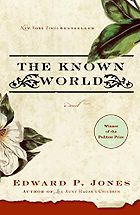
It’s a novel about slavery, but specifically the few recorded instances of black slave-owners, and it’s a masterful, masterful work, the most complete work of literary imagination in recent American fiction. Edward P. Jones could be one of the greatest living American writers. Again it blocks the simple emotional reading that provides redemption, and teaches you that slavery was bad. It shows how dehumanising the whole system was, not only to the slaves, but to everyone involved; it is quite literally soul-emptying. It is of course, again, in some ways like the Holocaust: it was not madness, it was a rational system, an economic system in which all participated in various ways. Even among the slaves there were differences and hierarchies, and degrees of ethical involvement with the issue of slavery. Jones narrates, or manages, dozens of characters. They’re all individually defined, but there’s no central consciousness the way there might be in a straight up psychological novel that you follow as it progresses through some sort of sociological landscape, and so it’s like he’s conducting an orchestra of characters. He shifts from one to the other and has this particular narrative device in which he goes beyond the knowledge of his characters to tell the reader what will happen to them in the years after slavery. The suffering is not simply the physical suffering of individuals; it goes well beyond that. It goes to the heart of the system.
What Jones does is very important, I believe, when we’re talking about war and violence and suffering: not to reduce the understanding to a mere emotional response. Of course the Holocaust is horrifying, of course slavery is horrifying, but if you just see emotional release and redemption then you never understand it and never experience it as a reader.
Why did you choose this subject to talk about?
There’s a way of reading books that’s common in the United States, which is to identify with the best person in the book. And there are complications related to this particular mode of reading: you have to react emotionally to texts, and then analyse your emotions as though you’re analysing a text, and then in that emotional release find redemption. As far as Primo Levi goes, that doesn’t really do anything. It’s hard for me to feel better about the Holocaust when I read Primo Levi. Blood Meridian is the most radical in that sense, in that it’s obviously not about the Holocaust or anything comparable, but it simply does not allow you to assert your moral and human superiority. It confronts you with things that you would rather not know, and it blocks this emotional reading: you have to think about it.
Five Books aims to keep its book recommendations and interviews up to date. If you are the interviewee and would like to update your choice of books (or even just what you say about them) please email us at [email protected]
Five Books interviews are expensive to produce. If you've enjoyed this interview, please support us by donating a small amount.