Your first choice is in Portuguese.
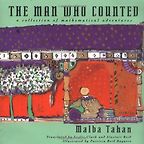
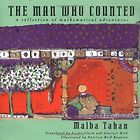
A fascinating property of maths is that it is totally international and never goes out of date. So if you write a maths classic it is a classic for ever, everywhere. This Brazilian book links my past life in Brazil with maths. The literal translation of the Portuguese title is ‘The Man Who Calculated’ but the English version is called The Man Who Counted. There are editions in many other languages too.
The author Malba Tahan is a fictional character, the pen name of Júlio César de Mello e Sousa, and the book is set in Arabia as a mixture of One Thousand and One Nights and a maths book – it’s coming out of the most populous Catholic country in the world and yet it’s as much a love story to Arab culture as to maths itself. There were lots of Arab immigrants in Brazil and they love Arab culture – one of the most popular fast food chains is called Habib’s. The story here is presented as if the author, who I believe only went to Lisbon once and virtually never left Brazil, has just stumbled upon or discovered this Arab text.
A bit like the Rubaiyat of Omar Khayyam?
Exactly. It is composed of lovely little stories and, with each chapter of a few pages, it introduces a mathematical idea along with a story about travelling through the Arab world. For example, one chapter shows you how to make every number between one and 10 just using four fours because the narrator meets someone who shows him this trick.
This is also a brilliant piece of international cultural history because Brazil is a country in which very few people read books, in which everyone is obsessed with sport. Yet when this book came out in the 1950s, Malba Tahan became as famous as any of the footballers. He was huge. So in Brazil when I told friends, ‘I’m now working on maths,’ they all said, ‘Oh, you must read Malba Tahan.’ And friends who were kids during that era said, ‘Oh, I remember my parents reading it to me’ – it’s almost like Alice in Wonderland in that it is one of the things that makes people feel nostalgic about their childhood. My Brazilian copy is the 74th edition.
It’s easy and it’s fun but any adult would love it. An international classic.
Your other choices are not fictional though.
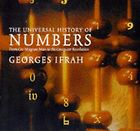
My next book is by Georges Ifrah, who you could say is the real ‘man who counted’. The French have what is probably the best tradition of popular maths in the world: they love their science, their maths, their engineering and philosophy. And from 1650 to 1850 probably the largest percentage of the great mathematicians were French: Pascal, Fermat, Laplace, Lagrange and the rest.
Ifrah was a schoolteacher who kept being asked by his pupils, ‘Where do numbers come from?’ He began to research it and – weirdly – it turned out no one had bothered to ask this question in the same way. He’s not an academic, nor is he a writer: he’s a massively obsessed schoolteacher on a mission. So the book is a bit sprawling and doesn’t have much of a narrative but it is absolutely incredible. He goes through each culture and describes why they thought of numbers and how they counted. So we have it explained here exactly how the Maya counted, the Sumerians, Hebrews, exactly how the ancient Chinese counted, all different types of tally systems, hand systems, how the abacus works.
Then halfway through it changes and becomes largely about India because Ifrah realises that our own number system really originated in India. Our number system being what we call Arabic numerals and which are really Indian numerals. What you realise from reading The Universal History of Numbers is that everything before India is just a curiosity really.
Get the weekly Five Books newsletter
The three things that define our number system are: only 10 digits, zero to nine; a place value system, which isn’t true of Roman numerals; and the use of zero, because with a zero it enables easy multiplication and it then becomes feasible for the lay person to calculate, which wasn’t really possible with Roman numerals.
So the book then becomes an encyclopaedia of all things Indian – a bit eccentric, but so full of information that when I was writing my book this was on my desk at all times to refer to. It’s the bible of counting and where numbers came from.
It’s an enormous, rectangular format.
Well worth having in among any other awkwardly shaped books you might have. Ifrah has never really done anything since, and he’s described here as ‘an independent scholar’ who was ‘the despair of his own maths teacher’. He funded his research around the world on the 10-year project by doing jobs as a waiter and taxi driver.
Your next choice looks less unusual, although it’s an unusual subject, zero.
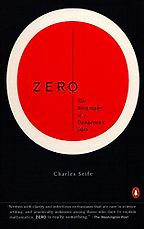
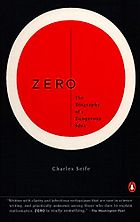
Unlike Ifrah, Charles Seife is a brilliant popular science writer who has here written the ‘biography’ of zero. And even though he doesn’t talk that much about India, it works well as a handbook to Ifrah’s sections on India. Because Seife talks about how zero is mathematically very close to the idea of infinity, which is another mathematical idea that the Indians thought about differently. Seife gives you the context and it explains why, really, without zero, you can’t do anything. The difficulty of understanding zero is similar to the difficulty of understanding infinity. The Greeks had no zero, Roman numerals have no zero, and they had no infinity. He plays with this idea that we were afraid of infinity and then gradually we learnt not to be afraid of it.
There is an energy to the way Seife writes about maths, using a strong narrative, which is very difficult to pull off: but he knows exactly how to do it. You finish each chapter and you really want to go on to the next one and ‘find out what happens’.
Why were we afraid of infinity?
There were different reasons, but fear of mathematical infinity is probably best expressed by Zeno’s paradoxes, the most famous of which is probably that about Achilles and the tortoise.
Imagine Achilles in a race with a tortoise, with Achilles starting behind. By the time Achilles reaches the tortoise, the tortoise has got a little bit further. This happens the next time he reaches the tortoise and again and again, so he will never beat the tortoise. How can that be? To understand this paradox you have to be able to cope with infinity, because you are counting an infinite number of time units and you are assuming that an infinite number of time units goes on for ever. But in fact it can be finite. Only with calculus and Newton did mathematicians harness the power of infinity rather than run away from it.
But Seife says the other reason, spiritually or religiously, that we were afraid of infinity and zero and the reason that India got zero, was that Western religions thought there has to be God everywhere. Nothingness, or the void, is frightening, because it’s a world without God. Whereas in Indian religious thought, that’s nirvana.
That we are, in fact, all struggling towards a state of nothingness.
Yes, so this religious thought provoked the mathematical thought. The Seife is a rip-roaring page-turner about the history of zero, but it is great to read it with Ifrah so that you can just stare at all the lovely information on India alongside.
Your next choice is about pi, another number.
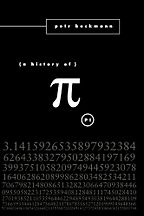
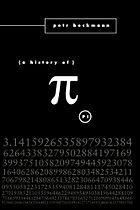
Petr Beckmann was a Czech electrical engineer who lived in Czechoslovakia until he was 39 in 1963, when he went to America as a visiting professor and just stayed there.
The History of Pi is so well written. It is really funny, really witty and charming – full of weird deadpan one-liners – but also incredibly opinionated. He says, ‘Not being a historian I am not obliged to wear the mask of dispassionate aloofness.’
This guy was a teenager in Prague who then escaped the regime, and there is so much brilliant anti-Communist stuff in here. For example, when he talks about the death of Archimedes at the hands of the Romans, he obviously really hates the Romans, whom he sees as totalitarian. It is quite rare in maths writing that you get someone who is such a good stylist, and he’s cultured so he puts it in context. It’s an absolute joy to read, even though some of the maths is quite difficult. I would probably recommend it to someone who is already interested in maths, maybe to a teenager also.
You only have one more choice from that pile.
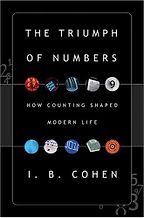
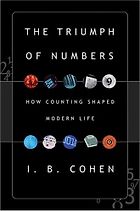
OK, so this is The Triumph of Numbers by IB Cohen, who is a scholar, an eminent historian of science and he has written many academic books. But this one – very short – was only published after he died. Again, the difficulty in maths writing is often that the mathematicians don’t know how to write and the non-mathematicians don’t really get the maths. But Cohen is an amazing historian, so although what he has chosen is a massive subject, he has only nine chapters which are nine moments in the history of numbers.
It is quite hard to write good history of science because there are so many things happening in different eras and you want to choose something that explains the science but also has a bit of personality, but then again doesn’t demean it. The sort of mind that understands how to write history is very different from the mind that understands how to do maths, which is very structured. So most maths writers tend to be incredibly structured and a bit obvious. For example, they tend to do history very chronologically and can’t really do it any other way. But you can tell that Cohen has this breadth of knowledge and that he chooses the right moments and then puts them in the right context.
Historians can synthesise the knowledge differently.
Yes, and this is an absolutely brilliant history book – you really feel that you are in a great pair of hands. Often with the history of science you feel that the writer only really knows about the narrow subject they are writing about because it is too specialised. Here, though, you can tell that his other knowledge filters through. So he talks about Napoleon, who was a great mathematician and surrounded himself with top mathematicians. There is a great anecdote where Napoleon had just beaten the Berbers at the Battle of the Pyramids. While his generals climbed up the pyramids, he sat at the bottom and worked out that, using the stone from the Great Pyramid, you could construct a wall three metres high and, I think, a third of a metre wide that would more or less exactly match the perimeter of France. And then he had the top mathematician of the day check his calculation, which was correct.
Wouldn’t you tell him it was right even if it wasn’t?
The emperor was correct! Or in fact he wasn’t emperor at the time – I think he was just the coming man. It’s a great anecdote anyway. But the book is essentially about the time from the 18th and 19th century where, thanks to Indian numbers coming into common use, all of a sudden everyone could use them. To start off with no one really had use of numbers – now in the modern world we all use numbers all the time. And this book, using a few episodes, explains the birth of statistics, the birth of graphs, of measuring. There’s a load of stuff on how the rise of numbers created a huge backlash, using the example of Charles Dickens’s character Gradgrind in Hard Times, who cares only about measuring.
He tells the story of the obscenity case against the publication of James Joyce’s Ulysses in the United States, which rested on the idea of ‘the average man’. The judge referred to ‘the eyes of the average man’ but had no idea that it was a mathematical concept that had come to prominence in the 19th century with the numerical analysis of social phenomena. And that leads us into a discussion of statistics and how the bell curve plotting social data was used as an argument for eugenics, which was of course very fashionable until Hitler came along.
This interview was first published in 2010.
Five Books aims to keep its book recommendations and interviews up to date. If you are the interviewee and would like to update your choice of books (or even just what you say about them) please email us at editor@fivebooks.com
Five Books interviews are expensive to produce. If you've enjoyed this interview, please support us by donating a small amount.