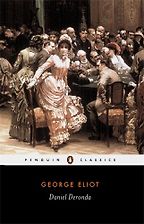
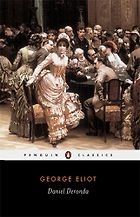
You begin with George Eliot’s last novel, Daniel Deronda.
Daniel Deronda is a book which is all about identity and diversity, and the identity issues that affect many of us who have an immigrant background or something of that kind – it’s a bit of a Victorian parable for the modern age. George Eliot was very interested in class as well.
Middlemarch includes a substantial proportion of writing about relations between the professions, trade and the landed gentry and the moral and ethical issues that affect those relationships. I think Daniel Deronda is a quite beautiful description of the identity dilemma and what we would today call diversity issues. It explains how conditioning by nurture can confuse someone, as it confused Daniel, who only really found his understanding of his origins when he met the unconfused if vulnerable young woman Mirah.
Have not those diversity issues been transformed since the Victorian era?
Everything changes but plus ça change, plus c’est le meme chose. Diversity has become, rightly, an enormously important issue in our time. But I don’t think the ethics behind diversity have changed very much. Although George Eliot, who was something of a social reformer, was thinking and writing about the changing times in which she lived, the lessons she gives us are an exemplifier we can use when facing similar issues today.
“The use of language is extremely important and that people are extraordinarily negligent in their use of language.”
I think ethical issues are a continuum. If you read the court speeches of Cicero, for example, you see exactly the same kind of moral and ethical problems being confronted within his historical matrix as we face today – by analogy at least.
Zadie Smith has written that we should read George Eliot as a moral education, as a way to fit us for society.
Yes, I think she is a moral education. If I have a pupil barrister, or a parliamentary researcher – or even a child – when they get to an appropriate stage I always say to them, ‘If you can find the time please read Daniel Deronda because it is part of the essential bibliography for life.’
The initial Victorian readers, and even the critic F R Leavis, didn’t like the Jewish theme – Leavis said it would be a great novel if those parts were excised.
There isn’t anything to the novel without that. The essential part of the book is about the character’s Jewishness, partly because it is a great storyline. But it couldn’t have been written without the Jewish theme. And don’t forget that at the time George Eliot was writing, pogroms were still taking place against Jews in otherwise civilised parts of the world. In Russia, for example, which had at the time possibly the most civilised aristocracy, and elsewhere.
Your next choice is about a more recent dilemma.
I read The Social History of the Machine Gun fairly recently as the result of a recommendation. And it does exactly what it says on the cover – it describes the development of the machine gun and its impact on warfare, which was dramatic, both within states and between states, and its effect on the fabric of society all over the world. The author speaks about Britain, Europe, India, South Africa. Once again, rather like my choice of Daniel Deronda, although this is a much more recent book, it is a parable for our times, applicable to our own dilemmas.
No society can prevent the invention of potentially lethal material. What it can do is ensure that it is dealt with within an ethical framework. I think this book shows that the invention of the machine gun and its deployment was rather badly handled and it has lessons for us. What is one of the greatest threats to our time? Nuclear proliferation, which we are still debating how to deal with. I am of an age never to have been called up for active military service and never have had to fight in a war in Europe (there have been no European wars outside the Balkans). One answer to the question of why this is so could be nuclear weapons and the stand-off between the old Soviet Union and Europe. As Professor Bernard Williams once said, nuclear weapons cannot be disinvented. They are an extraordinary invention which has been taken into the civilian world to some advantage in my view.
“There is something hypocritical about everyone who is very moral. There is something of the selfish and egotistical in the altruistic.”
The lessons of the machine gun apply not only to nuclear non-proliferation but also to the use of nuclear materials for generating electricity. Also to the use, within an ethical framework, of genetically modified crops. In fact to any other similar analogous issue. I think the lesson we learn is the importance of a proportional balance between progress and progress being misused – the balance between a Dr No-type scenario of antisocial use of an invention and the safe use of genetically modified crops to feed millions of hungry people is a very delicate balance. I don’t subscribe to the view that you shouldn’t take the risk of trying to find that balance. And the notion in this book, which is that something that can be hugely lethal can also bring about good, is one that we have to recognise and embrace.
So my lesson from this book is that when something like the machine gun appears on the horizon – and the machine gun changed battlefields because however many men were charging toward you with swords or muskets, it could mow them down before they came anywhere near you – whenever we see that kind of invention we have to look at whether it can be put to good use, rather than simply saying, ‘Let’s ban it.’ It is one of the fundamental disagreements that I have with my own party, the Liberal Democrats – and I’m not the only one in the party with a lot of political experience to take this view – that they indulge in too many calls to ban things.
I’m against banning things if at all possible, because I’m a liberal, but I’m in favour of putting things to imaginative use, or persuading people that they should be used in a way that is safe and effective. The price of wheat has gone through the roof, partly because speculators who used to buy money now are joining the futures market and distorting it, but the other reason is that there are an awful lot of hungry people in the world. To feed China, India, and particularly some of the poorer countries in Africa, they are going to have to embrace genetic modification.
Whatever campaigners say, the reality is that these developments are taking place, so controlling not banning them is the trick. We should be there in the vanguard of the ethical debate about how the technology is used. This applies also to stem-cell research and other scientific developments.
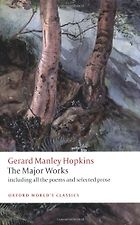
Why is Gerard Manley Hopkins on your list – how is this Victorian poet a guide to ethics?
I am not a religious man, although Hopkins was. My interest in him is the use of language, the use of words. I have been a barrister for 40 years, addressing juries fairly frequently, sometimes badly and sometimes, I hope, reasonably well. I have also been involved in reasonably frontline politics for approaching 30 years now. I believe that the use of language is extremely important and that people are extraordinarily negligent in their use of language – there are certain words that I would never use unless I had very carefully considered them. I’ll give you two examples of that: ‘Nazi’ and ‘fascist’, which I would never use as terms of vulgar abuse. But that doesn’t mean that we have to be politically correct to the nth degree nor unimaginative in our use of words.
For me, Hopkins is the supreme wordsmith of his time. Look at this poem, ‘Pied Beauty’. ‘Glory be to God for dappled things.’ Or some of these phrases: ‘Fresh-firecoal chestnut-falls’, ‘skies of couple-colour as a brinded cow’, ‘rose-moles all in stipple upon trout that swim’, ‘swift, slow; sweet, sour; adazzle, dim’. These are magnificent uses of words and they mean something. At the other irreligious extreme, I would say the same of Dylan Thomas.
Get the weekly Five Books newsletter
So his use of language is one reason for my fondness for Hopkins. The other is derived from the use of the phrase ‘dappled things’. Anyone who has practised criminal law for as long as I have knows that human beings are dappled things – there is something ugly about everyone beautiful. There is something hypocritical about everyone who is very moral. There is something of the selfish and egotistical in the altruistic. I have often used this phrase even in prosecuting apparently very good people who have done terrible things, and it also explains why people will do things that are not necessarily an offence but that they are rather ashamed of. This notion of people being dappled things, ethically, is very important.
Do you declaim the ‘terrible sonnets’ to the jury? What do they think?
I have occasionally declaimed but not generally. You have to be careful – not necessarily to simplify the reference to ‘Pied Beauty’ but to contextualise it. Juries are far from stupid.
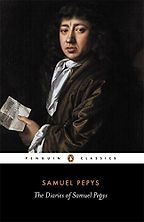
On to Samuel Pepys.
Pepys is about politics. He was not a politician in the modern sense, but he was something of a mixture between the politician and the civil servant. A bit of an Alastair Campbell of his time. Pepys writes about the political and court life in the raw, and about commercial life and the relationship between commercial life – particularly the business of building a Royal Navy – and the politics. And also, of course, he gives a wonderful picture of domestic life, warts and all.
I’m not a diarist. There are some awful political diarists around now – I didn’t think the Blunkett tapes were particularly interesting, for instance. But Pepys gives you a total flavour of his time. And of his several crafts. Allowing for the fact that these days we don’t execute people who fall out of favour, and that someone falling out of favour is no longer in mortal danger, Pepys gives us many lessons about political life. Also for anyone who is or wants to be a politician he gives us lessons about how to manage other aspects of your life. It’s also a wonderful picture of London – no one else has written remotely as well about London in those days.
What are the political lessons from Pepys?
Well, about relationships and the way that you manage those who, in those days, would have been your masters, and who in these days would be your colleagues. I suppose the modern analogy would be if you are a young politician and you are made PPS [parliamentary private secretary] to some senior minister, how do you deal with issues of divided loyalties? What if you disapprove of something that your minister is doing? What if you feel that you should do something about it but you don’t wish to appear disloyal – partly because disloyalty is not a great idea and partly because it might ruin your career? These are all dilemmas that have been faced by modern politicians – the recent Labour leadership campaign was a very fine example of how loyalties can divide.
Do you mean the Miliband brothers’ family drama or the general disavowal by the candidates of Labour’s time in government?
I think the Miliband brothers are both fine men and that is private grief – it’s extraordinary and I certainly wouldn’t like to run in an election against my sister, because I would feel it was divisive. I’m talking more about the broader loyalties to the Party and to the recent past; the disavowal of everything connected with Gordon Brown, who appears to be an unperson in the minds of most of them. Another book that takes up the same themes is Hilary Mantel’s Wolf Hall, which is great. I suppose Mantel wouldn’t claim that she is writing fact. She researches enormously well but nevertheless her work remains as historical fiction. The reason why people are still reading Pepys but may not be reading Hilary Mantel in 400 years time is because Pepys is 100 per cent fact and his real-life experience – albeit glossed, because Pepys was a vain and self-important person like lots of politicians. No, correct that, like almost all politicians.
Was he an ethical public servant?
I don’t think Pepys was an ethical public servant, but I think he was as ethical as somebody who is on the cusp of politics can be. I think he stands comparison with Peter Mandelson, for example, or Bernard Ingham from Margaret Thatcher’s day or any of the political fixers. In the members’ dining room in the House of Commons there is a portrait of Charles James Fox who spent almost all of his political career leading the opposition and never became prime minister. It is there to remind one, I suppose, that although he was a very ethical person, his principles were almost a disadvantage in politics. The streak of ruthlessness possessed by highly intelligent and broadly very ethical people like Jim Callaghan or John Major – and maybe Ed Miliband – got them where they ended up, rather than strictly adhering to a code of ethics. I’m dead in favour of politics being ethical but it’s a different kind of ethics really.
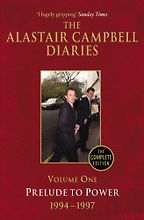
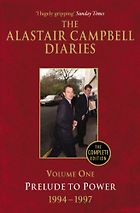
Your final choice is another of this political class of fixers – perhaps the most celebrated of our era, Alastair Campbell.
I love The Alastair Campbell Diaries because I was an observer throughout that period. From 1983 to 1997 I was a Liberal Democrat MP and since 1999 I’ve been a member of the House of Lords. So I’ve seen all this unfolding. Also in my nine years as independent reviewer of terrorism legislation I have been more close to some parts of government – or at least I’ve had the opportunity to see how some parts of government worked in a little detail. The opportunity to read what appears to be the unalloyed truth – about those relationships in the last government – is just fascinating. It’s very real in my mind.
Contemporary history is often boring, insubstantial and plain untruthful, but there are two fabulous political diaries written in recent years: one is Alan Clark’s diaries, probably vastly untruthful but hugely entertaining. Again I was there when Alan Clark made the speech when he was drunk and Clare Short accused him of it – to read about events like that is really very enjoyable after being there, sitting across the chamber. I think Alastair Campbell’s diaries cover vast areas of national and international politics with a degree of very personal engagement with many people. And Campbell is different from many of the memoirs because he writes with a pretty small amount of vanity in my view.
I also think Alastair Campbell’s diaries have the quality of Pepys to this extent, which is that people will be looking for insights and finding them in 100 years’ time when they come to analyse Blair’s pre-government years and the early years of the New Labour government and the early part of the relationship between Tony Blair and Gordon Brown – surely one of the most complicated political relationships of the last century.
And the ethics of what went on in Downing Street during that period? This question divides people.
Blair was the most wonderful communicator we’ve seen in recent years – the only competitor was probably Mrs Thatcher. As to the ethics of it, I think we are still too close to judge. I have absolutely no doubt that Blair never deliberately told lies. Those who suggest that he deliberately did so about the Iraq war are not recognising what a deep moral sense he feels. Whether his deep moral sense was always on an accurate compass I’m less sure – and probably so is he. But I think history will come to judge Blair as an effective prime minister.
The Blair government did one thing which I think will be its monument and which isn’t recognised because people tend to dwell either on the kitchen sink or on the whole edifice. And that is the enactment of the Human Rights Act, which to me as lawyer – and it went far beyond what most lawyers expected – was a more dramatic piece of legislation than any I can think of in my lifetime. It’s a huge monument, and it enabled the quality of United Kingdom justice to be clearer and fairer.
As to the ethics of what happened between Blair and Brown, it really depends on which version you believe. I regard Brown as a deeply ethical person – I’ve heard him speak on the odd occasion, in what I took to be speeches that came from the depths of his heart. Although some of his judgments seem to have been deeply flawed, I don’t believe Brown made them for cynical reasons. I get very, very cross, having been an MP and now having been in the Lords for over ten years, when people say, ‘All politicians are just out for their own interests.’ If you were to take the unwritten ethical code of MPs you would find that the vast majority – in fact all, with a small number of exceptions – are doing their best for their constituents and other interest groups that they represent, within what they judge to be an appropriate ethical framework.
If Pepys and Campbell are not, as you said, ‘the political masters’, then why the fascination?
You are not the master, but you are in a position to write the chronicle, and chronicles are extraordinarily valuable. Where do we find the real accounts that connect up to give us a sense of the history of our public life? Maybe if you start with the Venerable Bede, then pick up various religious figures, then when you reach his time you have Pepys, then Evelyn, maybe Thomas Carlyle in a way, and then in the modern era you come to Campbell, actually. I think it’s justified to include him in that list.
Another issue that’s quite important to me is that Campbell is quite a fragile character. He very frankly describes his demons. In his diaries he says that one of the worst demons that people can have is serious endogenous depression. Maybe Pepys suffered from it too; Churchill certainly suffered from it – I think most of us have a bit of a ‘black dog’ inside us, particularly energetic people. Campbell having the courage to write about it in the way that he did in the diaries is very useful for people suffering from the mental illnesses about which we tend to whisper when we should actually speak.
It’s dappled again.
Very dappled.
Five Books aims to keep its book recommendations and interviews up to date. If you are the interviewee and would like to update your choice of books (or even just what you say about them) please email us at editor@fivebooks.com
Five Books interviews are expensive to produce. If you've enjoyed this interview, please support us by donating a small amount.