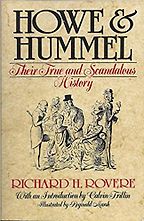
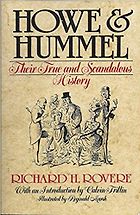
Tell me about the Richard Rovere book, Howe and Hummel.
This is a fun book and everyone should get it. It’s about two of the most shyster lawyers you can imagine in New York in the second half of the 19th century. In those days you didn’t need a degree or anything to be a lawyer. Howe was an English guy on the run for murder and he pitched up in New York and started a law firm on Center Street in downtown Manhattan. He fell in with the much smarter but equally impecunious Hummel, a ratbag from the Lower East Side.
“In those days you didn’t need a degree or anything to be a lawyer.”
Hummel was a brilliant lawyer but Howe was a brilliant trial advocate and Howe did over 600 capital cases and hardly ever lost. He never lost because of underhand practices like bribing judges and jurors. He also designed his own clothes and he would change his outfits as the trial grew closer to the verdict.
What did he wear for the verdict?
All black apart from a diamond pin in his cravat.
Brilliant.
Brilliant indeed. If you’d killed someone you definitely needed him. He would also dress his clients. He once defended a seaman who had killed three captains one after the other. The prosecution showed up with these captains’ families, their wives and children, and Howe thinks: ‘Shit! What am I going to do?’ He sees his own wife and daughter in the courtroom watching his performance and he gets them to play the wife and child of the seaman who, of course, gets off.
So they had a whole casting agency and would hire wives of fragile beauty suckling infants. He always dressed his clients as paupers even though they were paying him tens of thousands of dollars. He was a terrible sadist too and he once engineered for a guy to swing just because he could.
Was Hummel nicer?
Nicer isn’t the word I’d be looking for. Hummel’s favourite wheeze was sending showgirls round to chat up wealthy engaged or married young men and then blackmailing them and splitting the profit with the showgirl. There is a bit of Howe and Hummel in every lawyer.
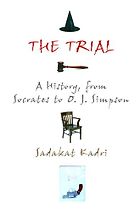
Next up is The Trial: A History from Socrates to O J Simpson by Sadakat Kadri.
This is a jolly good read and informative about how trials fit together in history. There’s also a good bit about how the English trial by jury came about. At the Fourth Lateran Council in 1215 Pope Innocent III decided you couldn’t ask God to decide on earthly affairs and so the old trial by ordeal was no longer acceptable.
They used to put a red hot poker in your hand and then bind it up and if it healed nicely then you were in the clear but if it festered then you were guilty. Of course, if the evidence was weak they might cool the poker off a bit first. But now the authorities had a problem. How would they continue…
To execute people?
Exactly. So they came up with La Preuve Légale, which was judicially sanctioned torture. The law was that you couldn’t convict unless you had two eye witnesses or a confession. Obviously, the likelihood of two eye witnesses coming forward was slim, so…
But that was just continental Europe. We didn’t do that because it seemed unfair, so we used something that had already been around for hundreds of years. The jury. Until then they had just vouched for things by oath, partly deciding whether there was a case to answer.
So, until 1933 you had the Grand Jury which decided if there was a case to answer and the Petty Jury which would decide on guilt or innocence. The first trial by jury was in 1219. But there was no concept of innocent until proven guilty until William Garrow’s ‘presumption of innocence’ in the late 18th century.
Trials in those days were blisteringly quick and the prosecutor was usually the victim, unless it was a murder case, of course. So you’d be hauled in front of your accuser, face to face —there were no lawyers— and you’d say: ‘No! No! It wasn’t me!’ Judges were doing 20 trials a day.
How quickly were people executed?
Well, this is all in my book, but by the 17th century execution days were hugely popular. They’d wait until they’d rounded up enough people and then there would be a bank holiday. The condemned were kept in Newgate and at 7am they’d be taken up to Tyburn (Marble Arch) and the crowds would line the route. The condemned would sit astride their coffins, even children.
They executed children?
Oh yes. And everyone would dress up. A shroud if they were guilty, a feather if they were innocent. The women wore silk and handed out oranges. They stopped at all the pubs and people gave them parting cups.
So at least you’d be drunk by the time you got to the gallows?
Slaughtered, yes. And to watch the execution you could buy Mother Proctor’s pews, priced according to the fame of the person being put to death. Earl Ferrers went to execution in his own carriage in the 1760s and wore his wedding suit, saying that his wedding day and his execution day were the unhappiest of his life.
People fought for the best position and when the person was dangling twitching on the rope, his or her family would rush forward and tug at them to quicken their journey to the next world. What the mob really hated was a reprieve.
One of the most important things in Kadri’s book is the Bushel case, which is of seminal importance to British legal history. Bushel was the foreman of the jury in the common law trial of William Penn (who went on to found Pennsylvania) and his associate, accused of speaking ‘to a tumultuous assembly’ which was illegal.
In 1670 Penn, a Quaker, preached in the street at Grace Church and the prosecutors —Simon Starling, Lord Mayor of London, and Thomas Howell, the Recorder of London— wanted a guilty verdict. The jury couldn’t reach a unanimous verdict and Howell sent them to Newgate for the night with no food or water (which they weren’t allowed until a verdict was reached).
“The Bushel case is of seminal importance to British legal history.”
Eventually, both men were found not guilty and the judge fined the jurors for bringing in a verdict contrary to his wishes and threatened them with Newgate if they didn’t pay. Bushel refused to pay and spent ten weeks in Newgate. Eventually Vaughan, the Chief Justice of England and Wales, drew a distinction between witnesses, who give evidence, and jurors who believe something to be true or not – this is a fundamental cornerstone of English law. Bushel was released.
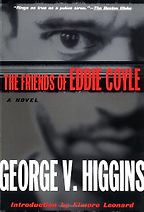
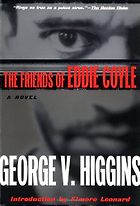
Your next choice is The Friends of Eddie Coyle by George V Higgins.
This is a thriller that really captures the low-rent squalor of most criminals’ lives and the cynicism of the police and the lawyers. It’s about the kind of trade-offs that people make. Coyle is sold down the river by his friends and you see how the police and the lawyers co-exist with the criminals and the symbiotic relationships between these walks of life.
How does Higgins know about these things?
He was assistant district attorney in Boston for years. It’s the first book, I think, that captures how things really are and it’s stylistically interesting because most of the text is dialogue. He conveys the sense of place and the information so efficiently and effectively that you understand what these people and these lives are like.
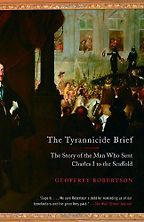
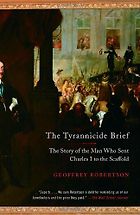
The Tyrannicide Brief by Geoffrey Robertson.
This is about a radical lawyer who took a case nobody wanted. John Cook prosecuted King Charles I on the basis that a ruler cannot kill his own people and then claim executive privilege. He won and in 1649 the death warrant was signed and the King was beheaded outside St James’s Palace. The room where the King spent his last night is still there – just on Pall Mall.
Cook established, as Robertson argues it, that rulers are not above their own people. Of course, it ends badly for Cook. Charles II was restored and Cook was hunted down, hung, drawn and quartered. An unbelievably horrible way to go and sad because he hadn’t wanted Charles I to be executed. But there are seeds of this case in current international law and in the arrests of people like Pinochet and Saddam Hussein.
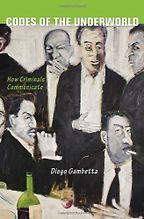
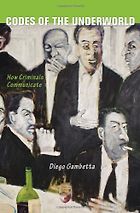
And, lastly, Diego Gambetta’s Codes of the Underworld.
Gambetta looks at the underworld from the criminals’ point of view and uses social anthropology to examine how criminals think and communicate with language and signs, how a pecking order is established.
Give me an example.
Well, you don’t go around screwing the wives of senior mafiosi.
You don’t.
But the Palermo singer Pino Marchese did and he was found dead on a park bench with his genitals stuffed into his mouth. This is a very eloquent sign to anyone thinking of bonking a mafioso’s wife.
Not very sophisticated, no, but the sophistication comes in Gambetta’s arguments – because what they can say to each other is so constrained they have to find ways of communicating without getting caught, and you don’t want to constantly threaten violence because you will end up having to carry it out. Gambetta says it doesn’t pay to go through associates like shit through a goose; you won’t be successful.
For example, when Toto Riina ordered the death of Falcone in 1992 everyone in the room knew that if a flicker of doubt about the decision showed in their eyes they would be instantly killed. These barely perceptible signs become so important in this world. He tells a story about someone who gets given a silver heart after a church ceremony like everyone else but his one is riddled with bullets. So, whatever you were doing you would stop doing it after that, wouldn’t you?
I would.
Five Books aims to keep its book recommendations and interviews up to date. If you are the interviewee and would like to update your choice of books (or even just what you say about them) please email us at [email protected]
Five Books interviews are expensive to produce. If you've enjoyed this interview, please support us by donating a small amount.