How much do we take in of the world around us? You can tell a lot more about your surroundings than you realise, if you only know how and where to look, as the psychologist explains
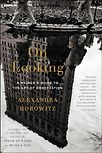
On Looking: Eleven Walks with Expert Eyes by Alexandra Horowitz
Before we look at your five book choices, I want to put them in context. You are currently working on a project that involves this theme.
Yes, I am writing a book that is about observation – in particular, observations done in an “ordinary” context. I am taking a series of walks, through the city of New York and other cities as well, with people whose expertise or in some cases physical condition allows them to see something about the city that I might not see. I am very interested in getting different perspectives on what we consider to be an ordinary, well-known landscape.
In the course of your research, what unexpected observations have you made about some well-known places?
Mostly I have seen that when we bother to stop and look, there is an enormous amount of surprising material right under our noses. For example, I live in New York and I have been seeing things like geodetic survey marks – small brass discs that are planted at a particular latitude and longitude. They are set in concrete or embedded in soil. I would never have noticed these before, but they are actually part of a large network across the US of these little topographic landmarks.
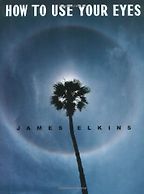
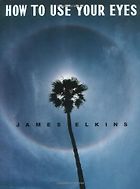
Your first choice is How to Use Your Eyes by James Elkins, which looks at how we can use our eyes more efficiently.
Elkins is a writer on art and art history. This book is really not about art per se – instead it is really about the act of observation. I adore his approach. He takes things that we are familiar with but have never looked at closely. He has 31 examples, which include things like x-rays and stamps and maps and the winter ice halo around the sun.
One of my favourites is pavements. He is not discussing what the stuff is that pavements are made up of. Instead he is looking at what the movement of pavement tells us about who has driven on that road. For instance he describes “shoving”, which is when warm pavements, over time, create a little crevice and then a hill after it – the pavement has been moved by the starting and stopping of a large force. If you begin to look for this shoved part of the pavement as you cross the street you will see it here and there. What it represents is where a lot of cars, or in New York a very large bus, might have stopped and started repeatedly. At bus stops you will see shoving. I love the idea that you can look at something so familiar that you have never really examined, and see this additional dimension – in this case, of who has passed by before.
It sounds like he is doing observational detective work.
Yes, it is like a forensic vision. He has another example, which encourages you to look at the inside of your own eye. And that is not through some strange microscopic mechanism. It is through becoming attentive to the blood vessels that run across the front of our eyes. If you look at a diagram of your eye in a biology textbook you see that they are there. We never see them because the brain has learnt to ignore them, so we need to trick ourselves into seeing them again. Then you see the vessels and you can see lots of little floater objects sashaying across your visual field. But for the most part we never see these things even though they are plastered to our eyes.
The problem being, that once you have worked out how to see them you might not be able to stop seeing them!
Yes. We have adapted to not see the inside of the eye because you don’t want to be focusing on it all the time. I find it entrancing that you can bring into mind something that through force of habit we have come to ignore.
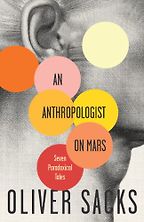
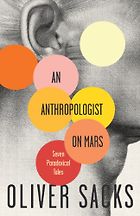
Your next book is Oliver Sacks’s An Anthropologist On Mars, stories of people with different medical conditions who see things differently.
Really, all Sacks’s books are an inspiration to me in bringing together scientific and philosophical reflections on various human conditions. In all his books he uses case histories where something is going wrong neurologically. In The Man Who Mistook His Wife for a Hat he talks about prosopagnosia, which is an inability to recognise a face, and then it turns out later in his life he actually has that condition himself. I find that kind of symmetry interesting.
Support Five Books
Five Books interviews are expensive to produce. If you're enjoying this interview, please support us by donating a small amount.
In this book he has some fascinating stories, including a well-known one about Temple Grandin, who was the high-functioning autistic who wrote the book Thinking in Pictures. He describes her ability to ostensibly see the world of animals that are being led to a slaughterhouse in a way that other people, especially those who designed slaughterhouses, could not. That represents the idea of being able to see for someone else.
And her work on this led her to be able to make improvements for animals in slaughterhouses in terms of their experiences there.
Yes, she helped the animals not to be so fearful of approaching their death. There is something paradoxical in that, of course. But putting that aside, it is interesting to me that she was able to realise that something shiny, like light reflecting off a puddle or a swinging chain, might disturb or alarm an animal that has a visual sensitivity to that type of thing. Most people wouldn’t think of that because we just go about with our heads and eyes and experiences.
So this book explores some of the other different visions of the world there might be.
That’s right.
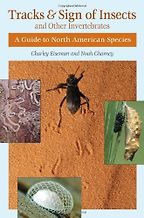
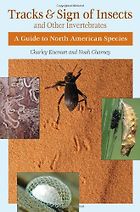
Your third choice is Tracks and Sign of Insects and Other Invertebrates by Charley Eiseman and Noah Charney.
This is a guide to identifying the tracks that insects leave behind. It is a glossy field guide which is densely packed with 500 or so pages, and it is a phenomenal book that should get a large amount of attention. It also shows insects, but mostly it is about the “sign” that show insects have been there in the past. The authors are identifying characteristics such as eggs or webs or droppings or leaf mines – which are little trails along leaves – or leaf galls where the insect has disrupted the growth of a leaf.
If you were trying to track down a particular insect this book would be a great way to help you.
Absolutely. You can identify what the insect is that is damaging your plant or your tree. But the authors see the sign as beautiful in itself, and it really is. As gardeners, we might just see it one way, but it is also evidence of the huge proliferation of this successful population of insect species. I have taken a walk with Eiseman for my book. In the least auspicious block possible, we saw a mind-boggling array of insect sign. He has many great images in the book. One of my favourites is an image of one of the beautiful bark galleries. These are tracks left under the bark by things like bark beetles, which lay their eggs under the bark. When the eggs hatch, each one heads off, excavating a trail under the nest site. What results is this radiating image on the bark of the tree which is extraordinary. Of course, it also does some damage to the tree, but to be able to see it as those two things at once is what this book has done for me. It made me realise the omnipresence of insects. Their sign and tracks are everywhere.
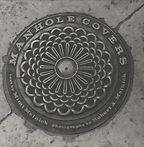
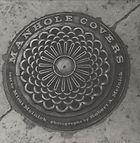
I am intrigued to find out more about how Manhole Covers by Mimi Melnick fits in with your theme of looking at the world.
This covers the part of the world which is underfoot, and might be the way that a lot of people find most immediately rewarding – to start to look at an ordinary block in a way they haven’t before. For the most part, even in New York where a lot of old manholes have been replaced and covered with resin, there are still many, many beautiful examples of 19th century ironwork that we drive or walk over. And this book is a picture history of a number of these covers. The Melnicks were some of the first to publish images of metal covers as though they were art. I think the covers really are beautiful and it is surprising that there will still be millions of people walking around in cities who haven’t bothered to look at these covers, which have things on them like a radiating sun pattern, or to wonder about the initials that represent the iron forger or the company which commissioned the making of the manhole. And so from this book you can remember to walk down your block, gaze at what’s underfoot and enjoy that.
And it talks about all the different types as well, including coalholes, grates, lamp-holes, storm drains, steam covers and meter lids.
Yes, which are easily identifiable as soon as you have an eye for it. The phone lines and the electrical lines are all going to be represented by different covers.
It sounds a little bit like trainspotting.
There probably are collectors of these covers, too. And there was a point at which, unlike trainspotting, people were often stealing these manholes and taking them away to have at home or be sold as scrap.
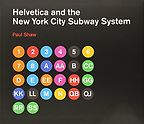
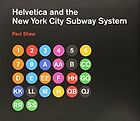
Your last choice is also looking at the world underfoot – Helvetica and the New York City Subway System by Paul Shaw.
Paul Shaw is another person with whom I have had a walk in New York. He is an historian and also designs types and is a calligrapher. He leads lettering tours, where the real focus of the tour, which could be somewhere like Italy, is to look at the varieties of lettering. That could be any kind of image of letters or numbers in a public space. It could be on a building, an inscription, underfoot or in signage. On our walk we wandered down the streets and looked at the variety of lettering and talked through what the type was. We looked at why some styles were successful and some were not so successful. You can learn a lot about the age of the sign and the business that it represented. Then there is ghost lettering, which is lettering on the side of a building that is fading over time and reflects now defunct businesses.
This book is a really nice example of his obsession with lettering on signage. He talks about the typeface chosen for the New York City subway system, reported a few years ago to be Helvetica, which is a common typeface that everyone can use as a font on their computer. And Shaw reveals, through a lot of images and a lot of historical research, that for the most part it wasn’t Helvetica until recently. The Metropolitan Transportation Authority decided to use a similar but non-identical typeface, which is called Unimark Standard. He documents the differences between these designs and he goes through the subway and photographs Helvetica and Standard signs, and also more ancient signs in tiles and stones. Anyone who uses a subway system would enjoy his interest in the detail of subway signs.
So all my five books have, I hope, shown how to open our eyes and look at the different layers around us. It slows you down on your walk but it is rewarding.
September 21, 2011
Five Books aims to keep its book recommendations and interviews up to date. If you are the interviewee and would like to update your choice of books (or even just what you say about them) please email us at editor@fivebooks.com
Alexandra Horowitz teaches psychology at Columbia University and is author of Inside of a Dog, a book on the psychology of dogs. Before her scientific career, Horowitz worked as a lexicographer at Merriam-Webster and was on the staff of The New Yorker. She and her husband live in New York City with Finnegan, a dog of “indeterminate parentage and determinate character”
Alexandra Horowitz teaches psychology at Columbia University and is author of Inside of a Dog, a book on the psychology of dogs. Before her scientific career, Horowitz worked as a lexicographer at Merriam-Webster and was on the staff of The New Yorker. She and her husband live in New York City with Finnegan, a dog of “indeterminate parentage and determinate character”