Alice Bell recommends her Favourite Science Books for Kids
Children learn in many different ways and the best science books for young people reflect that, says science writer Alice Bell. She recommends some of her favourite science books for kids.
When I was little, my mum was very keen on taking me to the Science Museum and the Natural History Museum in London. We would go to Kensington Gardens and play in the playground, and then walk down to Exhibition Road where she’d drag me round the dinosaurs and the spaceships. I found them a bit boring, but if I hung out with her at the spaceships and the dinosaurs then I would get to go and play in the Launchpad gallery, and have a go with some physics, which I enjoyed.
Dinosaurs at the Natural History Museum are a big favourite with most children, but you found them dull?
Yes, I wanted to play with things not just stare at them. I really liked the Natural History Museum’s human body gallery that Richard Gregory helped produce in the 1970s, and the Science Museum had Launchpad or the old children’s galleries in the basement. Those were interactive exhibits, not just big iconic things you were meant to stare at.
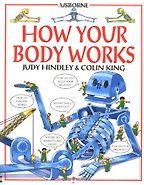
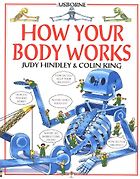
On the topic of the human body, let’s start with How Your Body Works by Judy Hindley and Christopher Rawson, which has some great illustrations.
This book has been in print for a long time, so there are a few generations of children that have read it. For me, it’s fascinating to talk to people who are now in their twenties and thirties about how they remember it. People often mention the illustrations. The book plays with metaphors to explain things but does so in a visual way. They had white knights as white blood cells, a scab which the knights are protecting, and the battlements of a castle. When I talk to adults about this today, they will say, “I remember that!” Another bit that people often remember are the robots that explained reproduction. The book clearly tried to make it not very obviously human – a way of distancing it from reality while also being able to explain it.
Are there two robots grappling with each other?
They are doing a running jump at each other!
Isn’t that a bit oblique as a metaphor for sex?
I think it has confused generations of children. There is an, er, energy to it though. There are hearts and cartoon movement lines as they run at each other. Clearly the illustrator has really thought about the reproductive system and how to communicate that in the weird abstracted form of rather box-like robots, because if you know what you are looking for you can see how it is meant to link to parts of the reproductive system. It is actually quite explanatory in many ways. But if you had been the sort of child whose parents were quite open, and you had seen examples of where babies come from and how the body works in a slightly less euphemistic way, it might just have seemed a bit odd.
For you, are the illustrations still the key to the book?
Yes, and it is something that you see a lot in children’s books, especially the HorribleScience books which I did my PhD on. They use visual metaphors and visual analogies. You play out almost fantastical things in often quite a jokey way, like that idea of white blood cells as white knights. There is another beautiful visual metaphor in one Horrible Science book where they are talking about amplitude and sound waves, and they have a character dubbed “an ample scientist” who is quite fat. The roundness of the scientist, as well as the way he is really messy about eating his food – with bits flying off him – becomes part of a scientific diagram with the shape of the sound waves coming off him. It is really clever at explaining something while making a visual pun.
“Some people think that children’s science is a very didactic form, ramming facts down people’s throats. But it is more fluid than that.”
Not all kids’ science books are so metaphorical, it’s only really the cartoonish ones. One of the things I like about children’s science books is that as a field it is actually really diverse. There are all sorts of different styles to reflect the many ways children like to learn. I tried to reference a range of styles in the books I chose, to reflect that.
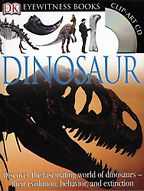
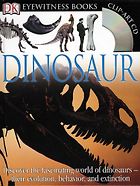
You said earlier that you are not particularly interested in dinosaurs – but to reflect all those children who are, you have chosen Dinosaur.
This is an Eyewitness book, which is an international series sold all over the world. The design is done internationally and the text locally, so they look very similar from country to country. A lot of them work with museums like The Natural History Museum or the Smithsonian, using images of their exhibits, and the attraction in some ways is a chance to view these objects when you can’t go to the museum.
With this book, you have pictures of dinosaur fossils but also artists’ impressions of dinosaurs. It’s a bit unusual for the Eyewitness style, which is normally more photo-realistic in its approach – an idea of science which is very immediate and about things you can see.
Surely people also want text to explain which bit of the dinosaur they are looking at.
That is there as well, it’s just that they are image-led – which is very different from, say, the Victorian book I’m going to talk about next or a more novel-like narrative work. The Eyewitness style is also less metaphorical than, for example, How Your Body Works. Dinosaur is in my list as an example of a famous series, but also of a style which is image-based, taking advantage of showing science not through reading as much as through seeing. It is almost meant to be like a paper version of a museum experience.
Let’s move onto John Henry Pepper’s The Boy’s Playbook of Science which was written in 1881, a golden age for scientific exploration.
Yes, and we could say it was a golden age for popular science books as well. John Henry Pepper is a fascinating guy. He not only wrote this book, which was incredibly successful for a long time, but he also used to do big science shows. People would flock to see his shows at the Royal Polytechnic, just north of Oxford Circus [in London]. He did these great shows almost like pantomimes – slightly less serious than the sorts of events at the Royal Institution in Mayfair. In fact, some of the science tricks he used to do in his show then became part of theatre.
Such as?
Pepper’s Ghost is the most famous, and it went on to be used in ghost rides at fairgrounds. It is a way to position mirrors to get a ghostly image to appear. If you are ever on a really old ghost train and seem to see a ghost, that was probably John Henry Pepper’s trick. He was also tapping into a history that happened before him. I thought this was a good choice because in some ways it isn’t a book for sitting down and reading, it tells you to have a go yourself. It is about hands-on science, which in some ways might be seen as the opposite of a book.
It sounds more like a manual.
It is a sort of an instruction book in many ways. I chose it because it is an early children’s book, which I think is interesting, but also because that approach to science books is popular to this day. You still see science books which are guides to so-called “experiments”, and there are loads of hands-on activities in the Horrible Science books. It is very different from a novel or something you might think of as children’s literature. As an academic, when I talk to people in children’s literature studies they sometimes turn their nose up a bit at the idea of studying children’s science books, because they are not seen as a literary or visual experience but more of an activity-based one. But I think that the big appeal for a lot of children is that they want to learn how to go and do something.
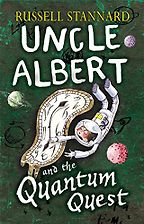
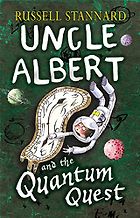
Russell Stannard’s book Uncle Albert and the Quantum Quest sounds like a fun way of making physics interesting for children. Did he succeed?
He would probably say that he has. In fact, there has been some research done on this book where they concluded it was very effective in teaching people. It is completely different to any of my other choices in that it is meant to be like a novel. It is a story. There is a character loosely based on Albert Einstein and a child character, his niece, who asks a lot of questions. The Einstein character says they should answer these questions scientifically by doing experiments – but you can’t really have the same easy empirical experience with quantum physics as Pepper was offering for, say, the laws of motion. At least not as a 10 year old in a kitchen.
Instead, Stannard creates this fantasy world – almost like AliceinWonderland – where the niece can travel into her uncle’s thought bubble and interact on the quantum level. There are other books in the series where she can travel very fast or see things on a very big scale, compared to the quantum world of the very small. This offers the readers a hands-on experience by proxy through her fantastical trip. It is through this fictional framing that Stannard allows you to understand these very fact-based ideas. This isn’t a new approach. There are Victorian examples of similar stuff and Stannard himself was heavily influenced by George Gamow’s MrTompkins stories.
Get the weekly Five Books newsletter
The book also gets into some of the scientific debates. It is not as simple as using fiction to explain fact. Stannard uses a story to explain debates within science and things that we are not sure about. The end of this book is almost unsatisfying – he says we don’t really know the answers yet. But we might argue that this is actually quite exciting for a young audience. You are saying, “We don’t know yet, but you might be the person to go and discover those answers. This is something that I am opening up for you rather than giving you all the answers.” I think that the more children’s books that do that the better, and from my research I’d say a lot do. Some people think that children’s science is a very didactic form, ramming facts down people’s throats. But it is more fluid than that.
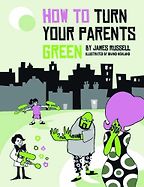
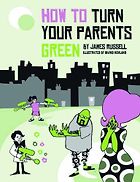
Your final selection is How to Turn Your Parents Green by James Russell.
The main aim of this book is to interest children in the environment with the jokey conceit that children get the environment in a way that parents don’t, so it is the children’s job to teach the parents. I chose this because there have been a lot of books about green issues aimed at children in the last five to 10 years, and there was a big wave of them in the late 1980s and early 1990s.
Maybe people want to talk to children about climate change, because they think that it will impact more on them. Or it might be to do with a long history of thinking that children are interested in nature. Probably both. What makes this book slightly different is that it takes a sort of pester-power idea, which is usually used to sell people things, and applies it to activism. It invites kids to say: We are kids, we know best and we are going to tell you what to do.
For a parent, that could be incredibly irritating!
Yes, and I have read a couple of reviews which say how awful and very irritating this is. But I think it is an appeal which has been used in children’s media for a while. There is this idea that the child knows best, which obviously goes down well with the reader and is played as a joke in the book. You see it particularly from the 60s onwards – it was a way of separating a children’s culture from an adult culture, rather than a family where everybody would read together. I suppose it stemmed from the rebellious teenage culture in the 50s and gradually trickled down to younger ages.
The HorribleHistories and Horrible Science books have a similar suggestion that kids are in the know, at least about some things. I’m not sure how I feel about the way books like these separate child and adult views. I like the idea of kids having their own culture and of respecting child perspectives, but I also think that it would be nice to have a shared, multi-generational sense of science, especially when it comes to climate issues.
November 20, 2012
Five Books aims to keep its book recommendations and interviews up to date. If you are the interviewee and would like to update your choice of books (or even just what you say about them) please email us at editor@fivebooks.com
Five Books interviews are expensive to produce. If you've enjoyed this interview, please support us by donating a small amount.
Alice Bell
Alice Bell is a science writer based in London, specialising in relationships between science and wider society. She also teaches at Imperial College London, where she worked as a lecturer in Science Communication for several years. Bell has a PhD in children’s science media, as well as degrees in the sociology of education and the history of science. She spent many years working in the children’s galleries at the Science Museum and has worked broadly in science education, policy and media
Alice Bell is a science writer based in London, specialising in relationships between science and wider society. She also teaches at Imperial College London, where she worked as a lecturer in Science Communication for several years. Bell has a PhD in children’s science media, as well as degrees in the sociology of education and the history of science. She spent many years working in the children’s galleries at the Science Museum and has worked broadly in science education, policy and media