I’ve chosen books that are very real to me. All five cover a 30-year-period that had a momentous impact on world history. They also deeply affected my mother’s family. Mine is therefore an intellectual and personal interest. These books represent the scope and drama of these events in a very poignant way.
This period saw a brilliant piece of mankind destroyed. And my mother’s family was the perfect example of the kind of culture that disappeared. Her paternal family were the Wittgensteins of Vienna. They were a colourful and extremely talented cosmopolitan family; they represented the assimilated Jewish bourgeoisie that’s obviously gone forever in that part of the world. Her maternal grandfather, Stefan Grossmann, was a Jewish intellectual who represented the same cultural milieu in a different, and less opulent, way. Everything I’ve done in relation to this 30-year period is an attempt, encouraged by my mother, to keep this culture alive and revisit what happened.
How does Manes Sperber’a Wie eine Traene im Ozean relate to that?
He was an acquaintance of my mother. Along with Arthur Koestler, he was probably the best-known communist activist. Sperber broke from the Communist Party in 1937. The book is a fantastic description of the events from the early 1930s to the end of the Second World War. Its main protagonist, Dojno Faber, is a member of the Communist Party, for perfectly good idealistic reasons. Despite leaving the party, he tries to find a basis on which to continue his original work and improve the world. With the rise of the Nazis and the outbreak of war, he ends up in Yugoslavia, the one country in Eastern Europe that rejected Stalin and had a sort of independent existence. Somewhere between Communist dictatorship and total democracy.
At the heart of the book are the conversations between Faber and Baron von Stetten, a cynical but clear-headed historian. From the start von Stetten tells Faber: “You’re wasting your time. It’s impossible to have a good revolution because the revolution will defeat you before you’ve succeeded. And when it does, it will destroy you and all your ideas.” There’s a wonderful core of intellectual discussion that gets to the essence of the problem: how can you combine a very worthy cause with the piece of machinery to implement it?
The conclusion is: you can’t. Faber finds a sense of purpose by looking after a little boy he met while exploring destroyed Europe. If you want a sign of hope, that’s it. The most worthy, realistic way to do good is to focus on the people around you. If you try and focus on large numbers of people, you’ll invariably fail.
It sounds quite bleak.
It’s actually quite a hopeful description of one part of what happened. It’s also a piece of fiction and not political philosophy in the conventional sense. It’s a real piece of theatre – with thousands of actors.
The book’s English title is Like a Tear in the Ocean. Is the English translation of the book a good one?
It’s very good. But it costs around £60 so it hasn’t been used much.
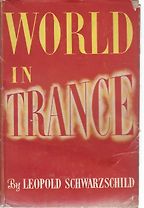
Tell me about Leopold Schwarzschild’s World in Trance: From Versailles to Pearl Harbour
.
Schwarzschild is the subject of the book I recently published. He edited the magazine Das Tage-Buch, founded in Berlin in 1920 by my great-grandfather, Stefan Grossman. He was a very intelligent Jew from Frankfurt and, though he abandoned the Orthodox faith, he came from from a very orthodox family. He was an economist and probably the most brilliant German journalist of the inter-war period. He moved to Paris in 1933 and relaunched the magazine with the help of a wealthy Dutch lawyer. Churchill was a great admirer of his; the French and Russian foreign ministers used the magazine as a source. He wrote in the first edition of Das Neue Tage-Buch – in July 1933 – that everything about the Nazi regime was designed to produce violent conflagration.
He wrote World in Trance in New York in the early 1940s. It’s a history of the inter-war period and it’s the best book on the subject. As the realities sank in over the next 50 years, his facts and arguments stood the test of time. But he’s also writing about his own life. He was writing about the destruction of his own past – the history of a class embodied in a family whose last representative was him. But he was not just a voice for an old culture. He added to it in a magnificent way. Of course, it didn’t prevent the destruction that followed.
In England, the orthodox representation of the inter-war period is that the poor Germans were crushed by the nasty allies after the First World War, the reparations destroyed the economy, the inflation caused Hitler and Hitler caused the Second World War. Hence the Treaty of Versailles caused the Second World War.
That’s what I’ve been taught.
That’s wrong. Every reasonable person, when presented with the facts, must surely agree.
What are the facts?
The reason it’s presented like that is largely attributable to John Maynard Keynes, the leading economist, He was a young, arrogant guy at that time. In Versailles he met Carl Melchior, a Jewish banker at M. M. Warburg & Co in Hamburg, who was advising on reparation payments. Keynes was in love with Melchior. Melchior completely pulled the wool over Keynes’ eyes. Keynes consequently wrote TheEconomic Consequences of the Peace, one of the worst books ever written about this period of history. It’s an appalling piece of analysis and virtually everything in it turned out to be wrong. The French economist Étienne Mantoux, who was killed a week before the German surrender in May 1945, elegantly dismantled it 20 years later shortly before his death.
Keynes said Germany would be destroyed by paying the reparations and it wouldn’t have enough money to buy imports. But he overlooked two things. First, German industry grew much faster than he had anticipated, creating substantial wealth and therefore the capacity to pay. Second, reparations may have been a cost to one party, but they constituted income to the recipient – and the recipient would use the money to make purchases everywhere, including Germany. That would theoretically offset or mitigate the original charge on the German economy. As it happens, the Germans didn’t pay any reparations. So there was no net transfer of resources outside Germany that would have required compensating payments to come in.
The key questions are: how much did Germany actually pay and how were these payments funded? Well, they paid around 20 billion deutschmarks – about 2.5 percent of GDP – between 1920 and 1933. And this was all funded by foreign loans, none of which were ever repaid when they were scheduled to be. To say that German reparation payments crushed the German economy cannot be right. The gross payments were small and funded mainly by American loans – on which the Germans defaulted.
The great strength of English politicals is getting on with people whose views you don’t share. In the House of Commons they beat each other up before meeting for a friendly drink in the bar. The English always thought that the Germans would behave like gentlemen, just like them. But nothing could have been further from the truth.
So from what tradition does Schwarzschild think Hitler emerged?
Hitler came from a long history of German nationalism that was ultimately invigorated by Bismarck. Bismarck, in my view, is the beginning of the end of Central Europe. He put together a couple of disjointed German statehoods and created a very aggressive, focused machine to crush its neighbours. That’s the ultimate cause. The immediate reason for what happened in the 1920s is that the Allies didn’t do what they did after the Second World War: crush Gemany completely. Whether or not that was possible is another matter.
The Germans never thought they had lost the war. If they had been made to believe they had lost it and caused it, things might have been different. The leaders of the army skilfully withdrew from signing the armistice and treaty. And the ones who did sign it were the Social Democrats, who assumed the role of government. They were later accused of stabbing the German nation in the back.
There’s a wonderful quote from an English diplomat in Berlin in the 1860s, Sir Robert Morier. He wrote a letter to the Crown Prince Frederick III – Queen Victoria’s son-in-law – who was very ill and German Emperor for only a brief period. Sir Robert wrote: “The malady under which Europe at present is suffering is caused by German chauvinism, a new and far more formidable type of the disease than the French. For instead of being spasmodic and undisciplined, it is methodical, calculating, cold-blooded and self-contained.”
They had 40 years to prepare and got away with it first time round. They then had 20 years to prepare again, unimpeded and uninhibited. The book is about how you got from there to Pearl Harbour.
The unfortunate culprit is England. The Stanley Baldwin view of war was that we must prevent it or it will destroy everything we’ve built. Vice-Chancellor Franz von Papen announced: “War is as natural a destiny for man as giving birth to children is for woman”. So there was a cultural ravine between the German cultural view of the good life and the British view. The British couldn’t understand how anyone would want anything other than a life of peace.
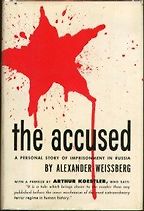
Tell us about The Accused by Alex Weissberg-Cybulski.
He was an Austrian communist and a friend of my grandfather. These are his memoirs. My mother gave me a copy when I was 12. He was a scientist and, like many communists, he went to Russia, working at an institute in Kharkov. He was accused of being a foreign spy and plotting to kill Stalin. He was imprisoned for two years and, like many others, endured sleep deprivation. Cybulski – a very jolly, big man – confessed. The next morning, after he’d been allowed to sleep, he withdrew his confessions. His case never went to trial.
Then, in that lovely act of friendship between Hitler and Stalin in 1939 – when Stalin handed over a few Jewish prisoners and Hitler gave up a few communists – Cybulski was exchanged and put on a train. He got off in Poland and spent a large part of the war as part of the Polish underground, fighting the Nazis and, miraculously, surviving.
The book is a description of the events in the Soviet Union. It describes in part what Darkness at Noon describes, only better. He’s on the list because I have a personal connection with him; my copy includes an inscription from Cybulski to my grandfather.
It’s ultimately an uplifting account, free of moralising. He used to visit us after the war. You couldn’t tell what happened to him. He was always very good-humoured. Life goes on.
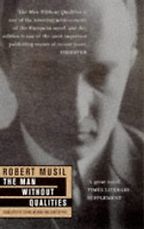
There’s a different feel to Robert Musil’s The Man Without Qualities.
This is the beginning of the arc. It’s set in 1914 and a very different book. Along with Ulysses and A La Recherche du Temps Perdu, some say it’s one of the three great books of the 20th century. It describes events in Vienna in 1914: a group of people prepares for the 70th anniversary of Emperor Franz Josef and the 30th anniversary of Emperor Wilhelm II. Hence it was called The Parallel Action.
The main protagonist, Ulrich, struggles to reconcile the enlightenment spirit of rationality within him and the Nietzschean urge for mysticism and spirit. He fails. But he does have an affair with his sister in the process. And numerous discussions between numerous characters, all representing parts of the declining Habsburg Empire. It’s a fantastic illustration of decline and the philosophical conflict of modernity.
Viennese life was dominated by this conflict, and the passion with which people engaged in it was extreme. The Wittgensteins were a good example. Karl Wittgenstein became fabulously wealthy and controlled most of the Habsburg steel industry. His sons were incredibly talented, sensitive men. Three of them killed themselves because they couldn’t handle their father’s materialistic inclinations. Like many at the time, they got caught up in a fight between spirit and body. It was a rather melodramatic fad. Young men thought they had to emulate Otto Weininger, the young misogynistic author whose premature suicide in 1903 probably triggered this period of self-destruction.
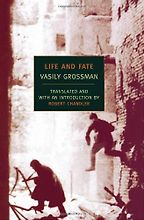
That’s an appropiate point to bring in your final choice for us, Vasily Grossman’s Life and Fate.
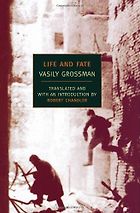
This is a wonderful, rich, melancholic, hopeful book. It’s a bit like Like A Tear in the Ocean: it embeds a piece of history in a well-crafted work of fiction and its characters represent the cornerstones of the period. It does that phenomenally well. He highlights the coexistence of conflicting emotions and choices within the same personalities. The conflict happens because you need to survive.
Viktor Shtrum is a good example of this: he spends the majority of the book as a victim of his beliefs. Then comes this magnificent phone call from Stalin, which knocks you for six when you read it. Very quickly thereafter he denounces two innocent scientists because it would be crazy to risk again his new position as favourite scientist to the great leader.
It also has the most moving account you’ll ever read of the gas chambers in Poland. Grossman drew on his pathbreaking article about Treblinka. Then, on the next page, he asks what makes life worth living. The book’s conclusion? In miniature versions of the world – in the relationship between two people, for example – the meaning of life is established.
These books have an overarching historical bleakness, ending up with the Candide thing of cultivating your own garden or a small child. Is this how you think about the period
?
Yes. I think any large-scale plan to reorganise society is impossible. You just start with what you can reorganise. This is usually restricted to a relatively small number of people.
But then you might end up being a libertarian or some kind of mad, ultra-right-winger.
It is conservative in a sense. Although in the way Michael Oakeshott described it. He said: “To be conservative is to prefer the familiar to the unknown, the tried to the untried, fact to mystery, the actual to the possible, the limited to the unbounded, the near to the distant, the sufficient to the superabundant, the convenient to the perfect, present laughter to utopian bliss.”
That’s a useful summary of what I believe is the right approach to organising society. And it’s the approach in books like Life and Fate and Like a Tear in the Ocean. I think it is impossible to reconcile, the desire to improve everyone’s life – and the emphasis here must be on everyone’s for it is possible to do so for some people or groups of people – and the maintenance of personal liberty. Ultimately the overarching ambition can’t succeed other than through the gradual progress of history.
Five Books aims to keep its book recommendations and interviews up to date. If you are the interviewee and would like to update your choice of books (or even just what you say about them) please email us at editor@fivebooks.com