Space historian Andrew Chaikin tells us about five books that capture the thrill and achievement of our venturing into the great beyond. He picks the best books on space exploration.
You’ve chosen five books about space exploration, but none are about NASA’s space shuttle. Was the programme ultimately worth it?
If I could magically go back in time and give NASA a different pathway at the end of the Apollo programme, I would not choose the space shuttle programme that we ended up with – but then neither would NASA. The shuttle was sold on the promise that it would reduce the cost of getting into low earth orbit and we could do it routinely, as often as once a week. But costs were still high, and the shuttle never did make space flight routine.
The space shuttle was created as much by political forces as by engineering. For instance, the shuttle was supposed to be the satellite launcher for the military. Its big wings were required because the military wanted to be able to land as much as two thousand miles from the shuttle’s flight path. The Department of Defense ended up not using the shuttle to launch all of its satellites, and only a handful of shuttle missions were defence-related. So those big wings, which added a lot of weight and vulnerability, were never needed.
“I love being able to walk around knowing that when I look up at the sky, I’m really looking up into an endless universe that we’ve only begun to explore.”
NASA was compelled to try to make the shuttle be all things to all people. It was supposed to be a laboratory in space, but it was never optimised for that. It was sized so that it could bring up big modules, which were used for the international space station. But we could have done a space station with smaller modules or we could have used rockets to launch large modules. So while I admire the engineering behind the shuttle – and am amazed by the repair work that shuttle astronauts did on the Hubble space telescope – I don’t think the shuttle was the best possible path for the space programme. It was not sustainable, and the fact that the shuttle and the space station consumed most of NASA’s budget made it difficult to innovate.
You’ve said that the shuttle became more of a “jobs programme” than a space programme. Please explain.
The shuttle was approved by the Nixon White House because of the jobs that it would bring to key states in the 1972 election – in California, where it would be built, and in Florida, where it would be launched. One of the reasons the shuttle is so expensive is because it requires a standing army of thousands to give it the tender-loving care that it requires between flights. When George W Bush decided, in late 2003 to early 2004, to retire the shuttle, the die was cast. All the job losses that we see are unfortunate, but they are a painful part of this transition to what I hope will be a new era in space flight, in which we have technologies that are affordable as well as reliable.
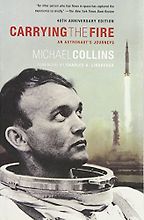
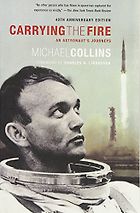
Let’s get on to the books you’ve chosen about space exploration. The first is about the most momentous moment in space history: Michael Collins, who piloted the first mission to the moon, provides a view of space exploration from the cockpit. Tell us about the man and his autobiography Carrying the Fire.
Carrying the Fire is widely regarded as the best of the memoirs written by astronauts. Mike Collins was the co-pilot on one of the two-man Gemini missions in 1966. He went on to be the command-module pilot on Apollo 11. He was the astronaut that stayed in lunar orbit while Neil Armstrong and Buzz Aldrin landed on the moon. Readers really get their money’s worth with Mike because his book is readable, personal, poignant and funny. It sets the bar for astronaut books.
Collins addresses what he believes the space programme means for humankind. What does he, and what do you, have to say on that subject?
Those of us who grew up during the space age were fortunate to have witnessed the opening act in a drama which is continuing to unfold. Political forces created the space programme. The Cold War competition between the United States and the Soviet Union is the reason why we had the tremendous acceleration in the space programme in the 1960s, and why we got humans to the moon before the end of that decade. But once that goal was achieved, that political rationale evaporated. All of us so-called space cadets have been left with unfulfilled dreams of the unused potential, that we still have, to become a space-faring civilisation. The most futuristic thing that we’ve ever done took place more than 40 years ago. But, as I say, this is a drama that is still unfolding.
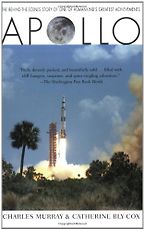
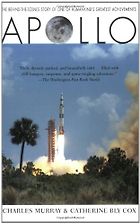
Let’s talk about the Apollo mission itself. First published in 1989, Apollo: The Race to the Moon by Charles Murray and Catherine Cox focuses on the people who built the space programme. What can we learn by reading this book?
It’s a book about engineers and flight controllers who – very many of them – are the people who built the space programme, not only the hardware but the techniques and the methods. They figured out how to choreograph the precise orbital ballet of a rendezvous in space between two spacecraft that are each traveling at 17,500 miles an hour. They designed and built a space ship that could take three human beings to another celestial body and home again, re-entering the earth’s atmosphere at speeds of thousands of miles an hour with temperatures outside the vehicle climbing to 5,000 degrees Fahrenheit [2,760 degrees Celsius]. These are very daunting problems.
And then they had to figure out how to deal with every conceivable emergency that might come up during a flight, as we saw with Apollo 13. Apollo 13 is the best known example, and really epitomises the kind of “what if” thinking that NASA brought to these problems. Even today, many of the techniques that NASA developed for Apollo stand as monumental contributions to managing very complex operations or endeavours, involving many hundreds or even thousands of people. The Murray and Cox book is a superb account of how NASA managed a complex operation involving thousands of employees. In my work, I focus on the astronauts and their experiences, but that only tells half the story. The story of Apollo would not have been complete without this book.
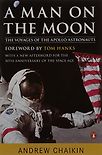
I’d be remiss if I didn’t mention that your book A Man on the Moon, which was made into a 12-part Emmy-winning television series by Tom Hanks, is commonly ranked as the definitive account of the mission. What did you set out to accomplish in writing this space exploration book?
There were two questions that I wanted to answer. What is it like to go to the moon? And how did the trip affect the handful of human beings who made the journey? Twenty-four people have gone to the moon. Out of those 24, 12 walked on the surface. By the time I started my research, Jack Swigert from Apollo 13 had died. I spoke to all 23 of the surviving moon voyagers. I spent many, many hours talking to them about every aspect of the experience of going to the moon. I wanted to get into their heads as much as possible. When I wrote the book I really wanted it to read like a historical novel. I wanted it to transport the reader along with the astronauts, as if you could be a stowaway on those flights.
You know space travellers well. So I wanted to ask you: What will become of America’s astronaut corps while the nation awaits a plan for the next manned mission?
For now there is still an astronaut corps that is active, and training for missions using the Russian Soyuz capsule as transportation to and from the International Space Station. At the same time, I’m sure that some of the astronauts are overseeing or getting ready for this transition to using private companies to transport people to and from the space station. It’s an uncertain time but a very exciting time. Just because the space shuttle is coming to an end doesn’t mean the space programme is coming to an end.
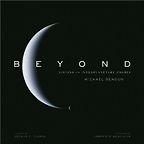
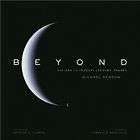
Next on your list of space books is Beyond: Visions of the Interplanetary Probes, a book of photography from robotic space probes. Please tell us about it.
It’s the best collection of images from robotic missions to other worlds in our solar system. I got my start as a geologist studying Mars. I was a student intern at the Jet Propulsion Laboratory during the first Mars landing in 1976. So my heart is with the robotic exploration of the solar system as much as it is with human space flight. Even though lots of important data comes back from space probes that land on Mars, or go past Jupiter, images have always been the most compelling aspect of these missions. Michael Benson has selected and processed truly spectacular images and the publisher did a beautiful job of printing them. The sight of a giant canyon on Mars, or the icy surface of one of Saturn’s moons, or the pockmarked face of Mercury, give us the ability to transport ourselves to these alien landscapes.
So these images in this book convey the beauty and mystery of our solar system.
I’ve always felt that space exploration is a spiritual endeavour. To me, exploration is essential to who we are as human beings. We are made to make discoveries. We’ve learned so much mind-boggling stuff about the solar system in the last 50 years. I love being able to walk around knowing that when I look up at the sky, I’m really looking up into an endless universe that we’ve only begun to explore.
Is robotic space exploration a substitute for manned space exploration? Tell us about the trade-offs between the two, and about NASA’s ongoing programmes.
We need both. We’ll always need the robots to go places that are too far away or too risky for humans to reach. No human has been beyond the moon, but we’ve sent our space probes way out past Neptune. In fact, one of the Voyager probes is still sending back data even though it’s escaped the solar system and is in interstellar space. Robotic probes extend our reach, by many orders of magnitude, beyond where we can send humans.
Having said that, I can’t imagine that a machine will ever match a human’s ability to make discoveries. Eventually we’ll need human eyes and human hands to look for evidence of life on Mars. And there is no substitute for hearing the sound of human voices coming from places where no one has ever been. If you listen to the Apollo astronauts’ broadcasts from the moon, it was really a watershed moment – humanity getting to share this great adventure as it happened. So I have a firm belief that we’re always going to want to see what is over the next hill. In this case, the next hill might be 100 million miles away, but we will find a way to make the trip. For now, our robotic missions are astounding feats that are bringing these distant places within our reach.
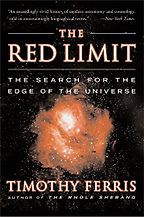
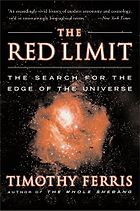
The Red Limit tells the story of our discovery that the universe is expanding. Please give us a précis and tell us why you choose this as one of your space exploration books.
Timothy Ferris is a great writer. The Red Limit is the beautifully told story of the first mind-boggling leaps in discovery that 20th century astronomers gave us through the development of bigger and better telescopes. Whether you’re talking about Edwin Hubble in the 1920s – realising that there are other galaxies out there, and that we are all flying away from each other in the rush of cosmic expansion – or if you’re talking about today, when we analyse the data from the Hubble space telescope and find that 95% of the universe is made of dark energy and dark matter, which is still unexplained, it’s awe-inspiring to think about it. Particularly when you’re standing under a night sky full of stars.
So when we look through a telescope we’re exploring space?
Absolutely. Putting your eyeball up to a telescope is a personal exploration. But as far as adding to the knowledge we have as human beings, for that we turn to the giant telescopes we have in Hawaii and other place, and the ones that are in orbit, above the atmosphere. The follow-on telescope to the Hubble, the James Webb space telescope, is designed to look further out in space to the most distant galaxies we can find. One of the things that is so compelling about astronomy and space exploration is that it really is an endless frontier. There’s never going to be a final destination or discovery. I think of Apollo as the opening act in a story that has no end.
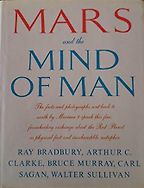
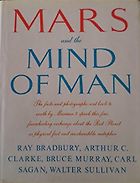
Your final choice, Mars and the Mind of Man, started with a panel discussion with astronomer Carl Sagan, planetary scientist Bruce Murray, science writer Walter Sullivan and sci-fi authors Arthur C Clarke and Ray Bradbury. What makes this out-of-print space book worth finding?
It captures a unique moment in the history of human discovery. It’s a combination of the transcript of that panel discussion – which took place the day before the Mariner 9 became the first spacecraft to orbit Mars in 1971 – and essays that the panel participants wrote roughly one year later. The transcript and the essays book-end one of the most spectacular unveilings we’ve had in the history of solar system exploration.
Before Mariner 9 got to Mars, we thought it might be another pockmarked ball like the moon, probably not a place that could have ever harboured life or even had interesting geological phenomena. Once Mariner 9 arrived and the dust cleared, what was revealed to its cameras was nothing less than a geological wonderland. We saw enormous volcanoes towering above surrounding plains, one of which was three times the height of Mt Everest. We saw a giant canyon, as wide as the United States. We saw ancient river valleys that were once carved by flowing water, even though today liquid water cannot exist on Mars because the atmosphere is so thin and the pressure is too low. And we found a kind of climatic time capsule – interbedded layers of dust and ice at the polar caps that reveal thousands of years of Martian climate history.
Get the weekly Five Books newsletter
The book combines the scientific with the poetic. It includes a couple of poems by Ray Bradbury, whom I think of as the poet laureate of space. To hear him, Arthur C Clarke, Bruce Murray, Carl Sagan and Walter Sullivan all discussing Mars, its relationship to humanity and its claim on our imaginations, is like listening to the tribal elders debate the meaning of the universe. Mars has been a Rorschach test for us over the centuries, as I wrote in my own Mars book.
You also refer to this space exploration book in A Passion for Mars. Is the red planet the right place to reach for next?
Mars is the most compelling destination we have in space, in that it is potentially an abode for life, past or present, and it may even someday become a second home for humanity. For those reasons Mars is a very compelling target but it’s also a tremendously difficult target. The atmosphere is extremely thin and there is a lot of deadly radiation from the sun. We aren’t ready to go yet. We’d learn a tremendous amount by going back to our moon and we’d learn a tremendous amount by going to Phobos, one of the moons of Mars, which could also serve as a base for astronauts to tele-operate robots on the surface of Mars.
But ultimately, Mars is the place to reach for because it is a world with a story to tell. It’s a place where life might once have existed and might still exist, if you drill down past the deadly radiation on the surface. It’s the best place we have to try to homestead. It’s a resource-rich place. It has ice, which you could melt for water or break down into hydrogen and oxygen to make fuel for the trip back. Over decades of work we could figure out how to live there and establish another foothold for humanity.
As I detail in A Passion for Mars, I consider it to be humanity’s Mt Everest. It’s going to take all of the ingenuity, perseverance and hard work that we can muster to climb that mountain. There are so many technical, medical and psychological challenges that stand in the way. Not to mention costs. But it is within reach.
You seem to be more optimistic about the future of space exploration than many of the dire op-eds and news accounts I’ve read. Why?
I’m very optimistic because I see the ingenuity at companies like SpaceX in California and Blue Origin, which is run by Amazon CEO Jeff Bezos. There are many companies committed to finding ways to get humans into space without breaking the bank and in a way that’s sustainable – two things NASA has never been able to achieve. We’re witnessing the beginning of a new era. Over the last several decades, NASA has had diminishing resources and very expensive projects to maintain, like the space station and the space shuttle. We’re entering a new era of invention in which NASA has the freedom to devote resources to develop new technologies, to allow us to leave the vicinity of earth and venture out, as we did with Apollo.
When I told my four-year-old son that we could watch the last flight of the space shuttle, he asked: “What’s next?”
Show him the Falcon Heavy launch vehicle on the SpaceX website. It will be powerful enough to send people back to the moon. There is a lot that’s coming up. Right now we’re at a point where people are holding on to what’s come before and saying it can’t be any other way. But others are moving full-speed ahead.
So can I assure him that the new era of space exploration will be as much the stuff of story books as the space age you grew up in?
When your son is able to have his honeymoon in low earth orbit, that’s going to be tremendously exciting. When we start looking up at the moon and seeing it as a place where people are living, making discoveries, and working make us a multi-planet species, that’s going to be tremendously exciting. And someday, maybe in your son’s lifetime, we will be able to look up at Mars and hear human voices transmitted from it. Then it will definitely be the stuff of story books as well as science books.
July 8, 2011
Five Books aims to keep its book recommendations and interviews up to date. If you are the interviewee and would like to update your choice of books (or even just what you say about them) please email us at editor@fivebooks.com
Five Books interviews are expensive to produce. If you've enjoyed this interview, please support us by donating a small amount.
Andrew Chaikin
Chaikin is an American author, speaker and science journalist. His book A Man on the Moon is a detailed description of the Apollo missions to the Moon.
Chaikin is an American author, speaker and science journalist. His book A Man on the Moon is a detailed description of the Apollo missions to the Moon.