You wrote to me earlier that you think of these books as for women in science rather than about women in science.
They are books for any woman who is in a minority. Particularly in a subject like mine – physics – women often feel very isolated. These are books to encourage them, to make them think about their circumstances and to help them reflect on if they feel different, why they feel different, and whether it matters.
What single piece of advice would you give to a woman who is in a minority?
To have confidence. I gave a talk last month to a group of women scientists, and one of them asked “how do you get confidence?” I said you have to act as if you’ve got confidence, even if you haven’t. I think a lot of the people who have got on in life, men or women, know how to portray confidence, whether or not they actually have it. And to some extent these books, although not explicitly about tactics, are about thought processes. Because it seems to me that – whether it’s nature or nurture – women appear to be less self-confident. If you are in a situation where you are in a minority it can really get to you, and then it’s easy to feel inadequate in some way.
“It seems to me that – whether it’s nature or nurture – women appear to be less self-confident.”
I think a large part of how to gain confidence is to recognise that while you may be different, that can also be a strength. After all, that’s what diversity is all about – the argument of having more women on boards and so on is that people come with different views. But I think that somehow there is the idea across our society that you are male by default, and therefore if you are a woman you are different and in some sense lack something, or don’t fit in. That’s absolutely the wrong way of looking at it. Difference is a strength not a weakness.
Your first recommendation is In a Different Voice by Carol Gilligan. Tell us a little about this book.
This was written about 30 years ago, by a psychologist, and it’s a classic text. It’s a book about why the way women make decisions, for instance, may be different from men. By doing studies only on male subjects and then saying that is the norm always makes women look less developed. That was the conventional viewpoint, that women somehow got stuck at an earlier stage of development. Instead of which you should be saying they are different, and compare women with women and men with men.
Also, if you test drugs on men, the results may be very different from if you test them on women. It’s a very important and basic idea that men and women may be different, for whatever reason, and if you try to compare results from studies you may be making the wrong comparison. For me, when I read the book, I realised that I perhaps present my arguments in a different way – which may not be because I’m bad at presenting arguments, it may be something more fundamental and I shouldn’t therefore see it as a failing in me. But I still have to learn how to use it to convince other people.
What differences between men and women do you feel are evident, besides physical strength?
I don’t think there is any single identifiable thing. You could say men tend to be more self-confident, but that’s almost certainly nurture not nature – it’s not a characteristic difference in the way that strength is. But even talking about strength, a weak man could lose to a strong woman, so I don’t think that’s a useful way of looking at it. I think that as an individual you should try to learn what your strengths and weaknesses are, then try to do something about your weaknesses and play to your strengths. It’s about working out who you are – if you’re trying to succeed, that’s what matters.
Let’s move onto your second choice, Whistling Vivaldi, and the concept of “stereotype threat”.
This book is again written by a psychologist, a black academic from the United States who studied why bright black students did less well than would be expected when they went to university. He demonstrated that a lot of people underperform because they expect to underperform – because of “stereotype threat”, a phrase he coined. That view of things has been tested out in a lot of different situations, including girls doing maths tests. And if you take away the threat, you can see a noticeable difference in the way the underperforming group does. So if you tell girls doing a maths test, “this is a maths test, we’re testing your maths ability,” they will do significantly worse than if you say, “this is a test to look at how you set about problem solving,” which takes away the girls-are-bad-at-maths message.
Get the weekly Five Books newsletter
Steele also demonstrates something I find completely incomprehensible, that very small interventions – which he calls “self-affirmations” – really improve performance. There have been studies published recently about self-affirmation before girls do physics tests, which show that the girls’ performance goes up. I think this is something that, in terms of how we approach teaching, is very important – how we subtly portray things to enable people to perform to the best of their ability.
So how does the stereotype of women not being good at physics and maths affect the choices they make?
If women are systematically underperforming in tests, even though they may enjoy the subject, then they are not going to choose to do it at a higher level. So it does affect choices, at whatever level you’re being tested, if you’re doing less well than your peers. Even if it happens to be not because of your innate ability but because of a subtle, completely unconscious fear, then you’re going to choose not to continue.
Is it a self-reinforcing stereotype, in the sense that fewer women going into physics itself gives credence to the stereotype that women are bad at physics?
I suspect that is true.
Why is the book called Whistling Vivaldi?
Because the author discovered as a young man that if he was walking through a white neighbourhood, and they saw this young black man coming towards them, the whites would react badly. But if he whistled Vivaldi it showed he was a nice, middle-class kid and one of them, and that made it all right.
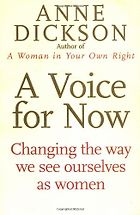
Your next book is Anne Dickson, A Voice for Now.
I think of this as a parable. It’s expressing, in a fictional situation, a lot of Dickson’s views about assertiveness – and she has done a lot of work around assertiveness training for women. This is a fictional account putting into practice some of the things she says [about assertiveness], and I find it an incredibly moving book. It’s quite subtle – she’s talking about how to handle very emotionally charged situations. For instance, a young mother who lost a baby and has never had a chance to grieve, or situations at work with colleagues with whom you’re not happy. But it’s not illustrated in the formal, didactic way in which self-help books are done. Instead, it is done within the context of a story of a psychologist who hires someone to act as her amanuensis. The stuff that the psychologist is dictating causes the amanuensis to think about a lot of her own situations and then she starts a dialogue about it. Put simply, it’s about questions of relationships and how to handle them.
What progress have attitudes towards women in fields like the sciences made since the 20th century?
I think expectations have changed. When I was young, there was never any doubt I was going to go to university but I never thought beyond, I never thought about a career, because for my generation it was still uncommon for women to have careers. That makes a huge difference in the way women portray themselves and the way men react. It’s a different mindset. I think the more women there are in visible, high-level positions, as opposed to just blokes who went to the same school, the more people learn the rules of engagement. And of course diversity is much more than just the gender angle – it may be that your accent demonstrates you didn’t go to Eton, it’s all part of the same thing. We are more accepting of people who are different. But we aren’t necessarily always unbiased in the way we react to them.
So what is the next step?
I have come to believe very strongly that unconscious bias rather than discrimination is a key factor – that people aren’t aware of their own beliefs, and how they judge others might have nothing to do with the individuals themselves. Everyone is guilty of that. I will put my hand up and say I have prejudices, but I hope I’m slightly more aware of them than some people – I know I may think, “this person, I don’t like the way they dress, that proves they’re such and such”. You can do it in all kinds of ways, which may be trivial or may be substantive, but the more people realise that they have these unconscious biases, the more they are no longer unconscious, and therefore you can deal with them.
Or the less prejudice becomes discrimination.
Yes.
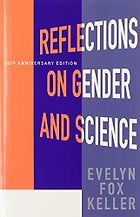
Let’s move onto your fourth book, Reflections on Gender and Science.
Evelyn Fox Keller is an evolutionary biologist who got very concerned about the nature of science practice, and realised that there were issues of gender involved. This book has various historical essays about Plato and Bacon, how science turned into a very male field and what it meant, and then some more recent situations. It’s a curious book and I don’t think I’ve entirely got to grips with it. The first time I read it, I was very interested by the early historical stuff but I reacted incredibly badly to the later chapters. I thought she was trying to say there was a female way of doing science.
But then I read it again and I realised I had completely misread the book. Actually she wasn’t saying that at all, she was saying that having a female way of doing science would be a terrible thing. It’s interesting because it touches on what we were discussing earlier – what the key differences between men and women are, and if there are differences. It’s quite subtle, and I’m still trying to digest what she’s written. So it’s a collection of essays that takes you through how we may have got to the situation we’re in now, but it leaves open where we’re going.
How do you encourage more women to go into science, or make that step from undergraduate to postgraduate?
Well those are two very different questions. In my subject [physics], I think the number of girls doing the A level [in the UK] is something like 25%, so you’ve already lost the battle to a large extent. Girls perceive the physical sciences and engineering as not for them. Now is that because the boys in their classes take their ideas to pieces, or is it because on television all the people they see doing engineering are men? There are all kinds of things that can cause that battle to be lost at a very early age.
Whereas the question of the leaky pipeline [whereby women drop out of higher education and research at progressively more senior levels] is entirely different. I like to think that problem is easier to solve, whether by the intervention of a teacher, or by having more role models, or by educating universities to be more supportive. Those kinds of things are easier to do than the societal things which impact on getting girls into science in the first place.
How early do those societal pressures come into play?
It’s OK for girls to play with dolls, to be interested in the life sciences, but we convey a very negative image of the physical sciences for them – playing with dolls doesn’t seem to translate into, “let’s take this thing to pieces, let’s understand how it works”. And we have to think about the ways toys are marketed. There was a long article in the Guardian recently about the pinkification of toys. If you look in the [toy retailer] Early Learning Centre I understand the toys are segregated for gender, and toys for girls tend to be pink. Is that good? Bad? What does it do to the way we distinguish at an incredibly early age what boys and girls do?
Whereas boys are encouraged to play with Lego rockets.
Exactly.
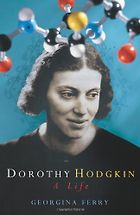
Your fifth book is a biography of Dorothy Hodgkin. What was so remarkable about Hodgkin?
Where to begin? She was a very influential scientist in her own right – a protein crystallographer who won the Nobel prize at a time when there were incredibly few women doing high-level science. She had a family, several children, and kept working throughout that time. There’s a lovely passage in the book about her giving a lecture at a conference when she must have been eight months pregnant, under her maiden name, and never realised this could bother people. She was married in 1937, at a time when it was odd enough for pregnant women to be giving talks at a conference, but then to do it under your maiden name and not realise that was even odder! She was very single-minded.
“I am a scientist who is a woman, not a woman scientist.”
Talking of role models, she was looking at crystallography and a lot of her scientific children and grandchildren are women, so that is also interesting. She did inspire people. And then at the end of her life she was a peace activist, and immensely influential. So she was an amazing scientist, an amazing person in the sense of the breadth of her knowledge and caring, and she was also a female scientist who was a mother. Yet even after her, we still have this impression that you can’t do both.
You do both.
I didn’t set out to have a scientific career. I didn’t set out to have a career at all, I kind of fell into it. I got married during my PhD, my husband was a mathematician, and there came a point when it was easier for me to get a job than for him. He gave up his job so that I didn’t have to follow him, and he became the house husband. And so in our family it was made possible for me to succeed because my husband gave up his career. That is not a choice that many families will make easily. Society makes it really hard on the man. But it is actually a model that is getting commoner. I know quite a few women whose husbands have either given up their career or who have the kind of career – landscape painter, freelance journalist – whereby the women can do the intense job that requires you to be on site, while the husband is at home with the kids and can juggle his own activities around it.
But every family has to find its own way of doing it. There is no one way, and it’s hugely important for people to realise you have to do what works for you with your circumstances, with where you are in your career, and with what stage you have your children. It’s a complicated situation but there are many different ways in which it can be solved if you think about it. You’ve got to be creative. There is no single right way of doing it. I know a woman who is fantastically successful, has won lots of prizes, and she took eight years off to have her family and then came back. People think you have to do it in a linear fashion, but it isn’t like that.
You’ve said today and in the past that there are too few female role models in science. You are without doubt one of them. But you’ve written on your blog in the past that you don’t consciously try to be a role model, even if you’re happy that you are one.
I never used to try to be a role model. And I never thought they actually mattered. I never had a female role model myself. But for some people it clearly does matter. And I suppose I have somewhat reluctantly been thrust into this position, and I feel I have to embrace it because people tell me it matters to them. I am aware from comments made publicly on my blog and privately to me that women really find it valuable that I am prepared to stand up and say some of the things I think, because they don’t feel able to. It’s a way of empowering them.
I feel very strongly, for instance, about telling women that they can have children. To give an example, many years ago I was returning to work after having my second child, and I won some prize. They asked for a photograph of me for them to publish, and I sent a photograph of me and my two children. But the children were cut out, because this was considered to be the wrong message. This was a long time ago, it must be 22 years ago given the age of my daughter. But I think it is absolutely vital that women get the opposite message – that [having children and a scientific career] can be done, that it’s difficult but not impossible, because if young girls believe it’s impossible then it’s another reason for not pursuing science. No one says lawyers can’t do it. No one says journalists can’t do it. There are lots of reasons why it might be difficult, but no one says you can’t be a journalist and have a family. And so it’s vital that we publicise the fact that you can be successful and have a family. I feel very passionate about that. Being a role model – it’s just something that happened.
Are you happy to take up that mantle? It must have its frustrations, for instance interviews like this one which focus on gender rather than science.
I am reluctant in many ways. I don’t like it. I am a scientist who is a woman, not a woman scientist. But I am in a very fortunate position. As a senior scientist it is harder for people to attack me now. It gives me freedom, and so I think I can say things that need to be said.
What needs to be said?
It needs to be said that you can be a woman, and have a professional science career and a family, as long as you’re prepared to work bloody hard.
Five Books aims to keep its book recommendations and interviews up to date. If you are the interviewee and would like to update your choice of books (or even just what you say about them) please email us at editor@fivebooks.com
Five Books interviews are expensive to produce. If you've enjoyed this interview, please support us by donating a small amount.