If you were starting from scratch, no one would design a healthcare system like America’s. The health economist tells us how it evolved and what needs to change. He picks the best books on US healthcare reform.
Leaving aside the insurance issue, why is the absolute price of American healthcare so high? The price of going to the doctor in the US, or buying drugs, can on occasion be 10 times what it is in Europe.
It’s particularly surprising when in every other area – from clothing to electronic goods to gas – American consumers are incredibly cost conscious and prices are almost invariably lower than elsewhere.
There are many reasons why US health spending is so high – and why we allow it to be high. One of the main lines of Paul Starr’s book The Social Transformation of American Medicine is that physicians have, over many decades, amassed considerable power over the policies that have been enacted, and they’ve shaped them to their benefit economically. So a lot of money flows to healthcare providers, physicians and hospitals, and also to suppliers of drugs and medical equipment. Those organisations are relatively powerful and they’ve been able to keep it going.
Also, Americans mostly don’t see the prices. Because of insurance, they don’t directly feel how expensive it is when they enter the system in any way – whether it’s a visit to a physician or a visit to a hospital. Worse than that, they mostly don’t even see the price of insurance directly. The vast majority of Americans have employer-based health insurance and much of the premium is paid by the employer. It doesn’t show up on their pay stub, and it doesn’t appear, to them, to come out of their own pocket – even though actually it does, through lower wages. When you think you’re getting something for free or pretty cheaply – whether it’s the insurance or the healthcare itself – you’re not that motivated to shake things up.
That’s for people who work. Then for retirees, almost all of them are on Medicare, so they’re getting considerable benefit through a public programme. They don’t see why that should change either. So things just keep marching along. We haven’t been able to put in place sustainable cost controls, either publicly or privately, largely because it’s politically difficult to do that.
You do see articles about spiralling insurance premiums and healthcare costs. Are attitudes changing, with people becoming more aware that this is unsustainable?
Healthcare is like every other issue in the American political discourse – it has its moments. It can rise to the surface if other things aren’t in the way. If the economy is bad, that’s always going to dominate what people are thinking about. Or other issues can dominate, depending on the news and where the crisis of the day is. But every once in a while, the spending on healthcare and the problems in healthcare markets do come up. They start to weigh heavily on people’s minds, and when that coincides with a political opportunity to do something then reform can happen.
That coincidence tends not to happen often. Maybe once every 15 to 20 years we get a genuine opportunity to do something substantial in health, and it doesn’t always succeed. That’s how Medicare happened in 1965. It had been considered, worked on and thought about for more than a decade in various forms. Other comprehensive health reforms have failed over the decades including, famously, the Clinton plan of the early 1990s. That was a time when there was a lot of attention paid to healthcare. People thought we should do something, and it seemed politically feasible. But it just wasn’t managed in a way that succeeded, because the politics are so hard. It’s like threading a needle. You have to do everything right to get something passed, even if it’s imperfect. Finally, in 2010, it was remarkable how well everything came together. It was very messy, but that’s the nature of it. It was the finest of margins, every vote in the Senate counted. They needed 60. They got 60.
I’ve seen charts showing that increased spending in the US doesn’t translate into higher life expectancy. Is that because the uninsured bring down the average lifespan?
There are studies out there showing that lack of insurance leads to higher mortality, but the estimates are not precise. It’s exceedingly hard to empirically relate insurance to mortality, because many health-related issues that lead to lower life expectancy take years to develop. In America, by the time you’re 65 you’re insured on Medicare. If you’ve reached that age, you’re likely to live quite a bit longer. What is the effect on mortality, after age 65, of being uninsured for some number of years when you’re younger? That’s very hard to tell.
Why we have lower life expectancy is a good question. Insurance does play a role, but it’s not the only thing that matters. What is true is that we spend dramatically more than any other country – twice as much as the next highest-spending country – and we have not just higher mortality but a whole range of quality measures that are worse than elsewhere. Sometimes much worse. So what one can confidently say is that we’re spending a lot but not showing a lot for it. That doesn’t mean that if we spend less, or just cut the budget, then we won’t lose something. It’s likely that we are getting something for all that spending – we’re just not getting it very efficiently.
One barrier to change is that rich and educated people, including members of Congress, believe that the US has the best doctors and hospitals in the world – and that if they move to more socialised medicine, as in Europe, then they will lose that.
It’s definitely a concern among the elite and health policy wonks. The way it plays out more broadly is that there’s immense status quo bias. That’s true everywhere. People tend to be comfortable with what they know. Everybody wants to believe that what they have and where they live is fantastic. People are very reluctant to give up the idea that the US is number one.
And you can receive the very best care in the world in this country. There is a reason why princes from Saudi Arabia fly into the US for treatment. But only a very tiny fraction of the population has access to the very best healthcare in the US. They don’t want to give it up, and I don’t want them to give it up either. But there are many people who don’t have access to the best care. In fact, there are many people who don’t even have access to basic healthcare. We’re not talking about state-of-the-art, triple-transplant surgery. We’re talking about routine preventative care, screenings, office visits and immunisations. The disparity is large between what the very best and the bottom quintile are able to obtain.
But is it true that the US is the best country in the world for top-end healthcare? Are there studies proving that if I’m treated for cancer at a top US cancer hospital, then my survival rate is higher than in other systems?
There are certain cancers we rate very highly on. Breast cancer is one of them – our survival rate for breast cancer is very good. But when you read anything claiming that the US has the best care in the world, they are cherry picking three or four specific diseases where we have very good survival rates. It could be because the care on those diseases is good. It could also just be that if you run enough statistics, then by random variation we’re going to be number one on a few things, even if we are middle of the pack or worse on 99 other things. It’s not a good way of judging the overall quality of healthcare.
Given the average age of members of Congress, they must have either been sick themselves or had a relative who has been, and so know what it’s like to deal with the healthcare system and insurance companies. Or do they have some sort of gold-plated insurance that means they’re shielded from the worst of it?
Actually, I am an employee of the US federal government so I have the same health benefits that congressmen do. It’s pretty much standard employee health benefits. For people who have decent jobs – as I do and as congressmen do – routine healthcare is not a big deal. But I’ve heard that it comes as a shock to people like us whenever they engage intensively with the healthcare system, for example if they or a family member becomes incredibly ill and is in hospital for a long time.
That’s when some of them finally say, “Boy, I was at a good hospital and still. Ugh. It was really unpleasant and I kept being asked the same questions. They didn’t seem to know that I’d already had that test. Thank God I had my wife with me during all this so she could made sure they didn’t amputate the wrong leg.” The stories are just shocking. There’s a story just recently that a large proportion of physicians don’t follow guidelines in washing their hands. It’s atrocious.
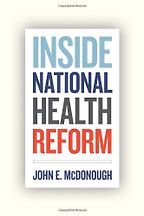
Let’s talk about the Obama administration’s attempt to reform the system. The first book you’ve picked is Inside National Health Reform,
which explains the 2010 law and also the political jockeying that made it what it is.
This is really two books in one. John McDonough is an insider. He was an adviser to Senator [Ted] Kennedy’s HELP committee, which was one of the two big committees in the Senate that wrote the health reform law. He was in a lot of meetings, talked to a lot of people, and tells wonderful stories about negotiations over the minutiae of the health law. It’s suspenseful and interesting to see how law, and this law in particular, is really made. There’s a lot about the politics but it also explains the policy rationale – why it was structured this way, why one side thought this and the other side thought something else.
That’s the first half of the book, and it’s not a hard read. The second half goes through the law in summary fashion, through each title and then each sub-section. It explains what they’re about and why, and how much money they cost or save, in plain language. That in itself, I will admit, is pretty tedious. I’ve read the law and summaries of it, and it’s not fun. You only do it if you are looking for something. However, he intersperses long passages explaining more of the politics and policy rationale. Those chunks are easy to pick out by eye, so you can just flip through the summary of the law and go straight to the narrative. It’s just as intriguing as the first half of the book.
This book is important because most people have no idea how laws are really made in the US, and what politics really means. Not the politics of campaigns but the politics of making a law, especially one as complicated and controversial as the health reform law. In the end, the message is that the health reform law we got in 2010 was the only one we could have got in 2010, or pretty close to the only one. The range of what was politically feasible was incredibly narrow. It had to satisfy so many political constraints that it almost didn’t happen. It was either that law or no law.
So while not perfect, it’s the best that could be done given the politics?
No law is perfect. No law will satisfy everybody. My view is that the correct interpretation of what we have is not the national health reform we all deserve and want, but a good first step towards an evolutionary reform. There will need to be more. We can build on what we have. But the status quo was not and is not acceptable, and this makes some important changes.
What is the best thing about the law, in terms of moving in the right direction?
The reforms to the health insurance market were absolutely crucial and, abstracting from the law itself, relatively uncontroversial. Across the political spectrum, it would be hard to find many people who would say, “Actually, it’s a good thing that private insurers can keep people off insurance. They should be able to keep people off, they should be able to throw people off, and it should be very expensive.” In reforming the way that market functions, the law logically requires some other things that are controversial, but that principle alone is one of the best aspects.
What will it mean in practice? For people who are already insured through their employer, presumably it won’t have much impact.
It will not have a substantial impact on most people who are currently insured. It is possible, depending on where you work, what your employer does and what your future holds, that you will be impacted. If you lose your health insurance for whatever reason, for example, there will be better options for you beginning in 2014. And there are some aspects of the law that will change features of your health insurance – some things you may like, some things you may not – but in relatively minor ways.
When I first moved to New York I tried to get individual health insurance, because I had no employer. It was incredibly expensive.
Oh yes. It’s very expensive and very hard. It’s a difficult market because it lacks the kind of rules that are required to make it function well. Those rules are in the law now.
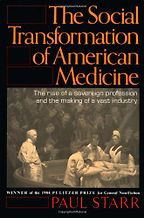
Let’s go onto Paul Starr’s book The Social Transformation of American Medicine. This explains historically why the American health system is the way it is.
This is a very long, detailed book, and it’s not all that easy for someone who is not deeply into health policy and healthcare to relate it to today. Its purpose is to describe the broad sweep of the history of healthcare in America, through to about 1980. It was published in 1982 so it’s not even that current. But it’s necessary reading for anybody who fancies themselves as a health policy wonk or expert, or a health historian, or anybody who works in healthcare. I found it fascinating, and I didn’t even know about it until relatively recently. I’ve put it on this list to remind people of its existence, because it should be more widely known and read.
So 30 years after it was written you still think it is relevant. What is it about the book that’s so interesting?
The parallels. He traces the development of institutions, many of which remain in positions of power as they did in the past, and have been able to amass more power. There have been some changes over the century, but many things have stayed the same. He tells stories about the politics of reform and prior reform efforts – of which there were a lot, even before 1980. You could lift so many passages from that book and people would say “Oh, you’re talking about 2009” and you’d say “No, that was 1917 or 1937”. It would be great to impress upon people that these issues of healthcare reform that we fight about so passionately today are the same issues people have been fighting about in the US for 100 years. That’s the reason to read this book.
We have spent decades on these issues, and perhaps up to half of us are still not convinced that we’ve taken a reasonable step in the latest reform. Just thinking about that is stunning – the number of years we’ve gone with the level of uninsurance we have in this country, and the rate of increase in healthcare costs. They’ve been escalating faster than any other country since about 1980. Unfortunately, Starr’s book ends right when the US healthcare trajectory, in terms of spending, diverges from the rest of industrialised countries. Look at the graphs and it’s in about 1980 that the US starts taking off, and everybody else stays at a lower level. And we’re still diverging.
One key difference with other countries is that in the US, employers provide health insurance. Why is that so embraced here?
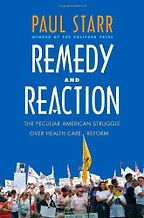
This is partly what my next choice, Paul Starr’s most recent book Remedy and Reaction, is really about. It’s describing what he and others call the US health policy trap. That trap is that we’ve evolved to a point where most people and most voters are insured, either through an employer or Medicare. Therefore, they and the institutions that they benefit are resistant to change. It’s very hard to move the system to something that would be more sensible. Right now, the reason people cling to employer-based care is because it’s what they know. On one level, it works. Yes it’s expensive and inefficient, but it’s what they know, it seems to work for them. That’s why it’s hard to change.
Do healthcare economists think it’s a good thing?
No. It’s widely recognised that a more rational system would sever the connection between health insurance and employment. To the extent that the debate is over policy, it’s about how to get there and under what terms. To the extent that the debate is over politics, it’s just too easy to use the spectre of change to frighten people.
Why is it so inefficient?
It creates too many distortions in the labour market. A lot of people will take and hold onto jobs for the health insurance, not because the job makes sense in terms of the work or even in terms of wages. There are many people who don’t retire because of health insurance. There are even studies that show that there is lower creation of small businesses and less entrepreneurship because of health insurance. It’s an unnecessary constraint on the labour market and on job creation, and it just doesn’t need to be that way.
I get the sense that if you started from scratch, you would not create a system like American healthcare.
No, and it’s not just me. I would defy anybody to come up with it. If you could go to a world where you are unaware of the American system and then design a system, there is no way you would come up with anything like what we have here. It’s just preposterous. It doesn’t make sense on so many levels. The risk pools are chopped up, there are many inefficiencies and strange subsidisations. Nobody would do it that way. One couldn’t even imagine that it would be possible. You can’t make this stuff up.
Tell me more about Remedy and Reaction. It just came out, and takes us pretty much up to the present.
Yes. It’s mostly focused on the last several decades, and relatively more attention is paid as we get closer to the present, including the most recent healthcare reform effort. Quite a lot of it is on the Clinton effort as well. It’s really about more modern development of health policy in the US and the policy rationale for the 2010 health reform law. It includes much of the politics that were in McDonough’s book but not the stories, because Paul Starr wasn’t sitting in on those kinds of meetings. If you want to read one book and learn something about the policy and the politics of health reform, this is a fine choice. It has all the arguments and all the nuances.
What in particular makes you recommend it?
As you know, I’ve been paying a lot of attention to this. There’s almost no issue about health reform policy and politics that I haven’t read about and seen debated. What really impressed me is how on every single issue that I’m familiar with, he said all the things that I knew and was expecting, and then he’d say one more thing that I hadn’t quite assimilated yet, or I hadn’t recognised. It was a nuance or an insight that went one step beyond and blew me away. There was always a little bit more from him that I hadn’t seen anyone else put on paper. Paul Starr just puts it all together better and more completely than I’ve seen anywhere else.
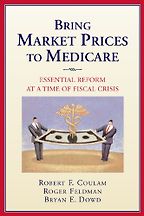
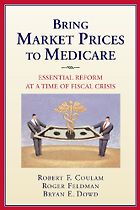
Your fourth book is Bring Market Prices to Medicare. I know from your blog that you believe we should take the authors’ advice on this, and that it would reduce Medicare expenditure by 8% – some $50bn (£32bn) a year. Can you explain?
One of the perennial debates about Medicare is how much we should support the participation of private plans, and how much we should make it a public-only programme. It started as just a public health insurance programme. All the bills were paid directly by the federal government, it was a uniform national benefit and there was no choice: You’re on Medicare, everyone is in the same programme, it’s one big risk pool. Then, starting in the 1970s but increasingly in the late 90s and 2000s, private plans have participated. You can enroll in what is now called Medicare Advantage Plan, through which you get all your Medicare benefits and maybe more. You pay them a premium, they get a subsidy from the government and it’s like a private plan arm of Medicare. Also, the Medicare prescription drug programme, which includes drug-only private insurance, is entirely through private plans. Medicare does not have a public prescription drug programme.
Every year in Congress, and also elsewhere, we debate: How much should these private plans be subsidised? Is it a good deal? Do they save money? Are they treating beneficiaries well? Are they just cream-skimming, ie choosing the healthiest beneficiaries and making a lot of profit off taxpayers? Conversely, is traditional Medicare – the public option – serving beneficiaries well? Is it slow to innovate? Is it inflexible? Is it wasting money? Is it not managing care well? One approach that would resolve the question of how much we should pay these private plans is to have them compete, along with traditional Medicare, for the rate of subsidy that they’re given. This kind of competition is akin to the sort that each of us would put a contractor through if we were remodeling our kitchen or having our house repainted. You would solicit bids from qualified painters or construction companies, and you would weigh the price of the bids against quality. You would probably ultimately pick a bid based largely on price.
Medicare Advantage and traditional Medicare could do the same, but they don’t. You could have these plans compete, bid for how much of a subsidy they would need to provide the Medicare benefit, and then Medicare would say, “OK, we’re going to pick the lowest subsidy rate and give all plans that same amount. They can all participate, but if beneficiaries want to choose a more expensive plan then they have to pay the difference.” That’s what this book is about. It gives a lot of detail on Medicare pertaining to some of the things that we debate regularly. It gets into questions like: What really is the Medicare benefit? What is the social contract? Does the Medicare benefit have to include a public option that’s available to everyone at the same price? Or can it be a different price in different areas, depending on how plans bid and compete? Do plans have to provide access to all willing providers or can they establish provider networks, as private plans do and traditional Medicare doesn’t?
Is this competitive bidding going to happen? From the way you describe it, it sounds like a no-brainer.
It’s a political battle. Plans don’t want to compete. They’re very happy with the relatively lavish payments they receive now.
Is the book comprehensive on Medicare?
No, it’s not the place to go on Medicare generally. For that, John Oberlander’s The Political Life of Medicare is a good book. That would be the place to go on the history of Medicare and why it was shaped the way it was – the political bargaining leading up to it, and its history since. But it was published in 2003, so it doesn’t get into the Prescription Drug Programme which was passed in 2003 and enacted in 2006.
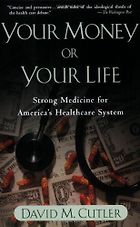
Let’s move onto the last book, by another highly regarded healthcare economist, David Cutler of Harvard. Why have you chosen Your Money or Your Life?
I suggested this book because it raises some very important points about healthcare spending in the US. We spend a lot, and it’s generally believed there is a lot of waste. There are a lot of things we could cut, or ways we could save on spending that wouldn’t harm health. Looking internationally suggests that this must be true. But even so, Cutler’s argument is that we do receive great value from our spending on healthcare. He argues that even if you look at just a few health conditions – heart conditions, mental health, low-birth-weight infants – and work out the value that we’ve received from improvements in healthcare, quality of life and prolonged life, it is greater than what we spend. He says we get high value for all this money. That doesn’t mean we shouldn’t spend less and still get that high value, it just means that we’re still making, on average, investments that are worth it.
Are you recommending this book because that’s not an argument you often hear?
If one is in favour of cutting health spending because there’s so much waste and so forth, then the next easy place to go – which is often where we do go – is to make very crude cuts across the board. To just cut Medicare, for example. That runs the risk of throwing out the baby with the bathwater. The book suggests that we do need to get smarter about how we make our health system more efficient. You can cut spending in a way that could be harmful to health or, in principle, you can cut it in a way that isn’t. We know ways to cut that aren’t going to harm health, we know some things that we shouldn’t be paying for. But we don’t know as much as we ought to.
For our international readers, can you outline how bad things are in the US for people who cannot afford health insurance? You hear horror stories, but there is also protection such as Medicaid for those with a very low income.
Things are very bad if you don’t have insurance. If you become ill, then not only will you suffer from that illness but you will also suffer from bill collectors. They don’t care – it’s not their job to care how badly you may be doing. They will harass you and repossess what they can. Eventually you’ll have nothing. You will be bankrupt. This does happen to people in the US. The reason it happens is that the safety net has a lot of holes in it.
You mention Medicaid, which is supposed to be the programme for the poor. Ultimately, if things are bad enough, if you spend all your money and have no job or income, then you might be able to go on Medicaid. But actually, it doesn’t even cover all the poor. You have to be poor and you have to fall into one of a number of qualifying categories, like being pregnant, elderly, blind or disabled. Beyond those federally mandated categories, individual states have the discretion to cover more. Many of them don’t. Or if they do, they only cover them if your income is extremely low, a fraction of the poverty level.
So it is possible in the US to be horribly poor and not have access to any health insurance programme. You’re at the mercy of charity care. And there is charity care. You can also walk into an emergency room and if it’s an emergency they will treat you. But that is no way to have a healthy, satisfying life.
People always tell me this, that if you’re really in trouble you can always walk into an emergency room and you will be treated. But the bill collectors will come after you if you don’t pay that bill, presumably?
Yes. They will try to collect payment but eventually, if you can’t pay, they can’t take what you don’t have. Many states have uncompensated care pools, so they’ll try and collect that or just write it off. Sometimes hospitals don’t get reimbursement for the care they provide.
Is there also a lot of difference depending on where you live?
There’s a lot of variation. In urban areas, there will tend to be better access and support for such things, because of population density and infrastructure. In rural areas, obviously there’s a lot less. And even though you may have access, it is constrained; you may not have access to many specialists, and you’re at the mercy of whatever quality those programmes are. There are many studies showing that your access is greatly restricted, and you’re not getting regular preventative care.
And some doctors just don’t accept Medicaid even if you have it.
Oh yes. Many doctors don’t take Medicaid. It’s not in any way a requirement and reimbursements are low.
I always thought Medicaid covered all low-income people.
That’s widely misunderstood, and is one thing that the health reform law will change. As of 2014, anyone with income within 133% of the poverty level is eligible for Medicaid, independent of anything else.
Five Books aims to keep its book recommendations and interviews up to date. If you are the interviewee and would like to update your choice of books (or even just what you say about them) please email us at editor@fivebooks.com
Five Books interviews are expensive to produce. If you've enjoyed this interview, please support us by donating a small amount.
Austin Frakt
Austin Frakt is a health economist and the creator of the blog The Incidental Economist. He spent four years at a research and consulting firm conducting policy evaluations for federal health agencies, and now has a joint appointment with Boston University and the Boston VA Healthcare System. Frakt studies economic issues related to US healthcare policy with a recent focus on Medicare and the uninsured. He has authored many scholarly publications relevant to health care financing, economics and policy, and has also contributed commentary for The New York Times and NPR
Austin Frakt is a health economist and the creator of the blog The Incidental Economist. He spent four years at a research and consulting firm conducting policy evaluations for federal health agencies, and now has a joint appointment with Boston University and the Boston VA Healthcare System. Frakt studies economic issues related to US healthcare policy with a recent focus on Medicare and the uninsured. He has authored many scholarly publications relevant to health care financing, economics and policy, and has also contributed commentary for The New York Times and NPR