With hindsight, was the euro a good idea? Will it come through the present crisis intact or will any country decide to leave? And what happens if they do? Economist Barry Eichengreen recommends the best books on the euro.
When we look back 50 years from now, what do you think we’ll say about the whole euro project?
I think we’ll say that it was dangerously premature but ultimately proved workable, and that governments eventually took the difficult steps needed to make it work because they essentially had no choice – because the costs of collapse were prohibitive.
Before we get to the current crisis, let’s start with the history. Your first book, Tony Judt’s Postwar, is an amazing 800-page account of Europe over the last 60 years. What does it bring to the table in terms of understanding the euro?
I thought this book was important for our conversation because in order to understand the euro, one really has to understand how Europeans see their own history. One has to understand the priority that European leaders and the intellectual elite attach to political reconciliation and integration. The book is not about the European economy or the euro per se – although the author understands economics, and monetary economics specifically, perfectly well. What the book does, above all, is to give one a sense of origins of the European project and of the depth of the political commitment to deeper integration, of which the euro is part.
Judt’s book is very good at bringing home the horrific human and economic cost of World War II. Are you arguing that while Europe may be suffering some financial problems right now, the euro will ultimately be held together by something greater?
The idea that European integration is a mechanism for delivering peace and harmony is now deeply ingrained – the fact that the disputes over how best to resolve the euro crisis are creating political tensions and schisms notwithstanding to the contrary. As a result, each time that Europe has reached a crisis and had to decide whether to go forward or go back, it goes forward towards deeper integration. Angela Merkel’s personal preferences notwithstanding, I think she will feel strong pressure to do likewise. It was Jean Monnet, the father of European integration, who once said something to the effect that “Europe will be forged in crises”.
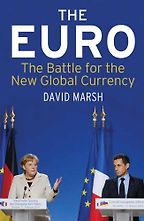
Tell me how your next book, David Marsh’s The Euro: The Politics of the New Global Currency, helps us in terms of understanding the euro.
Marsh’s approach, like Judt’s, is historical. Marsh argues that one can’t understand how the euro came about in 1999 – and I think he would argue, similarly, that one can’t anticipate what will happen next – without recalling Europe’s efforts over the course of the sixties, seventies and eighties to restore and maintain monetary stability. We have to understand the response to recent developments in that context. What I like about Marsh’s book is that, in telling this tale, he reminds us of the importance of human agency. He reminds us that actual individuals with actual lives took actual decisions to create the euro. In the absence of those individuals, things might have turned out very differently.
Most of these personalities – Helmut Kohl, Jacques Delors and so on – are now no longer on the scene. Is that a cause for concern for the future of the euro?
It’s often said that with the rise of a new generation of German leaders who didn’t live through World War II and don’t share the priorities of their predecessors, completing the European house will become more difficult. That’s why the Judt and Marsh books are important. Judt gives you a sense of the deeper historical forces at work, Marsh of how those historical legacies are passed on from generation to generation. All this leads me to question whether the attitudes and actions of future European leaders will really differ from those of their predecessors.
In telling his tale, Marsh emphasises two national traditions – the British and the German. He understands the UK, and he understands Germany. He tells his story by contrasting the attitudes of leaders in these two countries. This strength of his book is also its limitation, however. France features less prominently than it might. And lots of other smaller European countries that had a say in the development of the euro don’t get the attention they deserve. It’s a very heavily Anglo-German-accented account.
Speaking of the Brits, why do they always seem so keen for the euro to fail? Whether it’s coverage by the Daily Telegraph or, recently, a businessman holding a competition for how best to break up the euro, the Brits seem to love the idea that the euro was a mistake. Is it just a childish feeling of being left out?
While euroscepticism may seem like an affectation, it is really a deep-seated aspect of British culture as I see it. Britain has always had one foot in Europe and one outside, and the fact that the British economy both benefits from the single market and also suffers from the euro crisis only reinforces the feeling that Britain is attempting to ride two horses at the same time (not a comfortable position). Many Brits would prefer a minimalist Europe – a glorified free trade area – to a monetary union that created a need for fiscal union that in turn created a need for political union. So now that the euro project has gone badly wrong, there is a temptation to twist the knife.
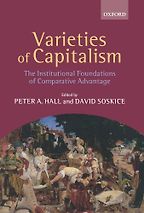
The next book you’ve chosen is by Peter Hall and David Soskice, Varieties of Capitalism. You mentioned to me earlier that if we’re going to understand the euro, we need to understand the viability of the European economy.
Americans, especially, are inclined to be critical of Europe’s long holidays, inflexible labour markets, and so on. The Hall and Soskice book is an articulate statement of the view that there are different ways of cracking the same nut. There are different ways of organising market economies – different constellations of social and economic institutions that, in combination, can be equally efficient. Europe has very significant strengths in precision manufacturing. It has apprenticeship training programmes and employment stability that facilitates the acquisition of skills on the job. It has patient banks to fund the operations of firms investing in their workers. It’s not obvious that this constellation of institutions is inferior, from the point of view of growth and competitiveness, to that of the United States. Ten years ago, the so-called experts would have been unanimous that the US had a leg-up on Germany in terms of innovation and export competitiveness. Now, to put an understated gloss on the point, this is no longer obvious.
Well I’m in Holland, after nearly a decade of living in the US, and I think many Americans, with their prejudices about Europe, would just be blown away by how much better things work here on an everyday basis – taking the bus, the train, going to the doctor, getting good childcare. I went to the dentist yesterday, and I watched as a computer and a machine made a new tooth for me in less than two hours. And it was so much cheaper than the US, too.
I published a book in 2007 that, to avoid being too self-referential, I didn’t include on this list. In that book, The European Economy Since 1945, I forced myself to ask: “What should I say now, in 2007, about the competitiveness and growth prospects of the European economy that will still sound right 10 or 20 years from now?” Which set of economic institutions is superior from the point of view of building social cohesion, investing in skills and competing globally over the next 20 years – in providing public as well as private goods? As your question suggests, the answer is far from obvious.
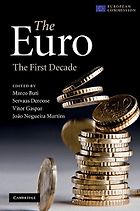
Let’s go onto the book edited by Marco Buti, The Euro: The First Decade.
Why, you might have asked, did I dare to suggest a heavy 1,000-page tome of dense economics? The answer is that this is a marvellous compendium of conventional economic wisdom. It was assembled out of a conference held by the European Commission in late 2007. It neatly summarises what economists think we know, or thought we knew, about the euro. There’s lots of good stuff about the benefits the euro conferred on Europe – the impetus it lent to financial integration and financial deepening, for example. It shows how countries adopting the euro felt pressure to undertake product and labour market reforms. The authors go on for 1,000-plus pages, and yet there’s not a single mention of the kind of dangers that developed at the end of 2009. This is a striking reminder that no one really anticipated the crisis that broke out subsequently. It’s a reminder of how intellectually unprepared we all were. I have a chapter in the book, so I do not exclude myself!
The introduction seems to dwell on the currency’s achievements – these disparate economies brought together to make the world’s second biggest economy generating 16% of world output, how they’ve managed to maintain macroeconomic stability, that the euro is giving the dollar a run for its money in terms of being the reserve currency, and so on.
True enough, but the book is not entirely Panglossian. Some of the contributors are seriously critical of the Stability Pact. They’re seriously critical that labour markets are not more flexible. There’s a big long agenda of things that Europe must do in order to make the euro area function more smoothly. But there’s no sense that everything is about to crash. It’s as if Europe has purchased a shiny new car that just needs a tune-up. There’s absolutely no sense that the vehicle is about to break down, which is precisely what happened at exactly the time when the book was published.
Why did the new car crash, then? Could it have been avoided?
The euro area has shiny coins, elegant bank notes and a tolerably good central bank, but lacks the other elements of a working monetary union, from common bank regulation and resolution to fiscal and political integration. The idea was that the missing elements would be added gradually, over a period of decades. Inconveniently, Europe was then sideswiped – to stick with the car-crash metaphor – by the global financial crisis. As a result, a process that was designed to be completed over a period of decades was forcibly telescoped into a few years.
Could the crash have been avoided, you may ask. This specific crash, perhaps, had the subprime crisis in the US been avoided. But just around the next curve would have been another obstruction in the road, resulting in another car crash – maybe not quite as devastating as the one that in fact occurred, but damaging nonetheless.
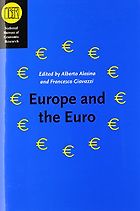
This gets us to your last choice, an article written by you titled “The Breakup of the Euro Area”, which features in Europe and the Euro, a book edited by Alberto Alesina and Francesco Giavazzi. It was written before the crisis, I believe?
It was – the article was written in 2007. I chose it because I thought it was important to include something on the topic of whether the euro area could break up, since this is what is currently on everyone’s minds. I think it’s accurate to say that this article is still the only semi-serious piece of scholarship on the issue. Alesina and Giavazzi asked if I would write on it for a project they were organising. So the idea that no one foresaw this possibility is not entirely right – my editors did.
The commission forced me to sit down and think hard about scenarios. The conclusion I reached was that countries with serious financial problems – like Greece – and, equally, countries fearing that they would have to pay for those financial problems – like Germany – would both be extremely reluctant to abandon the euro. Doing so would be equivalent to abandoning the whole European project, which, for political reasons, I regard as bordering on the inconceivable.
Also, if a crisis country abandoned the euro in order to reintroduce its own national currency with the goal of restoring its competitiveness, it would be creating more problems for itself than it solved. The more I contemplated scenarios of possible exits from the euro, the more I concluded it wouldn’t happen.
What’s your view now?
Rarely does an academic have the privilege of a real-time test of his hypothesis. With the benefit of that test, I would now say that I was both right and wrong. I was right in that, yes, if the Greek government were to announce tomorrow that it had decided to reintroduce the drachma, it would precipitate the mother of all financial crises. Everyone would know that its intention was to depreciate the new drachma, so in the first minute everyone would rush to get their money out of the country, out of its banks, and out of its bond market. The result would be the biggest bank run and financial crisis the world has ever seen. This danger is a formidable deterrent to even contemplating going down this road. So I think the argument I made in 2007, that attempting to exit the euro area would be the equivalent of burning down your own house in order to find a way out, was exactly right.
In what way were you wrong? Five years on, do you now think Greece could leave the euro?
I was wrong in that – as Paul Krugman observed in 2010 – if the house is burning down anyway, then the normal advice not to play with matches loses much of its force. If there’s a run on your banking system anyway, then the deterrent to action no longer applies. If there’s a run on your banking system and you have to close down your banks and financial markets anyway, you may want to take that opportunity to reintroduce your own currency. I still don’t think that things will be allowed to get to that point, but I no longer attach a zero probability to a country exiting the euro – just a close to zero probability. Never say never, but I still believe that the euro is an example of a path-dependent historical process that is unlikely to be reversed. It’s worth observing that even in the midst of a crushing recession, a majority of Greeks are still in favor of keeping the euro.
And at the other end of the spectrum the Germans won’t exit the euro, however annoyed they get with subsidising the southern Europeans?
While Germany is the country that faces the fewest technical obstacles to exiting the euro, I think it faces, if anything, the most political obstacles. That’s why the Judt book and the Marsh book are important – both explain how the European project is central to the German political psyche.
One quote that stuck with me from the Judt book is from Germany’s post-war chancellor, Konrad Adenauer. He said: “The people must be given a new ideology. It can only be a European one.” Judt argues that, unlike other countries, for the Germans a European project was the only way to fill “the void opened up in German public life by the evisceration of German nationalism”.
That’s the point. Every time the German public and press get upset about the prospects of another bailout, Mrs Merkel gives voice to their views. But then she backs down. In doing so she is, in effect, acknowledging how deeply invested Germany is in the European project.
So in the end do you think it was a good idea to launch the euro?
This response may seem odd in the midst of a rolling crisis, but on balance I still think that it was. I would have been happier, obviously, if more attention had been paid to domestic budget-making institutions so that euro-area governments wouldn’t have got into the mess they’re now in. But the last decade would also have been very difficult for Europe without the euro. There would have been chaos in foreign exchange markets after 9/11, after the Madrid train bombings, and after Lehman Brothers. Things may have gone badly for the euro in the last four years, but they might have gone even worse for Europe in its absence. I’m still inclined to the view that the decision to go ahead with the single currency was right. It was doing so without at the same time pressing ahead with domestic reforms that was the mistake.
If they’d waited for those domestic reforms, though, they might have been waiting forever.
And bad shocks might have come along in the interim. So if you wait and then get thrown off-course by disturbances to financial markets, you may never get to the destination.
Also, presumably the euro was necessary in order for Europe to have a single market?
That depends on what you mean by a single market. We have a reasonably integrated product market between the US, Canada and Mexico, but we’re not going to have a single North American currency in my lifetime, or yours. But whereas integration in North America is limited to product markets, Europe’s extends to capital and labour markets. And the further integration extends, the greater the political problems that arise when currencies move. The distribution impacts are greater. So it’s not so much that a single market needs a single currency for economic reasons, as a single market needs a single currency for political economy reasons. Europe first experienced the problem when its agricultural markets began to be integrated and then exchange rates moved – all sorts of difficulties arose, and the problems only deepened after that. As integration became more extensive, the disruptions to people’s lifestyles and security that could be caused by a currency shift became more serious.
Would you say Europe meets Robert Mundell’s optimum currency area criteria?
The euro area is not an optimum currency area in the sense of the members experiencing the same economic shocks. Europe doesn’t have as much labour mobility as it might. It doesn’t have the kind of fiscal transfers that Professor Mundell, when he developed the theory, pointed to as important.
But I don’t think that the question of whether a collection of states satisfying the optimum currency area criteria admits a simple yes or no answer. The US may be closer than Europe to satisfying Professor Mundell’s criteria, but even it falls short of being a true optimum currency area. Consider the limits of fiscal federalism in the United States. Look how the budgets of certain states are disproportionately constrained. Look at how the so-called sand states – California, Arizona, New Mexico and Florida – suffered much bigger shocks than the rest of the country in 2008 and 2009. The question is not whether Europe is an optimum currency area. It’s whether it comes reasonably close to that standard, and whether it will come still closer with the passage of time.
You mentioned a quote earlier in the interview, “Europe will be forged in crisis.” Will it?
I continue to believe that the end result of the crisis will be a more deeply integrated Europe. History tells us this. But history also tells us that it will take a long time to forge it.
Five Books aims to keep its book recommendations and interviews up to date. If you are the interviewee and would like to update your choice of books (or even just what you say about them) please email us at editor@fivebooks.com
Five Books interviews are expensive to produce. If you've enjoyed this interview, please support us by donating a small amount.
Barry Eichengreen
Barry Eichengreen is the George C Pardee and Helen N Pardee Professor of Economics and Professor of Political Science at the University of California, Berkeley. He is President of the Economic History Association in the 2010-11 academic year.
Barry Eichengreen is the George C Pardee and Helen N Pardee Professor of Economics and Professor of Political Science at the University of California, Berkeley. He is President of the Economic History Association in the 2010-11 academic year.