What do you see as the biggest problem facing food production in the world today?
My own feeling is that in the United States, North America, and much of the world, we have built a food system on the back of a labour force that is grossly underpaid and in many cases illegal. We have built this entire edifice on top of the people who are at the bottom of the economic ladder, and it is not sustainable. And that applies to restaurant workers as well as farm workers. It is a mess. There have been a couple of good examples recently in the United States which show this to be the case.
The state of Georgia put a very harsh anti-illegal immigration law on the books and when it took effect earlier this summer all of a sudden there weren’t enough people in the state to harvest the crops. They lost over $600m (£374m) of crops because the migrant workers are nothing if not migrant. And then, not learning a thing, the state of Alabama did the same thing in October, and farmers there were complaining that there was no one to get the crops out of the field.
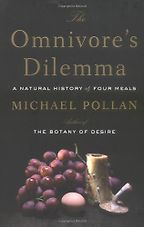
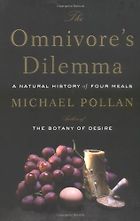
That leads us neatly into your first book choice, The Omnivore’s Dilemma by Michael Pollan, which looks at what is going wrong with government policies towards food production.
Michael Pollan looks at food production through four meals. One is a fast-food meal, the other is an industrial-scale organic meal, then there is a small-scale organic meal and finally he actually goes out and either grows or kills, in the case of the meat, the entire meal himself. That is the narrative.
The premise being that every day we have the dilemma of what we are going to eat.
Yes, if you are a panda bear you don’t have a dilemma because you only eat bamboo shoots but as an omnivore you have got choices. He looks at the way we subsidise big commodity agriculture in the United States – and there are some problems with subsidies. I think that is true for many places in the world, including Europe. It encourages an artificially cheap system for bad food. For example, we subsidise corn growing and make it into high fructose corn syrup at an artificially cheap price, which, of course, is fattening us up at an incredible rate.
The same corn getting subsidised is fed to the cattle that become hamburgers. And we are eating too much of that and the conditions at the massive places where they are reared are not good at all.
What do you think governments should be doing about this?
I don’t think they should be supporting the wealthiest farmers. Often the people who are getting these subsidies you wouldn’t even call farmers. They are more corporations than farms. Instead of focusing on them the government should be paying attention to improving small, sustainable, regional food systems.
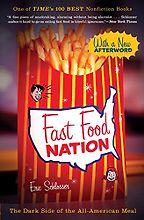
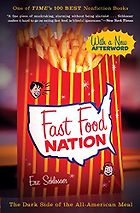
Another group of corporations on many people’s black list in the world of food production are fast-food businesses. Eric Schlosser’s Fast Food Nation really got people thinking about just what eating a burger a day is actually doing to us.
Eric Schlosser takes apart a single fast-food meal and shows not only how it affects our health but also how the people who serve it to you are treated. He also looks at how the people in the slaughterhouses working with the cattle are treated, and so it shows you the true picture of the all-American meal – burgers and fries.
And this book has had an effect on that industry. Big companies like McDonald’s seem to be going out of their way to show how things are sourced and making an effort to provide healthier options and give more information about their food.
Yes, it has been 10 years since that book came out and I recently interviewed Eric Schlosser and asked him if things have improved and he said yes. People are getting much more aware of childhood obesity and the role fast food plays. And, certainly in the States, fast-food restaurants are required to give calorie counts, so people can see just how much sugar and fat are in some of these things. Eric said there had been a lot of progress on that front, but sadly the situation with the labour has got worse.
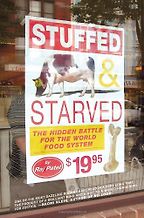
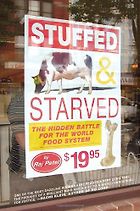
Your next choice continues with this idea of how our current diet is causing obesity in many areas of the world. But Raj Patel also points out in his book Stuffed and Starved that many people still don’t have enough food. So you get the two extremes provided by the global food system.
Patel is a very smart man, a scholar in the true sense of the word. He takes this huge global picture. The book goes everywhere from India to Brazil to southern Africa looking at how the global impact of industrialised food has led to this scandalous situation where there are a billion people who get too many calories a day and a billion people who do not get enough. Again, it often has a lot to do with economic choices made by government agencies and non-government organisations.
But do you really think that an efficient and healthier way of providing food to an ever-expanding world lies with locally produced food? Is that really viable?
I absolutely do and so do the United Nations. The Food and Agricultural Organisation did a study a few years ago that shows that it is the way to do it. What there hasn’t been is a real study on how the current system leaves a billion people today starving. How is that happening?
Locally produced food might work where you are living in Vermont but how about somewhere like war-torn Somalia?
Yes, Vermont is a small agricultural state which is very food conscious, so it is relatively easy for me. Even though we are a northern state right up against Canada without a long growing season, we can still manage. The growers and the people here are very tuned into the whole idea of sustainability. War-torn Somalia has so many problems I think it would be better to take another example.
OK, how about Namibia?
What has happened lately is that they have adopted some new crops, some of which are genetically modified. They are primarily cash crops, so crops that are meant to be sold and they are encouraged to do this. These crops require huge inputs as far as fertilisers go, which is an added expense. So you get the situation where you have taken people from producing food for themselves and turned them into producers of cotton or wheat or whatever it may be. That is true in other countries like India and much of agricultural Africa.
And all of sudden they are finding that things have changed. In the past they could at least farm from a subsistence basis but now they have stopped doing that and they are not making enough money because of the expense of growing these GM crops or hybrid crops that are designed to be used in connection with chemical fertilisers. You get situations in places like India where there is an epidemic of suicides from farmers. These were countries that used to feed themselves and now they no longer can. The United Nations study pointed to the idea that if they went back to smaller food crops they would be fed.
Some people would disagree with that and say the only way to feed an ever-expanding population is through GM crops and big cash crops.
I can reel off half a dozen major academic studies, including the one that I just mentioned from the United Nations, which show that not to be the case. Organic is probably the only way we are going to be able to feed nine billion people. I read about it all the time, people asking how are we going to feed all these people organically. Well, there is plenty of evidence that we can. What is lacking is evidence that we can feed more people under the current system.
It is a system that is based on petrochemicals. Fertiliser is nothing but natural gas turned into ammonium nitrate and things like that. It is basically natural gas. Many of the pesticides are derived from petrochemicals. Nearly all the fuel used for growing and transporting is based on inputs of petroleum products and we all know those are not a long-term solution.
But many people complain about how expensive organic is. Do you think we have to be prepared to spend a bigger proportion of our income on food, just as we did in the past?
I think with places like Europe and the United States there are two things at play. One is subsidies, which we talked about earlier, and the other is economies of scale. If you get more organic it will become cheaper.
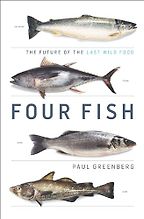
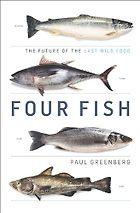
Four Fish by Paul Greenberg takes us to the ocean to explore some of the solutions to overfishing and fish farming.
This book is totally unbiased and very serious at looking for solutions to the global fisheries problem. He picks four iconic fish to use as examples to serve for the whole spectrum. So there is tuna, salmon, cod and sea bass. He doesn’t condemn fish farming outright but he explores ways to do it so that we continue to fish in what is the last wild place where we get our food.
What kinds of solutions does he come up with?
For wild fish, he says flat out that we must reduce fishing effort. There are too many fishermen in too many boats chasing too few fish. He suggests that certain areas of the oceans be completely off limits for fishing, and that we manage fish populations such as tuna, which can travel across oceans, on a global basis.
Five Books interviews are expensive to produce. If you're enjoying this interview, please support us by donating a small amount.
For fish farming, he says that the species we raise should be efficient. Salmon, for instance, are carnivores that must be fed more fish protein than they produce. That’s not efficient. Tilapia can get by on a vegetarian diet. So that is more efficient. Any fish farm should not damage wild systems and we should limit the number of fish farms in a given area.
Last up is John McPhee’s Oranges, a classic book about how food is produced and the people who produce it.
Oranges is a model for a certain type of journalism. Big food companies do not want you to know how your food is produced and who produces it. They want you to just think about it as something that arrives in your supermarket already wrapped up. This book is a model for me. Every day on his way to work McPhee passed through the train station in New York City and there was this place where you could go and they had a bin full of oranges and a machine and they would squeeze you a glass of orange juice while you waited.
“Big food companies do not want you to know how your food is produced and who produces it.”
McPhee started to think about that and decided that he would basically follow that glass of freshly squeezed juice back to where the orange was produced. He wanted to find out all about it, the history of that type of farming. It is a short book and it is not a political book in that he is not beating any drums, he is just telling you how it is done. And you come away never being able to look at an orange in the same way again. You will look at it and know about the people who grow it who have financial problems. And it will no longer be a pretty waxed orange sitting in front of you.
You were finding out similar things when you were researching your book Tomatoland.
Like I said, I think the big food industry goes out of its way to hide these things.
What kinds of things did you discover?
I focused on the winter tomato from Florida and discovered tasteless tomatoes compared to a tomato of 50 years ago. They are harvested when they are green and then exposed to ethylene gas, which makes them obligingly turn the right colour. Ethylene is a gas that the leaves of a tomato plant emit naturally when the fruit is ripe.
And that ties in to the whole debate of what shoppers in supermarkets have come to expect – this idea of uniformity in fruits and vegetables, which doesn’t necessarily signify taste.
Yes, one of the tomato growers that I was talking to told me that the supermarket shopper does not taste the tomatoes before she buys them. She buys them with her eyes. He was also the one that said he doesn’t get paid a cent for taste or nutrition, he gets paid by the pound. So I discovered that since the 1970s plant breeders for commercial tomatoes have focused almost solely on yield. That is what they got paid for, so taste and nutrition got lost.
Another thing I found out was that a horrific amount of chemicals have to be used to grow tomatoes successfully in Florida because the conditions there are not right for growing them naturally. The climate is far too humid for tomato-growing conditions, which need to be dry and sunny like in Italy. All too often the workers are affected by the huge amount of pesticides going on the tomatoes. That leads in some cases to birth defects and cancers.
Get the weekly Five Books newsletter
I was also really shocked to find out that there is still abject slavery in the United States. And this isn’t just occasional. There have been seven major cases brought to justice in the last 15 years. I am talking about people being bought and sold and shackled in chains at night to keep them from escaping. This is all in the court records, written down.
As consumers, what would you urge us to do about these issues?
Fortunately, very recently, some fundamental changes have been made in the relationship between the people who grow and raise tomatoes and the people who work for them, which could improve a lot of these conditions. The Workers Rights Group has been working for years to bring about these changes and they actually came to pass last year. So at least there is a mechanism in place that can deal with a lot of the labour abuses that are going on. Workers have time clocks in the fields to show how long they are working – they never used to. There is a grievance procedure. So the template has now been built and it looks like things could become much better.
Five Books aims to keep its book recommendations and interviews up to date. If you are the interviewee and would like to update your choice of books (or even just what you say about them) please email us at [email protected]