What unifies your choices?
My choices (except for Rawls) all deal with issues of quantifiable economic history. In other words, there are two pieces of information that I’m interested in and which I think are really necessary if you want to have some quantifiable view of history. One of them is to have mean incomes for countries, essentially like GDP per capita for countries in the past, and the second piece of information, which is, of course, much more difficult, is to have information on income distributions of countries in the past. These two pieces of information really give us a global picture of income distribution. So this is one unifying theme. The second one is to have books which show how inequality engenders certain political or economic developments – in other words, inequalities are not neutral. They do have an impact on, for example, imperialism. One book I’ve chosen shows how inequality in the Roman era actually prevented the adoption of new technology and stifled development.
Victoires et Déboires by Paul Bairoch.
This is a magisterial three-volume economic history of the world from Columbus to Gorbachev. Bairoch covers the entire economic history of the world and he provides lots of numbers, estimates and, at times, indeed guesses, but lots of numbers nevertheless on many things like income, wages trade, urbanisation, income distribution, population and so on. This is crucial for economic historians who want to build on these numbers. He also provides a narrative about development and what made Europe get ahead of China and India, and he talks about the role of the colonies, an issue which has been rather forgotten – whether, for example, colonies contributed to the European metropoles’ development and whether the colonies themselves did not develop precisely because they were colonies.
And did the colonies contribute to the metropole and did these places fail to develop because they were colonies?
There is a very interesting point that Bairoch makes, which is that colonisation was very bad for the colonies but on the other hand did not fundamentally matter for the metropoles. For sure, the metropoles imposed economic rules which favoured themselves, and thus, under what Bairoch calls ‘the colonial diktat’ they would ban manufacturing production in colonies and would require that colonies only import goods from the metropole and they required that colonies ship all the goods on ships belonging to the metropole.
That’s very interesting. Because in Britain lots of people think that the colonies did fine while we were there but now we’ve gone it’s a mess because these people don’t understand how to govern themselves. Obviously, it’s a mad imperialist view, but it’s very widely held.
This is a view that many people hold, particularly when you look at Africa after 1960, because there is no doubt that there was disappointment with what Africa accomplished since decolonisation. There was another argument that colonisation set up structures that were inimical to growth. But, on the other hand, it’s not true that colonies were crucial to the growth of the West. Western Europe and America had independent engines of growth already and the contributions of the colonies were not that big.
Bairoch argues that China and India were not significantly poorer than England in the 18th century and, in fact, he attributes the rise of Western Europe to its openness to the rest of the world, to political competition between the states, favorable climate, and intellectual curiosity from the Renaissance onward. The industrial revolution, he argues, was less a ‘revolution’ and more a steady evolution. He also shows how meaningless is the idea that the metropole (as Niall Ferguson claims today) followed a policy of ‘free trade’.
“Political competition, intellectual curiosity and a temperate climate breed economic and technological development.”
Bairoch discusses slavery, its huge human toll and how it affected institutions of the countries where the slaves were moved. He shows how agricultural revolution could not spread southward because new agricultural techniques were designed for moderate climates, so they could spread West to East or East to West, but not North to South. The initial catch-up of the Third World countries after decolonisation was rather successful (with the exception of Africa), but then ‘les années charnières’ (turning point years) of the second oil crisis, increased interest rates, and inability to service the debt plunged most of the Third and Second world into two decades of stagnation. (China and India, due to their relative isolation, did much better, and, of course, China’s institutions changed dramatically for the better at just the same time.) Most of our pre-global crisis world was shaped in the period 1979-80. By extension one can see the years 2008-2010 as another ‘années charnières’. A new world, with a new distribution of economic power will emerge.
How exciting. Let’s move on to Angus Maddison, Contours of the World Economy, 1-2030AD.
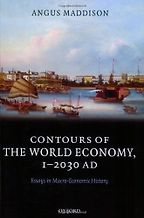
This is the last work by perhaps the world’s foremost qualitative economic historian. It’s more empirical than Bairoch. The two were competitors in terms of economic history studies. He’s more sanguine about the advantage of Europe over China and India achieved by 1750, and (as some recent works shows) likely right on that score. Maddison is the only person who has produced the only existent series of quantitative national account statistics, GDP per capita, for most countries of the world since 1820, and for some (like the Roman Empire) going back to the 1st century AD. Everybody who wants to do empirically based economic history has to start with Maddison.
You say he dismisses the idea that everyone lived in poverty until the last century.
Yes. He emphasises the continuous improvement of West European economies since the 16th century, so that the gap with China was already appreciable by the 18th. (In this, as I said, he differs from Bairoch.) He completely dismisses the hedonic equations empiricists and Malthusian historians who believe that until the last century men lived as cavemen in abject poverty and could not accede to anything above the subsistence level. This is a bleak and untrue view of the world. We were not living at subsistence level. If you look at Roman aqueducts, palaces churches, roads, army, as well as Greece, Egypt – this could not have been achieved at subsistence level.
Both these two books and Schiavone’s (my next choice) are included because they try to answer, using quantitative and analytic evidence, the ‘mother of all economic growth questions’: why have some countries and continents been able to launch themselves on to a sustainable growth path and others have not, and how global inequality was affected by inequality of mean incomes between countries?
What are the answers?
Well, the books are not very different in what they do. The books come with one overarching theory as to why Western Europe, particularly England, got ahead. It’s the combination of things we mentioned. Competition between city-states and countries in Europe because Europe, unlike China, was much more diversified politically, so people could move, if they were not accepted, from one country to another. Exiles would go from France to England to the Netherlands etc.
So this is a very capitalist thesis, then. Competition breeds growth.
Yes. Competition breeds growth, but it’s political competition that breeds growth because different political arrangements are more apt to accept growth. As is openness to the rest of the world, which started with the great exploration, and, of course, there you have the contrast with China, which started with the great explorations at about the same time, with bigger ships and more people, but then decided to stop and go into isolation. Also there’s the intellectual curiosity, which led to technological developments from the Renaissance onwards and also the inheritance from Egypt, Greece and Rome. Also, you’ve got a temperate climate (England’s cold but without the gulf current very few people would live there) and the serendipity of finding coal and so on.
It is very cold here. Now on to Aldo Schiavone and The End of the Past: Ancient Rome and the Modern West.
Schiavone is intrigued by the same question, but posed here (in the area of classic studies) with respect to the Roman Empire. Michael Rostovtzeff was, in fact, the first to ask the question: why did Roman civilisation, which contained many elements of modern capitalist and market economy, not develop straight into a commercial capitalism of the medieval Florentine type? In other words, why a detour of some ten centuries? It’s a very reasonable question. You can’t blame the Barbarian invasions because if the Roman Empire had developed further it would have been sufficiently strong to prevent the invasions.
Why didn’t it?
Inequality. Schiavone’s answer is that the main culprit was the existence of slave labour. Most of the slaves in Rome were the product of military conquests. Slaves were relatively expensive, meaning that they could produce output above their own subsistence, but they were not sufficiently expensive to encourage the use of labour saving, and thus more technologically productive, techniques. Slavery, as argued already by Marx, was the key reason why ancient societies could not go past a certain level of economic development (even if they knew of some technologies – most famously the steam engine invented in Alexandria). They developed well enough to know how to use slaves but didn’t develop sufficiently to make it profitable to replace them with machines. Thus, in a key Marxian formulation, social relations limited the development of the forces of production.
Do you agree with this? It sounds slightly simplistic.
I do. I believe slavery was an institution that was efficient perhaps in the short term but in the long term it really prevented development of efficiency. Schiavone is the link in the big question of Western Europe vs China and he provides an economic explanation for the Roman Empire’s lack of development.
Surely a lot of things came together? The Romans put so much energy into conquering the world that they found it difficult to focus on homegrown technology and advancement. It is hard to do that if your main aim is world domination by military means. Expansionism is always a disaster. Also, another interviewee explained that Rome was initially run by the educated upper classes and that the rulers became less and less educated as time went by.
Schiavone says that slavery made any labour, any useful work, seem unworthy of the upper classes. So there was the economic element to which you refer is more cultural. The upper class did not see that there was any value in material production, except for agriculture. So, the economic plus the cultural argument means that slavery made Rome unable to develop.
John Hobson’s book.
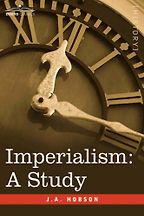
A classic on imperialism, published a hundred years ago. It shows how unequal distribution of income in the metropole implied a high concentration of free (investable) financial capital in the hands of few people, and a drift toward imperialism. The rich who own these free financial resources are in a search of more profitable opportunities than the domestic markets can offer, and they gradually invest more abroad. They have to invest outside home. By doing this they also provide the political underpinnings of colonial expansion because safety of their capital requires political control of these new markets. Thus colonies are born. You have to explain that the logic of expansion is always internally driven. Hobson combines the issues of domestic inequality, lack of domestic aggregate demand (because of insufficient ‘trickle down’ among middle and lower classes) and shows how an aggressive external policy develops to respond to these financial needs.
Get the weekly Five Books newsletter
It’s interesting today because we do seem to have a similar constellation of forces to those that existed in 1902 when Hobson’s book was published. You need control over raw materials, oil and other things – so in that sense aggression is internally driven. External decisions are made in response to internal need. The similarities between these two periods are uncanny. We have a huge concentration of financial assets in the hands of relatively few people. As we know, few people dominate politics because they fund the politicians. The system is driven by the people with money because you cannot do politics unless somebody pays for you to do it. These people contribute millions to the campaigns of both parties and they aren’t doing it out of charity. They want something. When we look at the aggressive policies in Afghanistan or Iraq we must remember that there are people who are benefiting from them – the most obvious are the arms contractors who have made billions of dollars. Hopefully the sequel which Hobson foreshadowed – the struggle of various imperial powers for world dominance – will not lead the world to a repeat of 1914-18.
Isn’t this what it’s been like throughout history?
Yes. The people who go and fight wars, if you look at the US, are often not even US citizens but are trying to get citizenship or good pay, and you have taxpayers funding the war and the rich are benefiting. So the burdens are interestingly distributed. One group of people dies, another group funds it and a third group makes money.
That’s very bleak.
It’s a simplification, but it is true that some rich people have become even richer because of a war. Hobson is the first to explain the dynamic of imperialism a hundred years ago and I think his book is very topical still now.
John Rawls: The Law of Peoples.
Rawls is different. He’s the first modern political philosopher (probably since Kant) that tried to answer the question of how just relations between nations and individuals should be organised in a philosophical sense in the era of globalisation. Here we really have the rules of how the world should be run.
What are they?
Well, the rules are that people don’t interact with each other but that nations interact with each other. Each people has different sources of legitimacy for its nation’s constitution. We cannot ask that Saudi Arabia have the same rules as the United States. Liberal democracy and illiberal regimes can coexist but, like in the UN, they should acknowledge each other’s legitimacy but relevant relations are nation to nation not person to person. If there is no direct relationship between individuals and no global government then there is no concept like global inequality because that concept is based on the idea of all individuals belonging to one common society rather than to their respective nations.
It’s very anti-globalisation.
It’s a very sophisticated mechanism set up here. Relationships between nation states are needed so that one group of people does not impose its institutions on another group of people. When you allow that the world is one polity and there is one set of human rights and rules then immediately people want to impose their own things on you. Rawls wants to prevent that.
That’s the United Nations, isn’t it?
Writ large with a more just order.
But what are you going to do when Hitler starts invading Czechoslovakia and massacring people?
Rawls does have a proviso for that because he says war is justified only if you have outlaw states (which he never defines very well – these states don’t accept the overall global agreement). But illiberal but non-aggressive societies can coexist with liberal societies.
It is a much more timid book than his famous A Theory of Justice (where the issue is how individuals living in a single political entity should devise their relations and create just institutions). In The Law of Peoples, it is, as I said, peoples (nations) that intermediate relations between individuals; individuals from various nations do not design global institutions directly, dealing with each other, but meet metaphorically through their representatives. (Because the relations between individuals are intermediated by states, no direct duties of justice arise as between individuals from rich and poor countries. Only humanitarian assistance remains.) The book laid down the rules for a peaceful coexistence between nations that espouse various ideologies and use different legitimacy criteria to justify their domestic rule – as, for example, do the United States, Saudi Arabia and China. The peaceful coexistence must also be seen to occur within the context of an overall just global order, to which all nations have contributed.
The point I’m really interested in is dismissing the person-to-person relations.
It has many implications because Rawls is a liberal thinker but he comes out against aid. He says aid can only be given up to the point that a society is ‘decent’ and consultative (everyone has some stake or a vote), because after that point there is no reason to give aid. Rawls also comes out strongly against migration. He views each people as being a custodian of the land that it occupies and having the right to exclude others who would like to move there. The only justified migration is the one which has to do with political or religious persecution. But economically motivated migration is not acceptable.
Five Books aims to keep its book recommendations and interviews up to date. If you are the interviewee and would like to update your choice of books (or even just what you say about them) please email us at editor@fivebooks.com
Five Books interviews are expensive to produce. If you've enjoyed this interview, please support us by donating a small amount.