Before we get to the books, what got you interested in studying the Korean War?
I went to the Peace Corps in Korea when I was trying to avoid the War Corps in Vietnam. The Peace Corps is not a substitute for military service but it does provide a deferment. I was quite stunned by the relationship Americans in Seoul had with Koreans in the late 60s when I was there. The Americans lived on compounds and there was very little interaction with the Koreans. So I got interested in the origins of the U.S.-Korean relationship. Then I went to graduate school and ended up doing a dissertation on the U.S. occupation in Korea right after World War II, before the Korean War. As I was doing that it occurred to me that I was learning about the origins of the Korean War. There is very little literature that you can find in the U.S., apart from what scholars have done, that will tell you what the long background to the Korean War was. It is usually seen as a thunderclap that came on a Sunday morning, like Pearl Harbor.
Your first choice is John Merrill’s Korea: The Peninsular Origins of the War.
Like several of the best books on the Korean War, this one is out of print. When David Halberstam was doing his book on the Korean War a few years ago he wrote that he went to a public library and he found 88 books on the Vietnam War and four on the Korean War, and I think that says a lot about the general lack of scholarship and interest in the Korean War in the U.S.
John Merrill’s book is one of the very best. It is based on a lot of archival research and it looks at the internal emergence of the Korean War in the late 1940s rather than this idea that it started only in June 1950, which is of course the official American position. He was the first American to write about a rebellion on Cheju Island off the southern coast where at least ten percent of the population was killed in a very brutal suppression campaign. It is a very fine book.
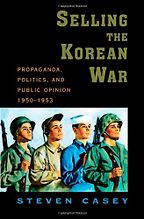
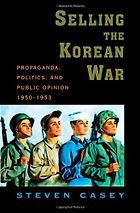
Next up is Steven Casey’s Selling the Korean War: Propaganda, Politics, and Public Opinion in the United States.
Yes. This is a recent book, and it is very well researched. I think for lay people who try to understand what historians do, it really helps to know that you can’t really cover a subject without using archives and primary sources. He also looks at formerly classified secret documents. All this information gives us a window into what really happened (as opposed to what was supposed to have happened), and it’s also unimpeachable evidence. What the author found with all his research is that the U.S. government had a major campaign to massage public opinion about the Korean War, both in the United States and on a global scale.
What kind of things were they doing?
One set of files that I looked at in the State Department is very typical. You might find the Embassy in Guatemala trying to refute an article in the local press praising I F Stone’s book, The Hidden History of the Korean War. In South Africa they would counter a letter to the editor in the Johannesburg newspaper. It is just amazing how much money and personnel the U.S. had to push its interpretation of the Korean War.
Which was what?
Essentially, that both South Korea and the U.S. were utterly blameless and that North Korea, backed by the Soviet Union and China, launched an unprovoked invasion which was courageously resisted. This is actually what many influential people believed. Another thing the U.S. did was censor the battlefield. The first six months of the war were not censored, so you get really interesting books. If I had a sixth book to recommend to you, it would be Cry Korea by Reginald Thompson, a British reporter, which was written in 1952. He covered the war in the first six months and said it was a very different war from World War II. It was really like what we came to understand to be the nature of the Vietnam War. In particular, Thompson discovered an extraordinary number of atrocities by the South Korean government, and saw that the U.S. was turning a blind eye to the situation. And it was when British and Australian reports about this came out, at the end of 1950, that censorship descended onto the battlefield. For the next two years, what you learnt about the war was what you got out of General MacArthur’s headquarters or the State Department.
You talk about how America manipulated press coverage of the Korean War, but you do have some critics who say that you are a revisionist historian who is too quick to criticise the U.S.’s role, and too eager to overlook the misdemeanours of the North Koreans. How would you respond to them?
Well, the last thing you said is completely false, so I would tell them it is completely untrue that I overlook what the North Koreans were doing. What my critics have done is to ignore South Korean atrocities, which we now know ran at a ratio of six to one with North Korean atrocities. That has been proven by a Truth and Reconciliation Commission that laboured for years in South Korea. When South Korea democratised, we got a lot more information about things like this.
I was the first person (except for former officials) to use the archives of the U.S. occupation in Korea, so there wasn’t any story to revise except the official story, which was full of holes. And I actually don’t think any historian worth his or her salt should be anything but a revisionist. If a book doesn’t say new things and revise our understanding of what happened, then what good is it? But unfortunately, particularly in this country, ‘revisionist’ is a term that you can label a person with and then others will shy away and not read their work.
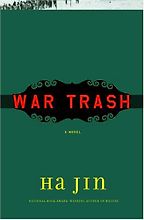
Your next book is a novel – Ha Jin’s War Trash.
Ha Jin’s novel is obviously based on either his experience or his father’s experience of the Korean War. There are some very stark and striking descriptions. He didn’t have access to South Korea, but he has this wonderful ability to treat everybody fairly and to listen to the songs of women guerrillas that were captured by South Korean prison camps and enjoy listening to them. He does the same thing with North Korean and Chinese soldiers and the civilians who were caught up in the battle.
I just thought that it was a very clear-eyed, true account. It rings very true when you know what is in the archives, even though he didn’t do archive research at all. It was based on a very truthful account of soldiers – particularly Chinese – coming to Korea and fighting there for two and a half years.
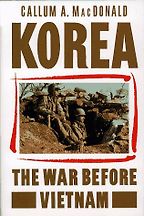
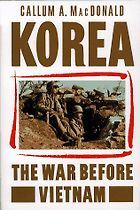
Let’s go on to Korea: The War Before Vietnam, by Callum MacDonald
Callum was a friend of mine, just because I read his book and got to know him, and I think this is one of the very best books on the war. It makes the point that you can also draw out of Reginald Thompson’s book: that the Korean War was much more like the Vietnam War than any other war before that. It had very shifting lines. The guerrillas were very much involved, particularly in the first year or so. There were atrocities and the kind of things that we have come to associate with the Vietnam War. I also think the book is overlooked because Callum died of pancreatic cancer when he was still quite young. It was a terrible loss to his family and also to the literature.
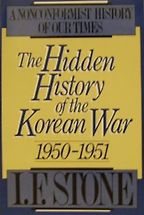
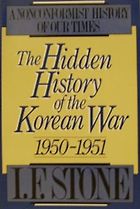
Your last choice is The Hidden History of the Korean War, by Isidor Feinstein Stone.
This book is very interesting. I F Stone was a famous iconoclastic investigative reporter. His method was to read a whole bunch of newspapers every day, clip them, and then read what the government was saying publicly through government reports, speeches and the like, and then try to figure out what was going on. And he got many things right about the Korean War using that method. In the early 1950s he was condemning the carpet bombing which the U.S. did in North Korea. This was an enemy that had almost no defence and no air power. I don’t think many people understand that North Korea suffered the same kind of fire-bombing that the British and Americans did in World War II against Japan and Germany – and yet North Korea was a small country.
Five Books interviews are expensive to produce. If you're enjoying this interview, please support us by donating a small amount.
In particular, I F Stone brought up the widespread use of napalm in Korea; most people identify that with Vietnam. I sometimes assign this book to my students, not because the narrative of the Korean War is necessarily all that great (we know much more now than Stone could possibly have known), but because it is such a great book to look at to learn how to read a newspaper or an official government report. It is also a very lively book.
My final question: I think most people in the West have a very set image of North Korea, a negative one – perhaps based on very little actual knowledge of the place. What is your own view of the country?
Well, I think that the contemporary North Korean regime is just an awful regime. For more than ten years it has imposed hardships and deaths and famines on its own people, and it is quite natural that people today would look at Kim Jong Il with his outrageous get-ups and see him as a caricature of a Communist despot and then transport that back to the time of the Korean War. The fact is that, in 1950, North Korea was eminently stronger than South Korea. It had a legitimacy that South Korea did not have, because its top leaders had fought against the Japanese in a long and difficult war, whereas the forces of order in South Korea were almost entirely populated by generals and officers and particularly police officers who had served Japan. So it really was a kind of anti-colonial war that the U.S. got involved in. But when they did, it was kind of transformed into a global crusade against Communism.
And do you see the regime today as some kind of legacy from that era?
Well, for them you have a direct line drawn back to the Korean War, and even earlier, to the 1930s. There are 23 people in the North Korean Politburo and 15 of them are over 80 years old. They lived through the Korean War, and in North Korean culture patriarchy runs very deep – much deeper than in South Korea. I think you have a fossilised regime which has been hanging on for the past 20 years since the Berlin Wall came down – and hanging on primarily because they know that if they give up they will lose their lives, and perhaps their families’ lives, and, ultimately, they will also lose the Korean War.
Five Books aims to keep its book recommendations and interviews up to date. If you are the interviewee and would like to update your choice of books (or even just what you say about them) please email us at [email protected]