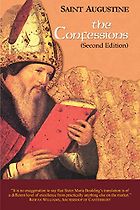
Tell me about your first book, St Augustine’s Confessions.
St Augustine is a good place to start because this is the oldest book that I have chosen. It was written between AD397 and AD398. St Augustine of Hippo was one of the first thinkers to struggle with the concepts of time, memory and eternity.
The Confessions is the first real autobiography ever written and it has a very strong philosophical and psychological dimension. One of his obsessions in the book is looking at memory. He tries to remember his past life and to figure out how it is that the past and present and future are related, and especially how the past stays in his memory even though it has ceased to be.
And this struggle leads him to the question of eternity – how it is that we are somehow already in eternity. But we only experience it sequentially one little bit at a time. Augustine is the very first person to try to dissect time and in one chapter he comes up with the insight that the present really doesn’t exist because the present is ever moving and by the time you say the word now and get to the last letter it is no longer now. So his take on it as a philosopher, and also by that time as a Christian theologian, is that the only real time is eternity. For human beings our minds and wills, every part of us is programmed not to live eternally, and time for him ends up being a great disappointment.
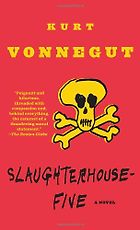
Your next book is Kurt Vonnegut’s Slaughterhouse Five.
This book is at the other end of the spectrum – written in the 20th century. Kurt Vonnegut, through fiction, takes up the same questions as Augustine all those centuries before. He is also looking at the relationship between the present moment and what had happened before. And then he takes it one step further than Augustine to look at the future. His main character, Billy Pilgrim, is constantly unstuck in time. He is abducted by aliens from the planet Tralfamadore. And the alien’s experience of time is very different to the earthling’s experience of time. They experience time almost as if it was a mountain range. It is just there. Everything that happens is there and solid. And on earth human beings can see just whatever moment they are in. But, Billy Pilgrim has the ability to do what the Tralfamadorians can do. He can transcend time.
What I find intriguing about all this is that Vonnegut tried so many times to write the story of his memories of the bombing of Dresden and he kept failing. And, finally with Slaughterhouse Five, he wrote this outrageous story about time travel. That was his way of getting to grips with the horror that he lived with. His character Billy Pilgrim lives through the bombing of Dresden and he goes back and forth to Tralfamadore. There is one beautiful bit where he describes how Billy Pilgrim experienced the bombing of Dresden backwards. The bombs fly up to the airplane, then they go back to the factory and the parts go to the places where the parts came from and eventually back to the mines where the metal is mined. And all this is seen in slow motion.
Even though he is no philosopher Vonnegut is still able to ask the questions that all of us think about – how time affects our lives.
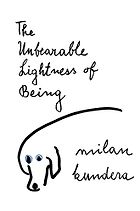
Let’s move on to The Unbearable Lightness of Being by Milan Kundera.
This is another novelist and a lot of the book is not about time and eternity. It is more about human relationships. But Kundera does keep picking up the question of human existence in time. The title, The Unbearable Lightness of Being, comes from the main character’s obsession with the fact that all we have is the now, nothing else except the ever moving now. He wants to know what is happening about our existence in relation to the ephemeral present, which comes and goes so quickly. Since we are stuck in this ever-moving moment, how do the past and future relate to that, and what difference do moral choices make over a lifetime? What is the meaning of our existence? We are stuck in this ever-moving moment, and how does the past relate to that?
One meditation in there is where he takes up Nietzsche’s theory of the eternal return – an ancient Hindu concept – in which everything that happens continues to happen eternally, an infinite number of times, over and over, like a broken record. And then when he considers that he asks himself whether Nietzsche was serious about this, and what difference it would make if he was right. He says, yes life is meaningless because you have no way to get out of this cycle. It is hell because all the bad things will happen again. And he puts it this way: if every second of our lives recurs an infinite number of times, we are nailed to eternity as Jesus Christ was nailed to the cross. It is a terrifying prospect… There is an infinite difference between a Robespierre who occurs only once in history and a Robespierre who eternally returns, chopping off heads.
Kundera was living in Czechoslovakia at the time of Soviet occupation. In a way, it is a very Eastern European Cold War take on what it is to be stuck in time. The eternal he considered is Nietzsche’s eternal, which is the eternal return, which is very frightening. The main character is paralysed between life at that moment and whatever there might be that has meaning.
How does your next book tackle the question of The Difference between Temporal and Eternal? This is the book by Juan Eusebio Nieremberg.
This was written in the 17th century. Nieremberg was a Jesuit priest and his parents were Austrian and part of the Habsburg court in Spain. The book is a very lengthy meditation and one of the most depressing and scary tomes anyone could ever read! He is taking Augustine to the extreme and saying that, rather than time being meaningful, it is non-existent compared to the eternal. This is a very Catholic, 17th century point of view. For him it is all about preparing yourself for eternity and, in true Catholic style, how you fare in your eternal life depends on how you lived your time on earth.
It is really a book about the connection between your time on earth and eternity, which comes down to ethics. Some of the meditations on the temporal and the eternal show up in James Joyce’s Ulysses, because the Catholic clergy kept referring to him in their sermons.
But, there is a flipside which I think is the one thing that kept it going for so long. And that is that these sermons and meditations were one of the few places that the clergy could preach to the wealthy and the powerful and tell them it was time to share their goods. There are meditations in there about rich people and their cool cellars which keep them comfortable in the hot summers. But there is this idea that they will get their roasting later in hell!
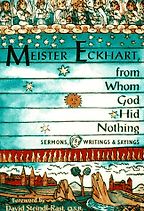
Your last book is Meister Eckhart’s From Whom God Hid Nothing: Sermons, Writings and Sayings.
Meister Eckhart was a Dominican priest in the 14th century. He spent most of his time in Germany, especially in Cologne. We are told that he was an immensely popular preacher which I find hard to believe. His sermons are incredibly difficult and they are very philosophical and focused on this idea of the now versus forever. What he comes up with is an idea that led to him being accused of pantheism. He had this idea that inside every human being there’s a spark of the divine. We all participate in God’s existence. And at the core is what he called Fünklein, the little spark of the soul in which God is fully present. If you are able to get there by divine practice itself, and by praying and meditating, you actually get to God’s state of existence which is eternal.
It does and there are quite a few people who have tried to compare Eckhart to concepts of eternity in Buddhism. There is this sense that in the eternal realm we are beyond time. One of his sermons is entitled ‘Get Beyond Time’.
Of all these books, which is the one which most chimes with your views about time and eternity?
I would like to say Eckhart. Of the five, who do I hope is really right? Eckhart! The problem is he doesn’t tell you how to get to the eternal now moment. He just speaks about it. There is this passage where he says: ‘When God created the world all creatures flowed through me.’ Eckhart also speaks of the birth of the Son in the soul, by which he means to say that when one gets to that eternal now moment, one can experience the begetting of the Son in the Trinity. Eckhart fills his sermons with such radical talk, where God and creation merge. He has a beautiful passage in one sermon where he says: ‘Whether you know it or not, whether you like it or not, all creatures seek God.’ As Eckhart saw it, all living beings are linked to the divine, and in search of consciousness of this fact. So he is saying there is no difference between an ant and a human being. All creatures are sacred.
July 30, 2010
Five Books aims to keep its book recommendations and interviews up to date. If you are the interviewee and would like to update your choice of books (or even just what you say about them) please email us at editor@fivebooks.com
Five Books interviews are expensive to produce. If you've enjoyed this interview, please support us by donating a small amount.
Carlos Eire
Professor Eire, who received his PhD from Yale in 1979, specialises in the social, intellectual, religious, and cultural history of late medieval and early modern Europe, with a focus on the Protestant and Catholic Reformations, the history of popular piety, and the history of death. He is currently writing a survey history of the Reformation and researching attitudes toward miracles in the 16th and 17th centuries.
Professor Eire, who received his PhD from Yale in 1979, specialises in the social, intellectual, religious, and cultural history of late medieval and early modern Europe, with a focus on the Protestant and Catholic Reformations, the history of popular piety, and the history of death. He is currently writing a survey history of the Reformation and researching attitudes toward miracles in the 16th and 17th centuries.