Let’s start with the Dreyfus affair.
The Dreyfus affair is a mythic event in French history. After the French Revolution, it created the most important social division in France before 1905, when the country was split in two over the separation of church and state and the secularisation of education. It divided France entirely and created unresolved conflicts in society that were fought out over the century to come. This is very rough and over-generalised but Republican France was always under attack in one form or another from those who never accepted the Republic, and the Dreyfus case is an exemplar of that.
“The Dreyfus affair is a mythic event in French history. After the French Revolution, it created the most important social division in France before 1905”
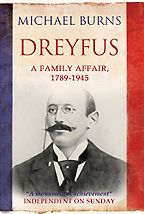
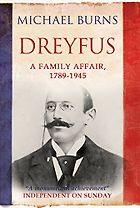
Alfred Dreyfus, Jewish and a colonel in the French army, was wrongly accused and convicted of espionage. He served four horrific years on Devil’s Island and all this time people all over France, and indeed, the world, were fighting for justice for him. Ultimately Dreyfus was pardoned and the army was found guilty of fabricating the evidence against him, but it took years and years of oceanic battles.
This book is the first to tell the story of the entire Dreyfus family – taking them from their origins in Alsace to the Nazi death camps where some of Dreyfus’s descendants were murdered – sent there by the Vichy government. It’s a wonderful historical narrative which tells you all the background you need to know about the family before coming to your own conclusions – everyone comes to their own conclusions about the Dreyfus case.
It’s the story of a remarkable family who suffered greatly at the hands of the French state but who also maintained absolute allegiance to it. They are the best example of what the French Revolution did for French Jews, which was to give them equal status – this, of course, did not happen throughout the rest of Europe until decades later. The family is quietly heroic and what is interesting is the number of French Republicans, thinkers, philosophers, intellectuals, who came out to defend them.
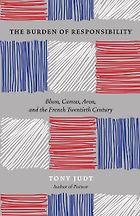
Now Tony Judt’s The Burden of Responsibility.
Tony Judt is my hero. He died very recently. I think he is one of the most important and impressive English historians and philosophers of his time. People call him a dissident but I don’t think he was a dissident actually – he was more a defender of moral values in life, society, politics, history, war. He was a great thinker and a great humanitarian and in this book he describes three men of a similar vein, men he admires, and he brings out that great spirit of European honour and philosophical thought.
His first subject is Leon Blum, the first socialist prime minister of France and also the first Jew. He was an intellectual, a good man, a man of principle and an idealist who came to power at the most terrible time – the 30s were really an agonising decade for most Europeans and Tony Judt’s portrait of Blum reveals what it was like when the Popular Front ruled France.
Then we have Camus, a resistant but very much his own man, an independent thinker. What Judt points out are the resolute standards of morality and justice which Camus lived by and held to throughout his short life. And when it comes to the intellectual philosopher Raymond Aron, he does exactly the same thing. Aron was disapproved of by both right and left, as was Camus – none of the three were extremists; they were liberal thinkers.
And what is important about this book is that it tells you about Tony Judt too. He would always see evil where evil lay. He was Jewish, raised in a Jewish family, lived on a kibbutz, and he spoke out about the injustices meted out by the Israeli government to the Palestinian people. And he was hounded because of it. In this sense this book about these three men echoes what happened to him in his own life.
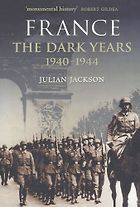
Let’s move on to Julian Jackson, France: The Dark Years.
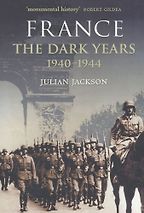
Julian Jackson is today’s most important and prominent British historian of France. The way that the war is seen by historians changed completely with the publication of a book in the 60s by an American, Robert Paxton [Vichy France, Old Guard and New Order, 1940-1944] – it was the bible for people who wanted to understand what happened in France during the Second World War. He showed for the first time that Vichy was a government of oppression in its own right; it didn’t require the German occupation to do the things it did. Today, the book which I think has replaced or rather expanded upon Paxton’s is France: The Dark Years.
[Pullquote]Paxton showed for the first time that Vichy was a government of oppression in its own right; it didn’t require the German occupation to do the things it did[/pullquote]
One of the interesting things about it is the way it sheds light on how the French have dealt with the events of the war. What struck me when I first came here, and to France, of course, was how alike the British and the French are, but they don’t see it. To someone like me, an Australian, they seem to have much in common. One notable aspect of this is their exceptional nitpicking about each other. It’s because they’re so close, you know, like sisters.
One of the things the British cannot get into their heads is that the French have faced up to what they did during the war – they know exactly what they did and they write about it endlessly. They are not happy about it, mostly – of course there are still unreconstructed old war criminals out there. But the British don’t realise this. When I published my book Bad Faith, if I had to answer that question once – ‘Do you think the French will ever face up to what they did during the war?’ – I answered it a thousand times: ‘They’ve already faced up to it.’
And Julian Jackson explains to the British what actually happened, what the French have done since about the terrible things their government was responsible for. It’s a great book, a great work of history.
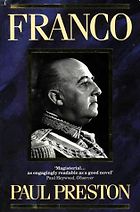
Tell me about Paul Preston’s biography of Franco.
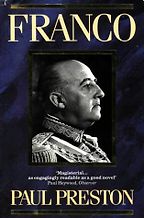
Paul Preston is another great British historian and his subject is Spain. This is the biography of Franco. What is so wonderful about it is that, generally speaking, the history of the last war for many decades in Britain is seen through the prism of what happened to Britain and America. And all the other countries that suffered so terribly in Europe were very much neglected.
And then along came Ian Kershaw whose three-volume biography of Hitler opened up the whole story of what happened in Eastern Europe – horrific, horrific stories about the Nazi occupation there. And then Russia – it took many years for British people to realise that it was Russia that really won the war and it took something like 20 million dead to do it. Of course they had a leader, in Stalin, who thought little of allowing 20 million people to die.
Now, all the time these horrors were going on, Spain was, so-called, neutral. Of all the dictators of Europe in the 30s it was Franco who lived the longest and ruled the longest. And, of all of them – Hitler in Germany, Mussolini in Italy, Pétain in France, Salazar in Portugal and Franco in Spain – my choice for the worst of them all is Franco. Franco actually hated and killed his own people, which is an unusual attribute for a fascist.
Paul Preston’s book tells you about his hideous regime. What’s so fascinating is that, because Franco wasn’t at war, most of the German and French war criminals – those who achieved freedom and there were a substantial number – were sheltered after it by Franco in Spain. It’s remarkable how much material there is in the archives about the war criminals who lived here. Many used Spain as an avenue to Argentina or Brazil, but many, many stayed. And this book covers the whole period.
It tells too how his ghastly rule came to an end. Franco died – and it all stopped, instantly. Preston brilliantly describes this most extraordinary episode.
Does he explain how this totally uncharismatic man came to wield such power?
Well, it was sheer ruthlessness, I think: Franco had more in common with Stalin than any of the others. And, of course, he had the power of the Catholic church in Spain on his side. The church was an enormous supporter of Franco. The church and the army kept him in power.
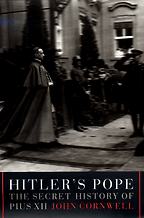
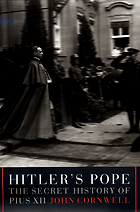
Your last book: John Cornwell’s Hitler’s Pope: The Secret History of Pius XII.
The history that I have researched and written is the dark and murky side, the underbelly of history. I was really writing about hatred, about French fascism, and time and time again I would come up against the Catholic church – there was nothing much written about why it did what it did and how it got away with what it did.
This book gives a history of Pope Pius XII and explains two very important things: how he changed the Vatican into a centre of power and then came to a concordat with Hitler which took away from the Catholic bishops the possibility of fighting Hitler, should any of them have wanted to. He explains the absolute silence of the church when the Holocaust was happening.
If the Pope had spoken out against the Holocaust, would that have made a huge difference?
Yes, I think it would have. But the church was always identified with authoritarian states – it was hostile to democracy and to republican and humanitarian values. It’s very difficult to accept that. But we live at a time now when people are beginning to accept it…with all the child sex abuse scandals. I may sound like a rabid anti-Catholic. But I am not. I’m just telling you what I discovered through studying the history of the Second World War in occupied countries.
You see, in France, the church was the only big institution outside the Vichy state itself. Yet in France there was only one cardinal who spoke out about what was happening to the Jews. The others accepted it because they thought that socialism and democracy and freemasonry were evil – they were obsessed with freemasons, the bêtes noires of the Catholic church in the 19th and 20th centuries.
I realise it is not a popular route to take and it doesn’t mean that I think all Catholics are bad, but I think one day people will realise that the hierarchy of the Catholic church, in its authoritarian mode at times of crisis in European history, has been a force for evil.
Can you tell me a little bit about Bad Faith – I’m wondering if it was hard to write about such odious people?
It wasn’t. I found it absolutely fascinating. I didn’t find it hard because I felt I was in pursuit of justice. I enjoyed writing and researching my book. You know, some of these old fascists are remarkably peculiar. Sometimes it was hilarious – they’re so vile you have to laugh. It’s a sort of tragi-comedy about evil.
I think the history of Europe in the 20th century possibly marked the end of the dominance of Europe. Studying the Second World War is to study a most exceptional civilisation at a time of great change.
Five Books aims to keep its book recommendations and interviews up to date. If you are the interviewee and would like to update your choice of books (or even just what you say about them) please email us at [email protected]
Five Books interviews are expensive to produce. If you've enjoyed this interview, please support us by donating a small amount.