In the last decade you’ve moved from being a British foreign service officer to a member of Occupy Wall Street’s general assembly. What are the causes of this metamorphosis?
It’s a long story that’s told in my book but it started with what I saw in my own [foreign service] work on Iraq – that government was capable of misleading its own population to an extraordinary extent. I found that a profoundly disillusioning experience. It was a shock. There was another emotional component to it: One of my colleagues whom I worked very closely with on the issue of Iraq and WMD [weapons of mass destruction], a British weapons scientist [David Kelly], was driven to commit suicide after he was named as a journalist’s source for the fact that the Number 10 dossier on WMD had been exaggerated.
Up until then I was more or less happy being a British diplomat. But that triggered a process of exploration about what was wrong with government – not so much why people lie but why people take bad decisions. Without getting too complicated, my exploration of theories of knowledge led me to the belief that government basically cannot understand the complexity of the world. A much more devolved system of power is therefore necessary to cope with a complex world.
Newspaper front pages offer plenty of evidence that traditional methods of governance are fraying. What’s your evidence?
There are two very contemporary examples. Everybody but a few mad people recognises that climate change is a great threat to humanity’s future, but the governmental process to address it has totally failed. They’re meeting right now in Durban and nobody expects that meeting to come up with an agreement on eliminating carbon emissions. So it’s quite clear that government is in this case not capable of producing a solution.
The same problem is very clear in what’s going on financially with the tremendous economic volatility we’re experiencing. National governments and international bodies that were supposed to arbitrate these problems are not proving effective. The G20 met to discuss the eurozone crisis. It did not produce a meaningful decision to deal with it. It’s becoming clear to people that we’re confronting very new problems that are a function of globalisation, and that the old methods of dealing with them – looking to national governments and international bodies like the UN or the G20 – are inadequate. It’s a dramatic and scary thing but it leads to some very clear conclusions.
It led you to advocate for a “leaderless revolution”, which is the title of your own book, please tell me about it.
The book is about my own journey to the conclusion that self-organised systems are best for the 21st century, but it’s also a call to arms and a suggestion of principles that people might follow. It proposes a method of politics rather than any particular ends. That method is: Do stuff for yourself rather than asking a government or others to do it; address political concerns directly to those in power; use nonviolent methods and always act as if the means are the end; and embody the political principles you’re trying to promote. The book proposes guidelines but it also gives examples of how this might happen in practice. So I hope that it might be seen both as an analysis of what’s going on in the 21st century and a handbook for how to go about addressing it the most effectively.
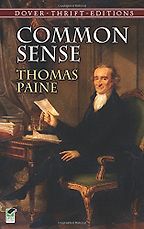
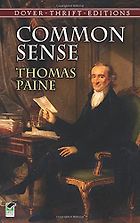
You’ve cited five books that lay the foundation for just such a leaderless revolution. Let’s begin with America’s most revered revolutionary tract, Common Sense by Thomas Paine. Why should we still read this pamphlet from 1776?
It’s an extraordinary and brave book, written by a man who was born in England and adopted America as his homeland, so I relate to him in that way. It’s just an incredibly clear account of what was wrong with British colonialism and why Americans should throw it off. It’s a brilliant political argument and a model of inspiring political writing – eloquent but also concise. It’s about freedom. It’s about how to throw off the shackles of repression.
How does this relate to leaderless revolution?
Paine saw a particular circumstance at that time and he felt that people were not articulating clearly what the real problem was and what the solution was – that they were just dancing around the problem. To an extent that’s how I feel. We’re talking about manifestations of the problem without getting to the fundamentals. He cuts to the chase and that was an inspiration.
But Paine argues strongly for a democratically elected government, right?
To an extent he does. He talks about the design of Congress and it’s an ideal system that he describes. But I think Thomas Paine would be pretty horrified by what he might see today that passes for democratic government.
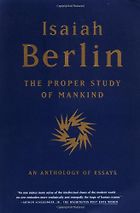
Let’s move onto Oxford philosopher Isaiah Berlin’s The Proper Study of Mankind.
I started reading him in my twenties when I lived in Germany, in a very boring little town called Bonn. The British embassy used to be there when it was Germany’s capital, and so you could devote a lot of time to reading things like Isaiah Berlin. His writing is just extraordinary.
He didn’t really write books, he wrote essays. There are two particular essays – “The Hedgehog and the Fox” and “Two Concepts of Liberty” – which were really formative in developing my political thought. “The Hedgehog and the Fox” in particular was very interesting to me because of its analysis of political thought in Tolstoy. I ultimately came to a conclusion (this will sound very arrogant indeed) that Berlin missed the big picture of Tolstoy’s writing, which is that Tolstoy believed, and this is evident in War and Peace, that it’s not great men or governments who make history but the actions of ordinary people. One begins to understand that Tolstoy was in fact an anarchist, that this is what Tolstoy believed in. He believed in the theory of ordinary people making history. “The Fox and the Hedgehog” is not about that, it’s about other, more mystical aspects of Tolstoy’s thought, but it is nonetheless a sublimely good piece of writing, as is “Two Concepts of Liberty”.
While it seems inarguably true that traditional democratic governance is often corrupt and always imperfect, do you advocate leaderless governance? If so, why do you think anarchy is a better system?
I think people need to act on their own convictions to address their political concerns, and by definition that is a leaderless activity. If they look to leaders to define the agenda then it’s not going to happen. People need to look to themselves, and the great beauty of that is people releasing themselves from the framework of leadership and of leaders giving people permission to act. The actions of the many upon their convictions have far greater potential for real change than the actions of any small group or government.
All the great changes in human history – from the emancipation of women to civil rights – came about because of the actions of groups of people. In the 21st century we are tremendously more connected to other people globally than we were before. The potential for triggering sweeping political change from the actions of just a few people is extraordinary, which is one reason why I think the Occupy movement is very, very interesting.
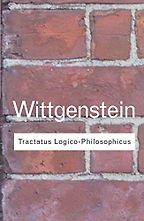
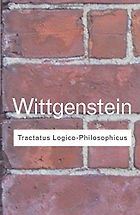
Next let’s tackle Wittgenstein’s first work and the only one published in his lifetime, Tractatus Logico-Philosophicus. The book is concise and epigrammatic: 75 pages of spare propositions. It is recognised as one of the most important philosophical works of all time.
It’s a really extraordinary book, and probably the only book on the list that is absolutely unique in its form and its nature. It’s a very short book, divided into a list of numbered positions. It is basically about Wittgenstein’s search for logic. He goes in search of a perfect language, where the symbols equate perfectly to the atomic facts – as he calls them – that those symbols are attempting to describe. Wittgenstein comes to the conclusion that logic itself cannot be expressed, it can only be shown, and from that he concludes that all the most important things in life are actually beyond expression. He ends with this very famous and extraordinary paradoxical quotation, “Whereof one cannot speak, thereof one must be silent.”
One of the extraordinary things that the book shows very convincingly is that any attempt to represent reality through symbols or language or numbers is always going to be highly inadequate. I think intuitively we know this to be true, in things like meaning, purpose, compassion and love. We can put words to these things but we know that they can’t actually be adequately described.
This book had an enormous impact on me when I read it in 2003, while I was on sabbatical from the diplomatic service. Wittgenstein proves that all representations of life are inadequate. However logical they may appear they cannot describe logic itself – they cannot describe what is most important. From that follows, for me in particular, that something like economics (I studied economics at university) is a woefully inadequate way of describing what is important in life. How human life functions on the planet is not something you can describe through graphs and equations. So Wittgenstein shoots a hole under the waterline of the theoretical construction of what society is about, and that to me was a revelation.
“Whereof one cannot speak, thereof one must be silent” certainly seems like a wise admonition to me. Can you connect the dots on how this relates to the faults of representative government?
The Leaderless Revolution is not just about the inadequacies of representative government. The influence of Tractatus is that it leads to a fundamental intellectual shift for me. Representative government and the market economy are the two pillars of how Western society is organised. Democracy is heavily influenced, I would argue to a corrupt level, by money and by business. If you conclude that the capitalist enterprise is not about what matters most, you start to question the whole edifice.
That’s what happened to me. I began to question the whole edifice of economic thought that justified an economic system such as we have, that is predicated on a very limited understanding of human objectives and desires – that basically all we are is profit-maximising animals and that the things that matter most to us can be measured, when in fact they cannot. If you accept Wittgenstein’s argument, one of the fundamental premises of market economics basically falls apart, and instead what you should work for is a society that promotes these inexpressible values. Values like purpose, meaning, love and compassion are more important than what is measurable.
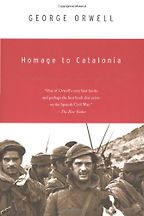
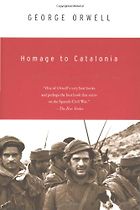
Let’s turn to George Orwell’s account of what he saw while volunteering for various factions against fascism in the Spanish Civil War. Tell us the story of Homage to Catalonia.
This is just a wonderful book. Like all of Orwell’s work it’s incredibly well written. It’s a very powerful piece of prose. Usually this book is seen as a picturesque account of an ultimately failed attempt to fight fascism, but what made a big impression on me was the fact that people like Orwell and 30,000 other foreign volunteers went to fight fascism in Spain at all. It’s in such contrast to the way we think politics works now. In those days people realised that to fight fascism you had to go risk your own life. Thousands of foreign volunteers didn’t return from Spain. These days, we’re led to believe that signing our name on an internet petition is really going to end genocide in Darfur. That was the contrast that really hit home to me in that book.
The other thing that’s interesting about it – and the reason why it’s one of the books that led to The Leaderless Revolution – is that in Republican Spain, before Franco’s victory, anarchist society came into being. There were organisations of peasants and workers, intercollectives and self-managing groups. And it worked. So it’s actually one of the few examples of anarchism in practice. Orwell writes about it beautifully and clearly he found it very compelling. He later admitted that where in the book he joined a communist group in Spain called POUM, if he had his choice again he would have joined the anarchists – which is a very little noted fact about Orwell.
He gives great narrative detail about his journey through this war, from seeing those anarchist symbols and early organisation to his injury when he is shot through the neck.
It’s wonderful to read, and a great book in its own right of a man going to fight in a foreign war.
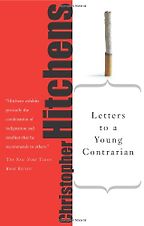
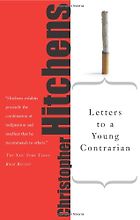
Your last choice sounds like a lot of fun. Based loosely on Rilke’s Letters to a Young Poet, this is Christopher Hitchens’s intellectual self-help book, Letters to a Young Contrarian.
This is a wonderful book and it deserves to be a classic. Christopher Hitchens has long been a hero of mine and this book is one of the reasons. It’s more than a book about how to be a contrarian; it’s a book about how to think politically. His style is gorgeous, with all his literary references. The book itself is written in an incredibly rich and enjoyable way, and it’s funny too. It’s about the transformative power of argument, and how how one thinks is almost more important than what one thinks.
How do you mean?
There was a particular bit that struck me where he talks about the account of the Oracle of Delphi. His ultimate statement was “nothing too much”, and in modern times it’s lazily interpreted as “all things in moderation”. But Hitchens argues that if the balances are tipped, moderation in those circumstances is wrong. That is an extraordinarily important lesson for our times when the normal is unacceptable. It’s no good to be moderate.
The other reason I love him is because of who he hates. He writes scathing critiques of everyone from Lady Diana to Henry Kissinger to the Dalai Lama. He’s a sublime puncturer of these ghastly mediocrities who have become celebrities in our culture, and for that I salute him.
You both participate in the general assembly of the Occupy Wall Street movement and have – I won’t say led but “established” – a subgroup on alternative banking. Tell us about it please.
I’m not one of the occupiers, as they sometimes call the folks who actually live[d] in Zuccotti Park. One of the interesting phenomena of OWS which is not reported on a lot, because it doesn’t really happen down in the square, is these working groups that have been established. There’s about 60 or 70 of them now, which are trying to tackle particular issues from recycling to alternative banking. The alternative banking group has attracted an incredible array of people who you would not normally expect to see as part of a protest movement – a former SEC regulator, a professor of financial law and several bankers, all of whom are thinking about and discussing how to create a better financial system. I was pretty amazed, at the first meeting, at who showed up.
What’s your programme? You have a several-point programme that you put out.
That was early on and I think it was wrong of me to do, because one of the things that’s become clear about OWS is it’s not about manifestos. Its own manifesto is so broad that you could sit a hundred manifestos within it. It’s such a diverse movement that I don’t think anybody can claim to articulate what the movement as a whole wants. But in groups like the alternative banking group we are trying to substantiate a vision, a change through practical design. We are getting down to the details of what a bank or banking system would look like that is democratic but universally accessible – including, above all, to the poor. One that did not engage in the behaviours that the banks have indulged in recently which put the entire global economy at such risk. We’re not talking about setting up a little credit union, we’re talking about setting up something that is national or even global. That is much better than the current set of profit-seeking banks that we have, who not only have exposed all of us to extraordinary risk but also, frankly, provided a very poor service.
How is the leaderless revolution going, in your view?
It’s had an extraordinary impact. I passed a store today that, obnoxiously but nonetheless interestingly, was advertising its goods as “crockery for the 99%” – it used mock demonstration placards in its display, altered to advertise their crockery. When you see that happening, or you see the chef Mario Batali comparing bankers to Stalin, you know that you’re having a cultural effect. People are beginning to feel the vibration of what the Occupy movement is about.
But in terms of its future direction and what OWS achieves as a movement, that is very much open to question at the moment. In the discussions I’m seeing down at Zuccotti Park, OWS is finding it very difficult to achieve the level of organisation that will enable it to gain momentum. That’s a problem, and it’s why the groups that are working on practical things like an alternative banking system are very important. I do think a political movement of this kind will be very limited if it is only about protest.
I hear people from the protest saying that this generation knows that voting is worthless. Is that your view?
I certainly think that voting is insufficient. But I don’t think it’s worthless. Government still has extraordinary power and it matters who runs government. It matters a lot. But my preferred model of change is not lobbying government to do things differently, or voting for different politicians. I think the existing system has been thoroughly corrupted and that therefore we have to build an alternative system.
I don’t mean declaring an Independent Republic of Zuccotti Park. I mean building companies that are cooperatively owned and share wealth amongst partners, rather than having privately owned companies where CEOs are paid 300 times more than the minimum wage employees. It is not absurdly idealistic to imagine such companies. Indeed they already exist, and are very successful in Britain and Spain for instance. A bank of the kind I’ve talked about is a plausible possibility. I’ve talked to incredibly serious financial experts who really know this field and say this is doable. The method of decision-making down at Zuccotti Park – of what is called the deliberative democracy, where everybody is allowed to speak and where decisions are taken after talking collectively – is a much better model of how to govern ourselves than representative legislatures that are often corrupted and sclerotic.
Systems of mass participation in self-government do work elsewhere. In Porto Alegre, Brazil, 50,000 people participate in the budgeting process. Studies show services are shared more equally where there is more equality and less government corruption. These seem to be desirable objectives, and the methods of achieving them are not pie in the sky. They’re not the declaration of some kind of utopia. They are very practical and achievable things, but they do require people to actually set them up.
Five Books aims to keep its book recommendations and interviews up to date. If you are the interviewee and would like to update your choice of books (or even just what you say about them) please email us at editor@fivebooks.com
Five Books interviews are expensive to produce. If you've enjoyed this interview, please support us by donating a small amount.