Before we start with your five books I want to know why you are so interested in narrative non-fiction as a genre?
When I was young I thought I would be a novelist but I quickly discovered I found real life more compelling. I became a journalist because of this, and eventually moved toward longer works so I could make sense of life in ways that daily deadlines do not always allow. Both my books have taken over five years to research and write, and each has allowed me to really dig into subjects that are nuanced and extraordinarily important – though they may not be the stuff of headlines. This work allows the kind of sustained intellectual commitment you don’t always get as a journalist. And it has taught me some wonderful new skills – like how to research and bring to life a time 400 years ago. So moving to narrative non-fiction has been a very natural progression for me, and probably one I always wanted. In my opinion, some of the very best writing today is coming out of this genre. It’s a terribly exciting time though perhaps not yet well enough appreciated.
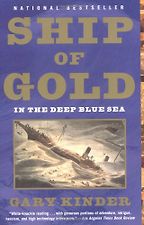
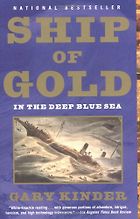
Tell me about your first book, Ship of Gold in the Deep Blue Sea by Gary Kinder.
This is an incredible saga about the sinking – in deep water – of a ship filled with gold at the end of the California gold rush, a sea tale that is then twined with the contemporary story of a young engineer’s efforts to recover the sunken treasure by developing the world’s first robotic submersible, capable of working with precision at great ocean depths – obviously a technical achievement we are all thinking about now with the oil spill on America’s gulf coast. The book opens in 1857 with a nail-biting reconstruction of the ship’s last days and the hurricane that took the ship down. Here, Kinder traces the fates of several families on board the SS Central America. The opening establishes a wrenching human tragedy. From there Kinder jumps to the 1960s and a land-locked farming community in Ohio where the engineer, Tommy Thompson, grew up. Thompson would spend decades obsessed with the ship as he sought to locate its wreck and recover her lost cargo. The Central America was carrying almost 600 people when she went down and a staggering amount of gold. It foundered near North Carolina’s Outer Banks. Kinder does a remarkable job here of translating really arcane engineering, scientific, nautical, financial and other material into crisp and arresting prose. He educates and entertains – two keys that are essential to this sort of work. He’s so good at it that he can write everything from a heart-stopping three-word sentence to a 200-word monster that, incredibly, still works. The book’s longest sentence describes the ship’s final moments. It is so loud and twisting and wild that it grabs the reader and takes her down with the ship – gasping for breath.
When I teach this book I always make my students stop there, and read the passage aloud in its entirety. Then I point out that the ship’s final plunge happens in this single, extraordinary 202-word sentence. It drives them crazy! And they immediately see how the language mirrors the dizzying, suffocating, final trip to the bottom.
I suppose I have this book in mind right now in part because of the oil spill off the Louisiana coast. For anyone who wants to grasp the challenges of working at this depth, I can’t think of a better book. Kinder captures the cold, the incredible pressure, the salt, the darkness and other challenges subs of this sort must handle. He does so not in tortured technical language but by walking us through Thompson’s journey as he takes on this enormous challenge. The young engineer’s only real competitors are the US Navy, which poured millions into research and development, and the ever-looming threat of bankruptcy. I won’t give away the ending, but what a thrilling story this is about the power – and the quirkiness – of the individual human spirit in the face of almost unimaginable odds.
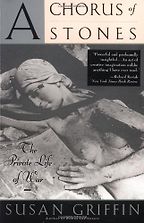
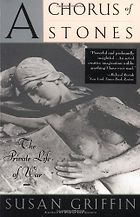
Let’s move on to your next book, A Chorus of Stones: The Private Life of War by Susan Griffin.
This book is much more philosophical, meditative, personal. Gary Kinder never really injects himself into the narrative in Ship of Gold and, frankly, I appreciate that. For too many authors it is just the easy way out. But Susan Griffin succeeds here and writes with purpose, humility and conviction, making exceptionally sophisticated links between subjects as diverse as the psychology of war, legacies of abuse, the history of a German education, the development of the atom bomb, the Gulf War, and the rise of military cultures. It makes war intimate. In some ways, it makes war understandable on an almost cellular level. Having covered various wars and spent much time considering the legacies of abuse and abusive structures, I found it absolutely revelatory. To my mind, it is one of the best books I have read in terms of moving between disparate subjects, times and places. In addition, her prose in this work is seamless, and often deeply poetic.
This is a very disturbing book. But, by its close, Griffin pulls the material together in a way that profoundly shifts the reader’s perspective. I’m not sure it ever sold very well but I think her twining of different subjects makes this a masterpiece.
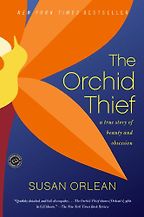
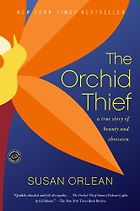
I love the look of your next book which is all about various people through the ages and their obsessions with orchids. This is The Orchid Thief by Susan Orlean.
Yes, this is such a fun book, all about obsession, history and botany. To a limited extent it also engages with the author’s internal experience as she acknowledges the envy she feels for people graced with this level of attachment to the world. To do this, she looks back in history – tracing the earliest orchid hunters to their roots, if you will – and then drifts among contemporary collectors who are certainly an odd and often fanatical bunch. In terms of content, this book falls almost perfectly between the first and second. It has a ton of factual material and is hugely instructive, like Ship of Gold, but also manages to focus deeply on less tangible aspects of human experience, as Griffin does.
Orlean’s writing is fresh and very lively. Interestingly, the book became a superb movie too, Adaptation. These are fun to teach together and anyone who enjoys the book will probably love how the film plays with what is on the page and takes up how hard it is to translate this kind of material from one genre to another that plays by different rules. It is rare that you have a great book that also ends up as a terrific film.
The Orchid Thief begins with this crazy character, John Laroche, who has devised an ingenious but totally immoral plan to go into the Fakahatchee swamp, a state preserve in Florida, to collect rare and endangered plants. His plan is to use men from a local tribe essentially as front men to collect rare species that Laroche can then reproduce and sell. While Laroche is prohibited by law from collecting, the Indians are not, since the law gives them special rights because the swamp and its contents are considered part of their unique heritage. This is really just a scam for Laroche to make money, but he rationalises it every which way and his character is the glue that holds the narrative together. While Orlean uses him to tell the tale, she also takes licence to travel widely through history and botany so we can peer into what drove Laroche in this enterprise and others. Somehow it all works. Susan Orlean came upon this topic when she read a brief newspaper account about Laroche being arrested in the swamp. She went to his trial in Florida and that trial led her into this longer project. The Orchid Thief grew out of a shorter piece that originally appeared in The New Yorker.
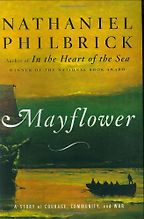
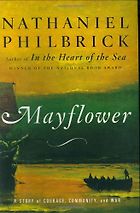
Your next choice is Mayflower by Nathaniel Philbrick.
This is a straight history but – and this is key – the emphasis is on the story. In this book Nathaniel Philbrick takes an event every American schoolchild knows about – the sailing of the Mayflower to North America in 1620 – and turns the comfortable mythology about that moment on its head. Mayflower completely disrupts the story of happy Indians meeting pacifist settlers to tell a very different and essentially tragic tale of politics, power dynamics, generosity, betrayal and war. Like my own book, Ten Hills Farm: The Forgotten History of Slavery in the North, Philbrick here is dismantling soppy, misty-eyed notions about North America’s founding as simply a test of endurance and religious purity to look instead at a set of dynamics that were harder, more complicated and more real. Much of this book involves King Philip’s War, a brutal conflict that in 1676 sped up and down the Eastern seaboard claiming thousands of lives on both sides. Though historians have long known about the events that Philbrick describes, he tells the story in arresting prose that dispenses with the notion of grateful Indians and brave Pilgrims, to provide a rather grittier and more realistic look backward at those earliest days.
What kind of reaction did it get?
We are a young country and we tend to hold tight to some fairly simplistic and naïve readings of our history. Scholars know better. But they don’t always get the word out past those ivy walls. To me it seems critical to have this material penetrate the public consciousness. Books in this vein are valuable because they reach past the classroom, past the doctoral students, and past the library walls to touch the general public. I’m sure there are those who were scandalised by each of these works. But, in my experience, readers hunger for truth and a great story. Combine the two and… there you go. Mayflower and Ten Hills Farm both aim to seduce readers into basically rethinking what they think they already know. That’s tricky. But Mayflower was a bestseller and it still keeps jumping off the shelves, and I have had really fantastic reactions to Ten Hills Farm from all kinds of people. The reason is that these books carry a kind of wonderful Ah Ha! energy. And that’s fun. The whole point is to excite and inform people about the world they inhabit. I think books that explode standing myths like these have a potentially huge audience. I’m biased, of course, but I never will understand why historians don’t write more accessibly – all the time. Which gets me back to the fact that the word ‘story’ is embedded there – and should be. Until that happens the historians are just leaving the field open for the rest of us.
What myths were exploded in your book?
Well, my book tells the story of 150 years of slavery on a 600-acre farm in Massachusetts first owned by John Winthrop, the first governor of the colony. Winthrop arrived in America in 1631 and took the land shortly after. Within a decade, settlers in the Massachusetts Bay Colony had enslaved African and Native American workers. At Ten Hills Farm, generations of slaves worked the soil and tended to the needs of whites. This is a story that ultimately reflects upon the lives and fates of tens of thousands of blacks and Indians, yet most Americans have no clue that slavery ever existed in the North. By understanding this story as a human one that stretched across families and generations moving from England to North America, the Caribbean and Africa, readers gain a whole new understanding about attitudes on race and also on the somewhat false divide between North and South. This was a shared history. We just erased the Northern half. That’s convenient. But pathologising the South and keeping this history out of the history books certainly does not help us move forward. I think the recovery of this knowledge holds the potential to regenerate conversations about race in this country. Seeing the whole picture is a powerful shift of perspective. Some of the greatest families in the North were very much part of this trade in human beings and helped found major and enduring institutions like Harvard Law School, which, in fact, was created by a gift from one of Ten Hills Farm’s slave-holding and slave-trading owners, Isaac Royall Jr.
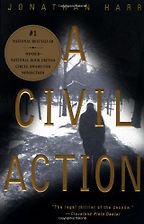
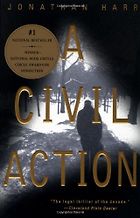
Tell me about your last book, A Civil Action by Jonathan Harr.
This book incorporates less history. Instead, it is just a whiz-bang narrative about a lawyer who takes up the cause of a small New England town that is host to a mysterious rash of cancer deaths. The narrative revolves around Jan Schlichtmann, a Boston lawyer who uncovers an environmental crisis and traces culpability up the chain to several multinational corporations responsible for the mess. As the reader follows Schlichtmann in his crusade, Harr uses the case and Schlichtmann’s obsession with it, to educate us about chemistry, cancer clusters, illegal dumping, environmental degradation and the law. Here again, a seductive narrative yanks the reader in, then great research and reporting leave the reader wholly changed. No one reading this book could ever think about ground pollutants and illegal dumping the same way again. That’s the beauty of it: Who would ever go to a bookstore and say to the clerk: ‘Gee, today I’d really like to sink into a 500-page book on cancer clusters, dead children and irresponsible industry executives.’ In the hands of a writer like Jonathan Harr, however, the education is a treat.
Five Books aims to keep its book recommendations and interviews up to date. If you are the interviewee and would like to update your choice of books (or even just what you say about them) please email us at [email protected]
Five Books interviews are expensive to produce. If you've enjoyed this interview, please support us by donating a small amount.