World » Americas » United States
The best books on Americans Abroad
recommended by Charles Glass
The much-travelled writer and broadcaster Charles Glass tells us about misunderstandings and misadventures of Americans in foreign lands.


The much-travelled writer and broadcaster Charles Glass tells us about misunderstandings and misadventures of Americans in foreign lands.
Your first choice is Innocents Abroad. Tell me about this book.
In 1867, Mark Twain accompanied a group of American Christian pilgrims to the Holy Land. As part of this excursion, they also enter Russia and various places in and around continental Europe. In this book, he sends them up marvellously – their pretensions, their messianic belief that they were better than anyone else in the world and their inability to understand what was going on around them. It’s a wonderfully wry look at a certain type of American who is striding the world, probably at just about the stage where America was about to take over the world.
Would you say American travellers are still like that?
Well, since then far more Americans have been abroad and America has fought two world wars. When Americans leave home now, they don’t really leave home any more. They come to places that have been taken over by the American world economy and they will see the same things abroad that they will see at home: McDonald’s, Starbucks, chain clothing stores etc. All of these things will be very familiar to them, whereas in 1867 they were coming to strange lands without outlets to American culture.
It’s really a compilation of articles Mark Twain wrote whilst abroad. He doesn’t seem that impressed in many of them by what he’s seeing around him.
Mark Twain wasn’t very impressed by anything, actually. He was a very funny character. In Baalbek he noted that every jackass from Missouri to New York had carved their initials into the temple of Jupiter. He was taken to the court of the Czar where he was singularly unimpressed by the figure of the Czar, and Lake Galilee, which he compared to Lake Tahoe, comes out as nothing much more than a mud puddle. And the kings of Israel, he realises, were just a bunch of local village headmen.
So was there ‘no place like home’?
Luckily he didn’t trivialise quite to that degree about anything. He didn’t tend to moralise; in fact, he didn’t like moralising.
Daisy Miller was published nine years later, about Americans settling in Europe rather than travelling through it. It follows Daisy Miller who goes to Switzerland and Italy where she is courted by the socially superior Winterbourne. What kind of American is Daisy Miller?
This is a very Jamesian view of the innocent American abroad corrupted by the old world and [SPOILER ALERT] in Daisy Miller’s case, killed by the old world. She represents this ideal of an American ignorant of the lurking dangers in that old world, typified by the miasmas of the Colosseum which finally kills her, but also the love that this man has for her which is powerless to save her.
It is another self-image that the Americans tend to have; that they are always pure and simple and when they go to places subsequently, like Vietnam, it is Vietnam that corrupts them, not the other way round. It’s completely wrong but that is a lingering self-image.
Isn’t she also a victim of the other Americans abroad and their own set of social aspirations?
Daisy was pure and not a gossip like them. In fact, she’s almost not a human. She’s a theory, a Jamesian idea of a virginal creature that can only suffer, who could only be corrupted. She is warned not to go the Colosseum at night with the mosquitoes, but she does it anyway and she dies. But it isn’t the Colosseum or the mosquitoes that kill her. It represents the idea that it’s not a place for someone as good as you. You don’t have the immunities that others have.
Tell me more about the social climbing.
She has aspirations to rise in an old world context, which can only be self-defeating in a Henry James novel. He was quite a social climber himself. He decided he didn’t really like being American any more, and actually became British.
He, like TS Eliot, became very anglicised and felt more at home in Britain than in America. There was a larger literary culture, literacy levels was higher and there were more writers. The writers were usually localised in London, while they were spread out in America and there wasn’t such a like-minded community.
Some people still care a lot about social mobility. There’s been a long tradition of American heiresses marrying impoverished titles so that the Americans get a bit of respectability and the Europeans get some money. This still goes on.
So Henry James’s pursuits were more intellectual than social?
He, like his brother William, was a very intellectually engaged man and a very sharp and perceptive observer of people’s customs and behaviour.
Do they get it wrong?
Daisy got it wrong to the extent that it was fatal to her and crushed her spirit. They do get it wrong but lots of people get it wrong. There are social oafs not just in America but also in lots of countries.
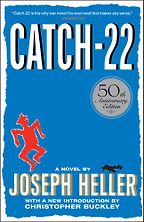
Tell me about Catch 22.
It’s one of the funniest books ever written. It’s about the insanity of military life and the absurdity of a big institution. Heller was very good on the absurdity of big institutions. Catch 22 has every character in it that the American military did have at the time and still has today in Iraq and Afghanistan: The money-makers, the crooks, the officers who were trying to claw their way to the top where they get their men killed, the placing in order of priority the pretence of military success at the cost of many civilian lives.
There’s a section in Catch 22 about the bombing of Ferrara. Its military significance is immaterial; it was a military objective so defined by a machine that did not brook insubordination or men dropping their bombs in the water, which they did because they didn’t want to kill lots of innocent Italians. Things like that did happen in the war. I’m writing a book now about the military in Italy and France in World War II and most of what Heller wrote is actually true.
There is the suggestion that the bureaucrats behind the war machine are to blame, or is the enemy actually within?
Both. The insane military bureaucracy, the machine that cannot be stopped by human will, the black markets, the Milo Minderbinders. There were lots of characters like Milo Minderbinder selling their own supplies, like food, cigarettes, clothing, blankets, and gas on the black market — supplies that should have been sent to the front. These characters still exist and there were lots of them in the US military during the war and some of them made millions. There were shortages of gas and artillery shells at the front as they’d been stolen.
Catch 22 is very funny and you know it’s satire, but when you study the history you know that Heller knew exactly what he was talking about, partly because he himself had fought as a solider.
What is ‘Catch 22’?
Catch 22 is about insanity. If you want out of flying combat missions as an American flyer in the US air force on a basis of insanity it means you must be sane because you don’t want to get killed. That’s the catch.
What’s the catch for Americans in combat missions now?
The Catch 22 no longer applies as that system doesn’t apply. If you flew a certain number of missions, you wouldn’t have to fly any more. Now they really don’t fly the number of missions they flew then. And now, when they do fly missions, it’s not really so difficult as they’re not opposed by anyone. You can fly jets all over Iraq and Afghanistan and bomb whatever target you want to bomb, but you’re really not taking much of a risk. There are no fighter planes to oppose you and very little anti-aircraft fire, so it’s not comparable on that level.
And on the level of metaphor?
The risk to one’s own psyche as a soldier, what you have to do to the civilian population of these places, the contempt in which you must hold them, the sheer larceny that takes place in Iraq and Afghanistan by the private contractors, Halliburton being the classic example, is all out of Milo Minderbinder in Catch 22. That hasn’t changed. If anything, it’s much much worse — except now it’s semi-legalised.
What’s made it legal?
Instead of Milo Minderbinder having to set up a company as a soldier, now he would be a private businessman lobbying Congress for contracts, lobbying the Bush or Obama White House for contracts without tenders or any bidding. Now you just walk away with a lot of cash and provide very little in the way of services.
Is the enemy within?
There’s insanity within, criminality within, but the enemy to the American people and the enemy to the people of the countries America occupies is really the American military-industrial complex that Eisenhower warned about.
Does insanity help combat?
I’m speaking of institutional insanity. The project is crazy. Occupying Afghanistan and Iraq is crazy. Many soldiers suffer severe psychological traumas that many will never recover from, which we saw in Vietnam as well. There are still casualties of that war walking around who are not mentally well. They’ve never recovered
Is the rational mind equipped to deal with these situations?
One could say that theoretically but many people do cope and come back and lead normal lives. That’s the reality.
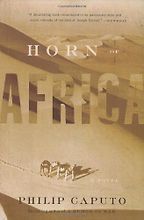
Horn of Africa by Philip Caputo next. What situation is the American abroad in now?
He’s involved in an intelligence operation going wrong in the Horn of Africa. It’s based on a trip the author made to Eritrea in 1975, but this time the characters are journalists who become mercenaries.
The hero, or anti-hero, is a character called Nordstrand who is a descendant of pioneers who committed a massacre of Indians in America. He embodies this American pioneer spirit and takes it out to the current frontier, a frontier that could have equally been Vietnam, where the author himself fought and was court-martialed.
Support Five Books
Five Books interviews are expensive to produce. If you're enjoying this interview, please support us by donating a small amount.
When Nordstrand arrives he is carrying violence within him and his way of engaging with the native population, just as his ancestors engaged with the native population of America, is to kill them. It’s the heart of darkness, it’s the evil of going to another place when you’re 1,000 times more powerful, where you can do harm and you do do harm.
What about the other character, the journalist Charlie Gage? He is someone who has come from a trauma in Beirut yet seems to remove himself from combat zones. Is this a bug that you yourself caught?
Well, Phil used the name Charlie Gage because it’s meant to be my name, Charlie Glass. On that trip in 1975 there were five journalists: Myself, Philip Caputo for the Herald Tribune, Carl Smith of the Observer, Don McCullin who was taking pictures for the Sunday Times, and a Swedish journalist called Stefan Heimerson for Aftonbladet, a Stockholm-based paper.
Apart from the name, there really isn’t that much similarity between Charlie Gage and me. My secretary wasn’t killed in Beirut, for example. It’s really about Phil. Phil was very badly shot at in Beirut, his office was trashed, he had a really horrible time during the civil war in Lebanon, so it’s much more him.
There is this difficulty that men — soldiers and some journalists — have in adjusting to what is called ‘normal life’, a mortgage and a normal house, after the excitement and the exhilaration and the fear, even if it’s from a life that they didn’t like. But it’s a life of such extremes that feeling outside those extremes is very very difficult. If you’re used to be being burnt at 120 degrees, at 70 degrees you don’t feel anything. This character has that problem.
What about the other characters?
Nordstrand didn’t have that problem. He was pure violence. Then there is a third character, Colefax the CIA character. He is the guiding hand who knows more than they do about what they’re doing. He is willing to use and destroy them.
So it’s the psychopath and the bureaucrat again?
Well, I think they’re all psychopaths, including the ones in the background. You know you’re still killing, even if you’re doing it by remote control.
Is there a less crazy solution?
Yes. You could obey the UN charter and not invade other countries. It’s international law. Unless you’re attacked, you’re not allowed to go and invade other countries with aggression. But no one seems able to enforce the UN charter.
The Quiet American. This is your only book written by a non-American about an Englishman and an American in Vietnam as the French colonialists are leaving. Let’s talk about the American character, Pyle. He starts off as an idealist and ends up a murderer. Was America’s presence in Vietnam motivated by idealism?
In the case of Pyle, he was Ivy League, innocent, believed that America was a force for good and should go out and do good in the world. As the French were reluctantly leaving Vietnam, he felt that someone had to go and pick up the white man’s burden and that could only be America as only America was pure and good. He then takes part in an assassination and a devious plot to plant bombs on bicycles whilst blaming the Vietminh.
This was written before the American war in Vietnam. Graham Greene saw it coming. And it was the idealism of liberals in America that led to the invasion of Vietnam by the armed forces. They should have read the book first and realised what they were doing. I think many of them did know what they were doing but they thought it was worth it. They were clearly wrong, for America and certainly for Vietnam.
What about the love triangle in the book, involving the Englishman Fowler, Pyle and a local Vietnamese girl, Phuong?
It’s a very well-told story and it’s also the old empire and the new empire wooing the non-aligned, soon to be colonialist, world. The new empire seems at first to be more attractive than the old, but turns out to be every bit as vicious.
Does the English character realise his empire is coming to an end?
Very much so. The character’s only pleasure in life is no longer sex, it’s his opium pipe and going into oblivion, denying his existence and surviving on that. This is very much a view of England at that time: a country that had lost its empire and had to find a new mission. Now, unfortunately, it has found that mission in being the Gurkhas of the United States, but at that time it wasn’t clear where it was going.
He very well represents what England was going through as it withdrew, as it turned over to an empire, a new American one which was consciously taking over from the French and British empires. The French and British very much looked down on them and felt they wouldn’t do as good a job as they had done. But, in fact, they did pretty much exactly what they had done, as all of them were very destructive.
So what is the fundamental error of colonialism?
That’s another subject and not really literary but I suppose its fundamental flaw lies in telling other people what to do in their own countries.
August 16, 2012
Five Books aims to keep its book recommendations and interviews up to date. If you are the interviewee and would like to update your choice of books (or even just what you say about them) please email us at editor@fivebooks.com

Charles Glass
Charles Glass is an author, journalist and broadcaster specialising in the Middle East. He writes regularly for The Spectator, Newsweek and The Observer.
Charles Glass
Charles Glass is an author, journalist and broadcaster specialising in the Middle East. He writes regularly for The Spectator, Newsweek and The Observer.
© Five Books 2025