What is Broadway, besides a street that bisects Manhattan?
Strictly speaking, a Broadway show is one that opens in one of roughly 40 theatres. Most of the theatres are around Times Square – very few are actually on Broadway. If you’re opening in these theatres, you must sign a contract that designates your show as a Broadway production, which has its pluses and its minuses. The biggest minus is you must use exorbitant union rates for the stagehands, musicians and actors. It’s all codified. The biggest plus is that, as a Broadway show, you’re eligible for Tony Awards, while off-Broadway shows are not. Increasingly the media focuses on Broadway. Off-Broadway has been losing ground in the last few decades as Broadway swallows up all the attention that’s focused on theatre. Which isn’t much.
What is unique about America’s theatrical tradition?
The most important contribution that American theatre has made to world theatre is the musical. This form had its roots in other forms of musical theatre – operetta and reviews. But it was Showboat in 1927 that really launched the musical. It was the first integrated show. It wasn’t just a bunch of songs and gags thrown together, but a narrative-based work of sophisticated musical theatre. The combination of drama and music aimed at a popular audience has since proved to be successful internationally.
What makes it to Broadway?
Over the past 30 to 40 years, Broadway has become dominated by big musicals. There are several genres that are artistically bankrupt. You have the jukebox musical. After Mama Mia was a huge hit, Jersey Boys followed, and so did some miserable Beach Boys shows and an awful Johnny Cash musical. And another genre is musicals based on movies. Broadway is in the business of replicating what works. When it comes to plays, it pays to have a London imprimatur. We import a lot from London. More generally, something that succeeds spectacularly off-Broadway, or in regional theatres, can sometimes make a transfer to Broadway.
Today, sadly, the most important factor is that producers think if you don’t have a star, you don’t have a show. The fact is that audiences will go see a star in something terrible or mediocre, and ignore the prestige play that doesn’t have a known actor in it. I think the star factor is detrimental to the health of Broadway.
Let’s turn to the books, starting with the memoir of the American playwright Moss Hart.
What do we learn about bygone Broadway and the glamour of its glory years by reading Act One?
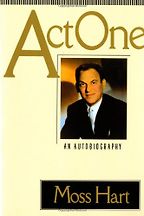
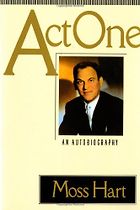
Act One may be the greatest show-business autobiography ever written. It’s certainly one of the greatest. The book is a compendium of backstage stories and anecdotes about all the fabulous people Moss Hart knew intimately – and he knew them all. Hart co-wrote some of the most successful comedies in Broadway history with George S Kaufmann. You Can’t Take It With You and The Man Who Came to Dinner are probably the most famous – you still see them being revived today. Hart also directed many successful shows including My Fair Lady, one of Broadway’s biggest musical hits.
But none of that is covered in Act One, and you don’t really care. The book is a funny, heartfelt description of Hart’s struggle to make it big on Broadway in the 1920s. He grew up poor in the Bronx. Even though Hart’s family couldn’t afford food, his aunt always found a way to go to the theatre. She’d come home and describe in detail everything that she saw on stage. She must have been a great storyteller, because Hart became obsessed with Broadway.
He writes that “the theatre is not so much a profession as a disease”, and offers a theory about who is particularly susceptible to infection.
Hart talks about Broadway as a refuge. Certainly that’s how he looked at it, as a magical place where the troubles of the world no longer matter. These days you may wonder what possesses people who are drawn to theatre, because it’s not the major American cultural force it once was. But there’s something about live performance, and the glamorous history that Hart writes about, which still attracts people to Broadway.
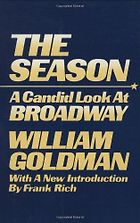
Let’s move onto The Season by William Goldman. Please tell us about this portrait of Broadway. What can we learn about how American commercial theatre works from reading it? Why is still relevant today?
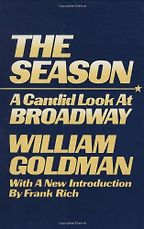
This book is an exhaustively researched assessment of a single Broadway season in 1967-68. He interviewed pretty much everyone involved with every show. The book is useful even today, because it analyses every production that opened that season and uses each to illustrate a different point about Broadway, the various forms of theatre, and the economics of putting on a show. He also shows how difficult it is to make money. Most Broadway shows never turn a profit, which makes it a very strange business but for the fact that a lot of people make money on shows that don’t return the investment of their producers.
Some of what Goldman has to say is dated. For instance, he puts forward the notion that William Inge, Tennessee Williams and Edward Albee – who were all gay – didn’t do a good job of writing about relationships between men and women, which is absurd. But aside from the anachronistic attitudes that crop up, the writing is frank, funny and entertaining. You get a sense of what was going on backstage. It’s really compelling.
The Season
covers a transitional moment in Broadway history. What was changing, and what has changed since then?
It was written at a time when the influence of Broadway on American culture had already begun to wane. In an early chapter he notes that the movie The Graduate, which opened during this period, out-grossed all of Broadway theatre during that season.
Through the 50s, the theatre maintained its importance in American culture. But by the late 60s, the culture was being upended. Producers and writers were desperately trying to figure out how to either find new audiences or keep the audience they had left. Some of the shows produced during that season – comedies about counterculture and the generation gap – reflect that desperation. Jean Arthur, an old-time film actress, appeared in one show called The Freaking Out of Stephanie Blake, about a spinster from the sticks who comes to New York to rescue her niece from hippies. Apparently, it was as shockingly bad as it sounds. I think it never even opened. But there were a few shows like it that season.
Plays were already in danger, they were already having shorter runs. The long runs of successful musicals was a phenomenon that was just starting with Fiddler on the Roof, Hello Dolly and Man of La Mancha. A decade or two before, a long-running musical like Oklahoma! only lasted for a few hundred performances. These days, musicals run for five, eight, 10 years.
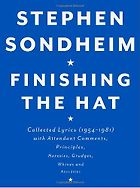
Let’s discuss a book by the master of modern musicals. Finishing the Hat is the first volume of the collected lyrics of Stephen Sondheim. Please tell us about the man and the book.
Stephen Sondheim’s appeal cuts across cultural hierarchies – he elevated the art form. He has never been immensely popular. A lot of his shows haven’t been very successful, financially. But he is the living master of American musical theatre.
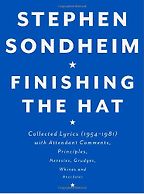
The meat of this book is described by its subtitle: Collected Lyrics (1954-1981) with Attendant Comments, Principles, Heresies, Grudges, Whines and Anecdotes. A lot of lyrics collections have been published over the years, but this book is particularly valuable because Sondheim put it together himself and it’s full of insights into his craft. This is one of those books which you can’t stop reading once you start, mainly because of the notes.
Sondheim gives the story of how various songs and shows were put together. Let me give you one example. The famous opening number of A Funny Thing Happened on the Way to the Forum was originally a song called “Invocation”. Then it was “Love is in the Air”. Both of them, he says, weren’t working, so the whole show wasn’t working. One of the things he learned from [Broadway lyricist] Oscar Hammerstein, who was his mentor, was that a show has to work from the start. The opening number is of primary importance. Another lesson that Hammerstein taught him was to tell the audience exactly what the show was about. So he wrote “Comedy Tonight”, which is remembered as one of the great opening numbers in musical theatre.
What does Sondheim teach about the ingredients of great musical theatre, and what can you add to that recipe?
It’s a very valuable book for people who want to work as lyricists or composers, because he goes into detail about the specifics of rhyme and how you set words to melodies. He writes frank assessments of his fellow lyricists, including Lorenz Hart, composer Richard Rodgers’s first great collaborator. He goes into detail about why he found Hart’s work unsatisfying. To Sondheim’s mind, Hart and Noël Coward were lesser lyricists than Gershwin, Hammerstein and Cole Porter. You can’t deny the truth of many of his criticisms, and even if you don’t agree with them all it’s edifying to read.
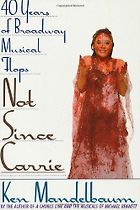
Next, let’s talk about Broadway’s biggest busts. Tell us about Not Since Carrie: Forty Years of Musical Flops by Ken Mandelbaum.
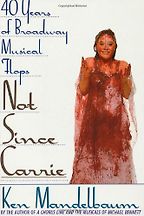
It’s such a juicy read. He divides the flops by theme, and defines flop very specifically. If you’re talking about shows that fail to make their money back, most shows are flops. But Ken draws the line at 250 performances, which may sound like a lot but in the post-war era very few musicals can make any money in that time.
There is a whole chapter devoted to Carrie, a [1988] musical based on the Stephen King horror story and the movie adapted from the book. It was famously terrible. It was considered the highpoint of musical disasters, and has retained its reputation as one of the greatest flops of all time – even though, strangely enough, it’s being revived off-Broadway this season. They’re trying to show us that it wasn’t too terrible after all. We shall soon see if there is a point to be made.
What do we learn from this autopsy of the American musical?
Most of the shows he writes about are unfamiliar, even to me. His descriptions of what went wrong, and why, are very entertaining. He has one chapter with rules about what you shouldn’t do. Rule number one is: Don’t musicalise works that can’t be musicalised. He talks about an adaptation of Shogun which seems destined for disaster. Another rule is: Don’t musicalise stories that don’t need music. In other words, if you’re not adding anything to a show by making it a musical, it’s probably not a good idea to do it. The funny thing is, these rules seem self-evident but a lot of people spend a lot of time and money on productions that flout them. If Broadway producers read this book, we probably wouldn’t have as many flops as we do today.
But we might not have The Book of Mormon.
I see The Book of Mormon as part of a new genre directly derived from the history of musical flops. The Book of Mormon, The Producers and Urinetown all mock their own form. They send up the conventions of Broadway very successfully.
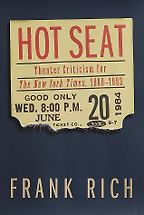
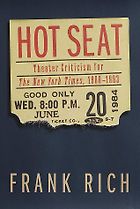
Finally, an anthology of Frank Rich’s reviews from 1980-1993, along with his thoughts on his time as the chief theatre critic for The New York Times.
I consult this book often, for work reasons, and find myself getting lost in it. It still has the immediacy of daily journalism. You get a real sense of Rich’s excitement at doing his job. It used to be common for theatre critics’ work to be anthologised, but since Rich stopped writing in 1993 the blogosphere and newspapers’ troubles devalued the voice of the critic. The Rich era was a fabled one at The New York Times. He earned the sobriquet “the Butcher of Broadway”, which shows that when you write as strongly as he did you can have a real impact.
Is the ability to kill the future of a theatrical production with a negative review a burden? Book critics can only kill one career at a time, movies seem immune to the opinions of critics, but theatregoers remain influenced by reviews. Critics like yourself sit in the same theatre and breathe the same air as the folks whose fate rests in their hands. Does the sway of your reviews weigh heavily on you?
In an essay at the end of this anthology, Rich notes that the power of The [New York] Times to make or break a show is a bit of a myth. Some of the shows he didn’t like, such as 42nd Street, ran for a long time. That’s the way it’s always been. But it is true that theatre and restaurant criticism are areas where critics may have more sway relative to movie critics these days. Movies can market themselves around critics. But because theatre takes a time commitment and costs a lot of money, people look to critics to help them choose among shows.
A critic is aware of their responsibility to be fair, but we can’t be swayed by the fact that if the show closes people will be out of work. If we let that influence us, every review would be a rave. You have to shut out that fact and even the reaction of the audience. Previews are packed with people friendly to the production. They might be laughing uproariously or jumping to their feet at the end, but you learn to tune that out too. You need to write as honestly as you can.
You once said that you see yourself as an “aesthetic referee”. Please explain.
A referee is impartial. You’re not in the game, you’re calling the shots as you see them. Personal taste is always an important factor in critical work, but if you’ve written for a while you establish a rapport with your readers. They know what your taste is, and they can gauge whether their taste lines up with yours. But part of the job is reporting. A critic wants to give a sense of what the show is about and what it’s trying to do. Then comes the question of whether or not it succeeds in its aims.
You recently wrote a column asking to be excused from reviewing the work of a particularly productive playwright, Adam Rapp.
There was a bit of brouhaha about that piece. A critic can’t pick and choose who he wants to review on a regular basis – that’s not how the job works. But in the case of this one writer, he writes so many plays. I thought that at this point reviewing more of his work would be like flogging a dead horse, or rather a horse that won’t die. I thought it was only fair to allow another critic at The Times to assess his work.
The Dramatist Guild applauded the fact that you acknowledged you don’t like his work.
I was surprised by a lot of the reaction. Some people applauded what they saw as bravery, others condemned me for bias. Well, it’s not a bias. I’ve seen a dozen of Adam Rapp’s plays. I’ve hardly liked any of them, and I can’t say that I’ve loved one of them. But that doesn’t mean my judgment of his work is unfair. The fact is, when I pan a play, the next time that writer’s work comes up I’m disposed to find things to like. Critics are human; if you prick us we will bleed. So every time that I saw an Adam Rapp play, over 10 years, I was hoping that I might like it, I tried to like it, but I just couldn’t fake it. So it’s time to give someone else a shot at appreciating his work.
Last question. With the emergence of so many other entertainment mediums, why is Broadway still important?
There is nothing like sitting in a theatre and witnessing a performance. There is something about the ephemeral nature of theatre that lends it its own magic. A great performance only lasts until the curtains close, and for that reason people always treasure it.
Broadway, strictly speaking, is less relevant than theatre in general. There aren’t a lot of artistic strides being made on Broadway – it’s off-Broadway where that is being done. Broadway is a huge commercial marketplace that caters largely to tourists. But Broadway nourishes the development of theatre more broadly. Work that makes it there can make it anywhere.
Five Books aims to keep its book recommendations and interviews up to date. If you are the interviewee and would like to update your choice of books (or even just what you say about them) please email us at [email protected]
Five Books interviews are expensive to produce. If you've enjoyed this interview, please support us by donating a small amount.