The best books on Learning from the Great Depression
recommended by Christina Romer
Economist Christina Romer, former chair of President Obama’s Council of Economic Advisers, says we’ve learned that terrible downturns can still occur, but also that the right policy response can make a huge difference to the outcome. She talks us through books and articles that help us better understand how to get out of an economic crisis.
The lessons of the Great Depression is our theme today. You are an expert on that topic. By all accounts, that’s one of the reasons why Barack Obama asked you to join his cabinet in the autumn of 2008. How well did economists understand the toll that the financial crisis of 2008 would take on the US economy as you prepared to chair the White House Council of Economic Advisers?
In the middle of the financial crisis, it was hard to estimate just how much damage had already been done to the economy and how widespread the impacts would be. But what economists certainly understood from history was that the crisis could be absolutely devastating if policymakers didn’t take steps to stop it and to mitigate the damage.
Right-wing websites are rife with references to “Obama’s Depression”. I know economists and partisan bloggers wield the word “depression” differently. When economists use the word, what precisely do they mean?
The word “depression” doesn’t really have a well-defined meaning, unlike the words “recession” and “expansion”. The National Bureau of Economic Research defines a recession, for example, as a time when economic activity is declining. Often what economists mean by depression is the same thing other people mean – a really bad and exceptionally prolonged recession. Importantly, as bad as the current recession has been, it has been far less severe and prolonged than the episode we all agree was a depression, the Great Depression of the 1930s. To give you one indicator, in 2009 the US unemployment rate peaked at 10%. In the early 1930s it hit 25%.
Let’s get to your books. The first three are about what caused the Great Depression, and the last two are about what ended it. Your first choice is A Monetary History of the United States by Milton Friedman and Anna Schwartz. Please give us a précis of the book and explain how it changed the debate about the causes of the Great Depression.
I frequently tell students: If you buy only one economics book, it should be A Monetary History. The book is obviously important for our understanding of the Great Depression, but its impact goes far beyond that. Friedman and Schwartz show us that monetary events and monetary policy have affected real output throughout American history.
That’s a fundamentally important finding. It tells us that a monetary development that affects aggregate demand has an impact on the things we care about, like employment, unemployment and how much we produce in the economy. The other thing that Friedman and Schwartz do is show us how to use historical evidence on policymakers’ motivation and thinking to help establish a causal relationship between money and output.
“The stresses on the US economy in 2008 were much larger than those in 1930. So why has this recession, as bad as it has been, not been a second Great Depression or even worse?”
When you asked me for my list of books, I debated about whether to put TheGeneralTheory by John Maynard Keynes on the list. The General Theory is an incredibly important book, but it’s basically a theoretical explanation of how aggregate demand could affect output. It was Friedman and Schwartz who provided the empirical evidence that supported the theory. That’s why A Monetary History went to the top of my list.
With regard specifically to the Great Depression, Friedman and Schwartz show that there were large declines in the money supply associated with repeated waves of banking panics. They also provide compelling evidence that bad economic ideas and a dysfunctional organisational structure were key reasons why the Federal Reserve did so little to stop the panics.
The book was published nearly 50 years ago. Do its explanations still hold up or has other research superseded it?
One of the reasons why A Monetary History is still such a classic is that it has held up to a remarkable degree.
The essence of the Friedman and Schwartz approach was very different from what modern economists do. Modern economists get data. They run regressions. It’s all statistical work. Friedman and Schwartz understood that even if you have all the data you could want on the money supply and output, it’s still going to be very hard to identify the causal relationship between the two because money changes for lots of reasons. Sometimes it changes because output is changing, and changes in output affect how much banks lend and the money multiplier. Other times, the money supply changes because the Federal Reserve makes a mistake or there’s a deliberate policy action unrelated to the state of the economy.
The brilliance of this book is that Friedman and Schwartz use a lot of non-statistical or narrative evidence. They read the diaries of people running the Federal Reserve in the 1930s and they went through the records of the policymaking process. They were able to identify times when the money supply moved for relatively independent or exogenous reasons – not in anticipation of what was going to happen to output or because of other things going on in the economy. What they found was that after these relatively exogenous movements in the money supply, output moved strongly in the same direction.
A Monetary History very much affected the kind of research that I’ve done in my career. There have been many times when I’ve needed to go back and read the same primary documents that Friedman and Schwartz read. What almost always strikes me is just how right they were. This book is an example of exceptional scholarship. They looked at documentary evidence carefully and honestly, and came up with an interpretation that has stood the test of time. That’s why it remains such an important book for our understanding of the macroeconomy and the Great Depression.
Nobel-prize winning economist Robert Solow famously quipped: “Everything reminds Milton of the money supply. Well, everything reminds me of sex, but I keep it out of the paper.” What point was Solow making?
Milton Friedman believed deeply that monetary forces had an important impact on the economy, and he never missed an opportunity to remind people of that fact.
In the 1960s there was a fight between monetarists like Friedman and Schwartz, who thought that monetary forces were very important, and Keynesians like [Paul Anthony] Samuelson and Solow, who tended to focus on the impact of changes in government spending and taxes. Modern economists tend to see monetarists and Keynesians as being on the same side. They both believe, based on strong empirical evidence, that changes that affect the demand side of the economy – taxes, monetary changes or government purchases – affect output and employment.
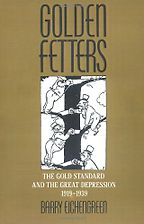
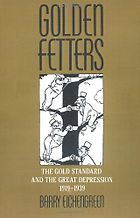
Your second selection is Golden Fetters by Barry Eichengreen. How did this book contribute to our understanding of the Great Depression?
It’s important for helping to answer the question, why was the Depression a worldwide phenomenon? Friedman and Schwartz and other studies have shown that what caused the Depression here in the US was largely domestic shocks – a terrible stock market crash and a series of uncontrolled banking crises. But if that is the case, why was the Depression so terrible in Great Britain, France and basically throughout the entire world? Golden Fetters, by my colleague Barry Eichengreen, gives a definitive explanation of the role that the gold standard played in transmitting the shocks centred in the US to lots of other countries.
The basic story is that if something happened in the US that pushed up our interest rates or pushed down our prices, it would draw gold from other countries toward the US. In the Depression, other countries were worried about their gold reserves and they didn’t want gold to flow toward the US. So they basically had to have a monetary contraction as well. You saw countries deliberately pushing up interest rates to try to prevent gold from flowing out of their economies. Golden Fetters explains that because of the gold standard, a monetary shock in the US led to a worldwide monetary contraction.
Eichengreen shows that a bad economic idea can have devastating consequences. The fact that policymakers throughout the world were determined to remain on the gold standard caused them to follow the US into the Great Depression.
At the time of the Great Depression, did economists understand the downsides of the gold standard and warn against it? Or did people only come to understand it in retrospect?
There were some who understood and warned about the downsides, but largely its flaws were realised in retrospect. The gold standard is a bit like the euro today. It worked quite well during the good times of the late 1800s and early 1900s, just as the euro worked quite well before the financial crisis. Policymakers tended to think it would always work well.
Eichengreen argues that the gold standard worked well in its heyday because countries played by the rules and the Bank of England was an effective worldwide manager of the system. But after the gold standard broke down during the First World War, economists and policymakers were slow to realise when they tried to restore it that it might not work as well, especially in the face of enormous shocks in the US.
Do you think there is anything like the gold standard today? By which I mean bad ideas about economic policy that history will judge as causing or exacerbating our economic problems?
Absolutely. The most important one is the notion that fiscal contractions – reducing the budget deficit immediately – can be expansionary. Some policymakers have become convinced that cutting spending and raising taxes will be so good for confidence that it will increase rather than decrease employment and growth. This is a very bad idea that is contradicted by strong empirical evidence.
This mistaken belief in expansionary fiscal contractions has caught hold especially in Europe. It’s a big part of why Europe is in the mess that it’s in. Deeply troubled countries, such as Greece and Spain, have been forced to adopt severe fiscal austerity in order to receive aid from other European countries and the IMF. And other countries, such as the UK and Germany, have moved to austerity because they bought into the idea that it would be good for their growth. But the outcome has not been good. Growth has slowed throughout Europe, and the eurozone has almost certainly entered another recession. Countries such as Spain and Greece that have adopted extreme austerity measures have seen unemployment rise dramatically. This rise in unemployment makes it all the harder for them to actually get their budget deficits under control.
There are much wiser policies for Europe and for the US. The fiscal problems are very real but they should be dealt with gradually. It would be far better to pass plans now, but not make the actual spending cuts and tax increases until the economies are healthier. Policies aimed at stimulating growth would be far more humane, and ultimately better for the fiscal situation. Without growth and full employment, it is very hard to ever get the budget deficit truly under control.
The gold standard is back in the news as the tent pole policy of one of the Republicans running for president, Ron Paul. What do you say to people calling for a return to the gold standard today?
Read Barry Eichengreen’s book. Not only is the gold standard not a cure for our current ills, it could make things much worse.
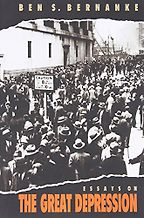
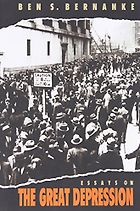
Your next book is a collection of essays by the current chairman of the Federal Reserve, Ben Bernanke, who was previously a professor of economics at Princeton University. Please explain how this book, and in particular the paper “Nonmonetary Effects of the Financial Crisis in the Propagation of the Great Depression”, has added to our understanding of financial downturns.
Chairman Bernanke has written a number of important papers about the Great Depression. The one that really stands out is the paper you mentioned. Friedman and Schwartz showed that banking panics caused a decline in the money supply, which likely depressed output by raising real interest rates. Bernanke argued that a financial crisis also has negative effects working directly through the decline in credit availability. When a financial panic causes banks to go out of business or makes them unwilling to lend, that can have an impact on the economy above and beyond any effects on the money supply. He found evidence from the Great Depression that such non-monetary effects of a banking crisis could be very large.
Bernanke’s focus on the non-monetary effects of financial crises turned out to be incredibly important. It started a whole literature on how credit matters, above and beyond what’s reflected in interest rates. He changed our view of how monetary policy affects the economy.
How did Bernanke’s theories impact the understanding and handling of the 2008 crisis?
His work and the subsequent research it inspired made us realise how important it is in a financial crisis not to just prevent the money supply from falling, but also to make sure that credit keeps flowing. We learned from the Great Depression that when credit dries up it has devastating consequences.
That idea had a huge impact on the Federal Reserve’s behaviour in the most recent crisis. In response to the financial crisis in the fall of 2008, the Fed not only followed the conventional central bank remedy – flood the system with liquidity and make sure there’s plenty of cash out there – but they also took extraordinary actions to keep credit flowing. When they saw credit markets were not functioning, the Fed was incredibly creative in finding ways to make sure that firms could get credit. For example, many businesses issue commercial paper to cover payroll and finance day-to-day operations. When that market stopped functioning and no one was willing to buy commercial paper, the Fed said, we’ll buy it.
These aren’t the type of actions that the public has historically associated with central banks. Has monetary policy evolved a lot? What is it?
Conventionally, monetary policy refers to Federal Reserve decisions about setting interest rates. We’re used to the Fed saying they’re going to push the federal funds rate up or down. But this crisis was so extreme that the Fed had to be much more aggressive and creative. In addition to reducing the funds rate to zero, the Fed has taken a number of actions to keep credit flowing and to reduce interest rates other than the funds rate. Whether you call that monetary policy or credit policy or quantitative easing is somewhat arbitrary. Since all the policies are being conducted by the central bank, I tend to lump them under the broad term of monetary policy.
A lot of people have second-guessed the Obama administration’s fiscal policy response to the “Great Recession”. Would you care to second-guess the monetary policy response?
We often think of the financial crisis as beginning with the collapse of Lehman Brothers, but there was real strain in financial markets starting from late 2007, with the meltdown in subprime mortgages. The Fed worked very hard throughout 2008 to mitigate the consequences of falling house prices and credit contraction. They were very proactive. Then when the crisis hit in the fall of 2008, the Fed was essential in helping to prevent a much more catastrophic meltdown. They kept the financial crisis from being much worse than it otherwise would have been. It’s hard to second-guess them on that part of their response.
Where I think you can second-guess them is once we got through the immediate crisis. By the fall of 2009, the financial system had stabilised but the rest of the economy was still reeling from the fallout and unemployment was heading up to 10%. Instead of further aggressive moves to encourage faster recovery, such as more quantitative easing or a bold communications policy, the Fed essentially took a breather. That was a mistake.
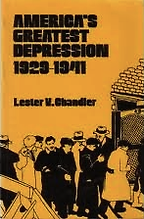
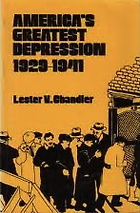
Let’s talk about the role of fiscal policy, from the perspective of Lester Chandler’s America’s Greatest Depression. Please tell us about the book.
This book gives a great description of what went on during the Great Depression. It is especially strong in describing the policy response. It was published in 1970, but is still the book I go to when I want to know about the actions that were taken in the New Deal. It gives you a sense of all the things that were done in the 1930s.
One of the things you learn from Chandler is that President Roosevelt was trying everything. Back in the 1930s policymakers didn’t know as much about what monetary and fiscal policy could do. So they tried all sorts of things – housing policy, agricultural policy, various credit policies, even allowing industries to collude to raise prices. Now, many of these policies were not very successful. And the ones that were successful often were not pushed far enough.
This is especially the case with fiscal policy. Chandler’s book reminds us of something that is often forgotten, that the fiscal response to the Great Depression just wasn’t very big. In fact, under President Hoover it actually went the wrong direction. When the deficit rose because tax revenues fell due to high unemployment, Hoover’s answer was a big tax increase – that was the Revenue Act of 1932. This misguided deliberate fiscal contraction was another reason why the economy kept going down and the Depression was as terrible as it was.
Even under Roosevelt the fiscal expansion was modest. When we think about the New Deal, we tend to remember things like the WPA [Works Progress Administration relief programme], which built dams and bridges, and the Civilian Conservation Corps, which constructed so many buildings in our national parks. These programmes left enduring legacies, and so we often think of the fiscal policy response of the New Deal as being big and aggressive. But what Chandler points out, building on a classic paper by E Cary Brown, is that the fiscal response to the Great Depression was actually quite small – not nearly as large as the American Recovery and Reinvestment Act of 2009. Even when Roosevelt increased the Federal deficit in the mid-1930s, a move to budget surpluses by state and local governments meant that the net fiscal stimulus was much smaller.
Brown’s famous conclusion, repeated in Chandler’s book, is: “Fiscal policy, then, seems to have been an unsuccessful recovery device in the ’thirties – not because it did not work, but because it was not tried.”
How did this book affect your thinking about the response to the Great Recession of the late 2000s?
Understanding the history of fiscal policy in the Great Depression certainly made me a strong advocate for a truly bold fiscal stimulus in early 2009. It also made me very aware of the counteracting role that troubled state and local governments can play. The Obama administration convinced Congress to use some of the funds in the Recovery Act to help state and local governments maintain services and not raise taxes. That turned out to be incredibly helpful.
In retrospect, it would have been good if the Recovery Act had been even larger. But as it was, it was the largest countercyclical fiscal stimulus in American history – not just in dollar terms, but relative to the size of the economy. As we’ve gotten more evidence about how it has worked, it is clear that it was immensely helpful. The Recovery Act is part of the reason why, despite the terrible shocks that hit the American economy in 2008, this recession, as bad as it was, wasn’t a second Great Depression. The policy response was much more effective and much more aggressive than it was in the early thirties.
Another part of the Great Depression that Chandler talks about that had a big impact on my thinking is what happened in 1937. Basically, monetary and fiscal policymakers got tired of all the exceptional things they were doing to help the economy, and they tightened policy too soon. The result was a “depression within a depression” – a big downturn that sent unemployment shooting back up when we were far from fully recovered.
That episode was very much in my mind as we learned over the first half of 2009 that the recession was much worse than almost anyone had expected, and that the recovery would likely be slow. It was a big reason why I argued that it would be a terrible mistake to take away support for the economy too soon, and that in fact we needed to be doing more, not less, to help the economy.
Your final choice is an article by Peter Temin and Barry Wigmore in the journal Explorations in Economic History. What makes “The End of One Big Deflation” so essential to understanding the end of the Great Depression?
An important fact about the Depression that will resonate with people interested in the modern economy is that by 1934 interest rates in the US economy were down to zero – what economists call the zero lower bound. At that point the Federal Reserve doesn’t have the option of more conventional monetary policy, like lowering interest rates further. That’s exactly the same situation we have been facing since the end of 2008.
A big question in economics is: Can monetary policy still be helpful once the policy interest rate is at zero? This paper by Temin and Wigmore suggests that it can.
One of the ways that monetary actions can have an impact when we’re at zero lower bound is by affecting expectations. If policy makes people expect more rapid output growth or higher inflation, that can raise demand and output today. For example, if I own a business and I see the government taking aggressive action, I might decide to invest today because I expect my sales to be higher in the future.
Temin and Wigmore show that going off the gold standard was a very powerful signal that US monetary policy was going to be more expansionary in the future. It seems to have had the effect of raising expectations of growth and inflation. They find that spending and output responded very quickly to that decision. For example, truck sales took off soon after the US went off the gold standard.
You wrote one of the most widely cited papers about the Great Depression, called “What Ended the Great Depression?” We’d be remiss if we didn’t include it in this discussion. Please briefly describe it.
That particular paper focused on how we got out of the Great Depression. One of the points that it made goes back to what we talked about with Chandler’s book – it provided some empirical evidence that the changes in fiscal policy were pretty small in the Great Depression. So in terms of accounting for what helped to end the Great Depression, the fiscal response mattered but was not very important because it was so small.
What I showed in the paper was that there was a very aggressive monetary response – not only going off the gold standard, as Temin and Wigmore discuss, but following up with a big monetary expansion. It was probably the one time in US history when we had a monetary expansion that was orchestrated by the executive branch rather than by the Federal Reserve. In the mid-1930s a lot of gold was flowing to the US because of political tensions in Europe. Because we were back on the gold standard (but at a lower price for the dollar), the Treasury Department had the ability to turn the gold inflow into increases in the money supply. As a result, the money supply grew rapidly after 1934. You can think of this as a very early version of quantitative easing – which economists describe as increasing the money supply even when interest rates are already at zero.
I showed that this monetary expansion affected real interest rates by ending expectations of deflation. In the data, interest-sensitive spending – such as business investment and consumer purchases of durable goods – responds to this fall in real interest rates. Interest-sensitive spending was a major engine leading us out of the Great Depression.
My study was one of the earlier papers to talk about whether monetary policy can be useful at the zero lower bound. I argued that absolutely it could be. I think the Great Depression provides the best evidence we have that more aggressive monetary policy can help us to recover faster, even in a world of very low nominal interest rates.
How common is it for an economy to function at zero lower bound?
Many countries are at the zero lower bound today, but it’s not very common at all. The main other time when it happened in a number of countries was in the Great Depression. The other key episode was Japan after their Great Recession, which began in the early 1990s. Japan, for the most part, has stayed at the zero lower bound since the mid-1990s and has never fully recovered. What’s important about the Great Depression in the US is that it’s a case where we were at the zero lower bound and successfully got out of it.
What does your and the Temin and Wigmore paper tell us about what can be done today? Have any countries figured out how to have an effective monetary policy once interest rates have fallen to zero?
What we learned from the Temin and Wigmore paper is that one way out of a recession at the zero lower bound is by changing expectations. To do that, often what is needed is a very strong change in policy – something economists call a “regime shift”. The most effective way to shake an economy out of a terrible downturn when we’re at the zero lower bound is an aggressive change in policy that makes people wake up, say “this is a new day” and change their expectations. What the Fed has done since early 2009 is much more of an incremental change.
I think that what the Fed needs instead is a regime shift. A number of economists have suggested that the Fed adopt a new framework for monetary policy, like targeting a path for nominal GDP. If the Fed adopted such a nominal GDP target, they would start in some normal year before the crisis and say nominal GDP should have grown at a steady rate since then. Compared with that baseline, nominal GDP is dramatically lower today. Pledging to get back to the pre-crisis path for nominal GDP would commit the Fed to much more aggressive policy – perhaps more quantitative easing and deliberate actions to talk down the dollar. Such a strong change in the policy framework could have a dramatic effect on expectations, and hence on the behavior of consumers and businesses.
Has the economy changed in important ways that require us to update our thinking about the roots and remedies of long-term downturns?
Of course the economy has changed over time. Our economic institutions have evolved and the composition of what we produce has changed. But the Great Depression is still relevant, because the economy is not fundamentally different. When I teach my undergraduate course on macroeconomic policy, I argue strongly that the Great Depression is a sensible place to start. The world was similar enough in the 1930s that a lot of the lessons that we learned then are still applicable today.
One of the things that we have learned from the Great Recession is that modern economies are still vulnerable to terrible downturns. Even very aggressive monetary and fiscal policy cannot fully offset incredibly large shocks to household wealth and credit. That fact should make us anxious to avoid the kind of bubble and bust period we have just been through.
What did your time in the Obama administration teach you about the ability of policymakers to affect economic conditions?
That good policy absolutely matters. The shocks hitting the American economy in 2008 were enormous, in terms of the destruction of wealth and the freezing of our financial system. I firmly believe that the stresses on the US economy in 2008 were much larger than those in 1929 and 1930. So why has this recession, as bad as it has been, not been a second Great Depression or even worse? I think the answer is a much better policy response.
But this episode has also shown that policy is very hard to get right. The policy response is inherently based on forecasts, which are subject to great uncertainty. And the political process often puts constraints on what can be done. Moreover, the policy response is limited by our understanding of how policy works and our vision of possible options.
The bottom line is that the Great Recession showed us that we have effective tools to fight a terrible downturn. But we also have much to learn about how to use those tools more successfully.
Five Books aims to keep its book recommendations and interviews up to date. If you are the interviewee and would like to update your choice of books (or even just what you say about them) please email us at editor@fivebooks.com
Five Books interviews are expensive to produce. If you've enjoyed this interview, please support us by donating a small amount.
Christina Romer
Christina Romer is a professor of economics at the University of California, Berkeley, and co-director of the Program in Monetary Economics at the National Bureau of Economic Research. She served as chair of President Barack Obama’s Council of Economic Advisers from 2009 to 2010. A graduate of MIT, Romer is renowned for her work on the Great Depression
Christina Romer is a professor of economics at the University of California, Berkeley, and co-director of the Program in Monetary Economics at the National Bureau of Economic Research. She served as chair of President Barack Obama’s Council of Economic Advisers from 2009 to 2010. A graduate of MIT, Romer is renowned for her work on the Great Depression