Was there a particular event that made you so passionate about freedom of speech?
I was shocked at university to discover the “no platform policy”. I just couldn’t understand how in an environment of academic freedom we could ban someone because of their views. I always thought that you could win arguments if you have them in public, but it appeared to me that people were frightened of having the arguments. That is what got me interested. A number of different organisations were “no platform” when I was at university.
Which ones?
There was a big fuss that anyone with racist or homophobic views should not be allowed on campus, and there were campaigns to not have anything offensive said in student union meetings. Obviously I didn’t have any sympathy with those views, but it struck me that there was a real sense of insecurity if you couldn’t have the argument. I was very passionate about the issues that I thought were important.
“I didn’t have any sympathy with those views, but it struck me that there was a real sense of insecurity if you couldn’t have the argument.”
In those days, we used to get over 1,000 students a week along to a union general meeting. And it seemed to me that having robust arguments about different topics was exactly what was needed. Also I think that from an audience’s point of view, if you ban an organisation on the basis of their views you make them more powerful and flatter them. I think that most of those organisations, if they were allowed to speak, wouldn’t have much to say and the audience should be allowed to find that out for themselves.
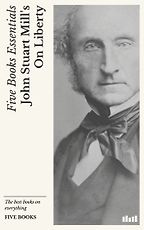
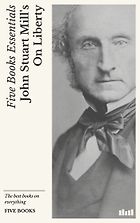
Your first choice, On Liberty by John Stuart Mill, is very much the bedrock of some of these ideas.
This is a fantastically important book even today, written by one of the greatest Enlightenment thinkers around. To me, it seems to enshrine the Enlightenment notion attributed to Voltaire that “I disapprove of what you say but I will defend to the death your right to say it”. What is rich about this work is that it doesn’t just assert the importance of free speech for the speaker without going into why it is important. One thing that very strongly impressed me over the years is its argument that we can all improve. Our arguments can only be improved by airing them in the public sphere.
We have to hone them, and people have to listen to and dissect them.
Indeed. Also, we always have to be prepared that possibly we are wrong. It is only by having those debates that you can improve your own arguments, but also possibly reconsider your position. John Stuart Mill says, “Truth gains more even by errors of one who, with due study and preparation, thinks for himself, than by the true opinions of those who only hold them because they do not suffer themselves to think.” I think it is better to have people try out ideas in the public sphere, even if they are wrong, than to simply parrot the right answer. That is what I think Mill is saying there.
“I think it is better to have people try out ideas in the public sphere, even if they are wrong, than to simply parrot the right answer.”
One of the important things about On Liberty is this idea that we shouldn’t just adopt certain positions or say certain things because it is fashionable to do so.
Why do you think that John Stuart Mill is still relevant today?
Because he encapsulates why tolerance and freedom have to be actively fought for and actively asserted.
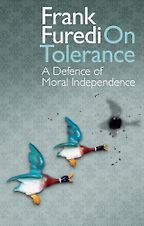
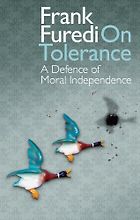
Your next choice is almost a modern sequel to Mill. Frank Furedi’s new book On Tolerance challenges the idea that we are largely a tolerant society.
John Stuart Mill argues clearly for tolerance, and he is very popular in this modern era. People quote him in school essays and formal debates. But Frank Furedi, in his new book on tolerance, looks at how the spirit of John Stuart Mill has been destroyed in the contemporary era, despite our paying lip service to the term “tolerance”. He talks about an insipid understanding of tolerance.
What does he mean by that?
We have come to interpret the very opposite of what Mill meant, that tolerance means that we should be respectful of all opinions. When we say our society has got to be tolerant, it becomes a relative thing – almost therapeutic mush that we are not allowed to offend anybody. This kind of tolerance leads to a situation where we refuse to challenge or test out arguments in the public sphere.
That is what is so ironic about the contemporary understanding of tolerance. It effectively says you must bite your lip and tolerate all views. This was not at all what Mill meant. Furedi takes on how tolerance has become degraded. He says tolerance has to be robust, interventionist and judgemental. You should tolerate all views, but that does not mean silently sitting by and agreeing with them. He makes a very interesting point about how in the name of defending tolerance, we’ve seen the introduction of hate-speech legislation which defends people from intolerant views. Actually, in the name of tolerance we have seen the growth of illiberalism. A kind of intolerant tolerance.
Which shuts out different parts of society.
Yes, we basically say you are intolerant therefore we won’t tolerate you.
Your critics say that your determination to allow everyone to express their views often goes too far. How do you respond to that?
To clarify, it is not just that everyone has the right to speak. Most importantly, I think that we all have the right to listen to all views. Because if you don’t say that, then someone else says which ones you can and can’t listen to. All speech is powerful but I do not think there is a direct line between speech and action.
“Actually, in the name of tolerance we have seen the growth of illiberalism. A kind of intolerant tolerance.”
The assumption that speech immediately incites people to act treats us as if we lack any autonomy or decision-making powers. It attacks moral autonomy and treats people as if they are no more than attack dogs. Do you really think that if you let people hear a racist homophobic speaker then that is what they will become?
But there is a lot of talk about the influence of, for example, extremist religious teachers on vulnerable young people who are talked into carrying out extreme acts.
The key word that you have used is “vulnerable”. That word gets used to imply that there is a feeble-minded kind of person who can be easily influenced, which I think is quite insulting. The idea is that I can resist these ideas while other people, who are living on a council estate or are Muslim youths, can’t. I think that is a very dangerous “them and us” approach to free speech.
Another argument that people use in the free speech debate is that if people hear certain words or insulting ideas, then they will be wounded and damaged forever, so the state needs to step in and protect us. There is the idea that we are no longer prepared to trust each other, and this goes back to Mill. Mill is forever arguing that we should be able to trust each other, hear these things, and then argue back.
There is evidence, though, that certain groups are truly hurt and outraged by what others have to say, and don’t think there is any excuse for them to be given a public platform. This often happens with the British National Party.
I am sure that people don’t like hearing those ideas, but if they exist in society you can’t just silence them. There is increasingly a culture of shutting down debate, which results in no one being able to speak their mind. People think a way of gaining recognition is to say, “I find that offensive and damaging for my particular community.” We then get fixed in a sense of identity, instead of it being something where we are prepared to take on these arguments and deal with them, regardless of identity.
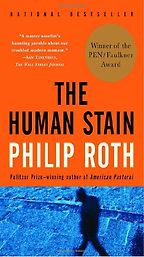
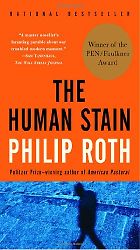
Let’s see how your rather intriguing next choice, The Human Stain by Philip Roth, fits in with that.
This is a novel set in a New England university. The main focus of the novel is a professor of Classics and faculty dean called Coleman Silk. It is a liberal university, and the reason why I chose this novel is to show how doing things in the name of tolerance can lead to a right old mess.
What happens is that Coleman Silk complains about two students who never turn up to any of his lectures. He says that they are “spooks” because they are never there, and he is accused of racism for using that word. As an academic he is interested in the use of language, and he cannot understand how this can happen to him. He didn’t even know what colour the students were, but because they are African-American it is assumed that he was being racist. The whole faculty turns against him, led by a woman called Delphine Roux, a professor in French Literature – a deconstructionalist in a way, so an archetypal enemy of free speech. He loses his job, and he blames the loss of his job and his public disgrace for the death of his wife.
The irony is that as the novel progresses, we realise that in fact he himself is black. Because he is a light-skinned black man he passed himself off as a Jew for many years, as when he was a young student he was refused service and called a nigger. He doesn’t want to be defined by identity or colour, because he knows that he will always need to be protected by someone else. He says, “I don’t want to be part of the oppressed we, but my own I.”
The sub-plot to the novel is that Coleman, aged 71, is having an affair with a young cleaner at the college. Delphine Roux is disgusted by this as well. She thinks he is exploiting this illiterate, disadvantaged, oppressed woman who is the victim of domestic abuse. So Delphine is all about labelling people. She thinks that it is about feminist protection of a vulnerable young woman. The irony is that the cleaner isn’t illiterate and doesn’t see herself as a victim.
So the novel focuses on the superficial way that we condemn people.
Yes. Someone like Delphine assumes oppression is happening, defines people through victimhood labels, gets it completely wrong and ruins people’s lives.
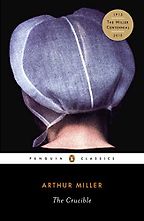
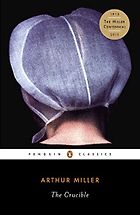
Let’s move onto another tale of victimhood, Arthur Miller’s famous play The Crucible.
This is the Salem witch hunt in the context of the McCarthy era. The reason I chose it is because I feel that we ourselves, in the contemporary period, are in danger of having our own heresy-calling and witch hunts. It is very popular to say this book proves what it is like when hysterical religions name people as witches, and how intolerant religion is. But I think we can see it in a much more contemporary light as just what happens in an atmosphere where people’s fear is exploited.
Give me some examples.
Contemporary heresy-calling tends to be much more in the secular field. There are certain orthodoxies that you are not allowed to challenge. Climate change orthodoxy is one of them. If you dare even ask a question of it you are assumed to be a climate change denier, denying the evidence.
You have got into hot water over this one, haven’t you?
Yes I have. But it is not a personal argument, it is more of a dangerous atmosphere. If you say you do not think we should have a witch hunt against, say, Catholic adoption agencies for being Catholic, then you get accused of being in league with the Papacy and covering up child abuse. That’s what happens in The Crucible. Anybody who challenges the idea that there are witches ends up being named as a witch.
So there is a climate of fear.
Exactly. There is also a reverend from the parish who is losing authority and the respect of the local parishioners. You see how the atmosphere around the hysteria drives people to name names and turn on neighbours to help him regain his authority. I think that is a significant aspect of it. People who are in power unfortunately can make gains from a climate of fear.
Your final choice is Hans Fallada’s Alone in Berlin, which was published in 1947 and set in World War II.
This is an important novel for a range of reasons, because it was written so shortly after the Second World War by a novelist who lived through the Nazi regime. It is a very rare glimpse into what working-class life was like then.
He used a nom de plume.
Yes, and there is plenty of ambivalence about Fallada himself. The Nazis tried to court him and ban him all at the same time. Unlike many writers, he remained in Germany throughout the war. The novel shows what it was like to have totalitarianism in the contemporary period, and what the suppression of not just speech but thought results in. You have a situation where neighbour spies on neighbour, and you dare not say what you think. You dare not speak at all. You are fearful that what you say will be used against you. Indeed, it will be used against you and we know the consequences. I think it is a hymn to bravery as well. In the story there are a man and his wife – this is based on a true story – who although not particularly critical of Hitler and the Nazis in the early 1930s, when their son is killed they start to want to speak out.
“The novel shows what the suppression of not just speech but thought results in.”
Of course, they know the consequences. The book has a literal free speech theme. They write anonymous postcards attacking Hitler and drop them all around Berlin. As it happens, this has little practical consequence. One of the horrible parts of the novel is when they realise themselves that nearly all the postcards have been handed in and it hasn’t led to an uprising. They are inspired to think there are other people like them, who feel the same and are trying to rally the troops. But in the end, Otto Quangel says to his wife Elsie, “What do we care, it is we who must do it.” So there is this morality of speaking out against all the odds, as well as a reminder of what it is like to have absolutely no free speech. For me, this is a book that reminds us all why freedom of speech matters. It is a very modern example of what it actually means to have the state tell you what you can and cannot say.
Five Books aims to keep its book recommendations and interviews up to date. If you are the interviewee and would like to update your choice of books (or even just what you say about them) please email us at [email protected]
Five Books interviews are expensive to produce. If you've enjoyed this interview, please support us by donating a small amount.