Our topic today is robotics, but a lot of the books you’ve chosen are science fiction. I wondered how much of what they describe is in the future, or how much is already happening?
The answer is always, ‘More than you think is happening right now.’ Also, there is no more avid reader of science fiction than the person who is making it come true. Every roboticist that I’ve ever met has some sort of vision of the future that they’re trying to make come true, and it’s always been affected by science fiction.
Tell me about your first choice, a short story dating from 1953 called Second Variety by Philip K Dick.
Second Variety is… OK, have you ever seen The Terminator? You know that part at the very beginning – it’s this apocalyptic future and there are these humanoid cyborgs with red glowing eyes marching over a field of human skulls, spraying everything down with these Gatling guns, and the humans are being chased around like rats? Then of course it cuts to Los Angeles and you’re thinking ‘Damn! I wanted to see that movie.’ Well this is that movie. Second Variety is what I just described almost exactly. I don’t know the complete provenance, but there is no way that Second Variety didn’t have some impact on the whole Terminator world.
The story is primarily concerned with ‘How do you tell a human from a robot?’ But what I found most interesting about it was that it was an apocalyptic future, in which human beings had built machines not to kill other human beings, but to learn how to kill other human beings. The robots initially were just landmines, they were very simple things. They learned how to camouflage themselves, and then human beings became more scarce and smarter, so the robots actually had to begin to learn how to mimic us. What’s interesting to me from a roboticist’s perspective is that it’s just a problem like any other – killing people. You can program a machine to learn how to do that optimally. What’s really fascinating is that the optimal form that this robot has chosen to kill human beings is another human being. That’s just a really, really cool concept to me; it’s a powerful message.
In terms of robotics, given the plethora of futuristic horror stories involving human look-alike robots, is there any value in concentrating on android development? Or will humans always mistrust and spurn robots too accurately in our image?
Whether or not roboticists should put effort into making incredibly human-like robots called androids is a topic of debate among scientists. On the one side, you can argue that you’re never going to be able to hit this target: there’s this uncanny valley and you’re always just going to fall into it and creep people out. The uncanny valley is this phenomenon – a psychological phenomenon that’s been demonstrated experimentally – that shows human beings get really scared by objects that look almost like human beings, but not quite. And it really bears out intuitively. If you think about zombies – that’s a human being, almost entirely, the only thing that’s wrong is that they’re staggering around, the gait is wrong, they’re not breathing. From a robotics perspective, these are all little things off on the margins. From a distance, zombies look like people, they walk around. But it’s not good enough. There’s an argument that this is a fundamental human reaction that is never going to change. You’re never going to get used to it.
On the other side, there are a lot of really good reasons to have androids. Human beings are designed to interact with other human beings. We very quickly, as children, learn how to recognise speech, other people’s emotions, their gestures, what’s going on in their heads. We are experts at figuring out what other people are thinking. And if you make a machine that looks like another person, then you’ve created the most natural interface possible, and therefore a machine that is optimally interacting with other people – as long as you’re not scaring the shit out of them! That’s a little bump in the road there for people who are designing androids.
My feeling is that this is research that absolutely should be done, and yes it’s challenging, but never say never – there are a lot of benefits associated with having androids around.
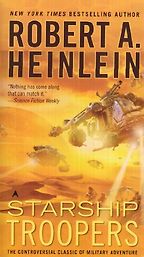
On to Starship Troopers by Robert Heinlein. This was first published in 1959 and it’s about a soldier in a futuristic military, who gets involved in an interstellar war between mankind and the bugs…
This is a story of war in the future with advanced weaponry against aliens. This story is so grounded, and so realistic – the way that the characters interact, their language, their lingo, the way the military is set up, the way they utilise their weaponry – everything is just pitch perfect. When you read it, you pretty quickly find – at least I did – that you aren’t worried that it is science fiction. I was thinking, ‘This is just so real, these are soldiers, and this could be Spartans fighting shoulder to shoulder – this could be a war that had occurred at any time.’ It’s just human soldiers fighting together, dying together, and that’s really what I took away from this – not the technology, or the crazy sci-fi aspects, and certainly not the political overtones. The politics are not my favourite part about this book, although Heinlein fans might have a different perspective.
What really is great about this book to me is that all the science fiction just dissipates in the face of absolute veracity. And that’s something that I think if you’re writing this kind of stuff, you should aspire to. You shouldn’t focus on the gizmos. In this, the power armour is a suit of armour that powers your joints and makes you a lot stronger. These are commonly known as exoskeletons, and I’ve actually worn one of those at Berkeley Bionics. It’s really exhilarating to see that that is something that is already 100 per cent true, but here it just becomes part of the background and the flesh of this story, without ever becoming a huge focus of it. The story ends up being about the characters and a story about war and soldiers suffering, and that’s an amazing accomplishment, I think.
So did the idea of exoskeletons appear for the first time in this book?
I’m sure exoskeletons had been around before this. This book came out in the 1950s, and there was the General Electric Hardyman prototype that was around then – I don’t know if it was before or after. But this is definitely one of the most famous usages of an exoskeleton in any area of our culture. Another exoskeleton that you see is Ripley fighting the alien queen in Aliens. But this idea of putting on a suit of armour that can make you super strong is obviously a very popular idea, based on how popular Iron Man is right now. It’s the same story, but this has actually become real research. For instance, Berkeley Bionics and Sarcos both worked off grants from DARPA, the Defense Advanced Research Projects Agency, to build real-world instances of exoskeletons. And these things really do work.
One thing is that if you put these things on, they basically anticipate where your legs and arms are going to move – and their goal is to get out of your way. The whole interface goal of the machine is that you’re not supposed to feel like you’re wearing anything. You just move and it has joints that are very similar to yours and it moves too, and so you’re just walking around inside it. The only difference is that whenever you pick something up all that weight is transferred all the way down to the ground through the frame of the exoskeleton and you don’t feel a thing. So you can obviously pick up heavy loads and carry them for long periods of time. Also, while they anticipate your movements they can also pick up on your gait. When you’re walking, you do one movement and repeat it a lot, as long as your terrain doesn’t change. So if, for instance, you’re marching down the middle of a highway, these machines can pick up on your gait cycle and then just start replicating it and you don’t have to move your legs at all. Which means you can fall asleep. So you could potentially have a column of soldiers wearing current existing exoskeletons, carrying 250lb backpacks each and not feeling it, marching down the road, catching some zzzs. That’s really just cool.
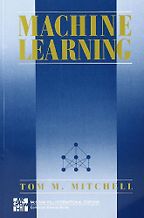
Your next book is Machine Learning. This is more of a textbook, I think?
Yes, Machine Learning is a textbook and I would call it the textbook for machine learning and artificial intelligence. Machine learning is just the math of teaching a machine how to solve a problem on its own, because you’re not going to be able to be there to solve it for the machine. It can be any kind of problem: it could be a robot that needs to figure out how to get from point A to point B or it could be a supply inventory algorithm for trying to figure out how many products it should order for Walmart.
What’s great about this book is that, first of all, it’s not intimidating. It’s really slim and it covers the full range of artificial intelligence algorithms for really solving any problem. You can think of it this way – if you’re a wrestler facing a problem, this has every wrestling move that you’re going to need, in order to knock out any problem that you see. And that is really, really empowering. Because after you read a book like this, you look at any problem that is out there, and you think to yourself, ‘Oh I can build a machine that can figure this out better than a human, with better accuracy, and more quickly.’ They say that once you have a hammer everything begins to look like a nail. That’s absolutely true, and Machine Learning is one hell of a hammer.
It’s from 1997 – is it still up to date?
It’s a textbook, so they update it. The author, Tom Mitchell, is the chair of the Machine Learning Department at Carnegie Mellon. In layman’s terms he’s a total badass – a very, very accomplished guy.
Isn’t machine learning still at a relatively early stage?
I disagree. I think machine learning has actually pretty much ripened and matured. Machine learning arguably started in the 1950s, and the term artificial intelligence was coined by John McCarthy in 1956. Back then we didn’t know anything – but scientists were really convinced that they had this thing nipped in the bud, that pretty soon they were going to replace all humans. This was because whenever you are teaching machines to think, the lowest hanging fruit is to give them problems that are very constrained. For example, the rules of a board game. So if you have a certain number of rules and you can have a perfect model of your whole world and you know how everything works within this game, well, yes, a machine is going to kick the crap out of people at chess.
What those scientists didn’t realise is how complicated and unpredictable and full of noise the real world is. That’s what mathematicians and artificial intelligence researchers have been working on since then. And we’re getting really good at it. In terms of applications, they’re solving things like speech recognition, face recognition, motion recognition, gesture recognition, all of this kind of stuff. So we’re getting there, the field is maturing.
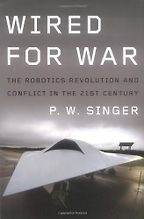
Let’s go on to Wired for War by Peter Singer. This is an analysis of real robots used in war, drones in Iraq etc, and it was a big bestseller. Tell me more.
In terms of science fiction becoming real, this book just blows you away – because it really has already become real. Wired for War goes through all the effects of having automated weapons on the battlefield, stuff that’s already happened and stuff that’s likely to happen, and also different ways to think about how to proceed. Do you allow machines to kill people? Do you have a human being who is like an executioner, who pushes the button and takes responsibility for the machine killing people? Should machines only kill other machines? What’s the psychological effect on a populace when they’re being hunted by machines and they never actually see their enemy? Does it scare them? Or does it empower them because they see that their enemy is too scared to come and fight them face to face?
These are all really fascinating questions and we’ve seen all this stuff explored in science fiction, again and again. But now you have this opportunity to see how this is affecting our real world, and it’s a much more grave and sombre and serious thing to consider, because it’s not as simple. Real life never is. So I think it is just an amazing contribution to people’s conception and understanding of how robots can be used as weapons, because that is a major use of robotics, to save people’s lives and sometimes to do that by taking people’s lives. It’s an incredible topic to examine and he really hits it from every angle.
What kind of things are already being done that people might not know about?
It’s filled with examples of futuristic technology. For instance, surveillance is huge. You need to know where things are at – so you can send a machine into a dangerous place to put an eye on something. You think, ‘Yes, I’ve seen that, they use these big goofy robots: I’ve seen The Hurt Locker.’ But the fact is that those are just baby steps towards the ultimate goal of having a completely appropriate machine for whatever environment you’re facing. As it turns out, pretty much every environment on earth has some animal that’s evolved to operate there – perfectly, optimally, totally efficiently. So there are mobile landmines that locomote the same way that crabs do, for being dropped offshore and crawling up under the waves towards the shore. There are snake-like robots that can really change their gait and slither through forest, wrap around a tree, roll their body up the tree and then aim a camera at something.
This is happening now?
Yes, I had one climb up my leg over at Carnegie Mellon. It’s pretty creepy, but also fascinating. If you look at machines, traditionally people think of them as robotic, which means they move awkwardly. But if you look at an animal it moves very gracefully. I think what we perceive as grace is actually just the beauty of an animal that’s perfectly evolved – there is something amazing about watching a deer bound over a fence. And as machines get more and more developed and advanced, they move less robotically and they start to move smoothly and with natural grace.
One of my friends who was in Iraq covering the war there for The New York Times said it was already pretty surreal. You have the local Iraqis going about their business, and then you have the American military venturing out of the green zone encased in huge gear. They’re not yet in exoskeletons, but it’s getting pretty close.
Have you noticed that the United States Army is actually pushing that? When you say surreal, what you mean is ‘like in a video game’. And the US Army is all about that. If you see their latest round of commercials, it looks exactly like a video game. There’s a crazy unmanned vehicle shooting around the sky and troops with night vision goggles and dropping out of planes. And at the end it says, ‘This is not a video game, this is real – join the Army.’
Perhaps not the best strategy for winning the hearts and minds of the local population though?
That’s a great question and not a simple one to answer. It’s something that Singer really examines from a lot of angles, because even if it’s true that it’s not the best way to win over hearts and minds, there’s still a trade-off because you’re putting fewer American soldiers at risk. It’s a really complicated question, and it’s really interesting to get a serious hold on the part that technology plays, instead of examining science fiction scenarios – because all the science fiction is really happening now.
OK, enough about war. Before we get to your last book, please tell me a bit more about gains in other areas – health, manufacturing.
The vast majority of the technology that’s applicable in a military setting is applicable in a home setting. Exoskeletons help soldiers run, but they also help elderly people stand up, they help nurses transfer patients from wheelchairs to beds without hurting themselves. The vast majority of research in robotics is also peaceful. I don’t want to give the impression that there are a lot of bloodthirsty roboticists out there.
Give me more examples. I had surgery last year – I think that was done using robotics, is that right?
Yes, the da Vinci robot performs minimally invasive surgery. The doctor controls it through tele-presence, so the doctor doesn’t even have to be near the machine, although typically he is. It has levels of precision that a human could never approximate. So do you want your doctor, with his big, greasy, human hands inside your body in order to perform some incredibly delicate surgery? Or would you rather have a pencil thin, slender, robotic manipulator slip into your body through a hole that you could poke with a pen, and do the surgery and leave – and you heal up twice as fast?
Robots are capable of operating outside of human boundaries. We humans are bound by our senses, by our embodiment – the size of our bodies, the level of precision we can get out of our hands. Robots aren’t. A robot can react much faster than a human being. That’s why there’s an artificial intelligence algorithm inside your anti-lock brake system that’s making decisions on the fly about how much braking pressure to apply. Human beings don’t even push the brakes or the gas on a car anymore. We just push a button that tells the car to do it, because we’re not that good at it. In little ways robots are creeping into our lives, in lots of places we don’t even notice, in order to do things better, faster, stronger.
What about in manufacturing? Everything is being made in China. Could we get it made domestically by robots instead?
I don’t think any sector of the robotics industry has grown faster or more successfully than industrial robots. Robot arms comprise the majority of that industry. In the past you had these gigantic arms that were rotely obeying their instructions and if, God forbid, you stepped in front of one of these guys, it would arc weld your face, just as soon as it would arc weld the side of the car. Now what’s happened is that these manipulators are getting more and more people friendly, they’re getting smarter. They’re starting to get sensors so they can see what they’re doing, they can make some decisions about how to do what they’re doing. They’re not just these blind slave arms that are just going about replaying the same commands again and again. So even the robot arms are getting smarter.
And the fact is that none of the products we have would cost what they cost if there weren’t these factories filled with robots. There’s no human being that can assemble a hard drive. No human being can assemble an iPod, much less all the components that go into the iPod. All the stuff that we own has robot fingerprints all over it, whether you know it or not – whether it came from China or whether it’s domestic.
I’ve also noticed that robot arms seem to star in car commercials quite a bit, which is massively ironic because the first robot arm was invented by an American, who went to sell it to General Motors. GM agreed to try it out but in secret because they were afraid that being associated with robots – which at the time were most popular in sci-fi serials, where they showed up and stole the damsel – would be bad for their corporate image.
Yes, I think in the popular imagination, if you think of a robot being involved in making something you think of a car.
Yes, absolutely – and that’s because that’s where it began, that’s where the whole industry began with Joe Engleberger and his partner.
But now it’s across the board.
Absolutely, there’s no mass-produced electronic product that is hand-assembled. That would just be crazy.
Lastly you’ve chosen For a Breath I Tarry, a post-apocalyptic novelette from 1966. Man has disappeared but the robot he has created lives on… Tell me why you chose this book.
I love to think about the world from the perspective of a machine. As human beings, we naturally can’t separate ourselves from everything that we see. We judge everything relative to ourselves, to humanity and humankind. When something is cold, that means it’s cold to human beings because we all function within a similar temperature range. Every single thing that we do is filtered through our embodiment.
Five Books interviews are expensive to produce. If you're enjoying this interview, please support us by donating a small amount.
If you’re examining human beings or you’re thinking about people, I think it’s really instructive to try to step out of your own human-ness and try to look at human beings like an alien anthropologist, or like a machine, because they don’t necessarily share our embodiment. They really don’t have that much in common with us at all, except that they can be intelligent like we can. This book is the template of what a short story should be. I’ve read this thing a million times. I read it again today and it made me want to cry. I, hands down, have to say, nobody gets killed, there are no murderous terminator robots, there are no super-action power suits, there are no roving unmanned airplanes in the sky – but this story is just incredible.
Why does it make you cry?
First of all, it’s one of those classic sci-fi stories that builds up until a great twist at the very end, so you’re rewarded for going along on this ride, and you just show up on the last page and go ‘Aaaaaahhhhhh… Awesome.’ What’s fascinating to me about the story is that misery and happiness are both human constructs. You watch a post-apocalyptic movie and you think to yourself, ‘Oh man, how sad, the whole world’s destroyed, everybody is dead. Bummer!’ But if you’re a machine with a totally different value system, or even if you’re a rat, and all your rat buddies are doing great, who cares that all the humans are dead?
In this story it’s a post-apocalyptic world, where no humans are alive. Machines are basically carrying out these instructions that they received from humans eons ago. There haven’t been people in ages, but the machines sort of idolise them almost as gods, because our word was all-powerful. They were totally subservient to us, only we destroyed ourselves. They don’t realise they’re in this post-apocalyptic world, it’s just their world. They don’t realise that when they blow up a bridge, and rebuild another bridge, and build cities for people that are never going to show up and purify water for people that are never going to drink it – they don’t realise how futile and sad that is. And at one point in this book, a machine finds a way to become human and he shows up and he looks around and within five seconds, the horror of the situation comes crashing in on him and he begs to go back to being a machine. He realises that he’s the only human in a destroyed planet, a destroyed race, that he’s surrounded by all-powerful machines that are performing countless pointless actions, bound by the idiot forces of physics day in and day out. It all comes down on him at once, and it’s such a powerful moment. It really makes you realise that without human beings things aren’t happy and they aren’t sad. They just are. I, for one, think that sucks. I’m very pro-human in that regard.
This idea – that humans are more qualitative and machines are more quantitative – is that going to be the case for ever?
There’s a big debate. A human being witnesses action A and is horrified, and the human being reacts – he screams, and covers his eyes. Then you have a robot who looks like a human being. It witnesses action A and it screams and it covers its eyes and for all you can tell it’s horrified. The human is feeling emotions, it’s flooded with them. The machine is looking at measurements of the world and then creating the same behaviour. And the question is, is there a difference? I think that there’s a pretty good case that there’s not, that what you see is what matters for all intents and purposes.
There’s a thing called the Turing test and it’s one way of judging machine intelligence. And the way the test works is this – if you want to figure out if a machine has human-level intelligence you just talk to it, and if you can’t tell it’s not a human, then who cares? It might as well have human-level intelligence. For all intents and purposes, it does. Everything else is just philosophical mumbo jumbo.
Do you think one day you and I could both be robots having this discussion, that I could be interviewing you about humans as a topic?
I do think there is going to be a blending between the two. I think that’s another thing that’s really interesting about this short story, which is that these machines rule everything that happens on the earth. If there were still people they could destroy them, they could do whatever they wanted. They’re like gods. But ultimately they’re still tools. They’re just really complicated tools that can make their own decisions. And I think as human beings we’ve always been part of our tools. If you take away all a human being’s tools, then we are just naked, defenceless, clawless, fangless, helpless creatures waiting to be killed by either the elements or other creatures. Human beings simply cannot be separated from their tools.
Get the weekly Five Books newsletter
For that reason I think that in the future, our tools will become even more a part of us. Some people will say that this makes us robots. Even so, human beings will take on advanced cognitive and physical abilities that come from using tools. We already do. I’m wearing glasses right now: when the glasses become part of my retina, will that be it? Will I be a robot then? Whenever I look up a fact on the internet from a neural implant, will that make me a robot? Yes, at some point we will be robots talking to each other.
Five Books aims to keep its book recommendations and interviews up to date. If you are the interviewee and would like to update your choice of books (or even just what you say about them) please email us at editor@fivebooks.com