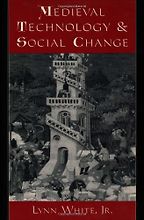
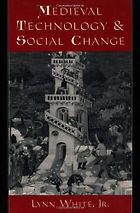
What made you pick your first choice, Medieval Technology and Social Change?
My graduate education was largely focused on the social and political history of Europe. It is only after I got my PhD that I encountered much broader aspects of history. Unlike many historians, who tend to specialise in a narrowly focused area of history, I have become ever more interested in broadening my view of history to encompass the power of technology and the relations between humans and the rest of nature.
This was the first book that called my attention to a new field of history. It opened my eyes to the role of technology in human affairs. Until then, my interest in technology had been purely instrumental – how to fix a bicycle, how an airplane stays up in the air, and so on. White’s book showed me that technology – the means by which humans use resources for their own ends – was one of the most important, though neglected, aspects of history, one that explained how some people were able to thrive in places where others had failed.
I hadn’t realised the importance of technology in human affairs until I read this book. One good example is when he talks about the invention of stirrups for horse riders, which is the metal bit that they put their feet through to keep them stable. This happened in the eighth century, and it meant that they were more agile in warfare because they could still stay on the horse even when they were pushed by a spear from an opposing rider. This transformed mounted cavalry warfare. Also the introduction of a horse collar in the early Middle Ages made the horse infinitely more useful in agriculture. So it was technology making the horse more powerful and useful.
Today many people think of technology as computers and the Internet, but really technology means those devices that humans have invented to make it possible to do things they couldn’t do otherwise – and that could be as simple as the horse collar or a stirrup.
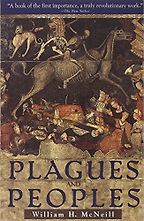
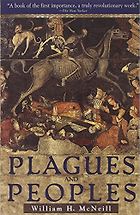
Tell me about your next book, Plagues and Peoples by William McNeill.
I had long known of McNeill’s work as a world historian. In Plagues and Peoples, he showed that humans were not only vulnerable to a force of nature – disease – but that their actions and ways of life made them more so. He looks at how diseases became much more prevalent, how they spread widely.
In Roman and Greek times, diseases were transported with people as they moved from one place to another. A key moment in the history of mankind is the spread of diseases across Eurasia during the Middle Ages. For me, perhaps the most important example of the spread with human interaction is the diseases that the conquistadores brought with them from Europe to Mexico. Many of the people of the Americas were wiped out by those diseases.
In short, this book opened my eyes to the relationship between humans and the rest of nature. Most history books deal with interactions amongst humans, with a passing mention of the weather or the oceans, which are seen as barriers to human interaction. What this book does is bring the role of natural forces – not just diseases – to the forefront and show how, despite what we think of ourselves, we really are a part of nature and vulnerable to the forces of nature. At the same time, we are not just passive victims of natural forces but we have greatly influenced these forces, as in the case of diseases. We are the ones who spread diseases which were once local to the rest of the world. I think that diseases and natural forces are an essential part of understanding world history. And that is what turned me from a political and social historian into an historian of technology and the environment.
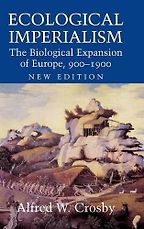
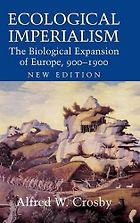
Your next book, Alfred Crosby’s Ecological Imperialism, continues this theme of the environment.
Alfred Crosby is a well known environmental historian. He became famous with a book called The Columbian Exchange, which deals with the spread of animals, plants and diseases between the Americas and the old world. What he does in Ecological Imperialism is take that idea one step further and show how environments influenced the relations between civilisations, especially between Europe and the new world – and how, in turn, contact between the old world and the new changed environments around the world.
He shows how Europeans have established what he called “neo-Europe”, such as North and South America, Australia and New Zealand. In taking over those parts of the world, they changed the population from indigenous to European. He says that was done not by warfare so much as by the introduction of plants, animals and diseases. In North America, much of the food and most of the domesticated animals that we have, and the diseases that infect us, are almost all imported from Europe or the Eastern Hemisphere. Technologies were extremely important because they involved transplanting plants and animals.
Some would argue that this movement has been very damaging in many ways for the environment and people of those places.
The damage for some people is a benefit for others. For the great majority of North Americans, it has been a boon. The same goes for the people of the Eastern hemisphere, who obtained a number of plants from the Western hemisphere in exchange. So the world as a whole is much richer and can support far more people as a result of the interactions and communications. I don’t think anyone wants to turn back the clock to the Middle Ages.
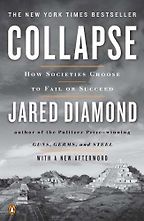
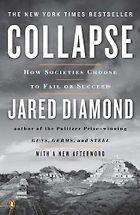
For your fourth book you have chosen Jared Diamond’s Collapse, rather than Guns, Germs, and Steel.
Though Guns, Germs, and Steel has been a best-seller for many years, and is one of my favourites, I found Jared Diamond’s book Collapse more valuable in influencing my own thinking, because it shows the importance of culture in determining how humans deal with environmental threats. In Guns, Germs, and Steel he argued that human affairs were essentially influenced by natural forces – geography, nature and diseases – that were not of human making. He was criticised for being a geographical determinist, which I think he took to heart. When he wrote Collapse he investigated the successes and failures of a number of civilisations which had reached a crisis point, and he looked at why some had succeeded and others hadn’t.
Five Books interviews are expensive to produce. If you're enjoying this interview, please support us by donating a small amount.
What he sees as the cause of success or failure investigated the successes and failures of a number of civilisations which had reached a crisis point, and he looked at why some had succeeded and others hadn’t.is human culture. For example he talks about the Norse Vikings that settled in Greenland. When the climate turned colder, instead of changing their way of life and adapting to the climate in the way the Inuit or Eskimos did they carried on with their way of life based on farming and raising cattle – which spelt their doom because the climate didn’t allow it. Diamond shows that it is all about whether people are willing to be nimble in their approach to the natural world and to adapt. Although he doesn’t say this, I think it is pretty clear that he thinks humans today are facing an ecological crisis, and we either will be able to adapt and surmount it or we will collapse like other civilisations before us.
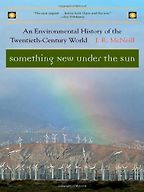
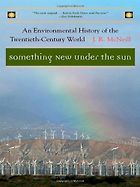
Tell me about your final book, Something New Under the Sun by John McNeill.
John R McNeill is the son of William McNeill, who wrote one of my earlier choices, Plagues and Peoples. He is an environmental historian, and in this book he traces the technological roots of the current global environmental crisis. Namely, the conflict between the growing power of technology on the one hand – abetted by military competition and rising consumer affluence – and the global environment on the other, in which this conflict plays out.
For the first time, humans have affected and transformed the global environment. In trying to find the causes of this change, he looks at things like the burning of fossil fuels – which goes back centuries but took off with the invention of automobiles in the 20th century. The growth of cities is also heavily dependent on fossil fuels, and this is another change that has really transformed the global environment. He also looks at things like the use of water in the world – how we are using up our fresh water. We are polluting and wasting it in a way that is unsustainable, and which is likely to lead to water wars in the future.
Get the weekly Five Books newsletter
McNeill closes by saying that the environmental changes of the last century are on an unprecedented scale, so much so that we can scarcely begin to fathom their implications. We can, however, start to think about them, and McNeill’s book is a helpful primer. He connects, as do most of these other books, changes in technology with changes in the environment. And these are the themes that have been most important in my thinking. I have learnt over the years, by reading these and many other books, to view the world not just as a backdrop for human events but as a participant in them.
Five Books aims to keep its book recommendations and interviews up to date. If you are the interviewee and would like to update your choice of books (or even just what you say about them) please email us at [email protected]