The city of romance and art is also, like most big cities, a place of grit and grime. The American writer and long-time Paris resident David Downie tells us where to look if we're to understand the people and past of this most alluring city.
Paris conjures up so many clichés – the city of romance, a picnic under the Eiffel Tower. But for someone like you, who has lived there for many years, what kind of images spring to mind when you think of Paris?
Crowds, cabbages, cleaning fluids – and of course wonderful walks and beautiful parks and museums with fabulous collections. Everything and its opposite, I would say. When you live here as long as I have and you become French – I am a dual national – you learn things about the city that most people don’t realise. You find out that in many ways Paris is one of a kind but is also like many other big cities. There is a real life here of the Parisians and of transplanted people like me who have become in a way Parisian. It is sort of like a long-running love affair or being married for a long time. You constantly find new things out about your partner.
Tell me something new that you have found out recently about Paris.
I discover things all the time. I walk down a street that I have walked down a hundred times and I look up and I see an artist’s studio perched on top of a 17th century building. I open a book that I have read or looked at over and over and I find something new. I find some chapter of history that I didn’t know at all.
I recently was reading about the Reine Margot who was married to King Henry IV and I knew very little about her. Somehow I missed the movie and I realised that there is a place that I walk by just about every day and she lived there for some years and got up to a lot of naughtiness that caused the death of at least two men! She also caused a 400-year-old fig tree to be chopped down. The road still bears the name of the fig tree. The road was named Rue du Figuier in the 13th century, she ordered the tree chopped down in the early 1600s and the road is still called Rue du Figuier today. And they have fig trees growing on it!
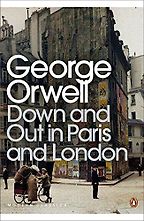
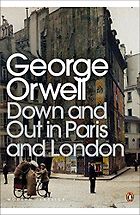
Let’s look at some of your book choices, which show these different elements of Paris. First up on your list is Down and Out in Paris and London by George Orwell.
That is a book I read when I was young – in my teens – and it really marked me. I had been to Paris in the 1970s and I was fascinated by the city but slightly underwhelmed. I knew Rome very well and other European cities and when I spent time in Paris I thought it was an awful lot more modern and tame than I expected.
Reading Orwell’s book suggested to me that there was a Paris underworld. I knew about an underworld in America, because I grew up in big cities like San Francisco, and lived in New York. I knew that America had a very tough side to it. I didn’t imagine before coming here that Paris had a very gritty real underside. Reading that book I discovered it. I also discovered that the Paris Orwell knew in the 1920s and early 1930s was very much still alive in the 1970s and in many ways is still alive today.
That is interesting, because when I think of Paris I think of that amazing artistic scene with people like Hemingway, Picasso and Chanel. Are people still trying to replicate that even today?
Oh, absolutely very much so, especially Americans. There are also many British people over here and also South Americans, Africans and Italians. Paris for them is the same city that it was for Orwell and that it was for me. It is a place that you can come to and when here convince yourself that you too might be able to become the person you wanted to be, or you could at least try to. You can do things like paint or write. One of the great things about Paris, then as now, is that if you are a writer or an artist or indeed a creator of any kind you are respected. Your status is actually perfectly high in society and you are not necessarily measured on your material success, how many books you sell, how much your paintings sell for – that sort of thing. Whereas in the culture I come from in America you are largely measured on how much money you earn, the neighbourhood you live in and the kind of car you drive. It was refreshing to me and I think it still is.
But Orwell’s book doesn’t just show the artistic side of Paris. There is a long section about working as a dishwasher in a restaurant and it really shows the grimness and filth of that life. He describes how people were basically wage slaves. They worked horrific hours – 16, 17, 18-hour days – and they had no energy to do anything but to work and sleep. My experience, as someone who has done a lot of reporting on food and restaurants, is that that scene has improved but it is still pretty gritty. People work very long, hard hours and are poorly paid and now they are almost entirely non-French. They are almost entirely North African or Tamil.
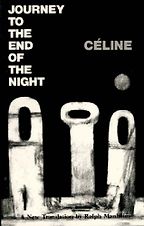
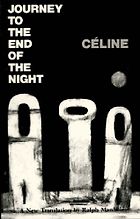
Your next book shows another gritty side of Paris, after World War I, and it is Journey to the End of the Night by Louis-Ferdinand Céline.
This is another book I read when I was very young and like my first choice I was impressed by the fact that Paris was a real city and had this underground quality to it. There could be really deeply subversive people living and working and creating here. I was particularly fascinated by Céline’s portrait of the city because Paris is one of the characters in the book. You get a real sense of what Paris looked like. Céline walked everywhere. He was a mad walker. He came from the suburbs and he lived and worked around Clichy and Courbevoie, which is a very rough suburb nowadays. He would go in and out of town and walk back and forth in many of the places that Henry Miller then lived in and walked around.
It just so happens that when I first moved to Paris I lived for a year not far from Place de Clichy and I found myself going to the same places and seeing the same kinds of scenes described in the late 1920s and early 1930s, and they really seemed to be current.
What kinds of scenes were they?
People hanging out in cafés and drinking madly and living much of their lives in a public sphere, outside on the streets. People often had such miserable little apartments and unheated garrets and suchlike, places that didn’t have proper bathrooms and showers, that when not at work they would spend a huge amount of time loitering or in cafés, at tables on the street. They were also discussing all sorts of things very animatedly, things that had you talked about them in many places in America you would have been considered a public danger or a marginal character or a crazy person. For example, in Paris it is considered completely normal to call yourself a communist whether you truly understand what it means to be one or not. And that was certainly not the case until not so long ago in the United States. Paris was a lot more liberal than America – you could talk about anything and say anything and that was considered completely normal.
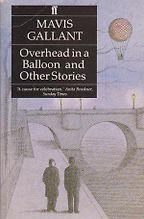
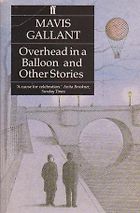
Overhead in a Balloon is by the Canadian writer Mavis Gallant, who moved to Paris so she could write.
That’s right. She moved here in 1950 and has been here ever since. She is still working and she is an absolutely brilliant writer and one of the things she’s done very effectively in her many short stories about Paris is capture the many communities of Paris – the foreign communities, the Parisian communities and the interaction between the two. She spent a great deal of time with all sorts of different members of society. She lived with French families. Her French is impeccable. She is bilingual. But she has never written in French because English is her language of artistic expression.
Like few writers I know, Gallant really penetrated the French mind. And if you read the story “Luc and his Father”, which is the second or third story in that collection, you get a real sense of a French bourgeois family. She wrote it in the early 1980s. She is very good about the pressures that are put on French children and the sort of stifling conformism of that social class. It is a beautifully written, beautifully expressed story. France is, in a way, very liberal but in another way extremely conservative and nothing has really changed in decades or centuries. That story could have been written today.
Emile Zola’s The Belly of Paris transports us to the French capital during the Bonapartist regime of Napoleon III in the mid 19th century.
There was a coup d’etat and he came to power officially as emperor in 1852, then was booted out in 1870 after the loss of the Franco-Prussian War. Napoleon did a great deal to change Paris. He rebuilt it and modernised it. It was so long ago that his modernisations now seem old and quaint. A lot of people have no idea that much of Paris was rebuilt in that period.
Support Five Books
Five Books interviews are expensive to produce. If you're enjoying this interview, please support us by donating a small amount.
One of the things he did was to pull down the medieval market that was in the centre of town on the Right Bank. It had been there for centuries. He replaced it with a modern market called Les Halles, with pavilions of cast iron and glass, which then became very famous as the Baltard Pavilions. Much later they were pulled down, in the 1960s and 1970s, by President Georges Pompidou. There were riots and protests. People still lament the destruction of Les Halles. Emile Zola’s book is set largely at the Baltard Pavilions because the main character, Florent Quenu, winds up working with relations there.
He was someone who had got into trouble with Napoleon III and he managed to escape his imprisonment on Devil’s Island.
Yes, and when he comes back he doesn’t recognise his Paris because of all the building work that has been going on. The book is really about the modernisation of the market and Paris, and French bourgeois society. It’s a study of the contrast of this individual who finds himself alienated from this rich, brilliant, new society. It is wonderfully described and even though much of that Paris has disappeared some of it is still around. The Belly of Paris is a wonderful book of imaginary history if you are at all interested in the creation of “modern Paris”, meaning the city born in the mid-19th century.
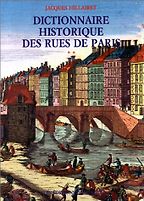
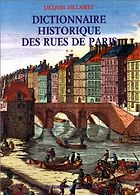
Your final choice fits in well with that and your love of walking. This is Dictionnaire Historique des Rues de Paris by Jacques Hillairet.
Yes, Jacques Hillairet spent decades and decades writing about Paris. His other books are about Paris cemeteries or particular Paris churches and general histories of old Paris. He was passionate about it. He lived to be 98 years old and he spent much of his life walking around Paris and studying the history of its streets. There are over 5,000 streets in Paris. In fact there are, at the last count, 5,334 streets.
Is Paris similar to London, in that it is essentially made up of lots of villages that have come together over time?
Exactly. Now they have all been knitted together, as has happened in London. But, Parisians still talk of les villages de Paris. The charm of this book is that, as with any dictionary, you can get lost in it. You jump from one thing to the next. You will never walk down a Paris street again, after you have read it, without looking at everything on that street and just wondering about the centuries of history of each of the buildings.
You and your wife, like Jacques Hillairet, are also very fond of walking and even do tours. What are some of your favourite places to go?
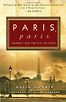
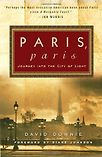
Yes we do tours, and I also write a great deal about walking. My book, Paris, Paris: Journey into the City of Light is about the quintessential Paris, if you will. It’s divided into three: Paris Places, Paris People and Paris Phenomena. My wife and I get a huge number of requests for walks around the Marais district, which is where we have lived for all these years. It is primarily 17th century although there are some older buildings and obviously some newer ones. People love to be taken along the back roads and into courtyards they don’t know they can get into. I really enjoy showing people the hidden things and taking them into the nooks and recesses. Many are open to the public. Visitors might quite normally go into them but often wouldn’t understand their significance.
Get the weekly Five Books newsletter
Millions of people visit the Place de Vosges, for instance, but very few know much about it or its history. Now they are curious to see where Dominique Strauss-Kahn lives! We like to mix and match the past and the present and sometimes speculate on the future.
November 30, 2015
Five Books aims to keep its book recommendations and interviews up to date. If you are the interviewee and would like to update your choice of books (or even just what you say about them) please email us at [email protected]
David D. Downie is a multilingual Paris-based American nonfiction author, crime novelist and journalist who writes most often about culture, food and travel.
David D. Downie is a multilingual Paris-based American nonfiction author, crime novelist and journalist who writes most often about culture, food and travel.