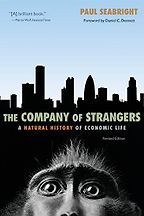
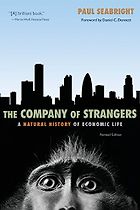
Your first book is The Company of Strangers by Paul Seabright, which reflects on how amazing it is that we let strangers make our clothes, serve us food, and we even allow someone we don’t know fly the plane we’re on…
It’s really about how the division of labour – which Adam Smith first wrote about in the 18th century – has become so extensive that everything we do in the economy means that we’re tightly connected to a huge number of other people.
This is really remarkable if you think about humanity’s evolutionary origins: very tight-knit social circles, where if somebody wasn’t a member of your immediate family or kinship group, you’d probably kill them as soon as you saw them. So this extension of trust to millions of other people who make products and services that we depend on every day is really quite extraordinary. The book is about how miraculous this is – and we normally don’t think about it in those terms very much. Also, how fragile that makes the economy in some ways. The new edition looks in particular at the global financial crisis as a demonstration of the kind of fragility that comes about through those interconnections.
Does that mean the system is at risk, that we might again become suspicious of strangers at times like this?
Paul Seabright isn’t hugely pessimistic: he’s not one of the people who are saying that civilisation is bound to collapse because it’s become overextended and overcomplicated. There are some books that do that – Jared Diamond’s Collapse is a good example of a book that is pretty pessimistic about our ability to sustain the kind of global economy and society that we’ve developed. But in The Company of Strangers Paul Seabright says we need to think about the way human beings relate to each other. We need to think about what we can learn, as economists, from anthropology and sociology, in order to understand how better to govern what we’ve created. Because if you think about it, there are lots of examples of how we don’t have very good rules and systems for making sure that the world economy is well related between countries. It’s still a very nation-state based system.
“Although I think the insights of economics are essential, actually, good economists have never thought economics was enough.”
This is something that people had started to say about globalisation anyway. If you look, for example, at what’s been happening at the Foxconn factory in China…when we think about the standards that those kinds of factories have, compared to the standards in our own country. What do we think about international trade rules that mean that we import things from low cost countries? What kind of intellectual property rules do we have between different countries, where what a US court decides about an American company, in the Google Books case, for example, has implications for writers and artists around the world? So the argument of the book is the need to think about how to do it better and how to draw on psychology and anthropology to allow us to do it better.
Economics isn’t enough; it needs the insight of other disciplines?
That’s right, and although I think the insights of economics are essential, actually, good economists have never thought economics was enough. There’s a kind of caricature about economics, that it’s all about the false assumption that people are rational, calculating machines who don’t care about anybody else. That’s never been true. There was a high tide of economics that was like that in the Thatcher and Reagan era, but that was well over 20 years ago now. For the past generation economists have moved very far away from that kind of caricature. And good economists always drew on history, they drew on mathematics, they understood psychology (even if they didn’t incorporate psychology formally in their models), they were interested in political science and political decision-making. It’s always been a subject that’s been at the cusp of a lot of other disciplines, and I think that interdisciplinary strength has been revived recently and is very much to the fore in a book like Paul Seabright’s.
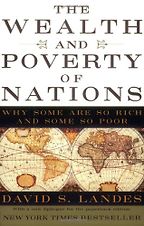
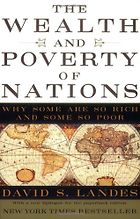
Next is the David Landes classic, The Wealth and Poverty of Nations, looking at why some countries are so rich and others so poor.
I’m one of those economists who love reading history books. I think we can learn an incredible amount from past episodes, because while I do think that economics is a science, it’s a science of a historical kind. It’s a bit like geology, where you have to understand past processes through the bits of evidence that you can see in the rocks around you. You can’t carry out experiments in geology, and you can’t really carry out experiments very widely in economics, though there are special cases.
So history books are really important source material for economists. As well as historical data, we need all the additional detail and colour you get from reading history. The Wealth And Poverty of Nations is one of several really fantastic economic history books of recent times that address the big question, the main question in economics, which is: ‘What makes people prosperous? What makes an economy grow?’ And we have to be humble and say we don’t actually have a very good answer to that question… We’re still searching for what the right answer is.
Different historians emphasise different aspects. Landes’s book emphasises the importance of culture in economic history, and there are other economic historians, like Joel Mokyr, who would emphasise the same kind of thing. So the idea people have about the economy, and how society ought to work, will affect economic growth and how it turns out.
“While I do think that economics is a science, it’s a science of a historical kind.”
There’s a fantastic example that’s always stuck with me. It’s about Jacob Rothschild, who died of an infected abscess. He died through want of an antibiotic that would cost $10 these days. He was the wealthiest man of his era, but he couldn’t be cured of a simple infection because innovation just hadn’t taken us to that point yet. It’s a really powerful example for me, because it points out that the thing about capitalist economic growth that makes people better off isn’t more stuff – it’s different stuff. It’s the innovation and it’s the variety, and it’s the new products.
Another terrific example was a television series that was on in 1999, ahead of the millennium, called The 1900 House. A family was asked to live their lives as if they were living in 1900 and not 1999, down to every last detail. And the thing that nearly made the mother want to give up the experiment was that she didn’t have shampoo and she couldn’t get her hair properly clean. When you think of the new, fantastic high-tech innovations there have been, like cars and computers and so on, they didn’t matter to her. She could live without those, but she could not live without shampoo. And those apparently minor innovations actually make a fantastic difference to people’s wellbeing and their prosperity. That is what economic growth is all about – understanding, over time, the conditions that allow people to have new ideas and to innovate. That’s what’s fundamental and that’s what The Wealth and Poverty of Nations is all about.
You say he puts the emphasis on culture. I never really know what that means.
I think it means the conditions in a society that determine how people think. Is it possible to have new ideas, or will you be regarded as a dangerously subversive heretic for having new ideas or doing things differently? Are there certain ways for women to behave that mean it’s very difficult to increase the general level of education in the society? Are there belief systems that people have that mean things have to be done one way, and not another? So that’s how I think about it. Another aspect I suppose is the social capital dimension of culture, how much people trust each other, because trust is fundamental to any economic exchange. Unless you’re handing over one item for another in a face-to-face barter, then you’re depending on trust. So the level of social capital is very important – how tight-knit the community is, how much people in the society will trust strangers, can you transact with people outside your own village, outside your own town, or in a different country? Globalisation actually places huge demand on the level of trust in the world economy – you really have to have confidence that if you place your order on the internet, somebody in the factory in China is going to deliver the product so that it will eventually turn up on your doorstep.
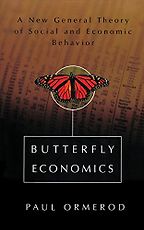
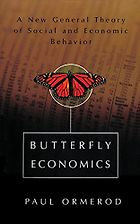
The next book you’ve chosen is Butterfly Economics.
Butterfly Economics is by an economist who is very critical of most other economists. Paul Ormerod might classify himself as a heterodox economist, outside the mainstream. But actually I think his approach is one that mainstream economists ought to take very seriously. He doesn’t adopt the model of rational economic man, he doesn’t believe that people make rational calculations based on wonderful information – he believes that they influence each other. It’s that aspect – of people influencing each other – that is missing from a lot of macroeconomics, when people think about how the economy as a whole behaves. Most economists would assume that I make my choices about what to buy in my own mind, and it doesn’t depend on a program I watch on television, where I see somebody else wearing something and that makes me want to go and buy the same dress.
So Paul Ormerod looks explicitly at how we influence each other in taking economic decisions. And I think it’s a much more fruitful way of thinking about a recession, for example, as a kind of collective failure of confidence in what the future is going to bring. If someone starts to feel pessimistic then they don’t invest in their firm as they might otherwise have done, and if they’re not investing then someone else starts to feel pessimistic about their prospects too. And it’s almost a kind of contagious disease, where a recession becomes a self-fulfilling phenomenon.
Get the weekly Five Books newsletter
Financial market bubbles are another good example of how one person having the confidence that the price of an asset is going to carry on going up will make other people have that same confidence, and it will make itself come true. So Butterfly Economics is about that – the title refers to the famous statement in mathematics of complexity theory, where the flapping of a butterfly’s wings in Brazil can cause a hurricane on the other side of the world – because those interconnections, even if they seem minor from one to the next, actually can have major implications for how the system as a whole turns out. In the book there are lots of terrific examples about how you need to think differently about economic growth and recessions and financial markets, if you are thinking about the influence that we definitely do have on each other.
Do you want to give me one of those examples?
One of the interesting implications is how we do economic policy. If you think about how the governments of the Western world are dealing with the financial crisis and its aftermath, they think of it very much in terms of, ‘We’ve got the lever of monetary policy, and we can loosen that a bit to help stimulate the economy,’ or, ‘We’ve got the lever of fiscal policy, and we can equally use that to try and stimulate the economy.’ It’s a very mechanistic way of thinking: that if you do x then y will follow.
But one of the implications of the self-fulfilling economy model is that it’s actually extremely hard to turn around one of these spiral or avalanche processes, and we only have the illusion that governments can control the economy in this very mechanical way. There’s a chapter in the book called, ‘The illusion of control’. It’s a fantastic contrast to the conventional way of thinking, which dates back to the 1950s when a well-known New Zealand economist called Bill Phillips actually devised a machine (which now sits in the Science Museum in London) where he built a physical representation of the economy as a model with lots of valves and tubes and reservoirs, and if you poured a bit of liquid in, the level of the economy would go up. It was an incredibly mechanical and reductionist version of how to do the economy.
But aren’t a lot of these insights really part of the mainstream now, in terms of the work economists are doing?
I think they have become part of the mainstream, especially in financial markets, where economists like Bob Shiller have made very much the same point, and in the behavioural economics literature. But that doesn’t stop a lot of people who are critics of economics pretending that they haven’t. You still read a lot of newspaper articles and even quite learned journal articles in other social sciences criticising economists for not doing exactly the kind of work that so many of them are doing now.
Yes, I’m not particularly convinced by the argument that the economics profession is under fire and is going to completely change going forward. Most academic economists seem to think people don’t understand what they’re doing, rather than that they’ve been doing the wrong thing.
I find it extraordinary. I’ve written a whole book, The Soulful Science, which says, ‘These are the terrific things economists have been doing for a couple of decades!’ It still doesn’t stop this rather ill-informed criticism. And I’ve even now come across people saying, ‘Well, economists are only pretending to change the way they think about things when they talk about behavioural economics and psychology. They’re still not really understanding the world the way they ought to.’ I don’t know what you can do, apart from carry on saying, ‘Here’s all the good stuff.’
When you say the Ormerod book draws on the mathematics of complexity theory, what does that mean?
It’s a fancy way of saying it’s mathematics that looks at non-linear relationships over time. Economics has tended to use linear relationships, because they’re easy to solve. This is a new kind of maths that dates back to the 70s or thereabouts, and has been used in the physical sciences and biology, and is now being adopted in economics.
So Ormerod is an economist, but he’s done a lot of maths.
He’s a highly mathematical economist.
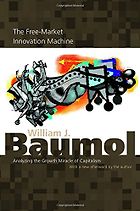
Let’s go on to your next book, The Free Market Innovation Machine.
The Free Market Innovation Machine is by Will Baumol, one of the most fruitful and creative economists of our time. He wrote my textbook when I was an undergraduate – which was a very long time ago. This is a book about how companies do research, put it into practice and develop new products and services. The real insight in it, which hadn’t really been documented so carefully before, is that big companies and small companies do very different types of innovation. The small ones are much more likely to come up with really radical and disruptive innovations, whereas big ones, with their huge corporate R&D departments, are much more likely to make incremental improvements of existing products.
It ties in with the literature in business economics and at business schools, such as the innovator’s dilemma, which argues that it’s very difficult for an established company to do something that will really disrupt its existing, profitable business model. It’s much easier for someone small and new to be disruptive. So Will Baumol looks at examples of the kinds of innovations small companies have introduced compared to the improvements that the big ones do. You need them both. You need the completely new product that will overturn things, but you also do need the constant, decade’s worth of steady improvements as well, because the first version of something that comes along usually isn’t very good, and you need the deep pockets and research efforts of a major company to bring along the successive improvements that will make it acceptable and accessible to the great mass of consumers and become a mass-market product.
This book launched an entire literature looking at the detail of innovation, and what different companies actually do, in much greater detail than had been brought together before. For all the great virtues of economists, many tend to generalise about business without looking at the detail – and the terrific thing about Will Baumol is that he’s an economist who really is interested in the detail of how companies and markets work.
So this was an important area of economics that you felt had been understudied before.
Yes, and since it was published it’s become much more widely studied. People have become much more interested in innovation as a whole, because the impact of the computer and biomedical technologies on overall productivity growth has been quite widely recognised since just after 2000. In the early days of the new economy, there were quite a lot of sceptics about whether it was having any impact on the economy as a whole, and the long-term growth rate. But by 2002, when this book was published, this was coming to be much more widely accepted. It’s something we really need to understand because we have ageing societies. We’ve had a long period of pretty low productivity growth in many Western countries, and if we want to be able to sustain living standards with an ageing and declining population, we have to put much more effort into increasing productivity.
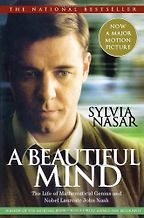
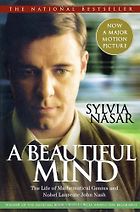
Lastly, A Beautiful Mind by Sylvia Nasar – which you’ve chosen because it is an accessible way to read about game theory?
This is a very different kind of book: it’s by a journalist, not an economist. It explains the work of John Nash, who was one of the leading lights of game theory. I chose it because game theory is such an important technique in economics and other sciences as well, particularly biology. But books about game theory tend to be pretty heavy going. This is a terrific book for just saying something about what game theory helps to do without plunging you into all the complicated mathematics of how to do it in practice.
Game theory is a really powerful technique for understanding the way people respond to each other’s behaviour – for thinking about what incentives they have to do things. What is something likely to make them do? And if they’re going to do that, then what does that imply for what I need to do to get the outcome that I want? It sounds terribly simple, but once you start thinking about it and taking that approach to how people decide anything, then you realise that it’s a tool for thinking about any kind of institution or decision-making context. Game theory was devised and applied originally in the context of making strategic decisions about warfare and the Cold War and nuclear weapons. But you can think about voting behaviour and political choices, you can think about economic decisions, you can think about business strategy. Pretty much any context, you can think about in terms of game theory: If he does this, then what do I do? What’s my strategy?
So even as a non-economist, I should be aware of its insights?
Absolutely. If you’re running a business, or you want to run for office in your local school district, it’s a good way of thinking about how to be successful. And there are, to be fair, some books – Barry Nalebuff’s is one that comes to mind – that do try to tell people how to apply it in practice, but A Beautiful Mind is a good read, and a good introduction as to how important it is and why John Nash deserved his Nobel Prize. Also, it’s an absolutely extraordinary human story – as anyone who saw the film will know.
Five Books aims to keep its book recommendations and interviews up to date. If you are the interviewee and would like to update your choice of books (or even just what you say about them) please email us at editor@fivebooks.com
Five Books interviews are expensive to produce. If you've enjoyed this interview, please support us by donating a small amount.