I’ve always been intrigued by the image chess has in the West as this indicator of extreme, logical intelligence. It really irritates some of my Russian friends, who say, “What a load of nonsense! It’s just a game.”
I don’t think it’s true that chess is a touchstone for the intellect or that it requires an astonishingly logical mind to be very good at it, though it probably helps. Mikhail Botvinnik, who was world champion on and off from 1948 to 1963, said that if music was “an art that illustrates the beauty of sound”, then chess was “an art that illustrates the beauty of logic”. It’s interesting that he used the word art. Chess does correspond, in some ways, to what we see in art – it does have a kind of beauty, and the appeal is very strongly aesthetic to those who actually have eyes to see it. But it’s also a sport and a game – it can be played just as a game, and just as a sport.
Do you have to be very clever to be good at it?
It would be difficult to be strong at chess if you had a subnormal IQ, but you certainly don’t need an IQ of above average. I’m sure you could find very strong grandmasters with IQs around about the 100 mark, which is the average. It was always said that [late chess grandmaster Bobby] Fischer had an IQ of 180. I don’t know if there is any evidence for that. It wouldn’t surprise me, but I don’t know what the proof is.
What I have noticed in very strong players, though, is an extraordinary degree of concentration. You really do have to concentrate very hard for long periods. There is a very boring phrase for that, which is hard work. That’s often underestimated, while the idea of effortless genius is greatly overestimated. And if it is hard work – and it is – then you must get something really quite special out of it, to put yourself through it. You need to really hate losing. Someone once said, “Chess is a battle between your aversion to the pain of losing, and your aversion to the pain of thinking.” Because hard thinking is stressful and difficult. Quite often, the reason why, as we get older, we lose more games of chess – certainly in my case – is that you begin to get more pain from thinking than you do from losing. Also, if you’re a young person, you’re probably rejecting other ways of occupying your time, which most people would think are more pleasurable, whether it’s watching Teen Idol or playing football or having a drink. It has to really excite you, so motivation plays a huge part. That’s often described as natural ability, but it may actually be a description of something that is more like desire, a really huge desire.
Bobby Fischer claimed he was a genius who happened to play chess, but if you look at his life history he was absolutely obsessed and playing chess constantly from age six.
Fischer became American champion at the age of 14, which is astonishing. But if you think about the amount of effort he put in between learning to play and becoming American champion, it was a huge amount, because he dropped everything else. This partly links into the idea in Malcolm Gladwell’s book Outliers of the 10,000 hours [needed to succeed], which he borrows from various psychologists. I think there is a lot to that. There are exceptions. At the very, very top of the distribution, you get people like Magnus Carlsen, the 20-year-old Norwegian who is the world’s strongest player at the moment. I remember speaking to his father, and he said that at the age of three Magnus would sit for hours doing 50-piece jigsaw puzzles – very unusual behaviour for a three-year-old. Or you have [José Raúl] Capablanca, who was probably the most naturally talented chess player that ever lived. He learned the game at the age of four just by watching his father play. He then beat his father at four and went on to become world champion. He clearly had something very, very special. There was something in the cast of his mind that grasped these concepts with amazing rapidity and very naturally. I don’t know whether the word innate is right, but there’s clearly something there that isn’t normal. But it’s statistically so incredibly unusual that you can almost disregard it.
For people reading this, who might know you as a British newspaper editor and columnist, do you want to explain your connection to chess?
Chess is my particular passion. I became reasonably good at it and I still play for my county, Sussex. I also write a monthly column in Standpoint on chess. I learned the rules of chess when I was eight, at school. Then I lost interest completely. I didn’t come from a chess-playing home or family. In fact, I think I had to teach my father to play. I didn’t really get interested again until my mid-teens, which perhaps ties in with my first book. This is when Bobby Fischer was mounting his assault on the World Chess Championship in the early 1970s. For someone interested in politics, there was a context which will never be repeated – the American loner against, as it seemed, the might of the Soviet Union. The Soviets had made it almost the national sport, and every single world champion since World War II had been a Soviet. I wouldn’t say Russian, although they were described as Russians. One was from Latvia, another from Armenia. Many of them, in fact, were also Jewish, which was never mentioned.
That period was the first time I really got to grips with it. I remember Nigel Short, who was phenomenally strong as a young player, saying to me, “Oh well, Dominic, that was too late!” He said he was lucky, because he was much younger when the Fischer phenomenon hit the West. You had to be much younger to get the bug in order to become very strong. When I won a cash prize at a tournament my father said to me, “That’s good! That means I don’t have to give you any pocket money. But it’s a mistake to think you can make a career out of it.” Of course he was quite right. Very, very few people are especially good at it. I discovered when I was at Oxford, and I was up against people who became very strong grandmasters, like John Nunn and Jon Speelman, that I had no real gift. Their mental hardware was simply miles better than my mental hardware – they just saw things that much more quickly and their powers of visualisation were so much greater.
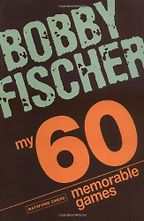
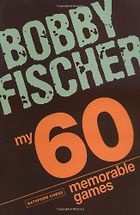
So Bobby Fischer gave you the bug. Tell me about his book, My 60 Memorable Games.
It’s not clear how much of this book was written by Fischer and how much was written by a grandmaster called Larry Evans, who was a friend of his and a very strong player. Nonetheless, officially, this is Fischer’s only game collection. The 60 games begin in 1957 and go up to 1967, so it’s only 10 years. What is very attractive about the book – apart from the fact that Fischer was such an extraordinary player and analyst – is the honesty of his comments. There was always a simplicity to Fischer which was seductive, even if at times it could also be very crude. Now one thinks of Fischer as someone who would never admit to any kind of error or weakness, but this book sprang from an earlier part of his life.
He’s laceratingly self-critical, which is quite unusual in these kinds of books. He uses phrases like, “I already knew that I had been outplayed.” Or, “I just underestimated the force of his reply.” It also contains three of his losses, whereas you tend to find in these “best of my games” books that it will all be wins.
At the beginning, he quotes Emanuel Lasker, a great world champion of the early 20th century, saying that on the chessboard, “Lies and hypocrisy do not survive long. The creative combination lays bare the presumption of the lie; the merciless fact, culminating in a checkmate, contradicts the hypocrite.” This is an aspect of chess which was especially compelling to me as an adolescent. There is no hypocrisy in it, no duplicity. Everything is open, you can’t hide and you can’t prevaricate. To people of a certain age, boys perhaps, that is very attractive. And Fischer, in that sense, never grew up.
The games themselves, Fischer’s best games, have a fantastic clarity, which is particular to his style. A lot of the very greatest players, and particularly the Soviet players, rather relished high levels of strategic and tactical complexity. Fischer sought clarity, and achieving it is, in a way, more difficult. This is why sometimes comparisons are made between Fischer and Mozart. As a young player, learning chess, you may not be able to emulate it, but you can understand clearly what he is trying to do. It’s not sophisticated, it’s not deliberately obscure. That was very attractive to me, and many other people, coming to terms with the game at that period.
People say he made it look easy.
Yes, but it’s deceptive because clearly he puts huge effort into it. Certainly he had a brain that cut through problems. Often, I suppose, that is the key to the great chess imagination – being able to see what the shortest route is from A to B, when it isn’t necessarily obvious. His play was very streamlined.
Was that the first chess book you read?
No, but it was the first one I found inspirational, partly because he described not just the moves but the psychology, what was going on at the board.
Give me an example.
There’s the game he played against the Yugoslav player [Petar] Trifunovic, game number 33 in the book, played in Bled in 1961. Trifunovic was a very solid player, extremely hard to beat. At one stage Fischer writes “I was considering a move, Bishop to N5”. He gives it a question mark – denoting a blunder – and says, “Trifunovic seemed too quiet all of a sudden, and I suspected he’d tuned into my brain waves.” Fischer goes on to write that it was only because he had sensed his opponent’s unnatural stillness that “at the last minute” he saw that the move he was about to play, B-N5, would in fact have been a terrible blunder. The book has many of these kind of notes that give a tremendously vivid sense of the mental and psychological struggle. He transmits the true nature of top-flight chess, which is not just a question of reams and reams of variations, but also of the interplay between two human beings.
People say of Fischer that he was oblivious to other people’s feelings, but in the context of a game he’s clearly acutely aware of what’s going on in his opponent’s mind.
Fischer used to say, “I don’t believe in psychology, I believe in strong moves.” In a way that’s true, but when you’re at the board you can’t not be aware of it. Of course the variations are also very deep and detailed. It’s one of those books where you need two chess sets, one for the board, and a pocket set to follow the variations, because Fischer had astonishing powers of calculation. It’s not an easy book, at that level. It’s not a book you could give to a beginner.
Are any of these books useful for a beginner?
No. These are books that repay constant reading and rereading. You couldn’t say that about books for a beginner – once you’ve read them, you throw them away or give them to your child, or the child of a friend.
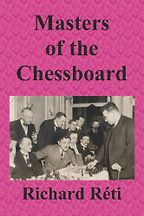
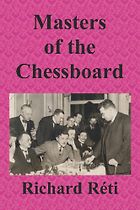
Let’s go on to Masters of the Chessboard by Richard Réti, who died in 1929.
Réti was a very strong player, who died at the age of 40, unfortunately. He once played 29 games simultaneously, blindfolded. He was a tremendous talent. His particular claim to fame is that he was a great theoretician, and invented his own opening, which still bears his name – the Réti opening. He was one of the leaders of a revolutionary philosophical movement in chess, called the hypermodern school. The hypermoderns overturned certain preconceptions which had become, perhaps, too rigidly adhered to, like the view that you had to occupy the centre at all costs.
But this book, Masters of the Chessboard, isn’t a polemical work. It’s beautifully written. What Réti does is he looks at all the great chess players of the past, going back to the mid-19th century, up to his own time. He analyses the style of the individual players and explains what they brought to the game. You get a sense of their character and personality, also because he played a lot of these people in his short career. He writes about Capablanca, and has this wonderful line about him: “He speaks his native tongue when he plays chess.” It’s as if he learned to play chess almost before he learned how to speak, and he contrasts Capablanca with another player, one of his challengers, who learned chess at a later age, and describes him as “someone speaking in a foreign language”, which I thought was a most elegant metaphor.
He also explains chess in a very scientific way, so he has a chapter devoted to the technique of chess combinations. He does it in a methodical way, which for the student of chess is very valuable. He also has a chapter on rook endings, the most important of all ending types, and he develops ideas on that in a way which you can’t help but learn from.
Even though it’s quite an old book, in Amazon.com reviews people are very excited about it – making comments like the “best chess book ever written”.
It was first published in 1933, and people have tried to write follow-ups, looking at more recent chess players in the same way. An American master called Anthony Saidy wrote a book called The Battle of Chess Ideas, where he went from Réti’s time to Fischer (whom he knew well). It’s a very good book, but it doesn’t have the kind of didactic or visionary properties that Réti has, so it didn’t make my list. Despite all the improvements that have happened in technique and knowledge, for anyone who really wants to understand chess, Masters of the Chessboard is a book to read just beyond the point of starting out, when you get to a certain level. It explains the nature of positional strategy in chess probably better than anyone else has ever done.
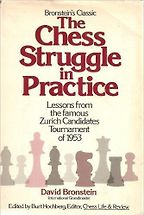
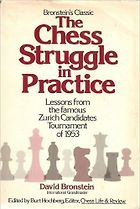
Your next book, The Chess Struggle in Practice, is about the 1953 Zurich International Chess Tournament, and it’s by one the top Soviet players of that era, David Bronstein.
Bronstein was very nearly world champion. In 1951 he played a match that was drawn, and because he was the challenger, the titleholder Botvinnik kept the title. It was very controversial because Bronstein was one game ahead with two to play, and lost the penultimate game in rather strange circumstances. This was during the Stalinist period, and it was said that because he was distantly related to Trotsky, and his father had been in a gulag, the Soviet system didn’t want him to win. I don’t think he deliberately threw it, but he was under certain unusual pressures. Bronstein is a marvellous writer. He wrote the best books of the era, and this is by no means his only great book.
It’s about one of the great tournaments of all time, to find an official challenger for the world championship then held by Botvinnik. Apart from Botvinnik, of course, it had all the great players of an extraordinary era: Bronstein himself, Keres, Smyslov, who won the tournament, Reshevsky, the American champion. It was a massive tournament, 28 rounds, of the sort that nowadays you just wouldn’t have.
Bronstein’s notes, rather like Fischer’s, are full of verve and honesty. He gives you a tremendous sense of what is happening in the middle game. He tends to ignore the opening and the ending, and concentrates on what he says is “the heart and soul of chess”. He gives you very sharp analysis, of course, but also the sense of having a ringside seat, right next to the players. So he describes a game where Reshevsky is playing and wins against another Russian, Boleslavsky. He says: “To understand the following curious events, one must know, first of all, that they occurred when Reshevsky was in tremendous time trouble, and secondly, that all this occurred very late at night. The 22nd round fell on a Saturday.” Reshevsky was an orthodox Jew, so, “For religious reasons, he started his Saturday games after… the rise of the evening star; on Fridays he played his games during the day, so as to finish before the rise of that same star.” So Reshevsky was not just moving very quickly because he didn’t have much time, but because he couldn’t play any longer.
Bronstein is full of these flashes of insight, which explain what otherwise would be a mystery if you just studied the moves. It’s the kind of book one never stops reading, and it also marked a significant period in the development of chess. These were the golden years of what became known as the “Soviet School of Chess”, when there were an extraordinary number of very strong Soviet players, who developed openings in a way that had never been seen before. Their preparation went right into the middle game, and their analysis was much deeper and much more rigorous than anything that had happened before. It was the dawn of the professional age. They called themselves amateurs, because they had commissions in the Soviet armed forces, but they were the first fruits of a special generation created by a great nation committing itself to the idea of people playing chess full time.
That was one of the questions I wanted to ask you – why did the Soviets dominate chess to such an extent? Are you saying it was a result of government policy, basically?
It was a mixture of things. Yes, Lenin in particular was very keen on chess. He was rather an addict, I think. Apparently he once said that one could make a revolution, or one could play chess, but that it wasn’t possible to do both. As you know, the Soviets liked to portray themselves as scientific in everything that they did. Marxism was scientific – dialectical materialism. Then there was the Sputnik and the space race. This is what Soviet man represented, a nation of engineers and scientists. Chess fitted in beautifully with that Soviet image because it was seen to be remorselessly logical and objective. It was also cheap, because all you needed were some wooden or plastic pieces. It could be given to very many people who were very poor. It was a way of proving that the Soviets were better than the West in a way that would have been more difficult to do in other fields that required more money.
Also, at the individual level, if you were a bright, intelligent young Russian, it was a very good way for the authorities to deflect people who might otherwise be quite troublesome, because it was entirely apolitical. I suppose the Chinese today have a very similar attitude to chess – they like it very much. Lots of them, including Bronstein, Botvinnik and Tal, were Jewish. Jews were discriminated against in more conventional areas of expertise because there was a lot of antisemitism in Russia. Chess was somewhere where they could be tolerated. Here they were innocuous, they weren’t exploiting anyone, they weren’t gaining power or money. Also, without being flippant, what would you do for many, many hours in the evening, if you were in the Soviet Union in the 1950s? How, as a young person, would you actually amuse yourself? It would be perfectly sensible to spend five or six hours at the Moscow Central Chess Club, because what would be the alternative? Not a whole lot that was very interesting or exciting. And what would be interesting or exciting might also be rather dangerous.
What’s the top nationality now?
The Russians still, or part of what we used to call the Soviet Union. The Armenians are fantastically strong, they have hugely disproportionate strength as a nation – they’ve won the chess Olympiad twice in recent years. That’s partly a legacy of the Soviet period, and partly because they had a world champion in the early 1960s called Tigran Petrosian. That created a huge surge of interest in Armenia, just as Fischer’s did in America for a while. Another country that has a huge interest in chess and a disproportionate number of grandmasters is Iceland.
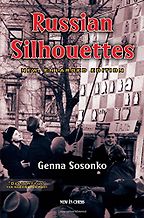
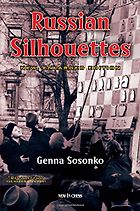
Your next book is by another Soviet player, Genna Sosonko.
Yes, there are two, Russian Silhouettes and The Reliable Past. They are basically a series. Sosonko was a Russian grandmaster and he emigrated, in 1972, to Holland. As someone who has left it behind, he gives extraordinarily deep, poignant, moving and personal accounts of the great chess players that he knew, people like Bronstein, Tal, Korchnoi, who really were part of a historical era.
The golden age of Soviet chess?
He probably wouldn’t see it as Soviet, exactly. Sosonko is also, I think, Jewish. Let me give you an example. In Russian Silhouettes, he talks about a player called [Mikhail] Tal who was a Latvian Jew. Tal became world champion in 1960. He was an extraordinary talent, a very unusual man, and perhaps the most daring attacking player of all time. He was tremendously popular with chess fans, not just because he was young, but because he had an enormous, dazzling flair. It was very hard to tell how much was calculation and how much was bluff or psychology, but Tal really used to bamboozle very strong players. He was a reaction against the Soviet school, in a sense. It didn’t seem very scientific, because he relied on a fabulous instinct. Kasparov said about him that he was unique in that he didn’t calculate variations, he just saw them.
Five Books interviews are expensive to produce. If you're enjoying this interview, please support us by donating a small amount.
He also conformed – and Sosonko is very funny about this – to the view of chess players as somehow from another world. He writes that Tal was “totally indifferent to any form of technology. It goes without saying that he never entertained any thoughts of learning to drive, he never learned to shave.” He also never wore a watch. Sosonko quotes Tal saying: “What’s that? You’ve got something ticking on your arm!” Unfortunately, he was also an alcoholic and a drug addict. He damaged himself by drinking and then his liver and kidneys began to malfunction, and the pain relief required the use of morphine. I remember seeing Tal, not long before his death at the age of 55. He looked about 90. He was an extreme character.
Given Sosonko left the Soviet Union, does he give us insights into the Soviet system?
It’s more about the players. It’s about the extraordinary intellectual culture of these brilliant young men, who somehow focused on this game. He talks about Tal’s death and how he was buried in a Jewish cemetery near the graves of his relatives. He writes: “I asked myself, where do these boys from decent European Jewish families, Modigliani, Kafka, Tal, who are even similar in appearance, get their all-absorbing passion for self-expression from? What is the secret here? I don’t know.” So he doesn’t come up with a theory, but he does give a sense of the passion that they have. Sosonko says that he is writing, in part, because players are dying or have died. He says that each time, after one of them passed away, he wanted to read about them. “Later, I realised that what I wanted to read about them was what I myself knew, which is why I’ve written this book.” It’s a very good way of putting it. The book is translated from the Russian, but he writes beautifully, better than any other person who has written about the chess of the modern era.
An attractive aspect of these two books is that although Sosonko was a very strong player and a grandmaster, they contain no moves at all. There are no games in them. They are purely biographical sketches. So anyone who doesn’t play chess but is interested in learning about the people who play chess – particularly in that period – can develop a very deep understanding of what it was about, the personality, the emotion and the character. There are also wonderful photographs from Sosonko’s private collection.
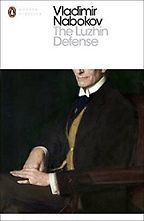
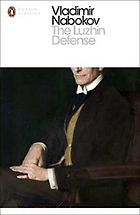
Lastly, you’ve chosen a novel, Vladimir Nabokov’s The Luzhin Defense.
The Luzhin Defense is far and away the best novel written about chess players. It deals with chess and madness, which is an intriguing topic, because it’s often said that chess grandmasters have a propensity to insanity. Statistically, it’s probably not true, but, nonetheless, people think about Fischer, they think about [Wilhelm] Steinitz, the first undisputed world champion who went insane, and there were others as well, such as [Paul] Morphy and [Akiba] Rubinstein. The great mystery to me, which this book touches on, is that it’s often said that these people are driven mad by chess, when actually it might have been the other way around – chess was the only thing that kept them from going off the deep end. It’s when they get away from chess, or try to break away from it, that their characters disintegrate. Fischer’s lunacy, if that’s what it was, broke out in full force when he abandoned playing the game. Within chess he was sublimely rational. They are often people who can be slightly awkward outside chess, but in chess are completely balanced.
And Luzhin is one of these people. A sullen, lonely child who takes refuge in chess.
Yes, he’s unpopular with other boys as a child. He’s mocked and teased, he’s physically uncoordinated, he doesn’t seem to have any particular aptitude. He’s an only child, and his mother brings back a chess set. Suddenly, it’s like a switch has been turned on in his head, and the rest of world is dark. There’s this flash of light and all he can see is chess. For Luzhin, chess is much more vivid than life itself. He’s perfectly at home there. The tragedy is that his fiancée, who is never named, thinks that he’s this wonderful person and if only she can get him away from his wicked, evil game he’ll be fine. But of course he can’t see any meaning in life outside chess. There’s a terrifying end to the book, when he throws himself out of the window of his hotel room and is falling towards the ground, and the floor below is tiled with black and white squares. It seems like a wonderful release – he is going into a familiar world and it’s welcoming him.
Was Nabokov himself a good chess player?
He certainly played chess. I don’t know how strong he was. I think he composed chess problems, which is a whole realm of chess closer to pure mathematics than playing chess is. He was of course Russian, though an émigré. He certainly understood the attraction of chess very well, which is why his book is so good. He’s also, of course, a fantastic writer. This is one of his earlier novels, he wrote his more famous ones later, but it’s a marvellous book, immensely powerful.
There’s a very wonderful passage in the book, showing that there are problems with chess itself for the human brain. Luzhin is playing a game in a world championship match and he’s lighting a cigarette – those were the days when you were still allowed to smoke during games – and while he’s contemplating the move he leaves the match lit and burns himself by mistake. Nabokov writes: “The pain immediately passed, but in the fiery gap he had seen something unbearably awesome, the full horror of the abysmal depths of chess.” Which is true because the variations are unfathomable. The computer has done a great deal, but it hasn’t solved it, and probably never will. So you think that you’re battling another person, but there is actually something much more powerful that you’re battling, which is chess itself. And chess itself, it seems, will always win.
Five Books aims to keep its book recommendations and interviews up to date. If you are the interviewee and would like to update your choice of books (or even just what you say about them) please email us at editor@fivebooks.com