What is the Buddhist equivalent of the Bible? What is the Dalai Lama's favourite book? Buddhist scholar Donald Lopez recommends some of his favourite books on Buddhism.
What made you first become interested in Buddhism?
I was a philosophy major in college, and out of vulgar curiosity I took a course called ‘Intellectual History of China to 618 AD’. That was where I first learned something about Buddhism. The Vietnam War was going on at the time and we were all looking for esoteric knowledge from the ‘Oriental religions’ as they used to be called. It was that admittedly naive interest that got me started.
And all these years later what do you think will be the effect of the Dalai Lama stepping down as the political leader of the Tibetan government in exile?
It is important politically, as a transition to the political structure that will be required after his death. However, he is held in such high esteem that his counsel will still be sought on all matters of importance. He will remain the central figure for the Tibetan people, both in exile and in Tibet.
Presumably he’s looking to retire more into study and prayer?
He already spends many hours each day in study and meditation. As far as I know, he will continue to travel around the world to give Buddhist teachings and promote the cause of Tibetan autonomy. Thus, I don’t think that his diminished political role will decrease his visibility.
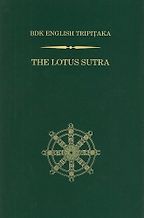
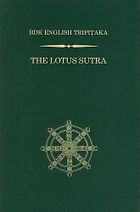
Let’s move on to your five books. Your first choice is one of the most important texts in East Asian Buddhism, The Lotus Sutra.
That’s correct. It is particularly famous in East Asia, but it was very important in India (where it was composed) and Tibet as well. We sometimes think of a religion as having a single sacred text, whether it is the Bible or the Torah or the Koran. And for those traditions that don’t have a single text, we sometimes think of a signature text such as the Bhagavad-Gita for Hinduism or the Tao Te Ching for Taoism. Buddhism doesn’t really have such a text. There are thousands of texts that are considered canonical by one or another of the Buddhist traditions of Asia. But if I had to choose one sutra it would be The Lotus Sutra.
A sutra is a discourse attributed to the Buddha himself, something that he is supposed to have taught. Yet The Lotus Sutra appeared four or five hundred years after the death of the Buddha. He probably died around 400 BC and nothing was written down until four centuries after his death. Then, for reasons that are not entirely clear, in the first and second centuries of the Common Era, texts started to be written that claimed to be the teachings of the Buddha.
And why do you think that was?
It is generally believed that tensions developed between a more conservative monastic element and groups that had a different view of the person of the Buddha and the nature of the path that he taught. This latter group, which came to be called the Mahayana or ‘Great Vehicle’, also included monks and nuns, as well as members of the laity. The Lotus Sutra is the most famous of the Mahayana sutras, proclaiming that all beings will eventually achieve buddhahood and declaring that the Buddha did not pass into nirvana at the age of 80 but has a lifespan that is immeasurable.
What do you personally take from it?
Despite the fact that it is teaching something that does not appear in the earlier tradition, it has ingenious ways of presenting itself as the Buddha’s highest teaching. It does this through the use of a number of famous and often moving parables. It also contains a rather strange and charming self-referential quality, constantly proclaiming itself to be the supreme of all the Buddha’s teachings. Many Buddhists across Asia over the subsequent centuries would come to see it as just that.
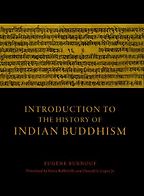
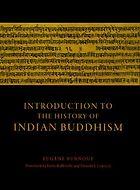
Your next choice was the most influential work on Buddhism to be published in the 19th century – Introduction to the History of Indian Buddhism by Eugène Burnouf.
Much of what we understand Buddhism to be today is a direct result of how Buddhism was portrayed in Europe in the 19th century. By the time that the Portuguese arrived in India in the late 15th century – eventually followed by the Dutch, the French, and the British – Buddhism had effectively disappeared from the subcontinent.
Why?
There are a number of reasons. We know from the reports of Chinese pilgrims that Buddhism had been in decline for some time, its fortunes waxing and waning based on royal patronage. It also seems that Hindu priests, more than Buddhist monks, were performing important life cycle rituals for much of the Indian population. In addition, in the 11th century, Muslim armies carried out a series of incursions into northern India during which a number of Buddhist monasteries were looted. Perhaps the greatest of the monasteries, Nalanda, was sacked in 1193: the Muslim troops apparently mistook it for a fortress.
As a result of these various factors, when Europeans arrived in India, the birthplace of Buddhism, it was active all around India, in places like Sri Lanka, Thailand, Burma, China and Tibet, but it was dead in India. What Europeans found were the remnants of Buddhism – texts, monuments, statues, inscriptions – and from these they built Indian Buddhism as we understand it.
So there has been a massive Western influence on Buddhism.
‘Influence’ may be too strong: it might be more accurate to say that the academic study of Buddhism in the West, often by scholars who never travelled to Asia, played a key role in defining what we understand Buddhism to be.
In the case of Burnouf, in 1837, 24 Sanskrit manuscripts arrived in Paris, sent from Kathmandu by Brian Houghton Hodgson, an officer of the East India Company serving in Kathmandu. They were Buddhist scriptures, long lost in India but preserved in Nepal. The Société Asiatique instructed two scholars to examine these texts.
One of them was a young Sanskrit scholar named Eugène Burnouf. He found the second text that he looked at to be captivating. It was The Lotus Sutra. He knew nothing of its huge importance in the history of Buddhism, but he liked the way it read. He soon translated the entire text, but he felt it would be incomprehensible without an introduction.
He thus wrote a long book, the first of as many as five planned volumes of introduction. Due to his untimely death, he was only able to complete the first volume, published in Paris in 1844 with the modest title Introduction à l’histoire du Bouddhisme indien. It would become the most influential work in the history of the European study of Buddhism, setting the stage for more than a century of subsequent scholarship. For example, it provides the portrait of the Buddha as we know him today.
And I know you had a big part to play in that with the translation you did of his book.
My colleague Katia Buffetrille and I translated the entire text, so we have an intimate knowledge of all 647 pages.
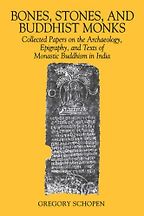
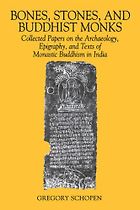
Your next choice looks at the social history of Indian Buddhist monasticism, Bones, Stones, and Buddhist Monks by Gregory Schopen.
After Burnouf, we see much of the European interest in Buddhism moving away from his emphasis on social history toward philosophy and doctrine. European thinkers became fascinated by ideas like karma, nirvana, and no self. In the process, Schopen argues, we lost sight of what Buddhism was ‘on the ground’ in India. Thus, rather than concentrating on canonical philosophical texts, Schopen looked to different sources. One was the monastic code that explains in great detail how monks and nuns are supposed to live their lives. Another source was epigraphy, especially those inscriptions describing donations made by monks and nuns. From examining these sources, Schopen was able to show that many of our views of Buddhist monastic life and practice were rather romantic.
What kind of misconceptions did people have?
We tend to think that Buddhist monks and nuns had no possessions. In fact they owned property, which they willed to others when they died. We think that they had severed all ties with their families when they were ordained, when in fact they did good works and dedicated the merit or good karma to their parents. We think that they spent all their time in meditation when in fact meditation was just one of several specialties in the monastery.
He wanted people to concentrate on the cultural and social aspect?
Exactly. Of course all religions are cultural and social, but for a variety of reasons, it became easy to lose sight of that in the case of Buddhism, which has sometimes been seen as a free-floating philosophy that benevolently descends on one culture after another without having much effect on the more quotidian elements of human experience.
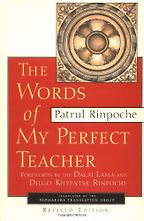
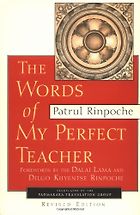
Your next choice is one of the Dalai Lama’s favourite books, Words of My Perfect Teacher by Patrul Rinpoche.
Tibetan Buddhism had rather bad press in Europe and America, being called Lamaism into the 20th century, as if it did not merit the name ‘Buddhism’. It is only since the Dalai Lama left Tibet and went into exile in 1959 that our perception has changed dramatically. Today, 52 years later, many Tibetan Buddhist texts have been translated and we know a great deal more about the practice of Tibetan Buddhism. Even after 1959, there was a certain prejudice in favour of works from the earlier periods of Tibetan Buddhist history, from the 11th to the 15th centuries.
Words of My Perfect Teacher is a more recent work, composed in the late 19th century by a meditation master from Eastern Tibet, Patrul Rinpoche. Someone who is interested in knowing more about what the practice of Tibetan Buddhism is really like would find this book very useful. It belongs to a genre of Tibetan literature that one might refer to as ‘everything you need to know to become enlightened’. But unlike other works of this genre, Patrul Rinpoche’s text is not overly burdened with quotations from the scriptures. It is conversational, even earthy, in tone, making it all the more powerful.
Often it is easy to forget quite how many different schools of Buddhism there are. Why do you think we are so fascinated by the Dalai Lama? Why is he far and away the most famous Buddhist alive?
There are a number of reasons. The High Lama of Tibet is something that Europeans fantasised about for centuries, extending into the 20th century and James Hilton’s 1933 novel, Lost Horizon, where the term ‘Shangri-La’ was coined. Beyond that, the current Dalai Lama is a highly accomplished practitioner and scholar of Buddhism. He is also a Buddhist monk who takes his vows very seriously. So there is a great deal to admire in him as person. He is also a figure from a land whose religion and culture have been ravaged. The Chinese invaded Tibet in 1950 and in the aftermath Buddhism suffered greatly. Thus, there is much sympathy for the Tibetan cause. This combination of the religious and the political in a single person makes the Dalai Lama a compelling figure.
Your last choice, Journey to the West, translated by Anthony Yu, is one of the most popular classics of Chinese literature.
In 629, a Chinese monk named Xuanzang set out for India in order to retrieve Buddhist scriptures, returning in 645. He was welcomed as a hero by the emperor and received the title ‘Master of the Tripitaka’, the Buddhist canon. Xuanzang wrote a detailed account of his travels, entitled Great Tang Records on the Western Regions – if I could choose six books, it would be the sixth. His long journey to India and back, much of it alone, is considered one of the most remarkable feats in the history of Chinese Buddhism, taking on legendary proportions. In the 16th century, Wu Cheng’en wrote a comic novel about it, entitled Journey to the West.
It is interesting that outside Buddhist literature itself, when we read Indian dramas or Chinese novels or Japanese fables, Buddhist monks are often portrayed as lecherous or avaricious or simply foolish. In Journey to the West, the protagonist, a monk named Tripitaka, is well meaning but weak, pious and learned, but inexperienced in the ways of the world, dissolving in tears at the slightest difficulty. He would never have been able to make it to India alone.
Fortunately, he is protected by the bodhisattva of compassion, who provides him with a bodyguard, a mischievous monkey endowed with all manner of magical powers. Although not intended for children, the novel, and certain chapters in particular, is among the most famous children’s story in East Asia, depicted in comic books and cartoons. Journey to the West is one of the great picaresque novels in world literature, often uproariously funny and filled with all manner of magical derring-do – even better than Harry Potter.
May 2, 2011
Five Books aims to keep its book recommendations and interviews up to date. If you are the interviewee and would like to update your choice of books (or even just what you say about them) please email us at editor@fivebooks.com
Five Books interviews are expensive to produce. If you've enjoyed this interview, please support us by donating a small amount.
Donald S Lopez Jr
Donald S Lopez Jr is the Arthur E Link Distinguished University Professor of Buddhist and Tibetan Studies at the University of Michigan, where he serves as chair of the Department of Asian Languages and Cultures and chair of the Michigan Society of Fellows. His most recent book is The Tibetan Book of the Dead: A Biography, one of the inaugural volumes in the new series ‘Lives of Great Religious Books’ published by Princeton University Press.
Donald S Lopez Jr is the Arthur E Link Distinguished University Professor of Buddhist and Tibetan Studies at the University of Michigan, where he serves as chair of the Department of Asian Languages and Cultures and chair of the Michigan Society of Fellows. His most recent book is The Tibetan Book of the Dead: A Biography, one of the inaugural volumes in the new series ‘Lives of Great Religious Books’ published by Princeton University Press.