Music & Drama
The best books on Protest Songs
recommended by Dorian Lynskey
The journalist and author tells us what happens when protest meets pop music, which book inspired Springsteen and where hip-hop is most potent today


The journalist and author tells us what happens when protest meets pop music, which book inspired Springsteen and where hip-hop is most potent today
How would you define a protest song?
I think it is a song which deals with political issues in a way that aligns itself with the underdog. I wanted to write about political songwriting in the broadest sense. There is no real set definition but this is the one that works for me.
What got you interested in this?
When I was a teenager and getting into politics, that was also when I discovered hip-hop. Also there were bands about like New Model Army and The Levellers, which are bands I haven’t really taken with me into adulthood but, at a time when I was thinking about politics, it was good that there were lots of bands reflecting that. For me they were a way of making politics seem like part of popular culture, and a part of my life as opposed to something distinct or dry or boring. Then it took me 15 years to realise that it might be something I could write a book about.
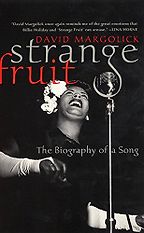
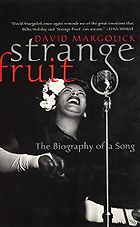
Let’s take a look at some of the books which helped you with your own, 33 Revolutions per Minute. Your first choice is David Margolick’s Strange Fruit.
Strange Fruit [first performed by Billie Holiday in 1939, condemning American racism] was the first time you had a really clear protest message in a song which was performed in nightclubs amid a set of songs which weren’t political.
How did audiences react to that?
Well, they were confronted with an issue that they maybe weren’t expecting. Before, there was a tradition that the folk singer Woody Guthrie represented – songs from the labour movement which started with the International Workers of the World. Those were songs that were very much designed to be sung by anybody. They were handed down not in records but in song books. They were basically propaganda. This song is art. So much is about the arrangement and the emotion in Billie Holiday’s performance. My interest in writing my book was what happens when protest meets pop music.
Presumably it reaches a more varied audience.
Yes, but it also creates more friction and complexity. Some people didn’t want that kind of message in their pop music. All the debates which animate the book start there.
And this particular book was instrumental in 33 Revolutions per Minute.
Yes, I read Strange Fruit when I was working on the proposal. I had heard about it before and it intrigued me because it is subtitled “the biography of a song”. And what I was trying to do was tell the story of a moment in history through each song. This book does it so well. It is such a brilliant, lean telling of that moment from lots of different angles. You get Billie Holiday’s biography, but also he interviewed a lot of people who had heard the song at the time, many of whom are now dead. Those interviews sparked so many ideas for me about the different perceptions and the ways people responded. You would expect them to be saying it was an amazing piece of art and a ground-breaking song, but actually lots of them felt it was very simplistic and not a very good piece of music. For some it ruined their Saturday nights, it wasn’t what they came out to hear.
There aren’t that many books which are about just one song, and show that the song is a pinhole through which you can see all these characters and issues. It was hugely influential and so thorough that I had to do quite a lot of other reading to make sure that all of my material about [the song] Strange Fruit didn’t come from this book. It is one of those books that you wish you hadn’t read because it is so good on its subject.
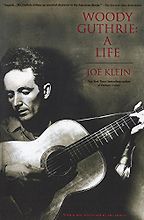
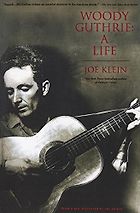
High praise indeed. Next up is Woody Guthrie: A Life by Joe Klein, a biography of America’s legendary folksinger activist.
There are other Woody Guthrie biographies, but this is written incredibly persuasively. Joe Klein is a very good storyteller. The fact that he has gone on to be a political correspondent for Time and also to write the novel Primary Colors shows just how good he is. It was invaluable research for my Woody Guthrie chapter.
But this book also became part of the history of protest songs itself. Bruce Springsteen got hold of a copy, and that really turned him onto the history of Woody Guthrie and made him want to deal more with politics and the idea of America in his own works. Springsteen responded very quickly to books. A lot of the time he would read a book or see a movie and then write a song inspired by it. He started covering Guthrie’s most famous song, This Land is Your Land. Springsteen’s Nebraska album owed a huge amount to this book because it introduced him to the history of the American left.
And he in turn went on to influence others through his songs.
Yes, and for me the book is just a really thrilling narrative, which made me realise how you could put political background into a personal story without it seeming like a big indigestible chunk.
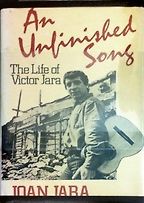
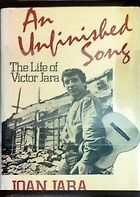
Your next book moves away from America to Chile. An Unfinished Song: The Life of Victor Jara was written by his wife Joan, who is actually English. Victor Jara had a particular grisly time in the national stadium.
Yes he did. When he was younger, he went to America, visited Berkeley and saw the late 1960s American left at its peak. He thought that the Americans didn’t know how good they had it and were not really up against life and death.
Certainly not in the same way that he was after Pinochet’s military coup in 1973.
Exactly, and he was proved right only a few years later. For all the hardships that someone like Pete Seeger went through when he faced jail after the [American anti-communist] red scare, nobody in the West had it as hard as [the Chilean singer-songwriter] Victor Jara – who was closely associated with the movement to get Salvador Allende elected and then keep him in power when businesses, rival parties and the American government were all conspiring to get rid of him. During the coup Jara was arrested, identified, tormented and mocked. He had his hands broken and then he was killed. Only recently did they really work out what happened to him.
He had written his last song while being held in that stadium with lots of other political prisoners, and the song was passed around and written down and memorised by people so that it would get out. That chapter was the only one where I was moved to tears while I was writing it.
And of course his wife is in such a good position to write about him.
It was great that she happened to be a very good writer with all those insights. She could quote from letters he sent her, and really break down what it was like in those final days during the coup. She writes about what it was like identifying his body and having to flee Chile. It is just one of those rare things. A lot of the time you have books written by the people themselves or people who were very close to them, and although they have lots of good information often they are not good writers. And then you have the professional writers who write much better prose but don’t necessarily have that first hand knowledge. This is one of those rare books where she has enough objectivity to give you lots of background but you also get the real emotional wallop.
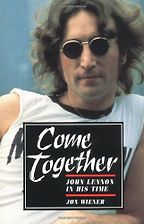
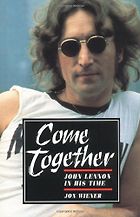
Back to America now, for Jon Wiener’s biography about John Lennon.
What is good about this book is that it centres on Lennon’s time in New York in the early 1970s and it also goes way back. It shows step by step his political awakening in The Beatles, the first time he spoke out against war, the first time he tried to write a protest song and the controversy over the song Revolution, which loads of people on the left hated.
Lennon was such a psychologically complex character and his political beliefs were very much wrapped up in personal responses – such as the way that people responded to Yoko, the way that he didn’t feel at home in Britain anymore, and the fact that after The Beatles broke up he needed something else, some sort of big project to embark on. Jon Wiener is very balanced. He is obviously a Lennon fan but he doesn’t mind pointing out the times Lennon pissed people off, or contradicted himself, or said something stupid or was acting from less than noble motives.
Considering he was interested in so many political ideas, what do you think were the main ones that inspired him and his music?
He was concerned with the future of the left and thanks to Yoko he was actually one of the first artists to release feminist rock songs. Unfortunately, he was never that good at writing protest songs. He was the most famous rock star activist in the world but he wasn’t very good at putting his views into songs. There was of course Revolution and Give Peace a Chance, which is better when sung by thousands of people on a march than on the record. You have also got Power to the People, which was really big at the time but hasn’t aged well.
His idea with his album Some Time in New York City was to look at the newspaper headlines and turn them into songs. Some people are very good at it but he wasn’t. They were kind of crass and simplistic and annoying. With a couple of redeeming features, it is just a really bad record. And then he gave up on politics for lots of reasons, one of which being that Nixon’s government wanted to deport him because of the things he was saying about the Vietnam War, and also he thought his music was getting worse. When Nixon won the 1972 elections Lennon got really depressed and thought, what is the point?
Despite all his negativity towards this time in his life and his protest songs, do you think that others judge him less harshly?
It depends really. The problem is I don’t really like the sanctification of him.
Which is why you like Jon Wiener’s book?
Totally, and to say that you can accept all those flaws and still think that he was a brave and fascinating person is very interesting. Even if he didn’t carry his principles into the years after 1972 they were still valid at the time, and still had an impact. Weirdly, some people who have read my Lennon chapter think I was really harsh on Lennon. To me, I am just telling it the way I saw it.
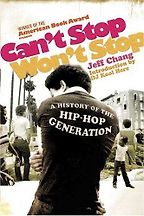
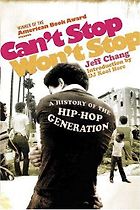
Your final book, Can’t Stop Won’t Stop by Jeff Chang, takes us to the land of hip-hop and looks at how it has changed American history.
This is not the biography of a single activist. It is a kind of sociopolitical history of hip-hop. It goes back a long way. Chang spends a lot of time describing the rise of gangs from the late 1960s. He tells you a lot about 1970s New York. Hip-hop really started as an artform long before most people outside the Bronx were aware of it. And I loved this social background because it shows that if people had a curiosity about the music you could show them all this other stuff.
The sections that I kept going back to again and again were the ones about Public Enemy and N.W.A and Ice Cube, and Chang goes through the various controversies they faced step by step. Political hip-hop was very controversial and widely discussed. And again you see the impact that taking a political stand can have on the individuals when they realise that they don’t agree with some of the members of their own bands, or their ideas are changing so quickly they become at odds with some of their fans. The author is a fan but not an undemanding one. He really digs deep into the complexity of it. There are lots of good books about hip-hop, but this is definitely the best one on the politics and social context of hip-hop.
Your book looks at all these different types of protest music, and examines the impact that singers have had on different sections of society in different countries around the world. What about today? Do you think it still has a role to play?
Well, I think it is most necessary outside the West. In North Africa and the Arab world it has still got this potency. That is where hip-hop is a really fierce unmediated voice of protest. Whereas in the West we have had moments of such social upheaval and such musical innovation that you can’t match that. Times like 1968. And there are so many factors at work – the way that people look at politics and the effect of the Internet. There is less faith in musicians. In the West, protest music began to decline as a really important force in the early 1990s. Now there are still lots of protest songs around, but it is not as thrilling to live through or write about as punk or civil rights. Those were moments where it felt like society was changing and music was at the forefront.
June 13, 2011
Five Books aims to keep its book recommendations and interviews up to date. If you are the interviewee and would like to update your choice of books (or even just what you say about them) please email us at [email protected]
Support Five Books
Five Books interviews are expensive to produce. If you've enjoyed this interview, please support us by donating a small amount.

Dorian Lynskey
Dorian Lynskey is a music writer for the Guardian. He was Big Issue's music critic for three years and has freelanced for titles including Q, Word, Spin, Empire, Blender and The Observer. He is author of The Guardian Book of Playlists, a collection of his popular Readers Recommend columns for The Guardian. His latest book, 33 Revolutions Per Minute, looks at the history of protest songs
Dorian Lynskey
Dorian Lynskey is a music writer for the Guardian. He was Big Issue's music critic for three years and has freelanced for titles including Q, Word, Spin, Empire, Blender and The Observer. He is author of The Guardian Book of Playlists, a collection of his popular Readers Recommend columns for The Guardian. His latest book, 33 Revolutions Per Minute, looks at the history of protest songs
© Five Books 2024