Boston University professor delves into the origins of crime science, using literary and historical works to explain early forensics, phrenology and criminal psychology
The Killer of Little Shepherds: A True Crime Story and the Birth of Forensic Science by Douglas Starr
What groups these books together? Are they all about new crime detection techniques at the end of the 19th century?
They all involve the early days of the science of criminology, which involved forensic science and criminal psychology. The late 19th century was an amazing time in several fields of science, and the scientific examination of crime was no exception. Scientists were exploring ways to interpret evidence (what had occurred) and delve into the causes of criminal behaviour (why it occurred). All these books deal vividly with those themes.
And they’re focused particularly on the era in which your own book – about the capture of the French serial killer Joseph Vacher – is set?
Yes. The Vacher case took place from 1893 to 1898, and most of these books appeared right around that time. It’s amazing how much they reflect not only the science of the times, but also the era’s state of mind. I recently reread Dracula. (It kept me up nights, just as it did when I first read it at age 15.) What strikes me is how much that book reflected society’s nightmare of what the criminal was, and how closely it adhered to then-current theories about the criminal mind. All these books touch on that to some degree.
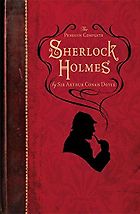
Let’s start with The Complete Sherlock Holmes.
Sherlock Holmes is the prototype for the master criminologist – the methodical detective who uses science to solve crime. I’m struck by the similarity between the powers attributed to Sherlock Holmes in that era and those attributed to the CSI television shows in our own. It might seem an odd comparison, but think about it: Sherlock Holmes used the latest methods in scientific analysis, solved crimes with blinding speed and was dead certain of himself at all times. Which is exactly what characterises today’s CSI shows.
“I’m struck by the similarity between the powers attributed to Sherlock Holmes in that era and those attributed to the CSI television shows in our own.”
Interestingly, Dr Lacassagne, the French criminologist who is the hero of my book, was a fan of the Sherlock Holmes stories, which were published in the course of his career. In fact, he was such a fan that he had one of his graduate students prepare a thesis on the science of Sherlock Holmes. I was lucky enough to find it, and found Dr Lacassagne’s handwritten remarks scribbled all over it. You can imagine my excitement at finding the real-life hero of my book commenting on one of the great fictional detectives of all time. Conversely, Conan Doyle knew about the real scientists and their work, and mentions them in his stories. So there was an amazing interplay between fiction and nonfiction.
What was Dr Lacassagne’s conclusion?
Although he enjoyed Sherlock Holmes, Lacassagne thought the science was a bit weak. Holmes worked alone, while real-life forensic scientists worked in teams, even then. Most notably, Holmes never conducted an autopsy – which even then was the staple of the criminal investigation.
Of course, none of that detracted from Holmes’s popularity. In a world beset by uncertainty and chaos and fear, it’s comforting to imagine there is someone out there who, with keen intelligence and a scientific method, can put things back in order, and make the world safe again. I think that’s part of Holmes’s enduring appeal.
Was France the leader in forensic science at this time?
Yes. The British were maybe ten to 15 years behind. The Americans were decades behind. The real leaders comprised a coterie of scientists in France, Austria, Italy and Germany.
Your next book is Hans Gross’s Criminal Investigation, aPractical Handbook for Magistrates, Police Officers and Lawyers, from 1891.
Yes. This is a handbook, but sections read like literature. The Austrian jurist Hans Gross was part of the era’s coterie of forensic pioneers – but while the others were doctors, he was an attorney. So he took the science of criminal investigation and translated it into colloquial language. The result is a handbook that ordinary investigators could read – as could you or I.
In addition to describing the new techniques in criminal detection, Gross discusses what kind of person the investigator needs to be. Some of the passages are almost inspirational. For example: “An investigating officer must possess the vigour of youth, energy ever on the alert, robust health and extensive acquaintance with all branches of law. He ought to know men, proceed skilfully, and possess liveliness and vigilance. Tact is indispensable, true courage is required.”
And it holds up over time?
Gross’s book would be useful to this day. It’s an enormous volume, covering everything from collecting evidence to maintaining an uncontaminated crime scene. Gross also writes about the sociology of criminals, and about how to tell if a suspect is faking insanity – which was quite common in those days.
“It’s an enormous volume, covering everything from collecting evidence to maintaining an uncontaminated crime scene.”
He also writes presciently about the proper way to conduct an interrogation. He makes it clear that you should never use torture in the course of an investigation. You need to be clever and persistent, and eventually the suspect will unburden himself to you. That’s a striking observation, given our disgraceful recent history in that area.
Whereas previously, the conventional wisdom was that torture was in fact a good way to get information?
Yes. They would round up the usual suspects, pressure them to the point of torture, and hope someone cracked. Their success rate was quite low. At the time, other books by lawyers were coming out on how torture is a terrible idea in an investigation – not only morally, but also in terms of gaining accurate testimony. But it was Gross who wrote the authoritative textbook on the subject.
What were the new techniques at that time? They didn’t have fingerprinting yet, did they?
Fingerprinting became popular in the early 1900s. It had been discovered before then, but it wasn’t in broad use. Prior to fingerprints, scientists used footprints and scientific measurements of body parts in order to identify criminals and suspects. They were also quite advanced in their analysis of hair fibres and particles, and in their ability to detect blood and semen stains.
On to Dracula.
This was published in 1897, the same year Vacher was captured. I was drawn to Dracula because the Count was the perfect incarnation of evil as society saw it – the personification of the criminal type. When you read the physical description of Count Dracula, he does not resemble the handsome vampires we see on television; rather, he looks like a thug. He has one continuous eyebrow across his forehead, thick hands, pointy teeth and pointy ears. The description bears an uncanny resemblance to that of the ‘born criminal’ hypothesised by the great Italian psychologist Cesare Lombroso. Lombroso felt that certain people were born with the physical characteristics of a brute, and an inborn tendency to commit crimes. Dracula was the incarnation of that sub-species, which Lombroso described as the ‘criminal man’.
He also exemplified the duality of the human spirit, which was another popular theme of the time. Before becoming a vampire, the Count had been a military hero, a man of inestimable nobility and bravery. After his incarnation as Dracula, his evil overshadowed his nobility. In that way, he represented the notion that the human spirit holds equal and opposite capacities for greatness and depravity.
I find it interesting that during this period, in the 1880s and 90s, with the birth of psychology, the question of good and evil shifted from the domain of the clergy to that of the scientists. You’ll note that it wasn’t a priest who defeated Dracula, but a scientist.
But this notion that there is a criminal type, who can be identified by the shape of his skull etc. – that turned out to be barking up the wrong tree, right?
In a sense, yes. The theory of phrenology was wrong, but the basis of that theory – the localisation of brain structures and their effects on behaviour – essentially was accurate. Franz Joseph Gall, who invented phrenology, is one of history’s laughingstocks, but in an odd way he was a man before his time.
Get the weekly Five Books newsletter
Lombroso’s concept of the ‘criminal type’ was a more sophisticated concept than Gall’s, but it too attempted to link criminal behaviour to a genetic proclivity. On the other hand, Dr Alexandre Lacassagne of France felt that criminality was caused by the environment, based on his experience spending several years analysing the social, economic and family conditions that produced criminals. Their debate over the origins of criminality marked the birth of the nature/nurture debate.
The belief in the born criminal continued long past Lombroso’s day. In the 1920s, there were the famous Jukes and Kallikaks studies in which scientists looked at extended families of criminals to demonstrate that crime was hereditary. Then in the 1960s came the hypothesis that an extra Y gene predisposed someone to criminality.
We now know those studies were invalid, but the debate isn’t over. In fact, it’s taken an unexpected twist. Currently, neurologists doing MRI scans of the brains of criminal psychotics are finding certain dysfunctionalities in the way various parts of the brain communicate with each other. Certain people do seem to have tendencies towards a lack of empathy, and a lack of impulse control. The research is very young, but there may well be a neurological component to criminal behaviour. So we can’t say, in a self-satisfied way, ‘Those people from the 1890s didn’t know what they were talking about!’ Maybe they were on to something.
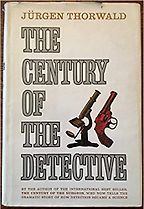
Tell me about The Century of the Detective.
This is a fascinating book, written in 1964 by the German writer Jürgen Thorwald. In this encyclopaedic yet highly readable volume, Thorwald demonstrates that the late 19th century saw the birth of modern detective work, from toxicology to fingerprinting to biometry to crime scene analysis. He must have been working in half a dozen languages, and produced what I consider the sourcebook on the founding generation of modern detectives.
Do you want to give an example?
Thorwald cites Dr Lacassagne’s analysis in the famous Case of the Bloody Trunk – the 1889 case that made Lacassagne world famous. Lacassagne pioneered forensic identification of old bodies, by examining inch by inch, almost microscopically, the body of a corpse until he could identify it. This really opened the door to modern forensic work.
It’s worth pointing out that before this time the police had immense trouble just identifying anyone. In your book you mention the case of the missing bailiff, Gouffé, which is nearly closed because his brother-in-law fails – not surprisingly – to recognise a greenish, bloated, decomposed corpse as his relative.
Yes, they had trouble identifying the body once the skin was decomposed. The issue of identity was extremely important to criminal scientists – the identity of both victims and perpetrators. Lacassagne and his colleagues explored ways to identify bodies, which involved examining bone formation and teeth, for example. They also developed ways to determine the time of death, such as showing that bodies putrefied on a timetable. They also learned that certain insect species inhabit a corpse at certain times, and therefore revealed when death had occurred.
They also developed techniques to positively identify living criminals, who were forever trying to disguise their identity. One of these techniques, developed by Lacassagne’s colleague Alphonse Bertillon, presaged the biometric identification used in hi-tech facilities today. Thorwald’s book takes these discoveries and credits them to the appropriate scientists. It’s a monumental work, and is also quite readable.
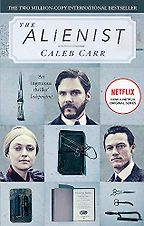
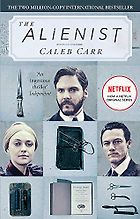
Last, you’ve chosen a novel set in 1896: The Alienist. What is an ‘alienist’, by the way?
‘Alienist’ was the term for a psychiatrist or a psychologist at the time. They were called alienists because mentally deranged people were thought to be alienated from themselves. This is a wonderful historical novel, written in 1994, about one such alienist in New York City, who helps solve a series of grizzly serial killings at the time when Theodore Roosevelt was the commissioner of police.
It’s a masterpiece of historical reconstruction. Although fiction, it’s populated with the characters that I’ve come to know, such as Bertillon and Lombroso. It’s a marvellous evocation. When I started my own book I used The Alienist as a kind of benchmark. I thought if I could recreate, in a nonfiction way, a sense of time and place as vividly as Caleb Carr does in his fictional treatment, then I would consider my book a success.
So as for the fact it’s called The Alienist – does the psychologist, and the psychology, of the criminal play a big role?
The hero of the book, Dr Laszlo Kreizler, is a crime scene analyst with an understanding of the criminal mind and an endless curiosity about human nature. He investigates these grizzly crimes not in a sensationalistic way, but as a means of understanding human motivation. Kreizler looks at these cases as though viewing humanity through a looking glass. He wonders, what is the human spirit capable of doing? And how can one scientifically understand that? In creating Kreizler, Carr perfectly captures the sensibilities of scientists of the late 19th century.
“‘Alienist’ was the term for a psychiatrist or a psychologist at the time. They were called alienists because mentally deranged people were thought to be alienated from themselves.”
He also captures their optimistic spirit. This was a period that saw the birth of so many sciences: toxicology, modern chemistry, evolution, germ theory, psychology. There was a sense of excitement that science might provide the key to understanding humanity’s problems and possibilities. They were especially caught up in the promise of medicine, and applied the medical model to many of society’s ills. In that sense they saw crime not as a question of good and evil, but as a problem of disease plaguing society. Even though they were distressed about crime, they sensed an opportunity to explore and understand.
Get the weekly Five Books newsletter
In a way we’ve gone backwards. The scientists of the 1890s were so full of possibilities – they even questioned whether prison was the right idea. One of the French scientists said, ‘As medical men, we wouldn’t use the same drug to treat cancer, heart disease and a broken arm. And yet we use the same medication — incarceration — to treat all crime. Shouldn’t we be looking at a variety of treatments?’
I worry that as a society we’ve given up on that creative kind of thinking; that we’re content just to lock prisoners away. Sometimes I wonder, with all our technological know-how, are we really more advanced or humanistic than the pioneers of criminology more than a century ago?
March 8, 2011
Five Books aims to keep its book recommendations and interviews up to date. If you are the interviewee and would like to update your choice of books (or even just what you say about them) please email us at [email protected]
Five Books interviews are expensive to produce. If you've enjoyed this interview, please support us by donating a small amount.
Douglas Starr
Douglas Starr is Professor Emeritus of Science Journalism at Boston University. His first book, Blood: An Epic History of Medicine and Commerce, received wide critical acclaim and was turned into a series by PBS. His second book, The Killer of Little Shepherds, is about the French serial killer Vacher and the birth of modern forensic science. His writings on science, medicine and public health have appeared in, among others, The New Republic and The LA Times, and on NPR.
Douglas Starr is Professor Emeritus of Science Journalism at Boston University. His first book, Blood: An Epic History of Medicine and Commerce, received wide critical acclaim and was turned into a series by PBS. His second book, The Killer of Little Shepherds, is about the French serial killer Vacher and the birth of modern forensic science. His writings on science, medicine and public health have appeared in, among others, The New Republic and The LA Times, and on NPR.