Before we talk about the five books individually, I wanted to explain what draws me to all of these books. They are books about strategy and the way in which America balances its resources and power with its commitments and aims. But they also explore something much deeper than that. They are prophecies about America’s destiny and role in the world, and the big questions to do with that. What is America’s purpose in the world? Is it to be different from any other global power before? Can a republic like America also be an empire? What is the relation between America’s power and America’s ideals, and is America ultimately there to be a promised land as its original founders intended? Has America become a crusader state?
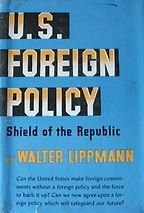
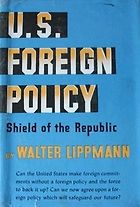
These are all things to think about, as we go through the books. Your first author, Walter Lippmann, is said to have put the phrase ‘the Cold War’ on the map and this is a theme he explores in US Foreign Policy: Shield of the Republic.
Yes, that’s right, he did. Actually the word was first coined, I believe, by Bernard Baruch. Lippmann was the one who popularised it. This book was actually written in World War II and he was partly looking ahead to the possibility of a Cold War with the Soviet Union. He could see the seeds of it even in the middle of World War II. So it really is a far-sighted book.
How do you think he managed to do that?
The book is a powerful critique of failures of US foreign policy in the interwar period – that is where it begins. Lippmann argued that Americans had fallen prey to the delusions of liberal and universal ideas. They believed that peace could be achieved without calculations based on real strength, whether by insulating itself from power politics or placing its trust in international institutions and law. The country, he believed, also fell prey to the false notion that geographical distance, rich resources and ocean flanks gave America ‘free security’. The net result was an insolvent foreign policy that left the nation vulnerable and polarised.
The book is a plea by Walter Lippmann for America to rediscover the realities of power politics that he believed the Founding Fathers had grasped. Lippmann counselled that America needed to rebalance its power and commitments and use the classical tools of negotiated spheres of influence, military muscle and alliances. Not only was a renaissance in strategy necessary to secure America by restoring a favourable balance of power abroad, it was also needed to prevent foreign policy dividing the country at home and creating a damaging internal conflict. Also, in the moment of victory it could overreach itself and get involved in a new antagonism and collide with another great power.
Lippmann’s fear was that the wartime alliance with the Soviet Union, Britain and the United States would fall apart after the war and the world’s hope for peace rested on those great powers. He argued that in order to avoid new confrontations, the US needed to recognise the limits of its own domain and the legitimate orbit of other states like the Soviet Union. That is where he saw the Cold War potentially originating – America wouldn’t know the limits of its own power, particularly in the moment of victory. The true shield of the republic was not nature’s blessings or utopian idealism, but clear-eyed statecraft that respected both power and the limits of power. It is an eloquent vision of tough restraint in the age of the masses – a vision that resonates today.
I think this is a book about America finding itself becoming increasing powerful as it mobilised itself for its intense struggle. It was lurching from a country that before World War II was much more reluctant to generate military power and intervene abroad to becoming a country that didn’t know where to stop. The way that America lurched from one extreme to the other was something he referred to as the deadly cycle. He says that it is ‘too pacifist in times of peace and too bellicose in times of war’. He thought there was not enough middle ground.
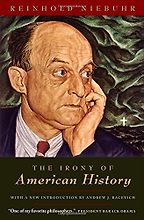
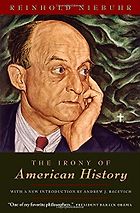
Your next book is by one of President Obama’s most favourite philosophers. This is The Irony of American History by Reinhold Niebuhr.
Yes, Reinhold Niebuhr’s classic book. It is also a prophecy by a theologian, the son of a German émigré to America. It’s one of the most important books in American self-criticism. It was written after America had risen as a giant, as victor in World War II, when many believed it had won the mandate of Heaven and had ‘dreams of managing history’, when some even entertained the thought of a preventative nuclear war, as the US became embroiled in global antagonism with the Soviet Union.
Reinhold Niebuhr, as a pessimistic theologian, was uneasy with American idealism and self-exaltation. He wrestled with the dangerous and intoxicating idea of American exceptionalism, and he found in that ideology the seeds of American self-destruction. The book is called The Irony of American History and there were a number of ironies in America’s condition. First, America became a superpower without a conscious grand design, without its people lusting for world conquest and despite the fact that it was created partly in order to reject the power struggles of the old world. It stepped into a vacuum created by war and the exhaustion of European nations. Drawing on its heritage as the ‘light on the hill’, it assigned itself the role as ‘tutors of mankind in its pilgrimage to perfection’.
Second, America as a superpower controlled its destiny less than as a continental power, because the more far-flung and global it became, the more it collided with other wills and forces which it could never ultimately master. And third, as the country reached for power and interpreted history as the triumph of the American way after World War II, it was becoming like the enemy in milder form and could destroy itself. Like Marxism-Leninism, Atlantic liberal democracy married with the might of the American superpower was becoming heedless of the ‘limits of all human striving, the fragmentariness of all human wisdom, the precariousness of all historical configurations of power, and the mixture of good and evil in all human virtue’.
“The temptation to see itself as the world’s great redeemer and all-powerful was almost irresistible, even though it was very dangerous.”
Unlike quite a lot of American patriotic visionaries at the end of World War II, who believed they were trying to interpret history and the meaning of America’s role in it, Reinhold was more pessimistic. He believed that not only was history indecipherable, but it would never end.
Do you agree with him?
Yes, I think he pointed up a number of great dangers in what can happen with a country which has ‘the victory disease’. This is the idea that in a moment of great success the country starts thinking that its strength alone makes it wise, and it starts to assign itself a role of global superpower.
It is very understandable why that happened because America was stepping into a huge vacuum of the old European empires which had exhausted themselves. And the world we know benefited hugely from America’s new role as it rebuilt Europe and extended its military shield. But the temptation to see itself as the world’s great redeemer and all-powerful was almost irresistible, even though it was very dangerous.
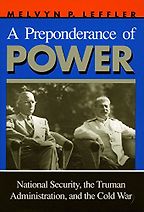
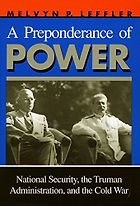
Tell me about Melvyn Leffler’s book: A Preponderance of Power: National Security, the Truman Administration, and the Cold War.
This book is really going back to the seeds of the Cold War and what Leffler sees as the tragedy of the Cold War. He asks the very important question: was the Cold War actually avoidable? He looks at whether there were moments between 1946 and the early 50s when we could have stepped back from the brink and had some kind of modus vivendi with the Soviet Union instead of having this confrontation.
Leffler, as a revisionist historian, finds some of the seeds of the conflict in the evolving world view of the Truman administration, where America’s new sense of its own relative power in the world, mixed with a sense of Messianic crusading, culminated in the Truman Doctrine in 1947. Leffler asks the question, that as tyrannical and dangerous as Stalin was in his own region, was he ultimately an old power tsar who could be accommodated with classical spheres of influence rather than having a global struggle? He tests out this idea that the revolutionary tyrant at home actually was a tsar abroad and could be lived with, and that Stalin, in a very cold and calculating way, was someone you could do business with.
This particularly centres in the debate about whether or not to commit to containing Communism everywhere all the time, and also how realistic it was that America and the Soviet Union could have negotiated a mutual withdrawal from Germany and left a buffer zone between them.
This, of course, throws up lots of moral issues about whether America was prepared to operate like that.
Oh it does, and part of the difficulty of foreign policy is that you have to hold your nose and compromise with all sorts of regimes. The Allies had, after all, been dealing with Stalin during World War II from 1941, in order to defeat something that we thought was even worse – Hitler.
So foreign policy is difficult because it involves that moral compromise. Leffler poses the question whether dealing with and accommodating Stalin would have been better for the world than this terrifying new conflict with the potential for World War III, and, with catastrophic ventures like the Afghan War, Vietnam, Cambodia and Chile, how the trillions of dollars that America sunk into it could have been spent on more productive things.
“Part of the difficulty of foreign policy is that you have to hold your nose and compromise with all sorts of regimes.”
So the morality question is a very interesting one and very difficult. Sometimes the most immoral thing you can do as a great power is be at war with other great powers, and it is better to compromise around that with a negotiated and imperfect peace.
Do you begin to see this time as the fall of America?
In a way I do, because it takes on a role as the guardian of world order that ultimately is exhausting, although in some ways it is the making of America. It emerges from World War II as the biggest power, the biggest financier and creditor, the centre of dynamism and intellectual achievement and scientific innovation. It is also the military superpower with global reach. But in other ways America was being drawn into this imperial temptation, which means it chooses to shoulder burdens on others’ behalf. Every time there is a crisis America is increasingly expected to solve it.
Also, I think it is dangerous because becoming an empire makes it harder to be a republic. It results in things like the rise of an imperial presidency, which becomes less balanced with the constitution and the erosion of civil liberties. There is this coarsening of domestic policies and weakening of the economy, which are things that damage what is meant to be the constitutional identity of the country – so it is a very mixed bag.
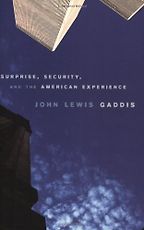
Let’s move on to Surprise, Security and the American Experience by John Lewis Gaddis.
This is a great book by one of the great Cold War historians of the United States. He has a simple but very compelling argument about when you look at the American experience, which is that you can only understand American grand strategy in diplomatic history by looking at how it reacts to shock and events.
His argument is that if you look at the pattern – whether it is Britain burning down the American White House or Imperial Japan’s attack on Pearl Harbor or bin Laden’s strike on the Twin Towers and the Pentagon – it has been quite clear. In response to emergency and to shock from these surprise attacks, America has struck back and expanded its security domain. America’s reaction is to fight back and to try to reinvent the world in its own image. It wants to spread its values and its open door market democracy. It has an enduring idea that it can only be safe in a world built around America’s ideals. And I think he is cautiously sympathetic to this view.
But don’t events tell us that it is unrealistic to do that?
It is unrealistic in the sense that it is very difficult to remake the world in your image because it presumes a lot of your own power. America had some success in exporting its ‘open door’ – through the Bretton Woods system, the International Monetary Fund, the market capitalist model. But the urge to transform the world to the Atlantic way also leads to overreach, resistance and exhaustion as commitments exceed power, whether in the form of Vietnam, or crippling fiscal deficits, or dangerous confrontations with Iran and China.
“In response to emergency and to shock from these surprise attacks, America has struck back and expanded its security domain.”
I think that you can create security by living in a world of balance and pluralism rather than uniformity. It is very difficult to be a global power. There are a lot of very serious regional powers, but to actually be a world superpower with commitments on five continents is incredibly taxing even for America!
Now that its economic power is eroding, that makes it even more difficult. I think the big question for the 21st century United States in terms of foreign policy is to decide whether they want to live in a world of dominance or balance. What is interesting about these books are that they are all written by Americans talking in the most critical way about themselves.
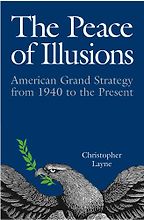
Your last book is The Peace of Illusions: American Grand Strategy from 1940 to the Present by Christopher Layne.
This is a fascinating book, written in 2006 by an American political scientist, and he asks a simple but difficult question. If you look at the traditional metrics, whether geopolitical or military or economic, America should be and should know that it is one of the safest great powers the world has ever known. Since 1900 it has been one of the most secure great powers in history and yet why does it have this restless foreign policy? Why does it involve itself in entanglements and commitments abroad and avoidable wars?
He offers a very strong answer, and that is that America is driven by a liberal ideology – this notion that the world can be transformed in positive ways by American powers, and by doing so America can be made more secure. When I say liberal I don’t mean liberal in the way that a lot of people think of the word – anything which is desirable and good. I mean liberal as a deliberate ideology about progress and the role of America in the world and how it can be made safer, more prosperous, free and liberalised and emancipated by the positive application of American power.
Liberalism can be a muscular and evangelical thing. In fact a liberal is often quite intolerant because they want to change things so they can be in line with liberal ideals, unlike, say, a realist, who can be much more tolerant and accommodating of a tyrannical regime than liberals. And it is this ideologically intense view of America’s interests that, Layne argues, powers its interventionist and expansionist urges, and explains a lot of America’s behaviour.
But then he goes on to argue that America doesn’t have to be this way and it can adopt other roles in the world, and in exchange for its role of global cop it can become an off-shore balancer – that is an off-shore power that has the ability to intervene occasionally in the world to protect itself but is much more restrained and keeps a ‘free hand’. And this actually shifts the burden of security on to other regional powers like India and the EU. This is an alternative vision for America’s place in the world.
Five Books aims to keep its book recommendations and interviews up to date. If you are the interviewee and would like to update your choice of books (or even just what you say about them) please email us at editor@fivebooks.com
Five Books interviews are expensive to produce. If you've enjoyed this interview, please support us by donating a small amount.