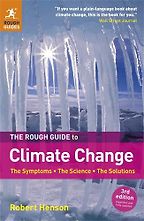
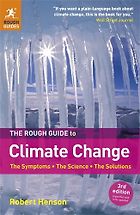
There are very few books and very few sources of information generally that give a truly balanced introduction to climate science, and even fewer that are both balanced and genuinely informed. Robert Henson is a staff writer at the National Centre for Atmospheric Research in Colorado, one of the world’s leading climate change research bodies. He’s a meteorologist by training, and his day job is to read pretty much every science paper that comes out on this subject, digest it and put it into language that students and the media will understand. He’s familiar with this subject in ways that very few other good writers are.
So it’s a non-partisan digest of climate science aimed at a reader who knows nothing?
Yes, it’s easily the best introduction to climate science, but the other thing that’s unusual about the book is that it gives a very concise yet thorough overview of the history and possible future of the climate debate.
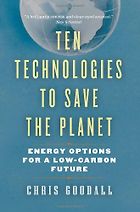
So that’s the overview. Now let’s talk about Chris Goodall’s Ten Technologies to Save the Planet.
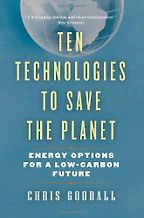
Chris Goodall is a former economist and business consultant. He comes from a business background, which makes him quite a rarity. He stood as a candidate for the Green Party in Oxford [UK] – probably the only person in the Green Party who used to work in McKinsey. So he’s very numbers focused, and very business savvy.
What Chris does in Ten Technologies is give an on-the-ground, up-to-date idea of where these technologies are and what role they could play in reducing emissions. Henson gives the overview on climate science. What this book does is address the various ways in which one can actually combat climate change. Take wind power. People in the press like to say that wind is inefficient as a generator, because it’s intermittent. Well that’s true, but what Chris does is say that there’s intermittency at a monthly level, a daily level, or at the level of an hour or minute, and he explains how it’s quite possible to compensate for all of them if you have the right infrastructure in place. So he’s very much a realist. There are others who write about technology who don’t know how business works, who don’t have the experience to make an educated guess about which technologies really do have a chance of being economically viable. For example, the possibility of filling the Sahara desert with solar panels.
A good idea?
Yes, he thinks so, with the right technology.
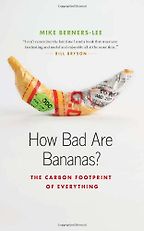
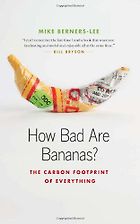
How bad are bananas?
Here’s a bit of light relief from the hardcore end of the discussion. How Bad are Bananas? was written by Mike Berners-Lee, whose job is to help businesses understand the carbon footprint of individual products. If Chris Goodall’s book is looking at technological solutions, this is looking at more lifestyle based solutions – lifestyle decisions that might be made by individuals or considered by the government.
Astonishingly, until this book came out there was no good survey of the carbon impact of different activities and objects. It’s always been easy to know the carbon footprint of fossil fuels, but what’s much more complicated is to work out the carbon footprint of, say, a bottle of wine. There is this huge debate about how much carbon emission making that bottle of wine generates. Actually it’s an impossible question to answer precisely.
How does he answer it?
He gives a sensible approximation relative to other things, from sending a text message to burning down an acre of rain forest. The book is arranged, in carbon terms, from the cheapest to the costliest, and it’s full of fascinating counterintuitive facts. We’re aware, for example, of the huge carbon cost of flying, but nobody would have thought that two people chatting on mobile phones for an hour a day for a year would be equivalent to a flight from London to New York. Or to go for a more colourful, if less likely, example: if you fuelled a cycle trip with air-freighted asparagus from Israel – about the most carbon-intensive food per calorie there is – you might as well have traveled by car.
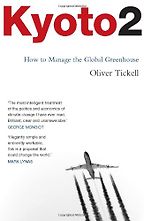
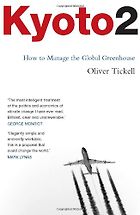
Your next choice is Kyoto2 by Oliver Tickell.
We’ve touched on technological solutions and lifestyle solutions, but the elephant in the room is of course political solutions. Unless you can create a global cap on the amount of carbon that’s emitted, you’re never going to be able to tackle this problem in any meaningful way. Oliver Tickell’s book isn’t so much a brilliant piece of writing, it’s simply the vehicle for a very brilliant and original idea.
Which is?
We all worry about carbon emissions at the point where they are released into the air, from cars or from power stations. But if you think about it, that’s almost impossible to control politically, because there are so many millions of separate points of emission. More effective is an upstream approach which simply limits the amount of fossil fuels available on the market to the amount we calculate is compatible with a stable climate.
But fossil fuels aren’t the only culprits are they?
No, but given that other problems, such as deforestation, might in theory be tackled quite quickly, the amount of fossil fuel we take out of the ground is the most important factor. The problem is that Kyoto1, which the UN has been attempting to negotiate the sequel to, is so obsessed with limiting the damage at point of emission that Tickell’s solution is probably politically unworkable. But it gets to the heart of the matter in a way the UN process has totally failed to do.
He’s suggesting a completely centrist, top-down approach?
Yes, and no other solution which depends purely on limiting emissions is going to be enough.
It’s an anti-national solution really, isn’t it? We’d have to belong to a global state.
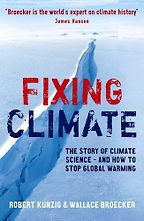
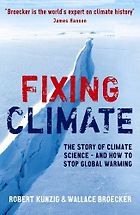
Probably, which is why my last book, Fixing Climate by Robert Kunzig and Wally Broecker, suggests an alternative solution – addressing the carbon that’s already in the atmosphere, sucking that carbon out and storing it away somewhere. It’s not to do with making energy from cleaner sources, it’s a sub category of geoengineering. But the authors of this book have been very keen to point out that it shouldn’t be classified as such because it has no side effects.
Whereas other fixes do?
Yes, most of them do, like filling the air with sulphates to stop so much sunlight reaching the surface of the Earth. That solution doesn’t deal with the fact that there’s still carbon in the atmosphere, acidifying the ocean, and if we ever stopped the sulphates it would get very hot very quickly. Sucking carbon out of the air is a fix the authors compare to the problem of sewage in the 19th century. There were people then who said there’s no point in trying to clean up the sewage because there’s too much of it. We’re always going to produce all this human mess. Well, the quantities are actually quite similar.
So how does the fix work?
It works through a clever sort of plastic polymer that attaches to the CO2 in the air. Then you put the plastic in a vacuum, flush it with steam which displaces the CO2, and then you put the CO2 somewhere safe, such as basalt rocks in Iceland.
Which lock in carbon?
That’s right. The gas fuses with the rock and becomes solid. Of course the advantage of that is that you get CO2 from all sources, and in addition you can put your capture funnel by the basalt rocks and capture carbon emitted all around the world, with no need for pipelines.
Get the weekly Five Books newsletter
Why don’t we just turn it all into diamonds?
Like in Superman, you mean, when he makes Lois Lane a nice diamond out of a lump of coal?
Exactly.
The thing is it would take quite a lot of energy, and create quite a lot of CO2. But seriously, this is a book to read. It’s not just that Wally Broecker, one of the authors, is the scientist who originally coined the phrase “global warming”, it’s that the other, Rob Kunzig, is one of the finest science writers in the business. It’s a book with authority, but you could also read it just for the lovely prose.
June 2, 2011
Five Books aims to keep its book recommendations and interviews up to date. If you are the interviewee and would like to update your choice of books (or even just what you say about them) please email us at editor@fivebooks.com
Five Books interviews are expensive to produce. If you've enjoyed this interview, please support us by donating a small amount.
Duncan Clark
Duncan Clark has worked to raise environmental awareness as a writer, journalist and campaigner. He is a consultant editor at the Guardian, and a director of the 10:10 campaign, which requires participants to reduce their greenhouse emissions by 10% within a year. In May 2010, the UK’s coalition government signed up to the project. His books include The Rough Guide to Green Living
Duncan Clark has worked to raise environmental awareness as a writer, journalist and campaigner. He is a consultant editor at the Guardian, and a director of the 10:10 campaign, which requires participants to reduce their greenhouse emissions by 10% within a year. In May 2010, the UK’s coalition government signed up to the project. His books include The Rough Guide to Green Living