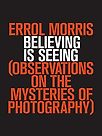
Your new book, which seeks out the elusive truth behind several famous photographs, is called Believing is Seeing: Observations on the Mysteries of Photography. Tell us about the book and what its title means to you.
We think we know what we’re looking at when we look at a photograph. We think we’re looking at something objective. We think we can see reality. But often we’re just looking back at ourselves rather than out into the world. We are reinforcing our beliefs with what we see. The idea of my book is that there’s a mystery in every photograph. What are we really looking at? In my experience, trying to figure out just what’s going on inevitably involves an investigation. I like to think of myself as the new Sherlock Holmes of photography.
You describe Believing is Seeing as a series of detective stories. That’s also how you’ve described many of your films throughout the years. You have moonlighted as a private investigator and have suggested you are an “existential detective”. Is detective work the vocation that bridges all your work?
I’ve been fortunate to receive a number of awards over the years, but the award I’m probably most proud of is my Edgar for The Thin Blue Line from the Mystery Writers of America. Yes, I worked as a detective years ago, and I think that almost everything I do – this book included – is of a genre that I guess you could call detective nonfiction.
Get the weekly Five Books newsletter
In the introduction, you write that you grew up surrounded by photographs of a father you never knew, and that despite an early childhood operation to correct eye misalignment you never gained stereoscopic vision. How does this personal history fuel your interest in photography and documentary?
I am nearly blind in one eye, and I do not have 3D vision. I’m not a great candidate for making 3D movies. When I was growing up, my father – who died of a heart attack when I was two years old – was very much there in photographs, books and other objects of his. But at the same time, he was not there. A photograph makes people seem so real and close, but you’re never really grabbing hold of them are you? They remain elusive. I often say that the biggest mystery of all is what’s inside the head – other people’s as well as our own. You look at a photograph, or stare into someone’s eyes, and you really never know. Trying to reconstruct the idea of a man from bits and pieces of evidence is a frustration.
“I worked as a detective years ago, and I think that almost everything I do – this book included – is of a genre that I guess you could call detective nonfiction.”
The first set of essays in Believing is Seeing is about a pair of photographs from the Crimean War, taken in 1855 outside of Sevastopolin what was called the Valley of the Shadow of Death. For me, photographs like these – taken to document a historical event – are almost like a time machine. I fantasise about what it would be like to walk in the frame, look around and figure out what the photo really represents. Maybe that comes from looking at pictures of my father. Maybe it ties back to your detective question. Maybe they’re related.
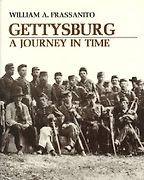
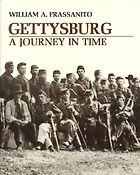
Let’s get to the five books you’ve chosen, beginning with William Frassanito’s attempt to stitch together the history of the Battle of Gettysburg using photographs. Tell us about Gettysburg: A Journey in Time.
I was hard-pressed to come up with what kind of a list to give you guys. But it did occur to me that an attempt to reconnect with what we are looking at when we look at photographs is at the heart of the book that I’ve just written. So I thought I’d give you books that have attempted to do something along the same lines – books that come from kindred spirits.
Frassanito was obsessed with Gettysburg and with reconnecting photographs of the Civil War to the circumstances under which they were taken. Through this obsessive quest, he reconnects the photographs to actual geographic places and reorders them to reflect the real sequence of events. It’s a deeply fascinating enterprise and I was inspired by his work.
In your film Standard Operating Procedure you undertook a similar project, reconstructing the history of Abu Ghraib through snapshots taken by the soldiers who policed the prison. At the same time you explored how photographing the abuses altered history. What did you learn about photography by making that film?
So many things. Yes, those photographs certainly altered the course of history. I also learned that they’re among the most widely-distributed, widely-viewed photographs in history, on a par with the Zapruder film [the amateur footage of John F Kennedy’s assassination].
Another book I would like to mention is Josiah Thompson’s Six Seconds in Dallas [about the Kennedy footage]. It’s an early example of an attempt to do just what we’re talking about – piecing together reality through photography, or in this case film. Thompson was a Kierkegaard scholar at Yale who went on to become an expert on what might be the most widely-seen piece of film in history. Not a still but a movie. Thompson attempted to analyse that film and reconnect it with reality. You would think that six seconds should be easy to interpret, but it turns out to be nothing of the sort. It evolves into a rabbit hole about the relationship between photography and reality.
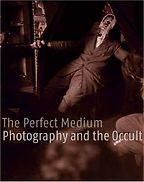
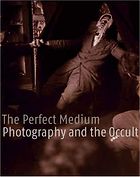
In The Perfect Medium: Photography and the Occult, photos of ghostly apparitions seem to float in the background of posed portraits. A fairy flies before the eyes of an Edwardian adolescent. It’s a reminder that photography was used for theatrical purposes from its earliest history.
These images answer certain people’s hopes and dreams – that they can reconnect with those that are lost, that the deceased are always with us. One example is William H Mumler, the famous spirit photographer who created a picture of Mary Lincoln with the ghost of her deceased husband hovering in the background. At the time, people invested these images with truth. You might imagine they would know better. But photographs are intimately connected with our desire to believe, whether that a person who is gone is still with us or in a particular version of history.
As you suggest, these sorts of photos are easily understood as trick photography by modern minds, but when they were taken people believed that the camera had the power to see what the eye couldn’t. Have we fully outgrown this naivety about photography’s authenticity?
I’ve been asked: Haven’t we become skilled at identifying falsified photographs? Aren’t we now less credulous about what we see with our eyes, more suspicious, more sceptical? I think: Yes and no.
The falsification of photography didn’t start with Photoshop, it started with photography. At the very beginning, people used photographs to convey false beliefs. They noted from the beginning that you could look at a photograph and form your own interpretation of it – one that might be at complete variance with what the photograph was documenting. Early in the history of photography, people learned that there was slack between the real world and our images of it.
Support Five Books
Five Books interviews are expensive to produce. If you're enjoying this interview, please support us by donating a small amount.
Are we that much smarter now? Within the last decade, Colin Powell appeared before the United Nations as Secretary of State and showed photographs of plants [in Iraq] that he claimed produced chemical or biological weaponry. On that basis we went to war. Have we really learned anything? When we’re shown an image we tend to let our guard down. People learn how to read critically and think critically, but I don’t believe we learn how to see critically.
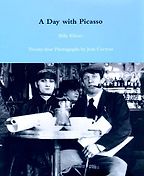
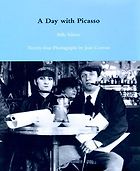
Let’s move forward to A Day with Picasso, about the back-story to a series of 24 photographs taken of Picasso, Modigliani and their artist friends over the course of one afternoon in Montparnasse in 1916.
This is definitely a book by a kindred spirit. I first heard about it from the writer Lydia Davis, who is a friend of mine. We knew very little about these photographs – the circumstances, how many there were, who took them, you name it – until Billy Klüver set for himself this project of trying to figure it all out. He did a forensic investigation of the photographs and discovered that they were taken by Jean Cocteau of his friends Pablo Picasso, Amedeo Modigliani et cetera. It’s a true detective story about photography.
Did Klüver’s decade-long quest to sleuth out the facts behind these photos inspire the investigations you write about in Believing in Seeing?
It’s an obvious precursor to what I’ve been trying to do. It’s also a great book in its own right. Unfortunately, Klüver died just a couple of years before I started working on my own book. I would have loved to talk to him.
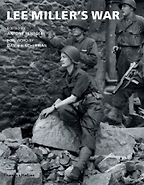
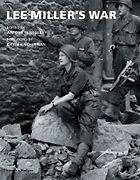
Lee Miller’s War
is a book of World War II photography and essays that appeared in Vogue, by a former model who switched to the other side of the camera. Of all the books of World War II photos, why this one?
In a way it’s an unfinished project for me. Ben Curtis, a photographer who had worked during the [2006] Israel-Lebanon war, went through a day’s worth of photographs with me in my book. We very rarely do this, but I wanted to do it with Lee Miller as well, because she took this series of over 100 photographs on one of the most critical days in 20th century history.
There’s this wonderful photograph of Lee Miller in Hitler’s bathtub, taken by her boyfriend at the time – a Life photographer she had teamed up with, David Scherman. They were there at the liberation of Dachau, and the series of amazing photographs that she took that day culminated with these photos from Hitler’s Munich apartment, No 16 Prinzregentenplatz. The announcement of Hitler’s suicide came on the radio just around the time she was taking her bath in Hitler’s tub. In fact, there was a pair of photographs – one taken by Lee Miller of David Scherman in the bathtub, and one taken by David Scherman of Lee Miller in the bathtub. The combination of photos from one of the most notorious concentration camps and the oddity of these scenes in Hitler’s apartment gives you a window into history that we otherwise wouldn’t have.
Lee Miller’s son selected the images. She is foregrounded in the cover shot, posed on a rock in a helmet and heavy lipstick. One review suggests that Miller brought a surrealist’s touch to the images because she was the lover of [American artist] Man Ray. All this made me less interested in the images than in the back-story.
The back-story is often more interesting than the photographs. In many ways they enhance each other. Photographs are in part about dreams – the dreams that we have about them, the ideas that we associate with them. But they’re also about connecting with reality, about being brought back into the world. They’re a window into the past, and to me this is powerfully evoked in that day or two of photographs created by Scherman and Miller. She was a great writer too.
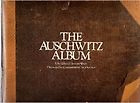
Finally, The Auschwitz Album. Please tell us Lilly Jacob’s unbelievably powerful and poignant true story. I’m astounded that no one has made a movie out of this.
Maybe this list is a frustration of articles I haven’t written and movies I haven’t made. I had thought about doing it. I was going to interview Lilly Jacob, and then she died. Lilly Jacob’s family was killed at Auschwitz, but she survived and ended up at Dora, a concentration camp inside Germany. She found a book of photos there, in an SS barracks where she was recovering from typhus after the liberation of the camp. In it were people that she knew.
Including her brothers.
Yes. She found pictures of herself, her relatives and others from the village where they had lived, who were all dead. In 1944 they were liquidating – it’s a horrific word – they were murdering the Hungarian Jews, and here you have an album of close to 200 photographs that were taken by SS men who were on the platform that day in Birkenau [an Auschwitz sub-camp], documenting the selection of Jews for the gas chamber. She took the album with her to America where she emigrated. She ended up as a waitress in Miami and people heard about this album, and went to her looking for family. Eventually, [Holocaust scholar] Raul Hilberg persuaded her to donate the album to Yad Vashem [Israel’s memorial to Holocaust victims] where it is today.
Again, it fascinates me because it’s a group of photographs centred around one historical moment. We’re really thrown into that moment. It’s the attempt to understand something that maybe can never be understood. We look at the SS officers on the platform and the many, many Jews, most of whom have only hours to live if that. We know that we’re connected to history here, but what is it that we’re looking at? On the one hand we know, and on the other hand we don’t know. We’re looking at something deeply disturbing and mysterious.
This question kept me up all night. Among the images you can find online, in one
there is a beautiful young boy, in another a golden-haired girl with her bow still in place, both staring inquisitively at the camera. These children probably only knew of being photographed as a sign of love. The distance between what they thought, the intentions of the photographer and the survivors who came to Lilly Jacob’s Miami apartment to find out their relatives’ fates is so haunting.
It is one of the more extraordinary series of photographs. I sometimes talk about the trunk in the attic. You go up to the attic, you find a trunk, you open it and there’s some photographs inside. Maybe you know the people, maybe you don’t. You look at the photographs and you want to know more. You want to know something about the people in them. Who they are, who they were. Again, what are we really looking at? It’s a mystery. An attempt to contextualise – I hate the word but I use it anyway – the photograph is the beginning of the investigation.
I feel the pull of The Auschwitz Album very powerfully. We’re looking at something that is indecent, it’s cruel beyond imagination and yet it’s real. It concerns real people and real historical events. I want to know more, to reconnect myself to that history.
What has your study of photography taught you about your work as a documentary filmmaker?
They’re both of a piece, investigating with a camera. I’ve learned as a documentary filmmaker how you can investigate. I’ve been lucky to solve – in part using a camera – at least one mystery, involving a terrible miscarriage of justice in Texas. [Morris’s 1988 film The Thin Blue Line presented evidence that a man was on death row for a crime he didn’t commit. The inmate was released within a year of the film’s release.] I don’t look at documentary filmmaking as anything more than an obsession with the world and what’s real. That impulse is in my filmmaking, and it’s certainly in this book I’ve just written.
Your 2003 film Fog of War won the Academy Award for best documentary, but some critics challenge your use of recreations and surrealistic sequences. In Believing and Seeing you express uncertainty about the boundaries of documentary projects.
There’s a passage in Believing is Seeing where I talk about posing – how all images are posed. There is no veridical image. There is no ur-image. There is no image that is more truthful than another. It’s a misconception about truth and it’s a misconception about the pursuit of truth.
One of the deep misconceptions about documentary is that it’s more truthful if you hand-hold your camera or use available light. Truth isn’t about style. That’s what makes it so absurd that the Academy didn’t even consider The Thin Blue Line for an award. The Thin Blue Line did what a documentary movie should do – it pursued the truth. It got an innocent man out of prison, not by virtue of the fact that I shot it in one style or another but by virtue of the fact that I investigated with a camera and uncovered the truth.
I don’t think that documentary has to be vérité or agitprop or narrated slideshows or whatever. But I do think that it has to try to uncover something about reality, investigating something to find things out. I think it’s a noble and worthy enterprise. What else would I do with myself?
Five Books aims to keep its book recommendations and interviews up to date. If you are the interviewee and would like to update your choice of books (or even just what you say about them) please email us at editor@fivebooks.com
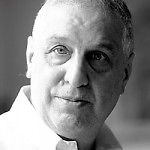
Errol Morris is an Oscar-winning documentary filmmaker. He has directed nine films, including The Fog of War, The Thin Blue Line and most recently Tabloid, and has won top awards from film festivals, film critics’ societies and the Directors Guild of America. Morris invented a camera called the Interrotron, that projects the face of an interviewer in front of its lens. He writes about issues ranging from email to epistemology for The New York Times. Believing is Seeing is his first book
Errol Morris is an Oscar-winning documentary filmmaker. He has directed nine films, including The Fog of War, The Thin Blue Line and most recently Tabloid, and has won top awards from film festivals, film critics’ societies and the Directors Guild of America. Morris invented a camera called the Interrotron, that projects the face of an interviewer in front of its lens. He writes about issues ranging from email to epistemology for The New York Times. Believing is Seeing is his first book