What ties these memoirs together?
They are all books about identity and questions of belonging and non-belonging, as the best memoirs always are. Interesting memoirs all reflect on questions on the self – both the particular self which is being presented, and the self altogether.
Why does one write a memoir? Why did you?
Good question. I actually came to the idea of writing a memoir reluctantly. I knew I wanted to write about living in a second language and in a second culture, and the relationship of language and culture to the self. I wanted to write about this because in America – where I was living at the time – there is a large immigrant literature, but it has traditionally been a very narrow literature about stories of struggle and triumph. I thought that the internal trajectory of emigration had not been talked about. I thought of writing a novel, or writing about Eastern European writers who had been exiled. But I decided that I wanted to write about the intersection between subjectivity and the external world. That was at the heart of it. Slowly I came to the idea of writing a memoir.
I think that memoir is a good genre for two kinds of circumstances. First of all, it is good for talking about marginal experiences, which have not entered the larger public discourse. An obscure life as opposed to autobiography. Autobiography is a record of a known life; memoir is a probe into an aspect of experience, in which the person himself or herself is not of automatic public interest. It’s also good precisely for expressing this intersection, the relationship between the internal and external life. As is a novel, of course, in other ways. But the memoir can combine narrative with stylistic writing.
And why does one read a memoir?
I think readers like testimonies from within – that kind of intimate, personal writing. Sometimes memoirs by well-known writers are among the best things that they write. I didn’t choose Experience by Martin Amis, for example, but I think it’s one of his best books. The Words by Sartre, which I did choose, is one of his strongest works. And there is often an element of identification on the part of the readers. I think we can learn about our own lives by reading about others’. Memoir is a way of reflecting on the inner life and on our existential situation.
From existentialism, perhaps we should begin with Sartre. Tell us about The Words.
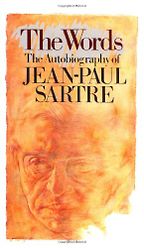
The Words is a memoir of Sartre’s childhood. It takes him up to the age of 10, and it is a brilliant piece of self-analysis. I think of it as philosophical psychoanalysis, because he decodes philosophically his inner conflicts and his very deep and perhaps unconscious motivations. Sartre’s childhood was spent in a bourgeois household, full of heavy furniture, grandfather clocks and books. He grew up with his mother and his grandfather (his father died when he was very little). His mother was related to the Schweitzers, so it was a very distinguished French family. He was a very coddled, adored and stifled child. His grandfather initiated him into the cult of culture. And the memoir is really about the effect of the cult of culture on him – about a childhood spent among books, and a child who has no self outside of his relationship to books and the written word.
I gather that it is also a renunciation of literature.
If not quite of literature, it is a renunciation then of the worship of literature. In order to confirm his grandfather’s and his mother’s idea of him, he reads all the time. He hardly goes out of this rather stifling apartment. He creates himself, a kind of false self, through his identification with literary characters. He begins to strike literary postures. He has no access to himself and to his emotions except through literature. Eventually, he realises that this prevents him from having a real self, from living a real life, from engaging with the present and from taking risks. Among other things, it is a brilliant analysis of bad faith. So Sartre’s leap from his early youth to his later philosophical notions is quite direct, through a reaction against the worship of culture and the unengaged, tradition-formed self.
How do you write a memoir of the first 10 years of your life? I can hardly remember enough to fill a paragraph.
That is what’s so wonderful about this book. It’s really a very deep decoding, of himself, his surroundings and the bourgeois lifestyle – but it’s steeped in his later ideas and his analysis of the whole tradition of literature and the culture cult. He deconstructs particular moments of his childhood with great acumen, as when he strikes a literary pose and how strangely false it makes him feel. It’s a work of great brilliance.
Next is Nabokov’s memoir Speak, Memory. I gather Nabokov originally titled it Speak, Mnemosyne but his publisher complained that readers “would not buy a book whose title they could not pronounce”.
I can see how publishers would say that. This was written in fragments, parts of which appeared in The New Yorker. It is a memoir which emerged from exile. Nabokov was forced into exile after the Russian revolution. In 1920 he moved to Berlin, then to Paris and finally to America in 1940. The memoir is a reconstruction of his own life, but also of his lost world. He grew up in the most privileged circumstances imaginable, in a palatial house in St Petersburg, part of a very prosperous and aristocratic family. His father was a liberal statesman, and was assassinated in 1922 by a stray bullet meant for someone else at a political conference. But Nabakov had a very happy childhood. He was convincingly loved by both of his parents, what I think of as the “Oedipal winner”. He was nurtured, nourished and loved.
Then, exile – and all of this was utterly lost. His mother lived in very meagre circumstances in Prague. He was reduced to impoverishment himself, and had to give tennis and language lessons to support himself. Fortunately, he was good at tennis. His wife was Jewish, and as World War II approached there was an increasing sense of threat. That is why they eventually went to America. The memoir takes them up to the point of emigration, but really is about the old world. He claims the rights to his bit of ecological territory – I mean the human ecology. And the memoir constitutes an almost palpable reconstruction of that ecology, of a lost world, through the powers of language and memory.
The narrative bears similarities to yours in Lost in Translation and you share one of his chapter titles, “Exile”. Was it a strong influence?
I reread it as I was writing my memoir, and I love it for several reasons. First, it made me feel that it is possible to give written form to nostalgia. The lyrical affirmation of that was quite important to me. Secondly, his preoccupation with language. I kept looking for books which talk about language, and at the end of the book Nabokov has a dedication to the Russian language, or an invocation of it and his incredibly poignant loss of it. That gave me the courage to think that this was a subject I could write about. His memoir was mostly written in English, although I believe some parts were written in Russian first. He was brought up in English as much as in Russian. It was practically his first language. He came from a part of the Russian aristocracy that was very Anglophile.
Nabokov was important to me because in a sense he was a counterpart to my own situation, and perhaps even to my response to exile. He responded to exile with largesse. It’s triumphant. He always felt that he could assert his absolute originality. He didn’t need to belong to any group, even though he came from a certain background. And he didn’t need to define himself by larger circumstances. At one point he mentions the Russian revolution by the by, as if a terrible event but below the notice of his attention. So in a sense it was the opposite of the vexed struggle that I had with the condition of exile, and I loved it for that.
How crucial is the language one speaks to one’s sense of identity?
To me it was absolutely crucial. And what was crucial was not the particularities of Polish or English, but my relationship to the language. The relationship to your first language is very different to your relationships to subsequent languages, no matter how well you speak them. You learn the first language unconsciously, and it seems to stand for the things that it names. There is no distinction between the word and the thing. It has a kind of absoluteness that seems to emerge from yourself. It is very difficult to recreate that in subsequent languages, especially if one learns them later in life.
Five Books interviews are expensive to produce. If you're enjoying this interview, please support us by donating a small amount.
But this was very much what I wanted to recreate in English for myself. That was my project for quite a few years – for English to drop into my psyche, so that I didn’t feel a distance from it. Initially, for quite a long time, I felt it was a different self when I spoke English. I sympathise with Sartre’s self-creation through words, and the element of falseness and bad faith that it necessarily involves. I made the decision to write my diary in English when I still hardly knew English. It involves a very wilful self-creation.
Let’s move onto three memoirs of lesser-knowns, beginning with The Woman Warrior.
This is a very interesting memoir by a woman, Maxine Hong Kingston, who was born in America but of a Chinese immigrant family, so it is an immigrant memoir. It recounts her childhood and youth in a desperately poor family, originally from rural China, who are uneducated and think of Americans as “ghosts” – the literal Chinese name for the natives. Her father has a contemptuous attitude to women, and she is treated shabbily in many ways. The memoir is about her conflict between this family and the American world that she enters into. She feels a double alienation. She feels increasingly alienated from her family and the Chinese immigrant community that she grows up in. But she also, initially, feels very lost in the American world which she goes to school in.
It’s also an incredibly imaginative and inventive memoir. On one level, it has this realist narrative. On another level, it imagines her mother’s life in China. Her mother recounts at length the stories of her own childhood and youth in pre-Maoist China. So Maxine listens to the story of her mother’s very interesting life, and that story – which may be semi-fictionalised – is interspersed with the story of her own life.
How do the two narratives play off each other?
The mother is in one sense a heroic figure, who went to medical school, “battled ghosts” and bought a slave at one point. She has a much less kind and gentle view of the world than Maxine, who struggles with her less heroic present in America. Alongside her mother’s story, Maxine intercuts her anguished sense that she is not living up to it. In the latter part of the memoir, she uses Chinese mythology – specifically a fantastically imaginative recreation of the myth of the woman warrior – to redeem her own sense of self, and imagine the possibility of being completely loved and accepted by her parents as a girl.
She creates her sense of self through her mother’s stories, but also through her rebellion, through being a good student in an American school, and through her initiation into the English language. At first, she can hardly speak English. Then, as she learns, there is quite a stunning encounter with another Chinese girl, who refuses to speak English. Maxine attacks her and begins to slap her. She cannot bear the silence of this girl, which she also was arrested in until she overcame it, and she wants the other girl to overcome it too.
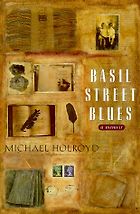
Fourth on your list is Basil Street Blues.
This was interesting to me because it gave me glimpses into a certain kind of Englishness. It is a family memoir by Michael Holroyd, one of the great English biographers. His family – his father’s family at least – is quite a privileged English family which has gone into decline. The memoir gave me a sense of the vicissitudes and non-belonging that one can feel within what appears to be a stable family and social background. Holroyd went to Eton, and as he grows up there are elements of glamour and identification with this background, but at the same time an ordinary human suffering which is quite strong. He wishes to disappear, as he repeatedly tells us in the memoir, because there is so much in his family life and upbringing that he cannot bear.
Holroyd says that his aim was “to pare back a little the cuticle of time”. How does he use his biographer’s tools to tell his own story?
He does a lot of close detective research on his own family history, through archives, letters, interviews and so on. He excavates the history in the same way that he would in a biography. He writes biographical portraits of his relatives. And he gives an insight into his impulse to write biography – which is the impulse to make himself invisible, the observer. He tries to overcome that in this memoir, where he must insert himself. But one can sense his impulse to disappear in his writing, and how much he is interested in other lives.
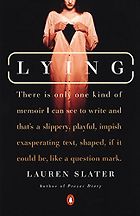
Finally, tell us about Lying.
I came across Lying by happenstance, and I thought it was fascinating. It is by Lauren Slater, who is now a psychotherapist, although that comes as a very unexpected revelation given the book. It’s the memoir of a young woman who has temporal lobe epilepsy and a very dysfunctional mother. So on the face of it, it would seem to be a misery memoir. There has been such a deluge of misery memoirs in America that I have started to think of the genre as being abuse, abandonment, trauma and dysfunction. In a sense, Lying is about that, but it is also a sceptical deconstruction of it on various levels.
Lauren Slater has epilepsy. Epilepsy apparently makes people very prone to imagination – as we know from examples like Dostoevsky – but also to lying, we are told. So we are never sure, and she is never sure, whether she is lying or telling the truth. Sometimes this is on a very factual level, but more interestingly it is on a metaphorical level. In other words, she has very acute sensations and experiences, which she describes metaphorically, and sometimes we’re not sure whether the metaphors are describing real events or not. At one point she falls off a precipice – the whole memoir is about the notion of falling, as you do in epilepsy. But did she really fall? Or is this a metaphor for these states of falling?
The book is subtitled “A Metaphorical Memoir”. It’s also very much a reflection on the metaphoric character of language altogether, and how it is impossible to give a pure, unmediated account of yourself. The truth of the self is always mediated through language.
How well does having an openly unreliable narrator work? Other memoirists may be just as unreliable, only they don’t acknowledge it.
It’s fascinating. She is telling you that this is how memoirs are. There is always an element of self-construction, self-invention, exaggeration. On the very first page, she simply says, “I exaggerate.” Then she says she has epilepsy – or thinks she does. But we don’t know if she really has epilepsy. She might have bipolar disorder instead, or Munchausen syndrome. We don’t know. She doesn’t know. She cannot be sure. In the middle of the book is a page which says “The End”. It’s an end to this narrative of epilepsy, and then she begins in another vein.
Finally she finds a vein of straightforwardness and sincerity. Even though she continues questioning, she acknowledges the need for a stable sense of self, and to say what you mean. But the memoir is about how ambiguous the notion of self is. She says that we invent and construct ourselves. In a sense she is talking about all memoir.
So how closely are memoir and memory related to fiction?
We all create our own lives, don’t we? We construct them, we imagine them. We have to imagine how we want our lives to be in order to live. And we revise ourselves very often. Sometimes we think the past was like this – our mother treated us terribly – and at a later point we think no, our mother treated us perfectly well. We revise our memories in the light of the present, and in the light, one hopes, of deepening knowledge.
Get the weekly Five Books newsletter
But I do think that it is different to fictionalisation. Lauren Slater takes us fascinatingly close to the boundary where memoir and fiction meet. I myself feel that there is a responsibility to simple, naïve, factual truth in a memoir. I don’t think that one should invent things that did not happen. But that aside, any memoir writer could write any number of narratives of their life. We’re constantly engaged in self-interpretation, and that interpretation very often changes.
Five Books aims to keep its book recommendations and interviews up to date. If you are the interviewee and would like to update your choice of books (or even just what you say about them) please email us at editor@fivebooks.com