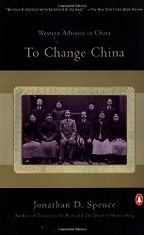
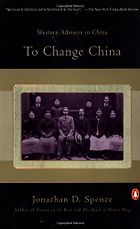
The first book you’ve recommended visitors read is To Change China by Yale historian Jonathan Spence. It’s about all the foreigners – missionaries, soldiers, doctors, teachers, engineers and revolutionaries – who tried to change China over a 300-year period…
At its core this book is about humility and understanding what is possible here as a foreigner. I don’t really know why, but going back to the very origins of foreigners coming to China, there’s something about setting foot on Chinese soil that stirs all of our most extravagant ambitions for changing the world. I think that’s partly because of the size of the place, and because it really does capture our imaginations. People come here intending to have a lasting impact on China and one of the smart things about the book is that it doesn’t tell you that that’s a bad idea – to be hopeful, or to try to help solve problems in China, whether they’re medical problems, or social problems or whatever. But what it does is plays out to you the ways in which a foreigner might be able to help here, and the ways in which a person might run into problems.
Can you give me an example?
One great example is an astronomer and Jesuit named Adam Schall. He came to China in the 17th century and really dedicated his life to the place. He taught the emperor and his advisers about astronomy, which was very important for them, because the emperor needed to be able to tell people when to harvest. That was the way regular citizens knew whether to support the emperor or not, that was the foundation of the emperor’s mandate, whether or not he had a good understanding of the heavens. So Adam Schall taught modern astronomy and as result he was rewarded and promoted: he became a very senior adviser in the imperial court. And then there was a change of mood and a change of guard among the Chinese leadership and all of a sudden Adam Schall was accused of high treason. He was ordered to be executed by death by 10,000 cuts, and it wasn’t until the final moment, when he was about to be executed, that a decision was made that, ‘Well, actually, he’s really, really old and infirm, let’s just give him a pass.’ So he died of natural causes in his own home in Beijing. I’ve always found that story to be quite a valuable corrective to any illusions about whether we are permanent or temporary residents here.
What do you think it is about China that brings out this desire in people to change it?
I don’t think it’s unique to China. I think one of our most enduring Western impulses is the ‘civilising impulse,’ the missionary instinct. We don’t need to go into all the various reasons why that can be hugely destructive, but it can also be productive. There are things here in China that foreigners have left behind over the centuries that are meaningful – for instance Yale University set up a Yale-China Association, which included a medical programme in Changsha that was very important in training a generation of doctors.
I also think the fact that China is a civilisation that is as proud of its history and contributions as our own is a challenge, fundamentally, to foreigners: the idea that you could come here and bring something to it and make a meaningful contribution. But the single largest reason is just because of numbers – the whole idea that if you accomplish something here, you’ll have a bigger impact than you would in any other country.
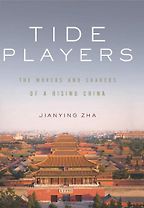
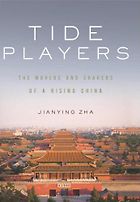
Next, you’ve got a book by Jianying Zha, Tide Players. I know you wrote about her in your blog. She’s writing partly about her brother who spent nine years in prison for co-founding a democracy party. But it’s also about people who have done rather well, the ‘movers and shakers of a rising China’.
Yes, she writes a bit about, for instance, Zhang Xin and Pan Shiyi, who are the property developers behind the Soho China chain. What’s interesting is that Jianying Zha is both an insider and an outsider. She’s of Chinese descent; she was raised in China, and then moved to the US around college. So she’s gone back and forth ever since and has real relationships with a lot of the people who are making big changes in China – whether culturally or financially. She’s able to write with real intimacy and understanding about why people made the kind of choices they made. But she is ultimately also morally candid. She’s an outsider, and so, for instance, in the case of her brother, she asks very hard questions about whether being a dissident in China has the kind of impact that her brother imagines it does, and whether it was worth the nine-year sacrifice. In the end she’s hugely admiring of him on one level, and also quite struck by the tragedy of his experience, that he hasn’t had nearly the impact that he thought he would.
And most Chinese people won’t even have heard of him…
It’s true, almost nobody in China has heard of him, except for the very small group of people around him. I return to that problem over and over again. Should that be the verdict on somebody’s life? I don’t think so. On the other hand, when you look at history, it’s very often the logically indefensible acts of people who are possessed by an idea that create history. That’s one of the reasons I like the book, it balances people like him against people who are more or less ruthlessly practical like these property developers who figured out a loophole in the system years ago. They figured out the need in China for a certain kind of low-cost, ostensibly modern architecture and have ridden that wave to enormous financial success. Put these two stories side by side and you get a very complete picture of the place.
So the Soho chain builds low-cost housing?
Yes, it’s all over Beijing now – for better or for worse. And the property developers as a class loom large in the Chinese consciousness these days, because property developers have become the face of the gap between the rich and the poor and issues about justice and equity which are so dominant in the Chinese conversation. Rightly or wrongly, property developers have really become an icon of this era in China’s economic story.
Why are you recommending this book to someone travelling to China for the first time? Is it so one doesn’t get too mesmerised by the shiny skyscrapers and fancy buildings designed by famous European architects?
When you come to China, it makes a deep impression on you that can also be misleading. On the one hand, we are struck by the incredibly fast and impressive development that’s happened here. That’s everywhere and it’s in some ways typified by developments like Soho. But you only get a certain impression of a country by seeing what it makes available to you at first sight. If you don’t push on any doors that are closed, if you don’t take the time or have the interest, to find out what it is that a country or a community seeks to shield from view, then you’re only seeing one part of it.
This is an enduring struggle for journalists in writing about China. Because if you dwell only on the dissidents and the terrible stories of villainy out in the woolliest corners of the provinces, then you’re really only giving a negative impression of China. But if you dwell only on the incredible new buildings and new airports and the fact that middle-class Chinese are now grooming their dogs at the cost of the GNP of some small African republic, that gives a totally distorted picture of the country as well. It’s really only the latter that’s available to you at first sight. As a responsible visitor, I’ve always felt I need to push on doors that are not being opened to me. Of course if you’re only visiting for a short time it’s harder to do that – but you can do it by reading and by taking the time to educate yourself.
In fact, as a foreigner, you can educate yourself better than an average Chinese person, because your reading material isn’t censored.
Yes, if you’re online overseas you’re able to read all sorts of things that your average Chinese citizen cannot read. So use the opportunity! It’s sort of exciting and it really does give depth to the experience. Professor Yasheng Huang, whose book I’ve also recommended, has this funny line he told me once about what he calls Airportology. It’s his version of the worst kind of writing about China (or India for that matter), which is when you come to a new country and you step through this spectacularly beautiful new airport, which China now has – built by Norman Foster. And you come away with the illusion that that is an indicator of the country’s overall economic, political and spiritual health. And it’s not. It’s an airport. It tells you something important about the level of infrastructure, but there are many other ways to measure the performance of a country, which are not as simplistic. That made a big deep impression on me.
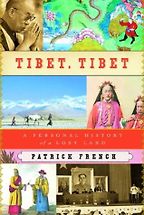
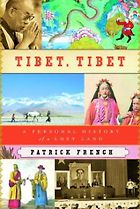
Let’s go on to Tibet, Tibet by Patrick French. He says he met the Dalai Lama at age 16 and that’s what got him interested in the place. It’s part travel memoir, part political history. But he’s pretty critical all around, even of the Dalai Lama…
Patrick French is an interesting storyteller about Tibet, in part because it’s very hard to figure out whether he is a dissident or the loyal opposition or a total partisan, or what. At some moments he’s very admiring of Tibetan culture and the Tibetan people, and obviously at a certain point in his life it really drew him in. At other moments he is very critical, for instance, of the leadership of the exiled Tibetan community. He is critical of the way the Dalai Lama has allowed his image and his name to be used in a whole range of books that have very little to do with Tibet and with the political issues at hand. In some ways reading this book is a bit like travelling through a Tibetan area with a particularly long-winded and knowledgeable and acerbic friend. In Tibet literature, it’s rare that you run into a voice like that: it tends to be that people are either hugely and entirely admiring or they are really critical and angry. It’s rare that you get a voice that depicts both, so I found it to be among the most interesting books written on Tibet.
Tibet is, after all, a very big issue in China, not just for the Tibetans, but for the Chinese. This is an area the size of Europe we are talking about, and of enormous importance to the Chinese sense of self and to what the Chinese government imagines is the future of the country. China regards Tibet and the territorial sanctity of Tibet as absolutely vital to China’s integrity, so it’s an important issue to study.
I’m never exactly sure why it’s so important to them, though.
I think they’ve decided that the collapse of the Soviet Union fundamentally hinged on the failure of Gorbachev to prevent ethnic separatism from taking off. It is true that when you look back the 1980s, he took a relatively tolerant attitude towards separatism and I think that’s why the Chinese go berserk about it.
Isn’t French pretty critical about the celebrity interest in Tibet as well? Doesn’t he argue that it’s superficial, that people campaigning for Tibet are often quite detached from reality?
He can be harsh on all sides. But I don’t doubt the motives of people who feel spiritually and emotionally connected to Tibet. I think by and large their motives are positive and the most prominent ones, who are deeply and politically involved in this issue, do not call for Tibetan secession – just as the Dalai Lama isn’t calling for a Tibetan secession. When I’ve encountered people overseas who are involved in the Tibet issue I’ve been struck by the fact that, in many cases, the ones who are most actively involved are hugely knowledgeable. I interviewed Richard Gere, for instance, and I was expecting a movie star who is casually involved in the issue. That is not at all the case.
What about travel to Tibet? Can you?
A foreign journalist cannot travel to Tibet without special permission.
What about normal foreigners?
Yes, a normal foreigner can certainly go to Tibet.
On this new railway that goes all the way to Lhasa, the ‘rocket to the rooftop of the world’?
Yes, you can go on the speedy train, and that’s probably worth doing. Also, if you don’t go to the Tibet Autonomous Region for whatever reason, there are huge cultural Tibetan areas in Sichuan and Qinghai and Yunnan provinces, that are worth visiting. In fact, many of us feel that the experience there feels a bit more ‘authentically’ Tibetan, to use an imperfect phrase, than some parts of the Tibet Autonomous Region, simply because these areas have not been developed as fast as Lhasa and the surrounding region. So there’s a lot to be said for going to remote parts of those provinces, to get a taste of Tibetan culture as well.
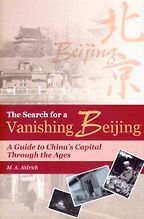
Let’s go on to your next book, The Search for a Vanishing Beijing.
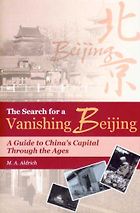
This is a quirky book that I don’t think many people have heard of. It’s actually been quite useful to me in terms of decoding the area where I live. I’ve never met the author – he’s a lawyer who lives in Beijing, and has evidently dedicated himself to understanding the folk history of the city. There are some really interesting odd facts in there. For example, he’s describing the part of town where I live, and he says if you look off to your left, you see an undistinguished guesthouse. But that guesthouse was, in fact, the former home of the founder of China’s secret police, who is one of the legendarily cruel figures in Chinese history. He was also quite an educated connoisseur of antiques and he filled his house with all sorts of elegantly chosen furniture. There’s something fascinating and horrifying about these two facts side by side. It’s not the kind of thing you get from your average tour guide, and certainly not what you get from your average guidebook. For someone who is going to linger here for a few days, and really wants to walk around the hutongs – which really is the most interesting thing to do in Beijing these days – it is a fairly indispensable companion.
It’s very practical, is it? You can use it to get around?
Yes, it’s organised as a series of walks. So you’ll start at the Drum Tower, for instance, and walk south from there, and you’ll pass by the old homes of China’s greatest writers and you’ll pass by the little one-storey house in which Mao Zedong lived when he was a young library assistant in Beijing, etc, etc.
And the title is apt: it really is a vanishing Beijing, isn’t it? These old courtyard houses and hutongs are continually getting mown down to make way for new developments, aren’t they? When I lived in China in 2001 I had friends living in courtyard houses who were constantly having to move because their abode had been slated for demolition. Has that slowed down a little or is it continuing apace?
I’ve lived in four houses in five years. It’s not actually that houses keep getting knocked down, it’s more the radical fluctuations in life which make you move. For instance, one place I lived, I was there a year and I liked it a lot. But I also happened to be living, it turned out, next to the centre of the window-making community in Beijing. It was a very earthy neighbourhood of migrant workers who built windows for contractors. I don’t know about you, but I had never spent much time around the making of windows. It involves cutting glass and steel with handsaws, and they do it more or less 24 hours a day. I felt very close to the artisanal economy of Beijing but I decided to leave after a year. But I love living in these places, so I tolerate the moves.
So none of your homes has been knocked down?
They haven’t been knocked down, though the place I’m living in now, my neighbours all say that we’ve been identified for demolition. They just don’t know when, probably not this year, but maybe next year. They have very complicated feelings about it: it’s never quite as simple as the feeling we have as outsiders, which is, ‘Oh how could you give up this lovely old house you’ve been living in at the centre of the city?’ In some cases people do feel very attached to the place, but in other cases they say, ‘Look my house doesn’t have a toilet; it doesn’t have reliable heating. I want to live in a modern apartment and I’m going to get a lot of money for this place.’ That’s not to minimise the emotional impact, and often these people don’t get compensated adequately. But Chinese people have more complicated feelings about it than a visitor can gather from only a few days of wandering though these terrific parts of town.
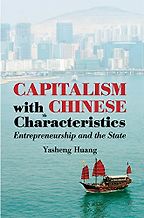
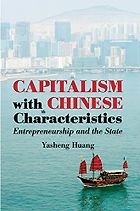
Lastly, you’ve chose Yasheng Huang’s Capitalism with Chinese Characteristics. I think it’s great you’ve included an economics book – in this day and age we all have to understand what’s going on with the Chinese economy. He was at Harvard Business School and now he’s at MIT’s Sloan School of Management. He’s a bit of a contrarian, though, isn’t he?
Yes, his would be a heterodox view, in part because he’s not a classically trained economist; he’s a political economist. But the fact that he’s a contrarian is quite helpful because he offers a valuable corrective to some of the conventional narrative on the China story. Also, I have to say, as far as economic books go, this is one of the livelier offerings. I put it on the list with confidence that it’s not going to be a gruelling experience, because it’s actually a pretty good read. And that’s because he tells a story. His story begins with these farmers who decided on their own, secretly in 1978, that they were going to end the collective farming arrangement, divide up their farmland and start to farm it individually. That became a hugely important model, because it was replicated across the country.
What Yasheng Huang is arguing throughout his book is that China’s great strength has been its own entrepreneurial culture, and that the country has been at its best when it has allowed that entrepreneurial culture to thrive. And that it has actually stumbled when it tries to move in and the state tries to regulate the economy inappropriately or tries to promote state interests. What he’s doing is arguing against the image of ‘market authoritarianism’ or ‘state capitalism’, which is in fashion these days. It’s become very fashionable to talk about the idea that China has rewritten the rules on private entrepreneurship, or on the power of the market. Yasheng Huang is saying, ‘As a matter of fact, no. China’s economic story is in some ways very conventional and we should remember that because it means people do best and the country does best, it grows fastest and their lives improve fastest, when you give them the opportunity to really pursue their own entrepreneurial instincts.’
You’re right that this is getting forgotten at the moment. Everybody is so impressed by China’s economic management because they seem to have navigated the crisis better than anyone else.
That’s what’s kind of interesting about Huang. He is hugely impressed with China’s growth and its ability not to get swept up in the financial crisis. But the difference is how he explains that growth and that success. He’s not just a naysayer – there are these books out there that are basically just predicting the fall of the Chinese regime and are essentially political documents. That’s not what he’s doing at all. He’s making an economic argument that still votes for the power of China’s success but does so for a different explanation, and that’s what’s provocative about it.
We have a tendency to see China as economic powerhouse, but if you’re there you quickly see that this is an economy which also has a lot of problems. What does he say about those? Can you give some examples?
The valuable voice that he brings is a couple of things. First, that the weakness in the Chinese economy is the effort on the part of the state to meddle with it, or benefit from it, beyond what is economically rational. As an example, he has the statistics that show that the average person’s life improved much faster – as told by the growth in rural household income – in the 1980s than it did in the 1990s. He has another book coming out now that shows that the growth in rural household income has really stagnated and slowed down substantially, which means that the average person is feeling poorer. That is a very dangerous fact, if you’re the Chinese government. You want your average citizen to feel richer every year than the year before – because that is the fundamental basis for your political future. The other thing he’s got is this great line: he’s collected all of these old issues of Business Week and the WSJ from the 1970s that were raving about the Brazilian economic model and how Brazil had redefined the way capitalism would work. You can let that speak for itself. What he’s saying is that these economic stories are not faits accomplis. There are moments of good management and moments of bad management, and it’s up to us to identify the moments when China has been at its best and try to take the lessons from that.
Finally, if somebody is coming to China on a two-week trip, where would you say are the top places to go?
I am hugely biased because I studied in Beijing, I live in Beijing and I happen to think that Beijing is where the action is. And there are a lot of people who would agree with me. But that’s a kind of Yankees/Red Sox declaration. I go to Shanghai all the time but Shanghai has never stirred the soul the way Beijing has. Beijing is this strange combination of being both the artistic and creative capital and the centre of a one-party regime. That’s a weird and incandescently productive combination. So Beijing is a must-go-to. I suppose you need to go to Shanghai because it’s cosmopolitan and it will show you something, but I think Beijing is unique.
Get the weekly Five Books newsletter
It’s also vital to get outside the huge cities, and everybody will tell you that. One off-the-wall suggestion would be to go to Xining, which is the capital of Qinghai province. Xining itself is an unlovely place. It’s not a place you need to spend much time, but it’s very accessible from Beijing. You can fly there in a couple of hours. It’s a really dramatic intersection between Tibetan culture and Han Chinese culture and Hui Muslim culture, and Uighur culture. If you go to the train station or bus station in the centre of town and just stand there for half an hour and look around you, you’ll get a much more realistic image of China’s incredible diversity and complexity than you will in Beijing, even in the hutongs.
So I say go to Xining, and from there you can actually get out to some ethnic diversity within an hour or two’s drive, and you’ll start to see something interesting.
Is it pretty countryside?
Yes, Qinghai has some very beautiful stretches. It has all the drama and scale of the lowlands of Tibet, but it’s a little bit more accessible and in fact more diverse.
What about Suzhou and Hangzhou? I went there in 1994 because my guidebook quoted this line, ‘In heaven there is paradise, on earth…Suzhou and Hangzhou.’ I was rather underwhelmed. Perhaps I ended up in the wrong part of town, but my memory is of the classic Chinese-grey industrial city. But my mother-in-law went recently and was raving about Suzhou.
They are beautiful but I would actually put Suzhou on the list for a different reason. Suzhou has lovely canals and it’s rightly proud of that, but what’s most interesting to me about Suzhou these days is that there’s now a high-speed train that can take you there from downtown Shanghai in about 20 minutes. It’s fascinating because it completely transforms the geography of central China. Suzhou is now, more or less, a bedroom community of Shanghai. I actually do recommend Suzhou, but don’t go in the summertime, it’s too hot.
What else, if I want to see the real China?
The other thing you could do is go to Yunnan province. It has incredible diversity and all of the challenges that you see elsewhere in China – for example, that’s where they’re dealing with HIV. Yunnan has what people call Shangri-La and it does have this amazing diversity. But some of the places that are most immediately available in the guidebook – like Dali and Zhongdian – they are part of what I think of as the ‘Shangri-La industrial complex’. They’re not short on foreigners, and may leave some people feeling that they didn’t get far enough off the grid. But as in the case of Yangshuo, which is down near Guilin, you are best off hunting for guesthouses or satellite villages that are outside those main tourist destinations. They have the advantage of being accessible – because of transport links into Dali, Yangshuo and the like – but still having the remoteness that you’re seeking.
Oh yes, the Li River winding through the paddy fields, very much my image of what a Chinese rural idyll would be.
The key thing is getting outside downtown Yangshuo, because there are too many backpacker hostels where you can eat banana pancakes and read your e-mail. If you go outside the city, not that far, there are a couple of guesthouses that are out in the hills that are easy enough to find. It shows you a side of China that is improving steadily, and people are not as sick as they once were and it’s not as poor as it once was, but it’s not given up its visible Chinese identity.
And it’s stunning: it has that classic Chinese scenery, the karst hills.
Yes the Renminbi 20 yuan note has the karst hills of Guilin – and there’s nothing more Chinese than a 20 yuan note…
Five Books aims to keep its book recommendations and interviews up to date. If you are the interviewee and would like to update your choice of books (or even just what you say about them) please email us at editor@fivebooks.com
Five Books interviews are expensive to produce. If you've enjoyed this interview, please support us by donating a small amount.