Francis Fukuyama recommends the best books on the The Financial Crisis
The author of "The End of History" says the financial crisis revealed a great deal about the nature of America’s political and economic system. The shame, he says, is that opportunities to change it are now being ignored.
You’ve chosen the financial crisis as your topic, but I can’t help but start by asking how it fits in with your famous essay, “The End of History”? Given the crisis and the responses to it, do you still believe liberal democracies are the be-all and end-all, as you argued in 1989?
I don’t think that the financial crisis is really relevant to the general conclusion that liberal democracy is the only plausible form of government for a modern society. The financial crisis had a lot of causes – in particular, policy decisions and institutional choices that were made by different countries – but it doesn’t represent some of kind of necessary by-product of the system. There are plenty of countries that really didn’t suffer the crisis, and certainly didn’t suffer it to nearly the extent that the United States did. So it’s more a reflection of policy choices, rather than systemic issues.
With this choice of books, are you suggesting that if people read all of them they’ll get a good sense of the financial crisis in general, or is there a specific point you’re trying to make?
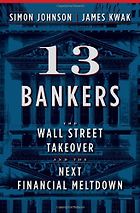
The crisis is obviously a big issue in itself, but the bigger question is what it tells you about the nature of the political system and the economic system that we’re living in. This has an ongoing relevance for how we elect presidents, and what kinds of policies presidents and Congress set in the future. In particular, the crisis has pointed to some interesting aspects of the American political system. One of the really big issues, which is most forcefully raised by Simon Johnson in his book, 13 Bankers, is whether we are actually living in a kind of oligarchy of the sort we attribute to places like Russia or Kazakhstan. The direct role concentrated wealth plays in blocking needed reform then merges, in my mind, into the larger question, which is the impact of interest groups and the way that distorts the political choices that we face – a general crisis for all modern democracies.
So in a way, the financial crisis was a good thing, because it has forced us to concentrate on this issue?
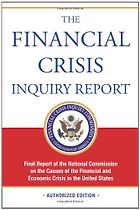
Yes – while nobody wants to have a crisis, it does serve as an opportunity for reform. I would say that one of the big tragedies is that in many respects this was a completely wasted crisis. It wasn’t deep enough. No one wants a crisis on the scale of the Great Depression, but because policymakers acted quickly to put a floor under the collapse of the system, a lot of the political actors were able to shake off the implications of the crisis. That really comes through in the dissenting Republican view of the Financial Crisis Inquiry Commission Report – to pretend, in a way, that nothing actually happened that would undermine a belief in the self-regulating nature of markets.
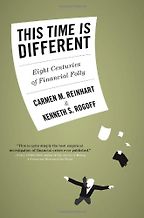
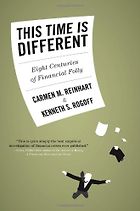
Before we get to that, let’s go through your other books. Your first choice is by Carmen Reinhart and Ken Rogoff and it’s called This Time is Different.
Reinhart and Rogoff are two macroeconomists who have done a marvellous job in bringing together a lot of historical and international data about how unstable financial systems are. The title of their book, This Time is Different, tells you the whole theme. In many respects, the Wall Street crisis was not at all different from Argentina or Britain in the early 1990s or any number of other crises that have been fuelled by credit bubbles and mismanaged macroeconomic policy.
The reason that it was so surprising is that a lot of Americans in the 2000s believed that the US financial system was so deep and well developed that it would never be subject to the kind of instability that happened in Latin America during the 1980s. In a way they were victims of complacency. The other thing that is disturbing about the book is that it really shows how long it takes for a country to recover from this kind of a crisis. This suggests that the US and Europe, which is involved in a separate financial crisis of its own, are in for a prolonged period of low growth and stagnation.
I’ve had the book on my shelf for a while, but I’ve found it quite hard to get through. It has this wonderful empirical data to dip into, but it’s pretty dry economics, isn’t it?
That’s one of its advantages. It’s written by two academic economists, it’s got a lot of data and you’ve got to plough through that. It’s a good reference, but it’s not the easiest book to read and it presupposes a certain amount of knowledge of macroeconomics.
How does the book tie into the bigger question that you raised earlier? One thing you homed in on in an article in The American Interest last year is that hasty liberalisation of the financial sector is very dangerous.
One of the great ironies that the book points to is the fact that a lot of the Asian governments were a lot wiser than the US. The US – through the US Treasury and its proxies, like the International Monetary Fund – put very heavy pressure on a lot of the emerging economies in Asia in the 1990s to liberalise. That had the effect of leading to a big influx of liquidity into Asia as a result of the Asian miracle, which then flowed out again in the mid-1990s and led directly to the Asian crisis in 1997.
“ Just like these Asian governments, we didn’t have an adequate regulatory system in place, and we got into even bigger trouble than they did as a result.”
The American reaction to that was to say, “Oh, this shows that the Asian governments are involved in crony capitalism! There’s not enough regulation, they don’t have mature institutions.” They patted themselves on the back that our system was much better than that. But in fact, in many respects, the financial crisis was simply a repeat of the Asian crisis. Instead of the money coming from the outside world into Asia, it flowed from Asia into the US, particularly from surplus countries like China. So there has been a certain amount of poetic justice. Just like these Asian governments, we didn’t have an adequate regulatory system in place, and we got into even bigger trouble than they did as a result. I don’t think there’s ever been a full acknowledgement of that on the part of Western policymakers. What’s happened in Asia is that all of those countries have gotten much more cautious about allowing free financial flows into their economies since 1997. That history – which we’ve managed to forget – is one that is pretty well covered in the Reinhart-Rogoff book.
Also, you mention that the Asians were accused of crony capitalism, but wasn’t a lot of the pressure for Asia to liberalise coming from Wall Street?
Yes, it was coming from the IMF, but the real pressure behind that was Wall Street. So, for example, in Korea, what we call the Asian financial crisis they labelled the IMF crisis. There is still a lot of bitterness. They believe that essentially the IMF took advantage of their liquidity crisis – that’s really what it was, it wasn’t fundamentally an economic crisis – and used that as an excuse to force open capital markets in Korea to the benefit of all the Goldman Sachses, Citigroups and so forth that wanted access to that market. All the American policymakers – Larry Summers, Bob Rubin – still swear that they had very pure motives in doing all of this, that this was just what was good for Korea. But behind that was, in fact, a tremendous amount of lobbying on the part of these big banks that had a direct self-interest in Asian financial liberalisation.
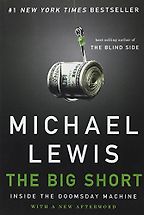
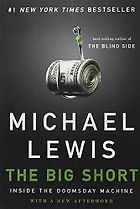
Let’s go on to your next book, which is highly readable and quite hard to put down: Michael Lewis’s The Big Short.
Michael Lewis is terrific both at picking topics and in his exposition. What I thought was most interesting about this book was that there is, to this day, a view about the whole pathology of collateralised debt obligations (CDOs) – these highly complex, packaged mortgage securities – as well as the credit default swaps – the insurance contracts written on those securities – that Wall Street created them and they simply got out of hand. They didn’t anticipate it would be hard to value them, how they would be misused, and so forth.
“So what this book does quite brilliantly is show that there was actually a high degree of intentionality in creating the crisis. ”
What Michael Lewis points out very forcefully is that they were deliberately created by Wall Street banks in order to produce non-transparent securities that could not be adequately evaluated by the rating agencies, which then could be sold to less sophisticated investors, who would buy the idea that this junk debt actually had triple A ratings. So what this book does quite brilliantly is show that there was actually a high degree of intentionality in creating the crisis. The worst of all these securities are the so-called synthetic CDOs. A CDO is a bond that represents maybe a couple of thousand mortgages; a synthetic CDO is a group of hundreds of CDOs, all packaged into a single security. When you get to that level of complexity, no one can evaluate what this thing is worth. You can come up with sophisticated rationales for why this might actually follow some kind of market logic, but I think Lewis shows that the reason this happened is that they didn’t want anyone to be able to rate it.
But they weren’t intending to cause a big crisis and recession – they were just making money by selling dodgy stuff. They were just being used-car salesmen, in a sense.
Yes, but it raises this issue of intentional fraud, which has been at the root of a lot of the charges against banks like Goldman. The book is a story about these five or six weird individuals that realise what’s going on – that this housing bubble was expanding and then eventually would burst – and the other thing it makes very clear is that it undermines any kind of notion that the crisis was not foreseeable. In fact, you can see that a lot of the big banks began to understand that it was not going to be sustained, and did a lot to promote it, hoping that they would be able to get out before the whole thing collapsed.
I’ve never been a fan of Wall Street, which I covered as a financial journalist and found considerably more secretive than the Chinese companies I followed as a reporter in Shanghai. In the case of Goldman Sachs, I remember even having a hard time finding out who their head of international equity was, as if this was some sort of big secret. However, I also know quite a few people who have worked there, and I find the idea of systematic fraud hard to buy.
It depends what you mean by systematic. Lloyd Blankfein doesn’t get up in the morning and say, “OK. How are we going to defraud people today?” but I do think the relationship of these banks to social rules is fairly dodgy. Rules are viewed as potential obstacles that you try to get around if that maximises your profit. This is a deeper social issue that I think has to do with the economisation of a lot of thinking. Economists have this model of rational utility maximisation – that social benefit comes out of everybody pursuing their private rational self-interest. This has shaded over – imperceptibly over the past couple of generations – to a downplaying of social norms as constraints on behaviour. You see this in a number of places. In business schools, for example.
“ When everyone was part of a partnership, there was more of a normative sense that you had a responsibility to customers and that your long-term reputation mattered a great deal.”
Back in the 1960s and 70s, business schools regarded themselves as professional schools along the lines of law schools or architecture schools. They were meant to inculcate a certain sense of professional responsibility, that you have obligations to society at large. But as a result of the economisation of a lot of what was taught in these schools, individual profit maximisation began to displace this normative sense, and this spilled over into the behaviour of the people who went on from these programmes into the financial sector. In their minds, they weren’t deliberately trying to defraud people, but if they saw an opportunity to take advantage of less sophisticated buyers of subprime mortgages, they would go ahead and do it.
Which doesn’t have to be the norm. It always amuses me to see Wall Street bankers flummoxed and frustrated by Japanese companies, for whom social responsibility – for example, not laying off workers or selling a business to a foreigner – takes priority over maximising profits.
A lot of people on Wall Street itself say that the norms were quite different 30 years ago. When everyone was part of a partnership, there was more of a normative sense that you had a responsibility to customers and that your long-term reputation mattered a great deal. This shorter-term trading mentality has really displaced that in many firms. Whether you can get that back or not is another big social challenge in the future.
What you’re saying does tally with what I see on the ground. For banks, it’s no longer about looking after their customers’ financial well-being, it’s about stuffing as many financial products down the customer’s throat as they possibly can. I guess it’s to do with investor pressure – that as a bank you have to get your stock price up?
It’s a lot of things. As the industry has got bigger and more competitive, and involved more money, the kind of clubby, elite-run brokerages and investment banks that existed a generation or two ago have just disappeared. More competition, more participation and less elite control don’t always lead to the best outcomes.
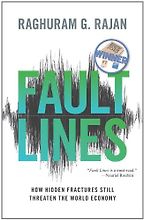
Let’s go on to Raghuram Rajan’s Fault Lines. I love the bit at the beginning where, pre-crisis, he’s in Jackson Hole telling all these central bankers about the risks in the system, and says he felt like “an early Christian who had wandered into a convention of half-starved lions”. Tell me why it’s on your list.
The book was written a couple of years ago now, but he begins by pointing to the issue that’s being raised now by the Occupy Wall Street movement. A major fact of the last 30 years is growing income inequality in the US. He argues that in many respects the housing bubble was the direct outcome of this growing inequality because, for various reasons having to do with political culture, Americans don’t like outright redistribution. They’re not comfortable with it the way the Europeans are and therefore they did a stealth redistribution through subsidised mortgage lending, which is the origin of Fannie [Mae] and Freddie [Mac] [US government-sponsored mortgage companies].
He accepts the fact that the crisis had multiple causes but he argues that redistribution done through subsidised lending is one of the most inefficient and dangerous ways to do redistribution. He wouldn’t actually disagree with the notion that the country needs more redistribution, but he would call for different social policy remedies. The book is interesting because it puts the subprime housing market in this larger context of growing social inequality.
It’s a great title he has for that particular chapter: “Let Them Eat Credit”. Do you agree with him in his analysis then?
Yes, it’s clearly right. There was such a bipartisan consensus – which we now forget about – in favour of expanded credit opportunities of home ownership for low-income people. Everybody wanted to create an ownership society, and was willing to take a lot of risks, not apparent at the time, in order to do this. This is not something that only Democrats favoured, this is something George Bush got behind in a big way as well. Rajan says it’s a very American approach to dealing with a problem of this sort.
“While nobody wants to have a crisis, it does serve as an opportunity for reform. I would say that one of the big tragedies is that in many respects this was a completely wasted crisis. It wasn’t deep enough.”
The other thing that I found interesting about that book is that Rajan is a former chief economist of the International Monetary Fund. He is quite aware – and gives quite a lot of evidence in the book – that ultimately one of the big causes of this crisis was Asia, and all the surplus countries that have been following this export-driven growth model. He says that that growth model is destabilising and is not sustainable for the countries that engage in it. One of the fascinating points he makes is that countries that grow using that model never grow up, in a sense. So Japan, all the way back at the time of the Plaza Accord in 1985, understood that they couldn’t keep exporting to the United States based on a weak yen for ever and that they would have to boost domestic demand. It’s now nearly 30 years later and they still have not succeeded in re-orienting their economy towards greater domestic consumption. That raises some very interesting problems for China because China is even larger than Japan and has been completely dependent on that same export-oriented model. Chinese authorities have been claiming that they understand they’ve got to re-orient towards domestic demand, but I suspect that even though it is an authoritarian state they’re not going to be any more successful than the Japanese were in bringing about this shift. When you grow in that fashion, you create all these big, powerful vested interests, which, in China’s case, are these big coastal export industries. The state is in bed with these people and that’s why I think they’re going to continue to run this extremely unbalanced economy.
How does Fault Lines fit in to your broader concern about the American political system?
In the US, we have increasingly concentrated economic and political power. In a democracy, that should get balanced out by the voting power of ordinary people, but that mechanism seems to have broken down. First, there has not been enough recognition of the inequality of power, and second, the way people have mobilised to deal with it, there’s something missing in that as well. The initial response, according to the Rajan book, was to subsidise lending. That is, in effect, a way of not facing the inequality problem openly but trying to deal with it in a covert way.
Also, as you’ve pointed out, the only real populist outrage has been coming from the right, which doesn’t make any sense at all.
That, for me, is the central puzzle of this whole crisis. You have a crisis that starts on Wall Street and implicates a lot of the deregulated free market institutions that were created since the Reagan revolution. The crisis also had roots in the increasing maldistribution of income in the US. Despite all that, there’s been no mobilisation of people on the left. I really don’t believe Occupy Wall Street represents a broad mobilisation. The particular demographic at issue are the white working or lower-middle class in the US, the so-called Reagan Democrats. In the 1930s, they voted for the New Deal coalition – if they were Europeans, they’d be voting for Social Democratic parties. But in the US, in most elections over the past 30 years, they have voted for Republicans who have pursued policies that largely hurt their interests. That’s the big sociological puzzle about the US, why that phenomenon exists.
It’s partly a lack of interest in politics isn’t it? People are losing jobs but they’ve got cable TV, two cars per family. Life is tough, but they can still go shopping and there are enough distractions never to have to think about politics at all.
That’s right. The economist Tyler Cowen has made the point that, in a sense, inequality matters less than it did 100 years ago. If you were at the bottom in terms of income distribution 100 years ago, it was literally a life-threatening situation, in terms of your life expectancy, your vulnerability to setbacks. It’s still the case in large parts of the developing world right now. But here in the US the level of people at the bottom is sufficient that they can still enjoy their smartphones and cheap clothing at Wal-Mart. The issue of inequality becomes much more abstract. They know there are people making billions of dollars, but it doesn’t bother them as directly.
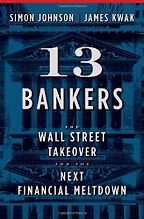
Let’s go on to Simon Johnson and James Kwak’s 13 Bankers. You mention in one article that “this book comes closest to the Marxist plutocracy conspiracy” theory of the crisis, which made me laugh, considering Johnson is, like Rajan, a former chief economist of the IMF.
Obviously that’s way overstated, but it is remarkable that here we are in 2012, the fourth year after the crisis. We still don’t have an adequate regulatory system in place to prevent a crisis like this from happening, and the recent collapse of MF Global indicates that in many respects Wall Street hasn’t learned lessons either, in terms of the kinds of risks they’re willing to take.
I’ve got this very simple view, which is that I don’t think regulation of the Dodd-Frank sort is going to work. The investment banks have got way too much talent, are way too creative and way too nimble for regulators ever to keep up. Therefore the real solution all along should have been to break these big banks up into smaller pieces, which is essentially what Glass-Steagall and the interstate banking regulations of the 1930s did. Once the banks are no longer too big to fail, then you can just let the market work the way it’s supposed to. If people take outsized risks and they get into trouble, then they just go bankrupt, and that is essentially what happened to MF Global. It hurts people, but it’s not a systemic crisis.
“You get these windows of opportunity that are created by big external shocks like the financial crisis, and if you use the opportunity and direct all that anger at the right moment you can accomplish certain things.”
That option was never seriously considered. We briefly toyed with the idea of nationalising the banks in the depths of the crisis. In the debate leading up to Dodd-Frank, there was actually one really interesting roll call vote. There was an amendment proposed that would have limited the size of financial institutions. It was defeated something like 60 to 30, and if you look at the list of the people who voted against it, it includes Chuck Schumer and all of these liberal Democrats. They’re the ones who should have been leading the charge against this kind of concentrated power, but given where they get their money, they weren’t willing even to consider it. That’s why we still haven’t solved this problem. In that one specific respect, Johnson is completely correct. It’s not just a matter of corrupt money bribing people; it’s also a case of intellectual capture. People just can’t think outside the parameters that are set by this community and just don’t entertain certain kinds of potential solutions to it.
If the break-up of the banks is the only solution, why don’t we just get on with it?
It’s not going to happen. That’s the nature of politics. You get these windows of opportunity that are created by big external shocks like the financial crisis, and if you use the opportunity and direct all that anger at the right moment you can accomplish certain things. Right now that window has slammed shut, and unfortunately it’s going to take another repeat crisis for it to open up again. In fact, given the way the debate has developed, the idea that we’d actually do more regulation in the US rather than less is off the table because of the right-wing reaction to everything. In general, I think deregulation is a good thing. It’s just that the financial sector is really different. It requires a stronger political muscle to make that sector not be of general danger to society.
Speaking of political constraints, what’s your view of the argument that authoritarian regimes are better equipped to deal with this kind of crisis? The Chinese were able – apparently successfully – to pump a massive fiscal stimulus into their economy, in a way the US, with its political gridlock, was simply unable to.
I think the China alternative is a big red herring. I just don’t think that in the long run the Chinese are going to look nearly as good as they do today. Buried in all that authoritarian decision-making are a lot of time bombs with regard to environmental degradation, with regard to repressed social anger at the way those decisions are made and so on. No matter how smart they are, they’re not that smart. No one can spend that much money in a stimulus and have it all go into productive investment. We’re going to discover in a few years that they’ve overplayed their hand and made lots of mistakes, just like in this much touted high-speed rail system that they have put in place. There’s obviously a tremendous amount of corruption and shoddy workmanship and we’ve only seen the tip of that particular iceberg.
But if authoritarian states need more accountability, you can make the case that democratic political systems have been paralysed by the multiplication of checks and balances over time. That really creates a situation of what I call “vetocracy”. There are no forcing mechanisms to make the polity take a difficult choice, but there is enough participation that everybody can block things that they don’t like. In the US we have a particularly severe form of this because our constitution mandates many more checks and balances and many more vetoes in political decision-making than do the constitutions and basic laws of other societies. The economist Mancur Olson was right, I think, that over long periods of peace and prosperity, the vested interests that take advantage of this kind of political system tend to multiply. So I would relate our current problem to a bad institutional set of rules.
So we need political reform?
Yes, every country needs political reform on different levels, but the US needs to trim back the number of these veto points and restore some mechanisms by which difficult trade-offs can be forced on the system.
Are people actively coming up with solutions here?
No, as far as I can tell, this is not an issue that anyone is willing to take up. For example, just to give you one possible solution – the super-committee that was formed as a result of the impasse over raising the debt limit. I think it actually points to one possible way of doing future budgets. Right now, an American budget is formulated by Congress. Essentially, 535 members of Congress have a six-month window of opportunity to load budgets up with tax breaks, subsidies, earmarks, exemptions for special interests and so forth.
Contrast that to the Westminster system in Britain, where the government writes the budget and because you’ve got party discipline, it’s passed within a week or two of its being proposed by the Chancellor of the Exchequer. Britain also got into trouble for different reasons, but if you had a system in which the budget was formulated by a much smaller group of people, that had a lot of technocratic input and was then sent to Congress for a single up or down vote, you would eliminate many of the opportunities that exist under the current system. Is anybody interested in considering this as a long-term solution? No, there is no political interest in anything remotely like this.
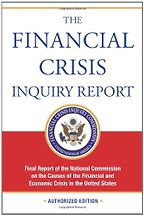
Let’s go on to your last choice, the report of the Financial Crisis Inquiry Commission. Are you interested in its analysis generally, or is it more the dissenting opinion?
It’s mostly the dissent, which basically shows this amazing phenomenon, that the Republicans have not been able to learn from the past 30 years. Especially the Wallison dissent, which takes what is a very complex crisis that has multiple roots and lays it all at the door of Fannie and Freddie and government intervention. It seems to me transparently designed to exonerate free markets. I like free markets – I think we benefit from having market competition and the market setting prices and so forth – but this crisis has proved that financial markets are not self-regulating. To draw from this complex analysis that particular conclusion I just find astonishing.
How can you change someone’s mind if they believe that all the distortions and problems are caused not by markets, but by government intervention?
That’s where reality, every now and then, intrudes. That’s why, as I said before, in a way the crisis wasn’t severe enough. Because a floor was put under the problem at the right moment, it was possible for people to move on. The other thing is just purely political. As long as the Republicans can get people to vote for these same deregulatory policies, they’re not forced to face the music. I think the election this year is going to be very crucial in either affirming or denying that. If you continue to deny reality for long enough, at a certain point you’re going to have to pay a political price.
I suspect that if the crisis had been worse, government would have been blamed even more.
We can’t know how that kind of counterfactual would have worked. You’re right that there’s a massive inconsistency in the libertarian position. The fact is that it was only very strong action by the Fed, through Congress and the TARP [Troubled Asset Relief Program], that put the floor under the crisis. And yet, there’s still a belief that the government caused this. There is a great deal of anger against the TARP, despite the fact that most informed observers agrees it was a necessary thing to do in order to correct a mistake that was created by private markets. You may be right, I suppose, that even in a more severe crisis, people could still maintain that belief, but it does seem to me that when suffering reaches a certain level, that argument is going to be harder to sustain.
I get the sense that the belief that government is bad and markets are good is almost like a religion. No reality check is ever going to be enough to make a difference.
It is true that it is a part of the American political culture, but that culture has changed over time. People believed that very strongly in the late 19th century. Then you had the rise of the Progressive movement, which shifted views towards the need for a stronger centralised state. Then it made a big comeback in the 1920s and then the Great Depression again shifted views. It may be a religion, but it’s not a religion that members believe in at all points.
There is also this problem that both you and Jeff Sachs have written on, that if you’re constantly critical of government, and say you don’t like government, the government you get is going to be of lower quality because it gets deprived of talent and resources. This, in turn, confirms your view of government as incompetent and it becomes a vicious circle.
It’s what’s an economist would call a low-level equilibrium trap. You don’t want to pay taxes to get better government services because you’re convinced the government will waste any money that you give them. So you’re never in a position to get out of that. A lot of Latin America is basically in that situation, and I’m afraid that the US has now been in this situation for some time.
Five Books aims to keep its book recommendations and interviews up to date. If you are the interviewee and would like to update your choice of books (or even just what you say about them) please email us at editor@fivebooks.com
Francis Fukuyama is an American political scientist and author. He is Senior Fellow at Stanford University's Freeman Spogli Institute for International Studies and Mosbacher Director of FSI's Center on Democracy, Development, and the Rule of Law (CDDRL), and Director of Stanford's Masters in International Policy Program. Fukuyama writes widely on issues relating to democratisation and international political economy, and first shot to prominence with an article "The End of History?" in 1989.
Francis Fukuyama is an American political scientist and author. He is Senior Fellow at Stanford University's Freeman Spogli Institute for International Studies and Mosbacher Director of FSI's Center on Democracy, Development, and the Rule of Law (CDDRL), and Director of Stanford's Masters in International Policy Program. Fukuyama writes widely on issues relating to democratisation and international political economy, and first shot to prominence with an article "The End of History?" in 1989.