Reading about Russia's 20th century is like finding another vision of how the world might have been. Francis Spufford, author of Red Plenty, recommends books that tell the story of Russia in the last century — from Soviet science fiction set in capitalist wastelands to Khrushchev as raconteur.
Before we start with your choices, what is it about 20th-century Russia that hooked you in?
I think because it offers this frightening and strange yet still familiar cousin to the 20th century that I grew up in, as a safe comfortable Westerner. The Cold War was the ordinary shape of the world when I was young. I was born in 1964 and I am old enough to have had the absolutely conventional nuclear apocalypse nightmare which was a standard part of being a teenager in the 1980s. I took that to be the shape of things. Then the world changed suddenly and drastically in the late 80s and the early 90s, and I found myself very interested in what was happening while the 20th century was so radically divided between the different groups. There were these different visions of how the world can be, and I like to look at what we can learn from both halves now they can be laid side by side.
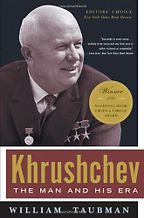
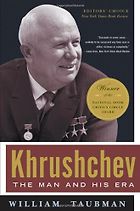
Your first choice is about one of Stalin’s henchmen – Khrushchev: The Man and his Era by William Taubman.
Khrushchev started off a miner’s son and had one of those rocket rides in the social stratosphere that could happen once Stalin had got rid of all the old Bolsheviks and needed a completely new political class. He went being from being a semi-literate party member out in the country to the deputy mayor of Moscow in about five years, and he finally ended up as one of Stalin’s inner circle. He worked closely with Stalin for nearly 20 years and approved thousands of arrests and executions and then went on to lead Russia during the Cold War.
For me this is a magisterial biography and strangely funny. Khrushchev was a funny guy – it is one of the things about him which was appealing and then, when you think about it, more worrying still. Of all the Soviet leadership, Khrushchev is the one who is recognisable as a human being. He had that rare gift among politicians of remaining recognisable, thinking on his feet and cracking jokes. He had an almost Clintonesque gift of the gab, which really wasn’t a crucial skill among high-level Stalinists. In some ways I would guess that he survived at the top of Stalin’s Russia in spite of it.
He was assumed to be too nice and too much of a peasant to be threatening, as a result of which he outwitted all of his contemporaries. One of the things I like about this biography is that as well as being the best record of Khrushchev, with the most use made of the archival stuff that has become available in the last 20 years, it is also a continuous lively attempt to think through the man, to keep fitting the new stuff you find into a picture that makes sense of him.
There is a wonderful passage about Khrushchev succeeding as Stalin’s henchman which talks about just how often he records what nice guys the other members of the group are, and not just to butter them up but in conversations as well. Taubman makes the point that some of these people were the worse mass murderers of the 20th century. And Taubman concludes that what he was doing is reflecting a genuine part of his personality on to them. Compared to his colleagues it was important for him to seem a ‘nice guy’ despite everything he was doing.
Khrushchev was a true monster and he also had an undestroyed conscience, which was a very awkward combination. Once he had fought his way ruthlessly to the top and succeeded Stalin, he tried his best to undo the worst excesses of Stalinism and to justify the suffering of the past by a genuine effort to deliver everything that the revolution had promised. He was not an immensely clever or subtle man but he really did believe that the land of milk and honey was coming in the Soviet Union.
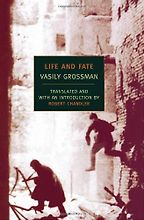
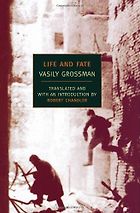
Your next choice is Life and Fateby Vasily Grossman.
Grossman was a Ukrainian Jew and a war correspondent for the Soviet military paper, the Red Star. He seemed to be a good Stalinist, but while he was writing very conventional socialist realist novels, he was storing up in his head ways of describing Russia that didn’t at all fit the compulsory official mould. And in the 1950s he secretly wrote this book Life and Fate which, most strangely, is a sequel to one of his official novels, For a Just Cause. It has got the same characters in it and continues the story. But it’s as though suddenly a switch has been thrown – it is alive and committed to truth telling. It is about the secret similarities between Nazi Germany and Soviet Russia, and about the strange interval of freedom during the Second World War in which the Soviet regime had to trust its people because it couldn’t compel their loyalty, and how that narrow window of freedom closed again.
It is also just a wonderful epic portrayal of the Battle of Stalingrad. It was used by Antony Beevor in his Stalingrad book and Beevor is partly responsible for Grossman’s rising profile in the West. It is a fabulous piece of military re-creation. It is a wonderful piece of writing about the Holocaust and although it is still quite a creaky conventional piece of Soviet realist writing, it is animated by the most powerful possible truth-telling urge. Once it followed its Jewish characters all the way to the gas chambers you are put where Vasily Grossman wanted you to be, which is, despite everything, immeasurably grateful to the Red Army for destroying that particular evil, even at the cost of cementing the other one. I started weeping uncontrollably on the tube while I was reading those bits of Life and Fate, and that’s a good thing.
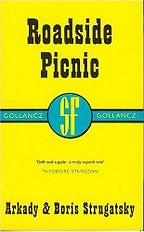
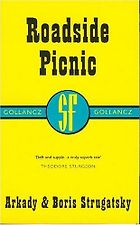
Your third book is actually Russian sci-fi. This is Roadside Picnic by Arkady and Boris Strugatsky.
Yes, Roadside Picnic is the single greatest work of sci-fi fiction, written by these two scientist brothers. It is what Tarkovsky’s great and weird film Stalker is based on. The story, like a lot of Soviet science fiction, is set safely outside the Soviet Union in a capitalist wasteland, where interesting things can happen that you can talk about!
Some aliens that are incredibly powerful arrive briefly on earth and then bugger off again leaving some ambiguous and very frightening objects behind them, which the book says are rather like the wrappings and empty bottles left at the side of the road after people have stopped their car for a picnic and gone on again. Around these mysterious objects, which may or may not have the power to grant wishes, a whole desperate shanty town of prospectors and chancers has grown up.
The thing about Soviet science fiction is that it was actually far freer than Soviet literary fiction to do interesting, bold, satirical, avant-garde things. Roadside Picnic is, among other things, a wonderful indirect metaphorical reflection on everything about Soviet Russia – from its terrible scrappy industrial texture, through to the way that the possibility of miracles kept bobbing on through the wasteland like will-o’-the-wisps. It’s about the way that industrial grime and decay always coincided with promises that at any moment things could be radiantly wonderful.
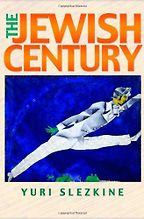
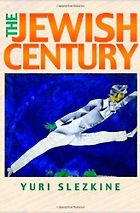
Your fourth choice is Yuri Slezkine’s provocative The Jewish Century.
Slezkine is an ex-Russian Jewish historian who now works in the United States. And this is a fascinating heterodox piece of 20th-century history which has annoyed some people quite a lot. That’s because he says our sense of 20th-century Jewish history has been distorted by the eventual success of the American Jewish experience as the main metropolitan one – that, he says, was not true for most of the 20th century.
He uses this metaphor from the story of Fiddler On the Roof about the milkman’s three daughters. One of whom goes to Palestine, one of whom goes to America and one of whom goes to Moscow. And he says that if you had to rank them in the importance people thought they had in the 20th century, America comes last, Palestine in the middle and Moscow is the most important Jewish city, and the central Jewish experience of the 20th century is the Soviet one. He thinks it wasn’t an experience of persecution and state-sponsored anti-Semitism until later.
Get the weekly Five Books newsletter
The bit that really annoys people is when he says in the 1920s and 30s the Soviet Union was a brilliantly successful state for Jews. It was the only officially philo-Semitic state on the planet. And it was somewhere where Jewish life thrived and there was incredible social mobility and educational opportunity for Jews. He has spun out of this a very engaging and, I suspect, deliberately annoying account of history which should certainly be read against the pieties of the present.
But do you agree with him?
I think some bits are undeniable. But communism is a bit embarrassing now. It is getting hard to get people to own up to the fact that once upon a time they thought it was sensible. It was part of the centre of gravity of the 20th century. What I agree with about it is that it brings an aspect of the 20th century into view. One of the hardest things for us to remember about Stalinism is that as well as being a system of horrors it also represented modernity and social mobility and opportunity for lots of people. In a horribly straightforward way the great purges opened up an incredible number of jobs, as we saw with Khrushchev, who is a fine example of Russia being a land of opportunity built on numerous graves.
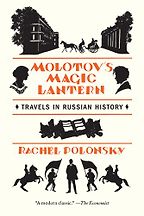
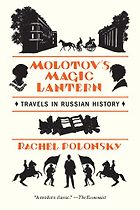
Tell me about your last choice, Molotov’s Magic Lantern by Rachel Polonsky.
Unlike the other books, which are wonderful in various ways, this one is beautiful. It is very much a 2010 book – a kind of travel book written by the historian/journalist Rachel Polonsky who lived in Moscow for ten years in the fancy old apartment building which for most of the 20th century housed the party elite. She lived just down the stairs from Molotov’s flat and gets let into it by the investment banker who now rents it, and it still has all his books and his magic lantern. In case anyone reading this doesn’t know, Molotov was Stalin’s Foreign Minister, the one who made the pact with Nazi Germany. He was described by Churchill as being the closest thing to a robot he had ever met. The famous Molotov cocktail, a hand-thrown incendiary device, is named after him.
Polonsky writes about the flat radiating outwards through Moscow now, in the 20th century and further back in the past, and then out through Russia’s north, south, east, west and all the way to Siberia. She has written this exquisite meditation on place – not just on big outdoor places but on little domestic interior places. It is like, if you can imagine it, reading a wonderful series of lamp-lit oil painting interiors so you feel like you are reading paintings. It’s about the indoor spaces in which Russian 20th-century history happened. But it is really tough-minded as well. It is a beautiful tough book about furniture and curtains.
September 6, 2010
Five Books aims to keep its book recommendations and interviews up to date. If you are the interviewee and would like to update your choice of books (or even just what you say about them) please email us at [email protected]
Five Books interviews are expensive to produce. If you've enjoyed this interview, please support us by donating a small amount.
Francis Spufford
Francis Spufford is Professor of Creative Writing at Goldsmiths, University of London. He is the author of a number of books, including Red Plenty, about Russia in the 1950s and 1960s, and the economists who tried to make good on Khrushchev’s impossible promise that Soviet citizens would shortly be richer than Americans.
Francis Spufford is Professor of Creative Writing at Goldsmiths, University of London. He is the author of a number of books, including Red Plenty, about Russia in the 1950s and 1960s, and the economists who tried to make good on Khrushchev’s impossible promise that Soviet citizens would shortly be richer than Americans.