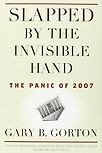
Yale professor Gary Gorton says today’s financial crisis may feel like a unique event, but in the US and in the UK crises are historically common. And we have a history of similar responses.
I get the impression from your selection that financial crises aren’t unusual?
Yes. The idea of the selection is that most people are very unfamiliar with financial crises. There might be some older people who lived through the Great Depression but they would have been children at the time. Today’s crisis seems like a unique event, but in the US and in the UK crises were very common events. The idea here is to try to show people that we have a history of these things and a history of similar responses. There is a structural reason for crises: banks create very useful liabilities (like checks and repo), but they are vulnerable to runs.
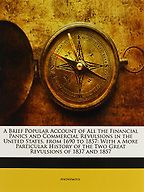
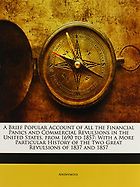
The New York Press book is a compilation of popular accounts of the crises assembled by the press. There are poems, jokes and articles about those pre-Civil War crises – there is everything here. They were correct in putting the 1837 and 1857 panics on the cover as they were the important panics prior to the Civil War. So, this book was written after 1857, looking back and saying: ‘Look! We’ve had all these other panics – 1690, 1748, 1780…’ The idea is similar in a way to my idea – pointing out the precedents in history.
So, we really haven’t learnt much.
Well, I think the first thing to learn is that these events are not so unique, that you don’t have to have specific policies for each event, that there is a commonality which is to do with how banking is structured. Before the Civil War banks printed their own money – bank notes represented the each bank’s private money. The problem then was that people could run en masse on banks demanding their money back. In 1837 the Free Banking Act was passed in New York State which required banks to back their note issue with state bonds. But, these bonds were risky so it did not prevent panics. During this period checking accounts grow significantly. Then, after the Civil War the government takes over the money supply. The problem is no longer runs on private bank notes, but from 1857 until 1934 there were repeated panics to do with checks: everyone demanding to withdraw all their money from their checking accounts. We finally get deposit insurance in 1934 even though there was a lot of opposition, including economists. Roosevelt was also not a proponent.
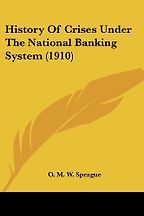
Sprague, the author of the History of Crises, was the first chaired Professor at Harvard Business School and his book is a classic narrative of the national banking era. So, during the Civil War the government passes an act which charters national banks: 1865-1914 is the national banking era. All the panics in this era are to do with checking accounts. Then, in 1914, the Fed comes into existence and the next panic, of course, is the Great Depression.
So, we have made some progress. The current crisis isn’t as bad as the Great Depression.
The Studs Terkel book, Hard Times, is an oral history of the Great Depression, including people from all walks of life describing what they did, from the demonstrations and riots of the out-of-work to Goldman Sachs executives talking about what’s going on. Studs Terkel was a Chicago radio host and he recorded all these interviews long after the Depression and played them on the radio in the 1970s. There are interviews with people who spent the time as hobos, people from the Works Progress Administration. There was 25 per cent unemployment in the Great Depression, whereas now it’s ten per cent. So, there is a group of people, like you and me, who are doing fine and then a large group of invisible people who aren’t doing fine.
Your next book is Dorothea’s Lange’s famous photos.
Yes. Everyone will recognise many of these photographs. She looked out of her window in San Francisco one day and saw unemployed workers lined for food. She ends up working for the Farm Security Administration and her job was to take pictures. The Great Depression was not just an economic catastrophe but it coincided with a terrible drought. So, Dorothea Lange ends up taking pictures for the FSA of people travelling from Oklahoma to California to find work and escape the drought – Okies, they were called. This is what Steinbeck’s Grapes of Wrath is about. People were living in tents with children in the middle of nowhere. This is not the distant past – my grandparents told me about the Great Depression and going to the bank to collect savings which were all gone.
This current panic was invisible to people, unless you actually traded in capital markets. Before, people would have been at the bank demanding their money but this time it was firms and institutional investors demanding money from the banks. So the banks sold their assets. The banking system has changed over the past 30 years. Nowadays, many firms use repurchase agreements (repo) like checking accounts. Repo involves the depositor taking collateral, which is often bonds that are securitised loans. The loans-selling process is called securitisation. Non-mortgage related securitisation itself was larger than the US corporate debt market before the crisis. So this is a very important market.
The book I’ve chosen on securitisation really is accessible. It’s a collection of lectures from people in the industry who are or were involved in securitisation. The first line says that securitisation is one of the most important and abiding innovations to emerge in the financial markets since the 1930s. This is a lecture from 1996, so people already recognised that it was important back then. There is a chapter about the role of rating agencies, securitisation’s role in the housing – something we’ve been reading about a lot with respect to Freddy Mac and Fannie Mae. But we had a series of crises before the Civil War too and attempts at preventing them were kind of short-circuited by the system’s evolution and the national banking era, during which repeated crises allowed the government to finance the war. What did prevent crises was not intelligent design by intellectuals, but a populist mandate in 1934 – deposit insurance. The economists were jumping up and down saying: ‘Don’t do it!’
But it hasn’t worked.
It worked until we had another change. This crisis is viewed as a unique event and people point to credit derivatives and compensation, but in the background of all this is this bank liability that looks just like demand deposit and people didn’t know about it. If we don’t understand that there is a common structural problem then we can’t act. We should recognise the problem.
What is the problem?
The size of the repo market.
The what?
I’ll walk you through it with a hypothetical example.
Great.
So, Fidelity Investments (for example) is a huge mutual fund manager and, let’s say, has $100 million in cash that people have sent in and they’re going to use it to buy securities, but not right now. They’d like to put it in a checking account but the ceiling on checking accounts is only $250,000. So, they’ll use a repo. This is a sale and repurchase agreement. They are going to go to, say, Bear Stearns and deposit the money and Bear Stearns will pay them interest and the transaction will happen overnight. But how will they make it safe?
I have no idea.
Bear Stearns owns securitised bonds that it has purchased. So, Fidelity will receive $100 million dollars of bonds at market value such that Fidelity doesn’t have to worry about Bear Stearns going insolvent overnight because it has bonds. This market in securitised bonds grew very large and the government never collected data on it.
Then the market suffered an economic shock – housing prices went down. That alone is not a global financial crisis, but nobody knew where the risks were. It’s like E.coli in ground beef. People then stop buying all sorts of things. So, Fidelity says: ‘I’m worried you might have this sub-prime housing risk and I need to sell some bonds so I want to haircut the collateral.’ They deposited $100 million and got an equivalent amount of bonds. Now they say they only want to deposit $90 million so they make a withdrawal of $10 million. Now Bear Stearns has to come up with that money. I have estimated that the repo market before the crisis was around $10 – $12 trillion. So, if the haircuts were zero and are now 30 per cent that’s a sudden withdrawal of $3 trillion.
Why didn’t we know?
Because the repo market is an obscure market. We did see the housing market collapse coming, but then, with the repo market, what people saw were only the effects of it and they eventually started to associate the effects with the causes.
April 1, 2010
Five Books aims to keep its book recommendations and interviews up to date. If you are the interviewee and would like to update your choice of books (or even just what you say about them) please email us at [email protected]
Five Books interviews are expensive to produce. If you've enjoyed this interview, please support us by donating a small amount.
Gary Gorton
Gary B Gorton is an American economist and Professor of Management and Finance at Yale University. He is a former member of the Moody’s Investors Services Academic Advisory Panel and former director of the research programme on banks and the economy for the Federal Deposit Insurance Corporation. He has taught at the Graduate School of Business, University of Chicago, and previously worked as an economist and senior economist at the Federal Reserve Bank of Philadelphia. During 1994 he was the Houblon-Norman Fellow at the Bank of England. He has been a member of the New York Federal Reserve Bank Financial Advisory Roundtable since January 2009. He is an expert in stock and futures markets, banking and asset pricing. He has been an editor of The Review of Economic Studies.
Gary B Gorton is an American economist and Professor of Management and Finance at Yale University. He is a former member of the Moody’s Investors Services Academic Advisory Panel and former director of the research programme on banks and the economy for the Federal Deposit Insurance Corporation. He has taught at the Graduate School of Business, University of Chicago, and previously worked as an economist and senior economist at the Federal Reserve Bank of Philadelphia. During 1994 he was the Houblon-Norman Fellow at the Bank of England. He has been a member of the New York Federal Reserve Bank Financial Advisory Roundtable since January 2009. He is an expert in stock and futures markets, banking and asset pricing. He has been an editor of The Review of Economic Studies.