The five books that you’ve chosen to recommend here are all works of literary non-fiction – a hodgepodge of history, reportage, travelogue. You’ve framed them as five unusual histories. Flicking through them I also thought one might apply the term “magic journalism” which was coined for Kapuściński, one of the authors you pick. I guess the one thing that connects all five books is that none of them quite fit into a genre. Indeed, that’s something that your own work could be accused of. What is it about this kind of genre-defying non-fiction that appeals to you?
I guess what I have to start by saying is that I promise you I’m not choosing these books as a thinly veiled hustle for the kind of thing that I’m doing. But I find it really tricky when asked to come up with five books of something to think of a category, whereas as soon as I thought of books that didn’t fit into any category, I realised there was a lot that I could come up with. So I guess that’s the first thing to say, that there’s a lot of this uncategorisable stuff about. So much, in fact, that I think it’s now time for a whole category in a bookstore to be devoted to the hitherto uncategorisable.
Then I thought that there were so many things that come to mind in terms of uncategorisable books I had to make it a bit more manageable. So I thought history. Because typically, I guess, you read history books for the content – that sounds an unbelievably stupid comment – and you’re drawn to certain works of history rather than others because you’re interested in the period. You read Stalingrad by Antony Beevor because you’re interested in the Second World War, or Russia or whatever. Whereas it seemed to me that the thing about these books was that you might be interested in the subject, but it’s the way that the subject is dealt with that is the distinguishing feature of each one.
And how did you yourself end up writing this uncategorisable non-fiction?
I guess when I left university I liked the idea of being a writer, and I thought then that being a writer really meant that you were a novelist. But if one of the impulses for being a novelist is wanting to be a storyteller, I never had any urge to tell stories. But I did have an urge to create criticism that was more creative, or that wasn’t just to one side of and several steps down in importance from the original stuff, fiction. And then I started encountering writers like John Berger and Roland Barthes, who actually made such a thing seem viable.
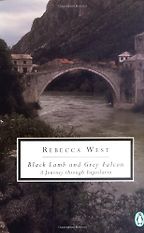
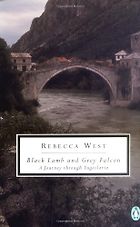
Let’s begin on your book selection with Rebecca West’s Black Lamb and Grey Falcon, which I know to you is one of your great core canon. Will you introduce the book for our readers, and tell us why it’s so important to you?
I guess it’s good that we’re starting with this, because it’s a seriously off-putting book. It’s close to 1,200 pages – a travelogue-history of Yugoslavia.
But it’s quite readable.
It’s incredibly readable. But it seems like such an enormous commitment, doesn’t it, to read a book in excess of a thousand pages. The opportunity-cost of committing to this book seems so huge when you could have got through six other books. So you have to be absolutely assured of its quality. And then there’s the thing of – we were talking about content before – why should you read this book if you’re not interested in Yugoslavia?
I know I had no particular interest in Yugoslavia until I was going to Serbia, Belgrade, for a British Council seminar and they mentioned this book that we might read, Black Lamb and Grey Falcon, as preparation for that. As always happens when I’m going to a place, I didn’t read it. I didn’t do the homework. And again as happens when I’ve been to a place, I then became incredibly interested in it. This was, interestingly, during the Milosovic era and one of the wars – although I can’t remember which now. Anyway, I came back and wanted to learn much more about this place I’d been to. I started to read this book, because I’d been to the place it was about, and then I started to realise: My God, this is a major, huge literary masterpiece. It’s without question Rebecca West’s magnum opus.
It’s the account of her trips to Yugoslavia in 1936-8, so in the context of Nazism. What are some of the things that she witnesses and considers?
The first thing to say is that she very cleverly stitches together three trips she made, so the book reads as if it’s one continuous journey – with this character who’s only ever identified as “my husband”. The husband is doing and saying all sorts of things but he’s just “the husband”, and I think it’s great to sustain that for 1,100 pages. She meets a whole load of people – some of whom, in Rebecca West’s great way, she takes this virulent dislike to.
I should say that nothing particularly dramatic happens to her – she’s never caught up in major events in the same way that Kapuściński is – but what is really remarkable, first of all, is that her experiences become an excuse for these huge metaphysical digressions about anything and everything. And also the extraordinary thing is that she’s describing events that she’s seeing at this particular moment in history, yet the book has this incredibly prophetic quality to it. So all the stuff we’re reading that is going on in Bosnia or Serbia, fast forward 60 years and you’re seeing the same scenes being enacted. So she’s reporting about a particular moment, but also she’s tapping deep into some essential and timeless quality of the place.
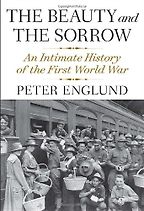
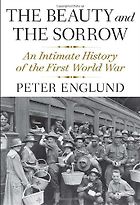
Peter Englund’s The Beauty and the Sorrow is more conventionally history in the sense that it looks back, but it’s also unconventional in the sense that it’s deconstructing [the First World War] into individual experience – he even describes it as “anti-history” in his foreword.
This is a very recent book – it came out towards the end of 2011. He has uncovered and found out about the lives of 20 different people from different parts of the world – some are combatants, one is a doctor, there’s this cast of characters – and he narrates the war chronologically through their experiences of particular days. This gives a real sense both of people being at the mercy of history – they’re not major actors in what’s going on – but they’re also completely shaping our view of what’s going on. I should say also that each person’s experiences are narrated with novelist-like techniques. The prose is very like that which we encounter in fiction. He also quotes a lot from their diaries.
But then quite an interesting thing happens. We have in our heads a pretty well-defined narrative of the First World War, and there are certain events that are obviously key. But one of the interesting things about this book, and perhaps one of its shortcomings, is that for us the absolutely key day of the First World War is the 1st of July 1916 – the first day of the Somme, 60,000 casualties – and in the context of this narrative it never happens, because coincidentally none of the people he’s chosen are there. It reconfigures the history of the First World War – it’s subtitled “An Intimate History” – and we’re very much at the mercy of these people’s experiences, but I think there is this slight problem with it.
It reminds me of those documentaries called things like “The Second World War in Colour”. Let’s take a series like “The World at War”, where you have the argument and then people will find the footage to illustrate the argument, the narrative. But when you’re doing a programme like “The Second World War in Colour”, the nature of the war is determined completely by what colour footage is available. Not surprisingly, therefore, since a lot of the Pacific war is filmed in colour by the Americans, that gets rather more emphasis. And some events completely drop out of history, because they’re not in colour.
He said that he wasn’t intending it to be a book about what World War One was, he was intending it to be a book about what World War One was like.
Indeed, that’s right. And there’s a lot of suspense to it as well, because we know the main narrative of the war – which is basically that Germany loses and Britain wins – but within that big narrative people’s individual experiences can often have no relation to it at all.
The book is structured with short chapters, turning the eye of the narrator between these 20 dramatis personae. And as you say, sometimes it feels like a novel in the way it’s written – it sort of exemplifies the tense historic present. Is that novelistic quality to it something which you admire?
I admire that aspect to it, but what I also admire is the way in which it’s not a novel. We can imagine that if it had been a novel, we’re quite familiar with this device where there are maybe six different narrative voices, they’re completely dispersed – one person is in Mesopotamia, the other is in the Arctic – and as the novel goes on we know that these disparate characters and different voices are all at some point going to converge. But that convergence never happens. They remain dispersed, disparate, separate people.
It seems to me that it’s not only a new way of doing history, it’s a new way of giving form to people’s lives without relying on the, I find, increasingly weary conventions of novelisation. But in terms of the prose, the visualisation of scenes and the imaginative rendering of documented events, it’s very novelistic.
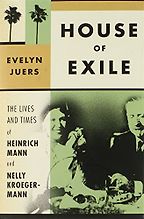
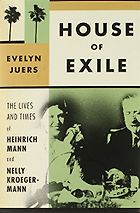
The next book on your list is House of Exile by Evelyn Juers, which is what she terms a “collective biography”, I suppose centreing around Heinrich Mann, brother of the writer Thomas Mann. Introduce this book for us please.
This book was a real revelation to me. As you say it is described as a collective biography – subtitled “War, Love and Literature, from Berlin to Los Angeles” – and I thought it was going to be what it says on the cover, a collective biography of these people. What I didn’t realise was it was going to be so novelistic. I just love the conceit of these German avant-garde composers all living quite near each other in Los Angeles.
So that’s the end of the book, but the beginning is set in pre-World War Two Germany, in the context of Nazism.
Indeed. She sets the scene for all these different people, who are aware of course of the looming threat and they respond to it in different ways. Some jump ship pretty quickly, others keep hanging on, some are more overtly political and involved than others. So it’s this array of different voices. I suppose, in a way, it’s somewhat like the Peter Englund book. We follow these different people to wherever their fates take them. They end up being dispersed all over Europe, and many of them end up in America and in particular in LA. That’s where Thomas Mann ends up, of course. He leaves Germany but he would always have his desk with him, and his desk represents for him the real soul of Germany.
That’s something thematic I was hoping to ask you about. I feel the book is about these events in history, but it’s also about the writerly life and the reader’s life, and in a sense about escape from history by means of writing and reading.
That’s absolutely right. And as a result of reading this book I was reading Thomas Mann’s book The Genesis of a Novel, where he tells the story about how he wrote Doctor Faustus. It’s really remarkable that he’s engaged in this massive act of creative immersion – immersing himself very much in theories of music – and his neighbour in Los Angeles is Theodore Adorno, living around the corner, coming to help Mann with the musical theory bits of his book. At the same time he’s listening to the radio and following the course of the Second World War, and being increasingly involved in the discussion of what will become of Germany in the post-war period. So it’s this multi-layered life that he’s leading. And it was this book, House of Exile, which first turned me onto reading Thomas Mann’s own account of what he was doing at that time.
As you say, it reads a little like a novel. I notice that on many occasions she begins sentences with “It’s easy to imagine that…”. And while it’s perfectly plausible that a lot of what she writes she might have cobbled together from her various sources – letters, archived materials – there are other sections that one feels are pure imagination. For instance, Heinrich Mann’s young wife Nelly Kröger lying in a blue slip in bed with Heinrich listening to birdsong and Puccini outside. How valid is it to introduce these imaginations into a historical account?
This is a big point. I think the key word here is trust, actually. And I never felt that any of the invented or obviously imagined scenes were gratuitous. I never felt they were being done purely for literary effect. I know this is a dangerous thing to do, but I took what she was saying on trust. I felt I could trust the voice of the book. So even these scenes that if you were writing a conventional history you couldn’t put in, because there would be insufficient evidence and documentation, the things in them rang true. And let’s not forget that I’m not recommending history books here, I’m recommending books that are doing something new.
I suppose there is a point to make that the phrase “experimental fiction” trips very readily off the tongue, and we all know what to look for in experimental fiction.
Including Geoff Dyer.
Yeah. But sometimes experimental fiction isn’t very experimental, it’s almost a set thing. Whereas what we’re seeing here are experiments in history writing. And they seem to me entirely successful experiments.
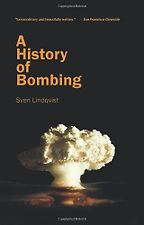
We’ll return to that discussion with Kapuściński, but let’s go by way of Sven Linqvist’s A History of Bombing. Tell us about this book.
This was published in 2002. The first book of Linqvist’s that I read was Exterminate All the Brutes, his great study of the genocidal impulse that he feels underlies the colonial project.
And that title comes from Heart of Darkness, the last lines which Colonel Kurtz scribbles in his pamphlet.
Indeed. So that was an incredibly original piece of literary criticism – let’s call it that. He takes all these accounts that are contemporaneous with Conrad on his computer, on a journey he’s making through the Sahara.
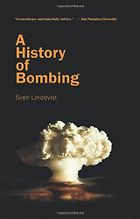
Then there was this book, A History of Bombing. It’s formally one of the most unusual, highly experimental books that I have ever read. Normally we read a book by flipping through it – page one, page two – and it takes us from beginning to end. Linqvist urges us not to do that. At the end of each little section – there are a total of 399 sections – you’re referred not to the next section but to some other section. So for example at the end of section 33, which is about the year 1783, you’re referred to section 62, which is concerned with the year 1903.
What it does is the book becomes this kind of whirlpool or vortex. You lose your bearings. It’s a completely new way of reading a book. I remember, when it came out, thinking this is way more original than any of the novels on this year’s Booker Prize list. This really is a formally incredibly innovative book. In a novel, if someone was doing that, you might think this is a bit of a game, a gimmick – it’s fun but what’s the point? Whereas, as he says, this draws us into this labyrinth or vortex from which it’s very difficult to extricate ourselves.
Also, one of the things he is very adamant about is that all of the strategies of bombing were first tried out with practically no scruples at all, as part of a colonial endeavour to suppress the natives, the savages. Then any kind of treaties or scruples that were drawn up about the morality of aerial bombing only really applied to battles between Western powers. It was considered completely OK to bomb Third World, essentially non-white peoples.
All of your five books are set in a context of violence and war. Is war something that interests you?
I hadn’t realised that about my selection but you’re absolutely right. I’m 53, and I’m certainly aware that more and more of my time is spent reading military history. But then I’ve always read quite a lot of military history. At the moment I’m going through this phase of being really quite fascinated by the military, and the more stuff I read about Iraq and Afghanistan, the more I find there’s something so impressive and admirable about the soldiers who are there doing things, irrespective of whether you think the war itself is a good or bad thing.
I guess, being born in 1958, I was absolutely formed by not actual memories of the Second World War, but it was such a dominant thing in my childhood. And then going further back, the First World War was a big part of the collective memory.
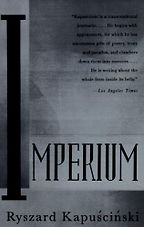
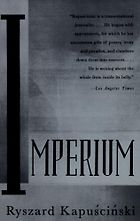
Let’s finish on the books with Ryszard Kapuściński and his book Imperium – the Imperium being the USSR and his travels in it, both early in his life and then crucially at its decline. You’ve written that if one contemporary writer should be sent to be a literary envoy to the remotest ends of galaxy then it should be Kapuściński. Why?
I think he’s really great. We’re talking about authors’ humanity – the capacity for empathy, this kind of stuff. With Kapuściński it seems to me you get all that, but it’s combined with politics and reportage telling you what’s going on in different places. Now, of course there are question marks about Kapuściński – about the reconcilability or not of the obligation to tell the truth and report the facts and the temptation to embroider, embellish and invent in the name of more literary ambitions.
Five Books interviews are expensive to produce. If you're enjoying this interview, please support us by donating a small amount.
It was funny because I was chairing this discussion at the Queen Elizabeth Hall about Kapuściński. It was meant to be a celebration of Kapuściński. And because I’m a very weak chair – because I didn’t have this ability to control the debate – as can happen this celebration took on an awful life of its own. One of the people there was saying he made this up or that up, and he’s a really bad reporter. Then another person started saying it’s really not good enough as journalism. And before I knew it, this celebration of Kapuściński turned into a massive dissing of Kapuściński.
Of course it’s really important that we find out what is made up, but for me Kapuściński is this great writer, a great literary writer. I really think that he merited the Nobel prize [which he was not awarded]. For me it becomes fantastic – sorry, that’s obviously the wrong word to use – it becomes really great literature.
Tell us more about this particular book, Imperium.
They’re all autobiographical, but some of them are autobiographical in the sense that he’s sent to somewhere to report about it as the Polish foreign correspondent, and then becomes caught up in events and he doesn’t try to exempt himself from the narrative. This is telling us about – as you were saying – his childhood. He wakes up one morning and Poland has been incorporated into the Soviet Union, they’ve all got to start speaking Russian. This thing of being Polish is so crucial to his later writings, because of course he’s in the Third World when all of these countries are freeing themselves from their colonial ties. There he is, a white European in Africa, an embodiment of privilege. But he’s able to say: I come from a seriously ill-treated country, a country that has really been on the wrong side of history.
But the reason I have chosen this one, rather than any number of the other great Kapuściński books, is that it is particularly full of digressions about all sorts of things – just amazing digressions about anything and everything.
How to make cognac…
Yes, that’s one that comes to mind – a great thing on how to make cognac. Just wonderful little parables about anything and everything. And perhaps it’s the one where the question about his reliability as a reporter is least important, because it’s the most directly autobiographical of them.
So to talk more full frontally about what we’ve been flirting with, namely the accusation that Kapuściński invents or certainly exaggerates bits, is that something which to you devalues his writing?
For me it doesn’t, because I’m not reading them as depositions. They’re sort of testimonies, but I’m not reading them in the same way that you would read something that has been rigorously fact-checked in The New Yorker.
Kapuściński shared the opinion with Gabriel García Márquez that good journalism is arrived at through poetry, because it performs the same function of clarifying your concision and aptness of expression. Is that something you subscribe to?
I hadn’t heard that before. I guess one thing that I am struck by is the Márquez thing. Of course I loved it for a while, but then I got really heavily allergic to magical realism. But I’m struck by the way that in Kapuściński you get a lot of what might be called documentary magic – these extraordinary things happening or these incredible things he’s seeing. If you think of the opening section of Another Day of Life, where he’s talking about this temporary city, it’s like something from Calvino in Invisible Cities, but in the realm of reportage and documentary.
Kapuściński said he doesn’t believe in unbiased journalism – that journalism must never be disinterested.
Yes, he certainly is a very interested participant. And he becomes increasingly the hero of his own narratives. In The Shadow of the Sun, it starts with this incredible thing of him in the Serengeti – he’s going down with cerebral malaria and there’s a cobra in the room, on which they plonk down this ammunition case. So he becomes increasingly an actor in his own narratives. But I’m always reluctant to say there’s only one way to do things. I’m nothing if not a pluralist!
We’ve limited you to five books here but we’re sitting in your study in London, encased with bookshelves on all four walls. At the risk of being obvious, how important is reading to you as a writer?
I guess one of the disappointing things about life – or my life generally – is the way that I seem to read less as I get older. Physically I don’t feel I’ve got less time now, but it’s just more difficult to arrive at that time. One thing I don’t feel bad about is the way that I read far fewer novels, far less fiction now. I think that conforms to a broader actuarial norm. More and more I’m reading non-fiction.
How important to you is your library, this physical library? Do you think it encapsulates your personality, as some people like to think libraries do?
Oh yes, this is my great achievement, my library. This is all I’ve got to show for my life. I really love being in this room, I love the way they’re arranged. It’s all so important to me. Ever since I was at Oxford and found I couldn’t read in the Bodleian [library]… I’ve never been able to read in reference libraries, and haven’t made much use of lending libraries because I like to annotate books. So I like to read my own books, and I keep them. Obviously it’s less important now with the Internet, but as a resource for me it is fantastic, having all this at my fingertips. It’s a source of daily joy to me, this big collection of books.
What are you feelings about digital books, e-books?
I think it’s great. I don’t have any of the various readers. There was a time about eight or nine years ago when my wife and I were travelling in South-East Asia. I was judging a prize, so wherever we turned up – in Laos or somewhere – there’d be three new hardbacks. That was quite convenient but if we were doing a trip like that again then the e-reader becomes a fantastic thing, and the idea of lugging around a whole load of books becomes ludicrous.
Tell us about your new book, Zona, which has just come out this month, February.
I increasingly like mad books, and I particularly like the kind of books that could never have got commissioned on the basis of a proposal. I like books that are not reduceable to a proposal. This new book of mine exemplifies that. It’s this crazy thing where I basically summarise, in a lunatic, unbelievably detailed way, a film that’s meant a great deal to me, Andrei Tarkovsky’s Stalker. It describes the journey into the forbidden zone where two people are taken, Writer and Professor, by this guide, a Stalker. At the heart of the zone it’s claimed there is a room where your deepest wishes can come true. That’s it, that’s what happens in the film.
Get the weekly Five Books newsletter
I summarise this long film, but it’s of the nature of the film that that literal journey which they’re undertaking has all sorts of metaphysical, philosophical or whatever resonances. And so I could do two things at once. I could stick very closely to the film, and I could also spiral off into these kind of – not exactly digressions – metaphysical speculations about all sorts of things. The film provided me with the tracks, and then I could do a whole lot of other stuff as well.
Finally, what would your advice be to a young writer who wanted to be the next Kapuściński or Rebecca West?
Isn’t it funny the way that in publishing they are always saying X is the new Salinger, or whatever? I remember it was only very shortly after White Teeth had come out when Monica Ali’s book Brick Lane was coming out – and it was “the new Zadie Smith” already! I suppose what I’m going to do, then, is reject the question. That is to say, why bother being the new Rebecca West or the new Kapuściński when I’m quite happy with the old ones? It’s not like some form of technology which becomes obsolete and unavailable when the new iteration is available. The key thing, I think, is to be doing something that no one else has done. So it’s not a question of being the new Rebecca West, it’s a question of being the new insert-your-name here.
Is there a new Geoff Dyer?
The old one is still going pretty well! There might not be a new Geoff Dyer, but there is, irritatingly, another Geoff Dyer, the FT’s Beijing correspondent. So there might not be a new, but there is an old and another.
Five Books aims to keep its book recommendations and interviews up to date. If you are the interviewee and would like to update your choice of books (or even just what you say about them) please email us at editor@fivebooks.com