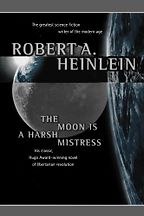
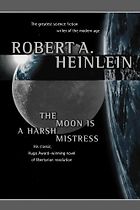
I read The Moon is a Harsh Mistress when I was a kid and I loved it but I thought it was science fiction. I did not realise there were political implications. What are those, why is it here?
Heinlein does two kinds of books. One is political and the other is weird sex. I thought he was a political activist because I was introduced to him through The Moon is a Harsh Mistress. It compares the flawed statist world to the freedom of the anarchist, utopian moon. So it has both utopia and dystopia available to you. It puts it into the distant future and it suggests progress and people gravitating towards liberty. There’s more liberty in the future – as opposed to the Marxist idea that we’re all inevitably moving to statism. I have read his other book, where everyone has to be a soldier to vote and they fight the bugs, Starship Troopers. That one is also political. It doesn’t have the line in it, but Heinlein is famous for the quote, ‘An armed society is a polite society’– you know, people don’t spit at other people.
And I suppose in The Moon is a Harsh Mistress, if you’re not polite, you get thrown out into the vacuum.
Yes. It’s obviously a radical vision, but it has the theme that in a free society, volunteerism works. Remember, there are two kinds of science fiction. There’s the one that Asimov and Heinlein do, that is high-tech and in the future science fiction/the science of the future will make you more free. Then there is the other vision that is Brave New World, science in the service of the state, that it will make you a slave. So this is a counter to the idea that science in the hands of the state will lead to serfdom. Science in the hands of individuals will lead to freedom. I like this book because it does both – here’s the future that doesn’t work, the earth, here’s the future that does work, the moon. Similar to Ayn Rand’s Atlas Shrugged, but it’s a different venue and therefore you don’t have to read turgid tracts…
What if someone says it’s not a conservative book, it’s an anarchist’s book? It’s revolution and not really a conservative vision of things.
It’s conservative in that the revolution on the moon takes place on 4 July 2076. I think there are many doors into modern Reagan Republican conservatism and this is a sort of a radical utopia, Atlas Shrugged kind of future. There are these people who argued, ‘Oh yeah, well, in the old days life was simpler, but now that life is more complicated the government has to run it all.’ Farmers could be free but not people who work in factories. I always thought it was a BS argument, but you heard it all the time, I remember hearing this from schoolteachers. So here was a future that was a utopian, free future, an optimistic future. I remember the Libertarian Party convention in 1980 wanted to have a science-fiction award for the person who uses science fiction to promote liberty most effectively. And there was this counter from the [Murray] Rothbard libertarian types who argued that bug-eaters have rights too. That we shouldn’t project the future as a high-tech future because some people may choose to live in caves. And I thought to myself, ‘For crying out loud! Yes of course people can live in caves if they want but that is probably not the future that most people would choose for themselves if there are other options.’
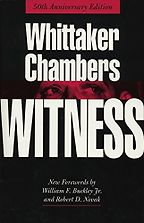
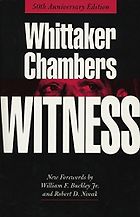
Let’s move on to the next two books. They surprise me actually because I think of you as primarily focused on economic issues, rather than Cold War kinds of issues and both of these books are very much Cold War period books. Let’s talk about Witness first because it’s the more famous of the two. Why Whittaker Chambers?
I read both of them in the same summer at my public library, in Weston Public Library.
How old were you?
Twelve, 13.
Where’s Weston?
Weston is 12 miles due west of Boston.
So you’re in the library…
Yes. So they were selling them off for a nickel or quarter a piece because the library was getting rid of all its silly right-wing books that nobody wanted. So I picked up all my anti-Communist stuff for a buck. I also got Masters of Deceit and the other J Edgar Hoover books and so on. I was an anti-Communist first, and a broader conservative/free marketeer later. I knew the other team for the bad guys, but I remember, as a teenager, not being completely opposed to certain government regulations. I hadn’t thought about it particularly, but then later I became more free market in my thinking. There was also the Vietnam War, which was a big thing. The Communists were pushing us, and the hard left was opposed to our opposing them, not as libertarians saying, ‘Excuse me but what are we doing in their war?’ but as, ‘They are the good guys, why are we fighting against the good guys?’
Are Chambers and your next book, Philbrick’s I Led Three Lives, relevant to conservatism today?
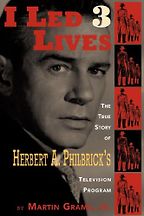
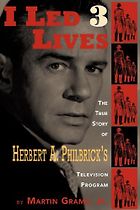
Yes, in the following sense. Philbrick used to hold cell meetings in my hometown, in Weston, Massachusetts, so that made it more interesting. I lived on Red Hill in Weston. It was called that because there were a lot of leftist people in the 50s and 60s who lived there. The idea that there were people in the United States who actually hated the country is something you find in both Chambers and I Led Three Lives by Philbrick. He thought he was joining the peace movement and discovered he was joining the Soviet Front. And so the idea that there were people who lived in this country and wanted us to fail, who actually wanted the Soviet Union to win the Cold War is in both of those books, and it is something we have to come to terms with. I remember Peggy Noonan talking about a dinner party where the former chief of staff to Tip O’Neill…he now has this TV programme, Hardball…
Chris Matthews.
Chris Mathews commented there were a dozen Democratic members of Congress – this is many years ago – who actually wanted us to lose the Cold War, who were actively on the other side.
So, the relevance here isn’t specific to Communism at the time, it’s that there are people who are not on the level – you can’t take good faith as a given?
It’s not all about nationalism. Just being born in the United States does not make you in favour of freedom. The United States isn’t just a race or religion or an ethnic group or a tribe. We are a people of the Book, of the Constitution. And yet, there are people born in the country who aren’t with the programme.
It’s about the vision, the philosophy of freedom.
Yes. I would argue that that’s what America is. In a sense, being an American doesn’t mean you were born here.
Chambers opens lots of people’s eyes and he is a movement touchstone, but Philbrick is much more obscure. Could you give us a couple of sentences for our readers who may not know who Philbrick is? He’s a guy who lives three lives by infiltrating Communist cells in the US, is that right?
Yes. His three lives were: his outward life, being an underground Communist and being an FBI informant. He had joined the peace movement in the United States, which was heavily influenced – at least the one he was involved with – by the Communists, but he didn’t know that. And when the Germans attacked the Soviet Union he’s at the peace movement meeting and someone stands up and says, ‘We must all be in favour of the United States entering this war.’ And he gets up and says, ‘What are you talking about? This is a peace movement!’ And he was the only guy in the room that didn’t get the joke because they were all Communists. They were against the US being militarised or strong until the Soviet Union needed help and then they wanted us to arm and fight. So he realises what is going on and then makes a snap decision and goes, ‘OK’. He apologises for his position and switches back. And realising that he’s in the middle of a Communist operation he goes to the FBI and asks, ‘Do you guys know what’s going on here?’ He became an informant for them and testified against the Soviet agents who were members of the Communist Party and working for Moscow. They were not some indigenous group of liberals but active agents of a foreign government who were actually trying to overthrow the US government and constitution and hated the country.
Was this book an eye-opener in its day?
Oh, yes. It was very popular; it was a big exposé. The lesson of both books, maybe Witness more so, is that the establishment can and will lie to protect their own. The liberals had to have known that [Alger] Hiss was a Communist and yet they sat around and insisted he wasn’t. Supposedly Truman was livid in private at Hiss, but in public said the whole thing was a red herring. So here you have a modern Democratic Party that did not deal with serious threats to the Republic, with serious enemies of liberty. They treated the whole thing as a joke and attacked people who pointed out things that they knew to be true.
Do you see echoes of that today?
Not particularly since the Soviet Union failed. The echoes of that that you get today are the environmentalists. People know that the data on global warming is fudged, that the calculations or software that proves the hockey stick graph was fudged and they don’t care and they just keep insisting.
Perhaps the common element is a sense of allegiance to a higher good.
Yes, a counterfactual allegiance – in the sense that the other team is willing to lie to promote what they want, and betray the interest of the country. They don’t see the country as the repository of freedom and the modern world. I do.
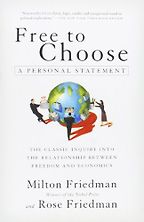
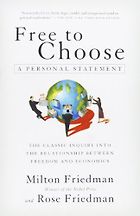
That’s a good note to go on to Milton Friedman. Now why Free to Choose as opposed to Capitalism and Freedom or his Monetary History?
With Free to Choose, the title summarises it. He deals with vouchers in education and the whole idea of what we’re promoting. This goes back to the argument on the science stuff. We’re not for freedom because it brings economic growth. We’re not for freedom because it brings technology and improvements in standards of living. We’re for freedom because we’re for people being free. It also happens to be the case that a free people are going to be more financially and economically successful than an un-free people. But the goal is freedom, not that you’re allowed to have a little freedom because it brings more prosperity. That’s the New Economic Policy of Lenin: ‘We’re starving, so we are going to allow a little freedom to have stores operate and people grow food.’ Freedom is a tool that you let people have a little bit in order to get what you want – which is food for the cities. For us, freedom is the goal.
If I’m reading one book to sum up Norquistian philosophy or conservatism is Free To Choose that book?
Leave Us Alone is that book, the book I wrote.
Is the second-best book Free to Choose?
It’s a very good book, yes. It’s a book that deals with freedom in the utilitarian sense as in ‘freedom works’. It’s a refutation of the left’s promise that statism will get you X, Y and Z. I understand the importance of making that argument. The left says that we need to clean up our environment, therefore we have to have statism. We say, ‘Look, actually, freedom and property rights will get you a cleaner environment.’ The left says, ‘We have to have statism to get economic growth and create jobs.’ We say, ‘Actually, freedom does that.’ We must have the government to educate people? Actually, freedom does that. So Friedman makes the case in a practical, pragmatic way. ‘Freedom works’ is, I think, the slogan that Dick Armey likes.
Just for the benefit of our readers who may not know, Freedom Works is the name of a group [www.freedomworks.org] chaired by Dick Armey – a former Republican member of Congress – which has been instrumental in organising or at least mobilising a Tea Party movement. Is that a fair description?
Yeah. It’s been a slogan of his for some time. The idea is freedom is not only a good in and of itself, which is what I believe. When you’re talking to someone else who hasn’t yet bought into the idea that you should be free just because you should be free, we say, ‘Well, tell me what you want. Freedom gets you there faster.’
So you can draw something of a line between Heinlein to Friedman to the current Tea Party kind of sentiments.
I would argue that the Tea Party people are a new addition to the people sitting around the conservative table. Everybody is at the table because, on the issue that moves their vote, they want to be left alone. Taxpayers: ‘Leave my money alone’; businessmen: ‘Leave my business alone’; home-schoolers: ‘Leave my kids alone’; people of faith: ‘Leave my religion alone’; and gun owners: ‘Leave my guns alone.’ And the Tea Party people have this sense that all this spending is going to lead to a threat to their standard of living and their ability to function in a free society. Which is a fairly sophisticated, two-step analysis. The others say, don’t pass a law to steal my guns because then you would steal my guns, don’t raise taxes to take my money, don’t take away my ability to educate my kids, etc. The Tea Party people say, don’t spend too much because it leads to inflation and taxes and statism and crowding out of my decisions and my ability to function in life. So it’s a more sophisticated group.
So when you hear liberals denounce the Tea Party movement as a bunch of know-nothings, you’d argue to the contrary – there’s a lot of iceberg under the water there.
Yes – it’s a self-defence group. It’s people who are worried about people doing things to them. The best news for the conservative movement is that the President refers to them as tea-baggers – in a deliberate effort to be slimy and disgusting and mean. So that’s cheerful. It helps when the other team is stupid.
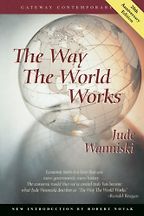
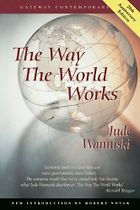
How about the Wanniski book, The Way the World Works? This is not about freedom as a good in itself; it’s about how the world works, about properly understanding economic relationships, is that right?
Yes. Incentives matter. Hard money matters. When the government inflates the currency, when the government raises taxes…it explains why high tax rates drive decisions by individuals and therefore collectively the sum of decisions by people in the country. It makes the practical argument for limited government.
I recall this was a kind of thunderbolt when it came out in 1978 because at the time the conventional wisdom was very much that inflation is not so bad for you; we’re going to have to raise taxes, and we live in an environment of scarcity. Wanniski’s book became a rallying call for what emerged as the supply-side movement.
Yes. It was the rejection of limits to growth, one of the reasons for tyranny. The other team always has different reasons for tyranny. Why do we have to live under statism? One was, the Soviet Union is inevitably going to win, so we might as well give up and learn to live with it. Or the watered down version of that is, there’s going to be this convergence between us and East Germany and the Soviet Union and we’ll all live in some version of Switzerland and Sweden and East Germany combined. You also have it with the limits to growth stuff: we’re not creating any more wealth, we’re not going to have more growth, now it’s just a question of divvying it up and the state will do that. The idea that the amount of economic growth that we can create in the world is not a fixed thing, that we can double our GDP, and make more people have money and be less poor – it was a refutation, at the time, of the left’s strongest argument for statism.
It was seen as kooky when it came out, as I recall – nutty and wild and bizarre.
The Laffer curve was not written as a PhD thesis, it was written on a napkin, for crying out loud!
Was that a thunderbolt to you, The Way the World Works, when it came out?
I didn’t find it difficult to understand. I was 21 when I graduated from college in 78. It struck me as reasonable to the extent that it was a new argument in the national debate. It just struck me as self-evident. When you read it you said, ‘Yes of course.’
Could you have had Reagan without Wanniski or is it more that you couldn’t have had Wanniski without Reagan?
You couldn’t have had a successful Reagan without Wanniski. Remember, Reagan ran in 76 saying, ‘I’m gonna cut the budget by 80 billion dollars by sending stuff out to the states.’ What Wanniski, and from that the supply-side revolution, did was to say: in addition to austerity on the spending, we’re going to have a pro-growth approach on taxes and tax rate reductions as our alternative to the Works Projects Administration [a New Deal public jobs programme] and to make work. So Reagan adopted this supply-side approach after 1976. He wasn’t particularly big on Proposition 13 [a 1978 California tax-cutting referendum]. He wasn’t against it, but he wasn’t one of the leaders for it. But then Prop 13 hit in June of 78 showing people do care about taxes and they are mightily pissed about taxes. Then Jude Wanniski made the argument that not only are people mad about taxes, but if you cut taxes it creates economic growth. That’s an important reform.
That becomes the long pole in the tent for the conservative political movement today.
Yes, that’s correct.
It becomes your life in a sense – this is the aspect of conservatism that you fight for on a daily basis?
Yes. Keep taxes low and cut them. If you have to have one thing that divides people it’s their understanding of taxation.
Five Books aims to keep its book recommendations and interviews up to date. If you are the interviewee and would like to update your choice of books (or even just what you say about them) please email us at editor@fivebooks.com
Five Books interviews are expensive to produce. If you've enjoyed this interview, please support us by donating a small amount.