You have spent most of your life exploring the ocean—why are you so fascinated by it?
Anyone who has put their head under water, whether snorkelling or swimming or scuba diving, will have hopefully caught a glimpse of an extraordinary world that for most of the time is out of sight and out of mind. As soon as I first got down among all the creatures and fish and extraordinary things you can see down there, I was instantly addicted to it.
Can you describe one really memorable experience that you’ve had beneath the waves?
I think it has to be the first time I saw a seahorse in the wild. These were a group of animals I’d been obsessed with for ages. But for more than 10 years of diving and researching in the sea, I never saw one. While I was in Vietnam, researching the impact on seahorses of shrimp trawlers for my book, I spent a day diving at a spot where I’d been told seahorses still hung out. And there it was. A perfect little orange seahorse, snoozing quietly on the seabed. Funny thing was, I’d been wrong every time I’d imagined what it would be like to see my favourite animal in real life. I didn’t scream and dance about in delight – I just lay down on the sand next to it and watched, utterly gripped and completely content.
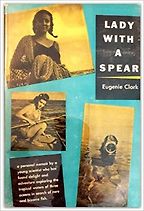
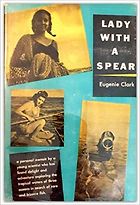
Your first book is the autobiographical Lady With a Spear. Its author Eugenie Clark was someone who dived the world, just like you have.
I had the great honour of meeting her when she was in her late 80s. She is an absolute inspiration to me. Getting a chance to sit down and chat with her over lunch was a joy. She had been studying the ocean for 60 years and was still diving, still researching and still as much in love with the ocean as she ever was. I felt a huge connection with her.
This book describes a time when she was a pioneering female scientist, going off and having adventures and following her extraordinary obsession with the ocean. She spent time in Egypt studying the fishes of the Red Sea, as a single female at a time when such things were completely unheard of. To some extent she is one of the female underwater explorers who isn’t quite so famous, and she really should be.
Where did she come from?
She was American, grew up in New York and tells a lovely story of how she fell in love with fish at a young age when visiting the New York aquarium. She went on to become known as the “shark lady” for her studies of shark behaviour, and founded the Cape Haze Marine Laboratory, now known as the Mote Marine Laboratory in Sarasota, Florida. Her second book, The Lady and the Sharks, describes how that was set up and how she raised her family at the same time in what was then a remote, undeveloped part of Florida.
She actually spent most of her career up in Maryland, where she was a professor at the university. I only wish I could have been one of her students, it must have been so exciting to work with her. She spent her whole life teaching and researching. And she was still doing it in her late 80s because she loved it so much she couldn’t give it up.
Do you think you will end up like that?
I would love to be like that. If I get to that age and I am still diving and exploring the oceans, it would be fabulous.
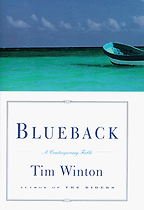
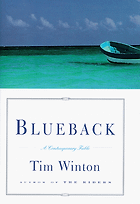
The next book on your list is Tim Winton’s novel Blueback, which is set in a very beautiful part of Australia.
I read this story years ago and it is just lovely. Winton calls it a fable for all ages and I think that is absolutely true. I read it to my nephews when they were about seven but I think everyone should read it no matter how old they are. It is about a boy called Abel Jackson who grows up in this gorgeous part of what I presume is the Western Australian coast, because that is where the author hails from. The story tells how Abel goes diving every day. He makes friends with a huge blue fish he names Blueback.
Get the weekly Five Books newsletter
It is part adventure story, part ode to the oceans. You see the unfolding problems of the modern world pushing in on his beloved bay. Abel decides that he wants to study the sea to figure it out and solve the puzzle of why the ocean is getting sick. And on a lighter note he wants to learn the language of the sea. He wants to know what Blueback is thinking about. It is beautifully written and very evocative. Ultimately, it is a story about childhood dreams and realising it is never too late to go back and relive them.
It also discusses the problems of overfishing by predatory fishermen.
Yes, one part of the story is that fishermen come and pillage the bay where Abel and his mother live. It describes the efforts they make to stop that happening, but I don’t want to spoil the ending.
Have you seen similar things during your travels – beautiful bays being destroyed?
Sadly, I often turn up when it has already got to the point of being fairly degraded. I have spent a long time working and researching in South East Asia where there are all sorts of problems like dynamite and cyanide fishing, and the impacts are obvious. I have been in the water when a fish bomb has gone off not too far away – which is terrifying.
What is it like?
You can almost feel it before you hear it. It was deafening. I was petrified that if it had come any closer my buddy and I would have been deafened if not worse. It rocks through your insides and you feel this powerful pressure wave coming off the bomb. It is that pressure wave that kills the fish. It really brought home to me just how destructive that kind of fishing is. We came up immediately and the boat was miles away, but sound travels through the sea so fast. So I have seen some sad cases of ocean destruction, but I have also been very lucky to go to some of the most beautiful and relatively untouched places there are left.
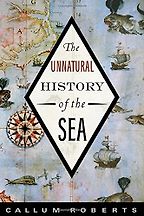
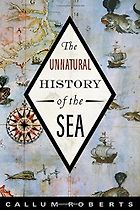
Callum Roberts’s book The Unnatural History of the Sea returns to the more destructive things happening to the ocean, tracing the roots of overfishing.
This book goes through the sequence of events that led us to today’s depleted ocean. It takes you back to a time when people believed the oceans were essentially inexhaustible.
It looks back to the late 18th century.
Yes, back as far as whale hunting and all sorts of different ways of exploiting the ocean. And it tells the story in a very vivid way. Everyone will learn something from this, even if they think they know lots of stuff about how we have affected the oceans. There are many things in there that I wasn’t aware of. And he reminds us that we easily forget about how things have changed. Even in recent times, we have come to accept a degraded state of the natural world and the oceans. We quickly forget just how abundant life used to be and how rich fisheries used to be.
I should point out that he does take an optimistic outlook. He isn’t all doom and gloom. He lays out hundreds and hundreds of years of over-exploitation but he also lays out his manifesto for restoring some of that former glory. He doesn’t think it’s too late.
What does he think we can do?
It is all about setting up marine protected areas or marine reserves, and reinventing the way that we manage fisheries. He knows what he is talking about. This guy is a top academic in fisheries and marine conservation.
Do you think people will buy into it?
That is the big question. The science is there. It is the people side of the equation that still has a big question mark hanging over it. I can only hope that books like this can help chip away at that. We have to remember that the things that live in the ocean are wildlife. They aren’t just resources for us to use up. We have a lot more respect for wildlife on land and see it as something we need to look after. There is a very different attitude towards the oceans. We see them as a place to dump our waste and grab as much food from as possible.
It is vital that we try and get the message across that these are wild creatures and ecosystems that we are damaging, and that losing them will affect our lives in practical and economic ways as well as more intangible ways. The oceans fuel our imaginations. I think it’s crucial for there to still be wild sea monsters out there. Werner Herzog said, “What would an ocean be without a monster lurking in the deep? It would be like sleep without dreams.”
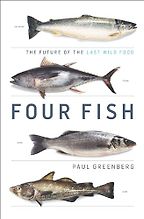
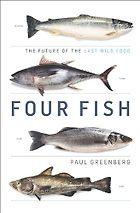
Next up is Four Fish by Paul Greenberg, which explores our relationship with the ocean through four iconic fish.
Greenberg brings Roberts’s story bang up to date. He answers questions about what we eat today and how that is affecting the ocean. He picks four fish, which in the western world at least are the main species we eat. Those are tuna, salmon, cod and sea bass. It is a fascinating story about how we got hooked on those four species, which he tells from his perspective as an avid angler.
Some of the most interesting parts of Greenberg’s book concern the future of fishing and particularly fish farming. He writes about a couple of companies that are taking a truly rational approach to large-scale fish farming and asking the question, will it feed the masses? Greenberg encourages us to think about farming fish in the same way that farmers think about raising animals on land.
Does he think that fish farming can feed the masses?
He thinks that if we pick species that get on well in captivity then absolutely we can. But fishers and fish farmers need to rethink what they’re currently doing, and as consumers we need to be persuaded to give up our rather boring palette. We only really eat four types of fish but there is so much more that we could be eating that has a lighter impact on the natural world.
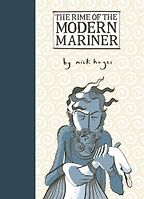
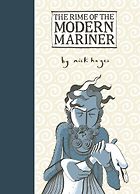
Your last book is an update of Coleridge’s classic. It’s called The Rime of the Modern Mariner by Nick Hayes and is a tale of environmental disaster.
This graphic novel is a beautiful re-telling of Coleridge’s poem for our modern plastic-filled times. It carries a really chilling message about our consumer-driven lives and its consequences on our planet and the ocean in particular. The book is also an object of great loveliness with stunning illustrations. In and of itself it is a beautiful thing to have, but the story is also very touching and poignant. And it has lots of science in there. I love the way Hayes has used his artwork and poetry as a really imaginative way of telling the stories of the oceans and getting ideas across about the problems that we are causing.
We have spoken a lot about overfishing, but what are some of the other problems that we are causing?
One of the big problems in the oceans is plastic waste, and the fact that so much of what we throw away or flush down the toilet ends up in the ocean and just stays there – it’s not biodegradable. A lot of it gets broken down into smaller and smaller fragments of plastic known as “mermaid tears”. These tiny plastic particles infiltrate marine ecosystems, causing all sorts of problems when animals eat them and choke on them, and because of toxic compounds associated with them. I was in the Red Sea just last year – every morning I would go out snorkelling on the reef next to where we were staying and I would pick up armfuls of plastic bags. I knew it wouldn’t make much difference in the grand scheme of things but it made me feel better.
Get the weekly Five Books newsletter
There is also the problem of climate change, which causes specific problems for the oceans like acidification – carbon dioxide not only warms up the atmosphere but it dissolves in the oceans, making them more acidic. That causes problems for all the creatures that live inside chalky, calcium-carbonate skeletons. The animals that build coral reefs, plus many plankton species and all sorts of organisms that are very important for ocean ecosystems, will suffer the consequences.
What can we individually do to help the situation?
We have to be positive that there are things we can do as individuals – everything from deciding which fish to eat, refusing to use plastic bags, that kind of thing. At the same time we can think about the bigger problems like climate change, and what we can do as individuals as well as nations to deal with that. There are many different scales at which we need to make our voices heard.
We must also support the setting up of conservation areas. The UK at the moment is establishing a network of conservation areas around our shores. We desperately need things like that. We need to protect parts of the sea from these problems that we are inflicting on the whole planet, and give the oceans a chance to recover.
Five Books aims to keep its book recommendations and interviews up to date. If you are the interviewee and would like to update your choice of books (or even just what you say about them) please email us at editor@fivebooks.com
Five Books interviews are expensive to produce. If you've enjoyed this interview, please support us by donating a small amount.