It's fashionable today to liken humans to animals but the developmental psychologist says it's more interesting to study the ways in which we're remarkably different from other creatures
I’ve chosen books that really show the massive gap between us and other animals, and explore exactly what it is that sets us apart from other animals and in particular our closest living relatives, the great apes. I do think it’s important today because this idea that we’re special, that human beings are special, is completely out of fashion. We’re continually told that animals are just like us.
Is this in the field of evolutionary biology?
It’s in a lot of scientific fields, whether it be primatology – studying ape and monkey behaviour – or within psychology, the trend towards evolutionary psychology, and in anthropology. Also, just in terms of public discourse, there’s more and more of a discussion of how close animals are to human beings and really we’re not at all special.
For example, animals can talk – they just do it a bit differently?
People always say: ‘We thought we were special because we can talk but animals have language too. We thought we were special because we can use tools, but animals use tools too.’ The list is endless. But there are still some fascinating books that really show how unique human beings are.
Human beings, like no other animal, have culture, we can exert some control over nature, and we’ve made life-changing inventions. We’ve built cities, nation states, governments, we’ve created language, we’ve invented the alphabet and other forms of written symbol and produced art and literature. We can diagnose illnesses and cure them, we have a sense of right and wrong and we have a sense of where we want to take society. Animals don’t have any of those things. So the big question is: what has made us so special? Where did we come from?
The first book you’ve chosen is Ape, Primitive Man and Child, which was first published in Russia in 1930 by the famous Soviet psychologists Alexander Romanovich Luria and Lev Semyonovich Vygotsky, a book that was later suppressed by Stalin.
In Ape, Primitive Man and Child, Luria and Vygotsky put forward a theoretical framework for explaining what makes us human. They argue that there are three principal lines in the development of the creation of our uniquely human abilities: the evolutionary line, the historical line and the ontogenetic line. In order to understand who we are as human beings, we need to understand that we’re the product of all three of these lines of development. If it wasn’t for the evolution of our human genetic make-up, the human genome, then we wouldn’t be human. But, as Luria and Vygotsky stress, the evolution of our human make-up is merely the precondition for our humanity.
Our genome is very similar to when homo sapiens was first around 100,000 years ago, but in terms of how we live our lives, we are incomparable to our ancestors. So, in order to fully understand who we are, we need to go beyond just the evolutionary line and we need to look at the historical line of development, and also, finally, to understand individuals you have to look at their unique social relationships, their own life history. Each human being that has ever existed on planet earth is unique, and that’s the result of the historical and ontogenetic line of development.
Ontogenetic?
It means individual lifespan. It’s the life history of an individual – the area really that developmental psychology studies.
And even though it’s an old book, it’s still useful today? It hasn’t been overtaken by new findings?
I don’t think so. I think as a theoretical framework it still holds. All of the books I look at, although they don’t always reference Vygotsky and his work, you get a sense that they have been influenced by his thinking and the real breakthroughs that he made, despite only living to age 37.
Why was the book suppressed by Stalin?
Stalin tended to suppress anything that did not conform to the party doctine. Vygotsky’s ideas would have been threatening because they were revolutionary – Marxist – in the true sense. He adopted the dialectical method for understanding the mind. But also he engaged with the ideas of great thinkers outside of Russia, such as Freud and Piaget, and was therefore dismissed by Stalin as a ‘bourgeois idealist’.
Let’s go on to your next books, The Prehistory of the Mind by Steven Mithen and The Cultural Origins of Human Cognition by Michael Tomasello, which offer different theories about our evolutionary development.
Yes, these two books really go quite far in trying to understand the emergence of our unique human abilities through evolution. Steven Mithen starts off by saying, ‘We’ve got a real conundrum here.’ Around 100,000 years ago there is some evidence among homo sapiens of novel tool-making, such as bone artefacts. But he points out that the tools that were used and made then were not that much more sophisticated than our ape ancestors. The major turning point only occurred once homo sapiens had been around for tens of thousands of years.
This is what is referred to as the Paleolithic revolution, where we suddenly see far more sophisticated tools, far more sophisticated and developed hunting techniques. You have oceanic travel, cave drawings, ceremonial burials. So moving from very simple tools to a far more sophisticated ways of organising ourselves in groups and even being able to travel over oceans. Mithen says the key challenge is really to try to understand this explosion in creativity around 60,000 years ago, which doesn’t correspond with an increase in brain size – because that was a lot earlier. Brain capacity alone can’t explain this sudden leap forward.
Wow, that’s exciting. How does he explain it?
His theory is that this explosion is as a result of changes in the nature of language. And, following on from that, he says you then see changes in consciousness within the mind. He argues that the language of early humans, pre-homo sapiens, was exclusively a social language. They used language to send and receive social information, to establish pecking orders and loyalties, etc, rather than using language for subjects such as tool-use or hunting.
With larger group sizes language was an effective means of building social ties; much more effective than grooming, which is the staple form of sociability for apes, that’s the way they maintain some kind of group cohesion. Mithen argues very persuasively that this social language, at some point, gets transformed into a general purpose language.
It’s only when language starts acting as a way of delivering information about the world other than the social world, that we’re able to really start thinking about our own thought processes. He says that, as a result of that, the whole of human behaviour became pervaded with the flexibility and the creativity that characterises modern humans.
Because the real difficulty, if you understand evolution, is that things change very slowly. But here you have this explosion. There must have been a small change in our evolutionary past that allowed language – a social language – to suddenly become a general purpose language, Mithen argues.
Evolution alone isn’t enough to explain language?
Some argue that language could be selected for through evolution. But if you look at something as complex as having grammar, and all the aspects of a language, and you look at the evidence of how long language has been around, it hasn’t actually been around for a long time. So if apes didn’t have language, and homo erectus and homo habilis didn’t have language, how could, over the course of several 100,000 years, something as complex as language be a result of a chance mutation?
What made the change possible?
I suppose his argument is that there was this social language. Once you have language, then you can start using that language to drive your own thought process and actually think about what you’re doing – rather than just banging away at something. When you get a tool that is helpful, you’re actually looking at it and thinking, ‘Well, this isn’t good enough, I want to use it for this, maybe it would be better if it was sharper this end, and blunter at that end…’, etc. I read Mithen’s book before I read Tomasello’s and I thought, it’s really persuasive. It’s very convincing. He has a detailed knowledge of everything that we know about early man and what tools existed and suchlike.
Yes what about the Tomasello book, The Cultural Origins of Human Cognition?
This book I am equally or even more persuaded by. Tomasello argues that evolution must have endowed us with something uniquely powerful. He says the only possible solution to the puzzle of this explosion in creativity, the only biological mechanism that could have brought about these changes in such a short period of time, is a new capacity for social and cultural transmission. In other words, what he’s saying is that there is a new, uniquely powerful way of social learning.
He says you can see how evolution has endowed animals with a more simple form of social learning: for instance, rat pups only eat food that their mother eats, they learn from what their mothers eat. Young birds learn their species’ typical songs by mimicking their parents. His argument is that this simple ability to learn from our fellows, not in a conscious way – animals don’t do it in a conscious way, is something evolution has endowed them with – stopped at some stage in our evolutionary past and became transformed into something a lot more powerful.
What is unique about our form of social learning is that we are able to imitate and that we are able to learn things co-operatively – whilst animals are not able to think about what their fellows are doing or what they themselves are doing. We can look at what somebody else is doing and we can make inferences about their goals and intentions. What they are trying to do here? What is the intended outcome of what they’re doing? And we can look at how they actually do it, the various steps towards achieving the end product and we can look at the end product. While all the experimental studies point very persuasively to the idea that apes are only able to look at the outcome. For a while people thought apes could ape.
They can’t?
No, they can’t. Not in the human way. They can look at the outcome of what somebody has done, and then they have to invent a way of achieving that through trial and error. So in an experiment they might see a human being using a rake to pull something towards them. Then they might realise, ‘Oh, a rake can be used as a tool.’ But they don’t understand the how. Through trial and error they might achieve the same result, or get the same result in a different way.
This is why, I would argue, in the right conditions, a clever ape could invent all the ape behaviour that we see today. An ape that is clever enough could invent all of the different ways that apes use tools, while it’s absolutely not the case that ANY human being, however clever they are, could invent from scratch X-rays, combustion engines, the harnessing of electricity – everything that humans have achieved.
But both Tomasello and Mithen are trying to explain that same mystery, what happened 60,000 years ago?
Yes, between 100,000 years ago and 30,000 years ago. We split from the chimpanzee six million years ago, and you see some changes in tool use with homo erectus, and there’s not that much evidence from the time of homo habilis, I don’t know why. You see some evidence of changes in tool use, slightly more sophisticated, over millions of years.
And then, suddenly, after homo sapiens, approximately 60,000 years ago, you see this cultural explosion. Just the ability to teach and learn from each other meant that the skills and discoveries and innovations of the most intelligent group members would then quickly be passed on to other group members. And each generation could learn from the insights of previous generations and build up on those insights.
So are these two books compatible?
It’s a very difficult thing to try to understand how evolution could have given us what we have. How can we ever get an answer to it? These are just two theories. There is a lot of overlap and they complement each other in a lot of ways. They both recognise the importance of language. Tomasello is saying that a simpler form of social learning exists, that might have become transformed into the kind of social learning that we have, where we can actually truly imitate. He argues that this emerged out of our innate desire to engage with others about the world around us. And from developmental psychology there’s lots of evidence of an infant’s innate desire to engage emotionally with other human beings, which brings me on to my next book, which looks at it from the ontogenetic line of development.
This is the book by Peter Hobson, The Cradle of Thought.
Yes. Hobson tries to make sense of how an infant becomes transformed from an instinctive being at birth into a social, conscious being and how this really powerful ability to learn from each other emerges in infants. He looks at a lot of experimental studies and explores all the exchanges that happen before language emerges. He shows that even in really early infancy, children have the capacity to react to the emotions of others. There are many developmental psychologists that have studied this innate desire to engage with fellow human beings: it’s an innate desire to engage, but it’s not a conscious desire, it’s just at the level of emotions.
These early emotional engagements were first investigated by Jerome Bruner and Michael Scaife in the 1970s. What they looked at is that towards the end of the first year of life children suddenly start following the gaze of their adult care-givers and they monitor the emotional responses of adults in terms of deciding whether they’ll approach something or not. Jerome Bruner and Michael Scaife called them ‘joint attention episodes’. They monitor how adults in their midst are responding emotionally to something, and also at this time we see what is called proto-declarative pointing. This, basically, is pointing at things just out of interest rather than merely as a request for something. So you will see a nine-month-old pointing at an airplane in the sky. They’re not pointing because they want you to give them the airplane – they’re pointing because they’re interested, and they want to share, to engender that interest in you. And we’re the only species that do that.
Hobson says you have to be very careful in terms of looking at these early engagements, and not assume that they are conscious thought. The infants aren’t consciously thinking, ‘Oh, I’m looking at that airplane, isn’t that interesting? I think I can get my mother interested in this by pointing.’ It’s just a very emotional response from them. But at some point these innate desires and engagements become transformed into something qualitatively different. By the middle of the second year of life, these early emotional engagements are transformed into more conscious exchanges of feelings and desires and views and beliefs. Hobson says this is the beginning of the revolution in a child’s thinking, the beginning of the revolution in their development. And it’s interesting because it’s very shortly after that that you see for the first time that children are actually able to learn through imitation.
How does this book fit into our overall theme?
It fits in in that it’s trying to look at how our unique human abilities emerge in the lifespan of the individual. We have an ability to understand other human beings as intentional beings like ourselves, which is something that is very powerful, and it is why we’re able to learn from each other. But we can’t be born with that consciousness. There must be something simpler there, and that’s that innate desire to engage emotionally with somebody. That’s what becomes transformed into something more conscious and much more powerful. Out of the cradle of emotional engagement, the ability to have thoughts emerges. There’s a really nice quote in Hobson’s book: ‘Empowered by language and other forms of symbolic functioning, [the child] takes off into the realms of culture. The infant has been lifted out of the cradle of thought. Engagement with others has taught this soul to fly.’
The Cradle of Thought really brings together all the work has been done within developmental psychology and presents the arguments beautifully.
Your last book is Aping Language, looking at whether or not animals can talk.
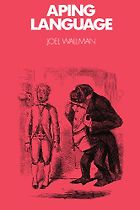
Joel Wallman’s book is very important because it shows, really convincingly, that animals do not have language, and that language is unique to human beings. He looks in detail at all of the ape language studies and analyses their methods and conclusions and all the published data and he concludes that, despite years and years of tutelage on the part of very dedicated individuals – trying to teach sign language to Washoe the chimpanzee or Chantek the orangutan or Koko the gorilla, or Kanzi the bonobo, etc, none of them succeed. Obviously this is contentious; the people involved would say they did succeed.
Why does he say they don’t succeed?
If you take even a three-year-old child, they use language for many different purposes, including just commenting on the world. Round about the time they are two to three, when a child is struggling with something, they’ll often talk out loud to themselves. They’re using language to direct their own behaviour. Ape communications, by contrast, are almost exclusively requests for things.
“It shows, really convincingly, that animals do not have language, and that language is unique to human beings.”
For example, much has been made of Kanzi the bonobo’s communication skills. But, as Wallman points out, Kanzi’s 25 most frequent two-item combinations and 25 most frequent three-item combinations are all requests for something. He uses many other examples in the book to show that really a lot of what they learn in terms of signing is trial and error in order to get reward.
It’s not anything resembling language, and they have nothing resembling human grammar. Many claims are made about how they string signs together. But, as he says, these multi-sign utterances remain relatively constant, despite intensive training. They don’t increase in length, or in any way in complexity. Whereas in young children, as Steven Pinker says in The Language Instinct, their sentences shoot off like a rocket. Children’s sentences increase in length and in complexity, so by three years of age they can string together sentences of ten words or more, and with age the mean length of their utterances increases, and so does the complexity of the word combinations. There’s nothing like that in any of the ape language projects.
Wallman shows an example from the chimpanzee Nim Chimpsky, as he was called. His three- and four-sign combinations include things like Banana-Eat-Me-Nim or Grape-Eat-Nim-Eat, Eat-Me-Nim-Drink. The book just shows you can’t elevate any of these communications to anything near the status of human language. He also looks at animal communication in the wild, and shows that there’s no evidence of animals being able to communicate intentionally – their communication is very tightly tied to emotion and to instinct.
Where does this book leave us in terms the difference between humans and apes?
He just shows that language is unique to human beings, and language is such a key thing for us. I believe that if you don’t have language you can’t have conscious thought. And if you don’t have conscious thought you’re not able to reflect on what you’re doing, or think about what someone else is doing that might be quite clever, and how you might be able to copy that. And if you can’t do that we would just continue to live like apes do – where one ape might have quite a clever invention: he might be able to split the branches of a stick in order to fish for termites. But once he dies that invention is lost because the other apes aren’t able to look at it and think, how did he achieve that?
Yes they are sometimes able to copy it, but it is mainly through trial and error. Take, for instance, nut-cracking. A young chimpanzee may see other chimpanzees using stones to crack nuts. Nuts are high in calories and are therefore important nourishment, so you’d think they’d be really motivated to crack them, which they are. And yet it takes young chimpanzees up to four years to learn how to crack a nut. That’s how long it takes them to figure out what kind of stones you should use and where you should place the nut before you hit the stone.
Is your belief in our uniqueness based purely on science or is there a religious element to it?
That’s a very important question. There are many scientists who are reacting against religion, and are therefore very reticent to acknowledge that there is anything qualitatively different about human beings. They would basically argue ‘Helene you’re wrong. You must be going down a spiritual route, if you’re saying that there is something qualitatively different about humans, and it’s not just evolution that has made us what we are. That’s unscientific, because, if it’s not evolution then there must be something spiritual, a God or something that has endowed us with something special.’
There are many very clever people around that seem to reject this idea of our uniqueness, because they think that must mean that it has to be a spiritual answer. But I think if you look at these books, they’re showing that evolution could have endowed us with a capacity for culture. But ultimately it is culture not evolution that has transformed us.
October 31, 2012
Five Books aims to keep its book recommendations and interviews up to date. If you are the interviewee and would like to update your choice of books (or even just what you say about them) please email us at editor@fivebooks.com
Five Books interviews are expensive to produce. If you've enjoyed this interview, please support us by donating a small amount.
Helene Guldberg
Helene Guldberg teaches developmental psychology at the Open University and the US study abroad centre CAPA. She is co-founder and director of the online publication Spiked. Her most recent book is Just Another Ape?
Helene Guldberg teaches developmental psychology at the Open University and the US study abroad centre CAPA. She is co-founder and director of the online publication Spiked. Her most recent book is Just Another Ape?