With your books and TV programmes, you have become a leading authority on the English language. What sparked your interest in this subject?
I think it’s impossible not to be interested in language. People often deny this, but you can get into a fantastic argument with just about anybody by talking about language. I find myself continually talking to my barber, taxi drivers, and people I meet on the train. I tell them what I do and the books I have written, and they pull a face as if to say that all sounds quite boring. But within two minutes I’m locked in an argument with them about whether English has deteriorated, or whether the Americans have ruined English or whether Chinese is going to influence English. Everybody is interested in this subject.
“English is a tremendous magpie language which has assimilated huge numbers of things from elsewhere, and actually our awareness of that gives us a much richer awareness of the past.”
It probably helped, with me, that I was an only child. I had parents who were very interested in language. My mother was a linguist and my father was a barrister. They were both linguistically punctilious. My mother spoke four or five languages and from a pretty early age I had this inculcated in me. But I defy you to find anybody who is not interested in the language that they speak and the underlying issues to do with how language works.
You have said that there are a lot of falsehoods uttered about English. What do you mean by that?
There are lots of water cooler myths about the language. One of the things people tend to say is that this is a uniquely sad moment in the history of English – that it’s all going to hell in a handcart. But actually, if you look at the history of the language, people have always been saying things like that. The moment we live in is not uniquely sad. It is simply the moment we are living in and we feel it very profoundly; there is something quite alienating about being caught up in the experience of change.
It may be that the technologies that are available to us in the area of communication are making changes happen more quickly than they did in the past. But the suggestion that the English language is somehow on the way out or is doomed to become less rich is nonsense, and is fuelled by people who have a political agenda for saying that. Most arguments about any language, and certainly about English, are actually arguments about other things like morality, class and political values. Language is something people find easy to address as a subject because everybody else has experience of it. Also, the “problems” of language are easier to address than the problems of society. So it becomes a way of mounting a flank attack on other serious issues.
There are loads of stupid myths about the English language. One of the things you hear, as I touched on a moment ago, is that the Americans are ruining English or that American English is worse. This is just an absurd thing to say. First of all, the things that people most complain about in American usage in many cases actually used to be standard British usage. Plus, one of the reasons that English is such an important world language is because of America’s political and cultural might in the 20th century. In some ways British people have benefited from that. So to sneer at America and American English seems to me to be incredibly short-sighted.
It could be argued that the quality of writing both in novels and in the media is of a higher standard in America than it is in Britain.
I would say that is true up to a point. That’s not to denigrate British writers and publications, but a lot of the writers and publications that excite me are American. I was introduced as a teenager to The New Yorker by my grandfather, who had lived in Chicago during the prohibition years and had become a massive Americanophile – if that doesn’t sound too weird. I have been reading it now for over 20 years. When my copy of The New Yorker turns up, I drop everything in order to devour it. I don’t think we have anything like that in Britain. That’s partly to do with the demise or decline of print media.
Five Books interviews are expensive to produce. If you're enjoying this interview, please support us by donating a small amount.
The New Yorker is very much sticking to the principle that people will pay for quality journalism. A lot of journalism in this country and in the US has adopted the reverse approach of becoming more crass almost as a reaction to losing sales, and trying to claw back market share. I love the production values of The New Yorker. I love the idea that they have fact checkers. It’s a very small point, but there is a sense to me that American literary culture is tremendously rich – and you denigrate that at your peril.
You have touched on this also, but many people make a link between the usage and teaching of English and moral decline and breakdown in society.
People use complaints about language as a way of addressing delicate issues in an oblique fashion. You look pretty ridiculous – in fact you sound a bit like David Starkey – if you start saying swingeing things about the changing fabric of modern cultural Britain. But if you talk about the decline of the apostrophe you will immediately have lots of allies. So it’s often a way of dealing obliquely with the way that change makes people feel uncomfortable.
I’m all for people in schools being taught grammar and a concept of how written English ought ideally to be. I think you get taught a set of rules and then you learn to abuse them – that’s part of what linguistic facility is. It’s about going beyond competence and understanding when you can violate conventions. We talk about rules but it really is more sensible to talk about conventions. The point is that these things will change. Language changes. That’s the fundamental fact that language rests upon. It would be really weird if language didn’t change, because people and society change. But there is this persistent desire to embalm language for all eternity. You get that in people, for instance, who say there should be a language academy here [in the UK].
They have one in France, don’t they? Although it’s often remarked that by the time they have made a ruling on a particular word its meaning has changed, and that everyone ignores what they say anyway.
Why should one respect the authority of an organisation of that nature? People say that the Académie Française exists mainly for the amusement of foreign journalists. It can feel like that. The other issue here is to do with what one might call English, or perhaps British, national character. We don’t like top-down government. So I think an institution of that kind would be doomed to failure here. We tend to ignore pronouncements that come from on high.
You can imagine what sort of people would think they should be in this organisation, and what sort of people would actually be in it. There is a disparity between the two. It’s quite common for people to think the way they use English is the best way. Everybody thinks that the ideal academy would be one that would have them in it, yet this is not actually going to be the case. And if it was professional linguists, well, one of the things to remember about professional linguists is that they tend to be very liberal about issues of correctness and grammatical nicety. So the edicts they might hand down might not be the edicts that the people lobbying for an academy would want to take on board.
Before we move onto your five books, I did notice that you once wrote a short book called How To Really Talk About Books You Haven’t Read. I trust you are not about to give us a masterclass?
That book is an outlier in my work. I have written three books about language and that was a little novelty item. The first thing to say about the five books that I have chosen is that they are very much not about the issue of linguistic correctness. They’re books I’ve come across in my general reading about language that I think are really interesting, and are dealing with slightly different things from the ones I tend to be occupied with. One of them is very well known, the others much less so. I think a couple of them deserve to be a lot better known.
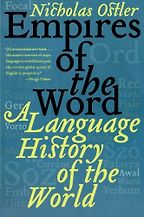
Why did you choose this substantial and comprehensive history of language?
It’s a history of all languages – some have called it a macro-history. The ambition of this book is really extraordinary. There have been lots of histories of English, and there are lots of histories of other languages in those languages, but actually to try and write a history of the whole of language is an incredibly audacious thing, and Ostler pulls it off.
So it’s a history of languages, the reasons for their rise and usually also the reasons for their fall. Most of the languages he writes about have rather faded from view. He concentrates on those that in some form or other have been globally or internationally influential. Obviously in later parts of the book you have English and Spanish, but going further back there is Latin, Greek, Sanskrit, Sumerian, Akkadian and so on. None of those languages achieved the global spread that English currently has, but there have been tremendous linguistic empires in the past and they have tended to fall. That’s one of the interesting stories that he tells. It’s one of those books that’s full of very surprising information about the past, and I always get excited by books that tell a version of the past that I wasn’t expecting to hear.
“None of those languages achieved the global spread that English currently has, but there have been tremendous linguistic empires in the past and they have tended to fall.”
Ostler also very strongly takes the view, with which I agree, that language diversity is not a liability for the human race. Different languages nourish different cultures and suggest different pathways through experience and different strands of knowledge. Actually the different empires of individual languages intertwine in all kinds of interesting ways.
It’s quite common for people to say: Wouldn’t it really be much better if we all spoke one language? Wouldn’t it be a great aid to human peace and collaboration? The answer is no, because different languages encode quite distinct cultural traditions, and having a plurality of languages actually makes life richer for all of us, particularly for people who know more than one language. This is a theme that comes up again in one or two of the other books – the sense that linguistic diversity is incredibly exciting. When languages become extinct, we should be unhappy rather than it being something to celebrate.
Ostler is chairman of the Foundation for Endangered Languages. It’s quite striking how many languages are disappearing.
Of course the ones that are disappearing are languages that have very few speakers, but when a language is lost something more is lost, too. There is a case for having language ecology, and certainly if you follow language loss to its logical conclusion there is something very deadening and homogenising about it. As someone who speaks English I benefit in lots of ways from the advance of English globally, but other people are victims of linguistic imperialism. Ostler writes about all this in a very interesting and unexpected way.
He’s a very erudite writer but he’s also crisp and elegant. It’s a book that looks pretty daunting. It’s physically big. There are lots of odd looking words in it. There are passages of foreign languages in it. It’s one of those books you could pick up and think “it’s too rich for my blood”, but actually he’s one of those rare non-fiction writers who says something interesting and unexpected on every single page, and I think that this book is a masterpiece. It’s the sort of book that people will be referring to in 10 or 20 years, rather than the kind of thing that will be rapidly superseded. It is a really enduring work.
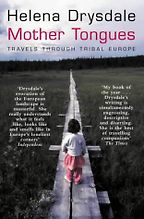
Let’s move on to your second choice, Helena Drysdale’s book about the 18 months she spent travelling across Europe with her family to discover more about its stateless tribes.
It’s a good book to segue onto after Empires of the Word. In a sense it says the same thing, but by a different means. Drysdale clearly feels that we should care about dying or moribund languages, for the same reason that we should care when a species of plant or animal dies and the diversity of our planet is reduced.
I happen to like travel writing a lot as a genre, and this is a travel book which has a linguistic thread running through it. It works extremely well just as a travel book, because she goes to lots of off-the-beaten-track places. She’s attracted to the ethnically confused borderlands and edgelands of Europe, where so-called “minority languages” are spoken. The indigenous inhabitants have a visceral, romantic, embattled, nationalistic spirit. We’re talking about people like the Bretons, the Corsicans, the Lapps and the Basques. It’s a very original idea for a travel book. I read it a few years ago when I was travelling through the Baltic states and then on to Russia – looking at those countries in the hangover of Soviet influence, and the way the indigenous languages were used. It was an interesting backdrop.
It’s a very ambitious mix of travelogue, politics and anthropology, written in a really accessible way. Again, this is a book I stumbled upon and it exceeded my expectations. It was also just different from my expectations, and that’s exciting. It’s a meticulously researched book, but it’s also very funny about the misunderstandings between communities and the quirks of these embattled nationalist figures. And it’s quite an impressive feat of travel. She covers a lot of ground, goes to places which aren’t necessarily on the tourist map, be they Macedonia or northern Finland, and her findings are really quite surprising.
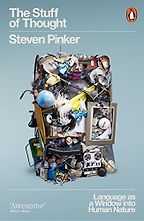
Steven Pinker describes language as a window onto human nature. What does he mean by that, and how does he demonstrate it in this book?
In this book he analyses how our words relate to our thoughts and to the world around us, and what that tells us about ourselves. You could say he is probing the mysteries of humanity and our nature through how we use words. That sounds a bit metaphysical, but as a writer Pinker is always grounded in a very real and sophisticated knowledge of psychology. He’s done a lot of research into cognition and language so there is a bedrock of science there. He is at the same time a really enjoyable, whimsical writer. He’s the sort of writer who one moment will be talking about some rather recondite academic squabble or curious feature of language, and the next will drop references to Woody Allen, Lenny Bruce and Tom Lehrer.
There’s a real sense that there is a journey going on, and I like that he asks questions that don’t normally get asked. There’s a fantastic chapter about swearing called “The Seven Words You Can’t Say on Television”. He asks questions about things we take for granted. For instance, what does the fuck in fuck you actually mean? I think that’s tremendous, because he is throwing up surprising answers to questions about everyday features of language. It’s quite a dense book and yet very clear. One review said it’s like taking your brain apart, and I know what the reviewer means. When Pinker writes about the mind, one begins to understand how it works – almost as if it’s a giant meccano set. He’s incredibly good at straddling the boundaries between the academic and the mainstream.
One of the things he talks about in the book is how we offer bribes, threats and sexual invitations in ways which are quite funny when one looks at them in isolation. They are elaborate and circuitous. He poses the question: How do our choices of metaphor backfire on us? He approaches this in a way that blends anecdote and serious neuroscience, and that’s what makes it so powerful. He’s perennially concerned about the way language negotiates the relationship between speakers and audiences. He shows that language is at the very centre of our lives, and how language makes us human. But he also has a lot to say about how ineptly we often use language, and all the disasters that the use of our language can provoke.
Pinker believes there is a universal language of thought and debunks the idea that there are radical differences in the ways different linguistic communities perceive the same phenomena. Do you agree?
Broadly speaking, yes. The facility for language is seemingly hardwired within us. Obviously, the way it manifests itself varies tremendously. But the capacity for language is part of the whole package of humanity. Pinker has made that case over many books and done it very effectively.
One of the things that’s incredible about him is the duality in his writing. He’s very interested in neuroscience, but he’s also interested in words in a kind of trainspotterish way, which is a quite unusual combination. He constantly cuts from the macro to the micro. One moment he’s explaining the ascent of man, and the next he’s investigating irregular verbs the way the rest of us might indulge in talking about great food or wine or old jazz records. There’s a lovely mix of the amateur lover of language and the person who has a richly evolved understanding of the cognitive machinery which makes it all possible. I think that’s the reason for his popularity. You feel educated by what he says but he doesn’t write in a haughty, academic way – there is a grassroots love of language and all the things you can do with it.
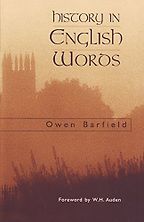
Owen Barfield has been described as one of the most neglected important thinkers of the 20th century. Can you tell us more about him and this book?
He was a very wide-ranging amateur scholar of a type that we don’t tend to have any more. Maybe because he was a solicitor for a significant part of his life, he didn’t have to genuflect before the pieties of academia and could pursue the things that interested him. He has the rigour of an academic scholar but the romantic sympathy of a creative writer.
History in English Words perceives the evolution of consciousness as revealed by changes in vocabulary. My own book The Secret Life of Words is a history of words assimilated into English from other languages, and what those assimilations tell us about English and English-speaking people’s contact with other languages and cultures. One of the first things I did was to see what else had been written in this field, and one of the most neglected and remarkable books was this one by Barfield.
Get the weekly Five Books newsletter
He sees the way that literature from the past can be understood: The meaning of the words is grasped not in the light of our current interpretation of the world, but by comprehending the way in which the world was experienced at the time when the works were written. Well, you might say, of course. But actually people are quite bad at doing that. Famously there are misunderstandings of Shakespeare based on misunderstandings about what words meant at the time he was writing. Barfield gets behind that issue.
He’s partly an etymological scholar, but he also has a very sympathetic imagination. He explores the ways in which the histories of particular words can reveal changes in the ways that humans experience the world. Flowing all the way through the book is a very grand vision of the evolution of consciousness. It’s not a long book but in some ways it’s quite daunting because it’s so erudite. It would now, I’m sure, be dismissed for not having scholarly rigour but it actually does have that, as well as a very idiosyncratic approach. He looks at particular words. In the first chapter of the book, three of the words are electric, garden and quality. He looks at how the meanings of those words have changed and what that says about the past. This idea of etymology as a form of archaeology really seduced me. But he is probably most famous for the fact that CS Lewis wrote the first of his Narnia novels for his daughter!
Yes, he was a member of the Inklings in Oxford in the 1930s and 40s – the select literary discussion group that included C. S. Lewis and J. R. R. Tolkien.
That’s right. His association with those people in a way makes it more remarkable that, particularly given his longevity, he didn’t carve out more of a place in our culture. His books are quite esoteric, I suppose, but this is one that should be better known.
One tends to forget that in addition to being a great novelist, Anthony Burgess was also a translator, linguist and educator. Why have you chosen this book?
Burgess, to me, is a remarkable polymath. One of the problems is that he wrote so much that there’s almost too much to grapple with. His amazing capacity for being apparently a master of so many disciplines led some people to say he was “a jack of all trades, a master of none”. I certainly think his shares have declined since his death. I suppose one of the things which links together the books I’ve talked about – with the exception of the Pinker and maybe the Ostler – is that they are written by people outside academia. But these writers actually have the finest minds you could possibly imagine.
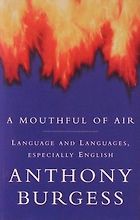
A Mouthful of Air is a very weird and wonderful book about language in general, not just about English. About half the book is specifically about English, but the first half is called “Language and languages” and there’s stuff in it about Latin, Russian and Japanese – and music as well. It’s very wide-ranging and, as you’d expect from Burgess, it’s a quirky book, dense with factual insights and wry opinions.
There’s a bit that sticks in my mind – which goes back to what we were talking about earlier – where he says the ability to speak three or four foreign languages with even moderate proficiency is regarded in Britain and America as either the property of head waiters and hotel concierges or as the mark of genius. But his point is that we all ought to be able to do this. He was a tremendous linguist who had a good command of something like 10 languages. That seems to have sharpened his appreciation of English and given him a quite sophisticated sense of how English relates to other languages.
There is a pernicious tendency to see English in isolation from other languages – in a sort of majestic isolation. But English is a tremendous magpie language which has assimilated huge numbers of things from elsewhere, and actually our awareness of that gives us a much richer awareness of the past. One of the things people tend to complain about with Anthony Burgess is that when he’s in more of a scholarly mode, the details are a bit wonky. But you can’t help but be impressed by his erudition, voraciousness and the way he breathes life into linguistics. There’s a sense of someone who finds language rich, dense, prickly, rewarding and succulent, and that’s what I look for in writing about language.
He had strong views on most things, even punctuation. He once argued that punctuation marks were taken far too seriously, and that he would prefer to use slashes instead of commas, semicolons and colons.
I think that’s completely bonkers. But I do think that a lot of the attitudes we have to punctuation are narrow-minded and highbrow. I have written quite a bit about attitudes to apostrophes. I choose to use apostrophes in a conventional way. But it seems to me today that apostrophes are so frequently misused that we are reaching the stage where it might almost be better not to use them at all, because their misuse is far more confusing than their absence.
Isn’t that just surrendering rather than fighting for their correct usage?
You can be accused of surrendering, but I’m not convinced the apostrophe is worth fighting for. I think there are other things that are worth fighting for, but you can’t fight for all things. There are punctuation vigilantes who go around amending film posters and so on, which is a mixture of cute and alarming.
Burgess doesn’t just say what I’m saying – that apostrophes are a kind of precarious orthographic squiggle. He pretty much says that all punctuation is ridiculous. That’s the sort of thing Burgess is always saying. He makes very bold statements, yet he has the intellectual capacity and the knowledge to if not convince you, then certainly make a very appealing case. It’s an informed book with a lot of scholarship in it but he’s constantly tying his scholarly writing to a personal appreciation of language and its resources. Of course, as a prolific novelist his sense of the resources of language had to be very sharp. So you could almost say this book is helpful as a guide to his entire philosophy of creativity.
Five Books aims to keep its book recommendations and interviews up to date. If you are the interviewee and would like to update your choice of books (or even just what you say about them) please email us at editor@fivebooks.com