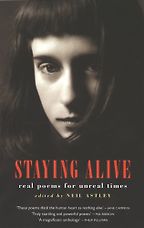
Like so many poets, you’re a champion of the Staying Alive anthology. What is its appeal, do you think?
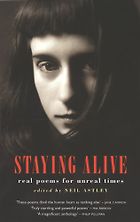
Staying Alive, a prequel to Being Alive, is published by Bloodaxe, a powerhouse in the poetry world. What’s really fantastic about this anthology is the range of poets from all over the world and the way it’s organised thematically. You can have a theme of personal journeys and you’ll find all these different poems on that theme. The other great thing about it is that different poems have a conversation with each other, just because of the way the book has been ordered. For some reason it really captures people’s imaginations and it was one of these poetry anthologies that really took off. All sorts of people backed it and it was exciting and groundbreaking.
Is there any section or poem that particularly appeals to you?
Yes. The roads and journeys section. There’s a poem by Mary Oliver, ‘The Journey’, which I love. It works on so many different levels and I think people identify with it. There are lots of poems from this book which I really like: the poems about wasps and bees and the body and soul section. It’s an anthology that I often use in workshops. I did one in Ilkley the other day on the theme of doppelgangers, and there were a couple of poems that I thought were perfect for that theme. Then there are poems like Robert Frost’s ‘The Road Not Taken’, so the classic poems exist alongside poets people wouldn’t have heard of.
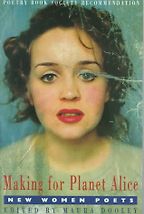
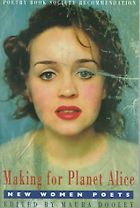
I was interested in your choice Making For Planet Alice: New Women Poets.
This is edited by Maura Dooley, who’s a wonderful poet and also a good friend. I like this book because it introduced me to lots of poets I hadn’t heard of, so that was exciting. I first came across Alice Oswald in this book.
Do you think poets like these don’t get enough attention in the mainstream media?
Yes, definitely. There are certain poets that get a lot of attention all the time. People will know Seamus Heaney, Carol Ann Duffy or Simon Armitage but there are a lot of poets that seem to exist just outside people’s radar, yet they’ve been doing good work for a number of years.
Why do you think that is?
I think it’s just because of our slightly obsessed media culture. We tend to point single lights at people rather than at groups. I think that within the poetry world, everybody has heard of everybody else. But that world is quite specific and it takes quite a lot to break out of that. Most of the people reading poems are other poets (of the kind of poets that I’m talking about). It would just be nice to see those poets break out into a more general readership.
How can we encourage a wider audience to read poetry like this?
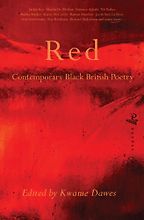
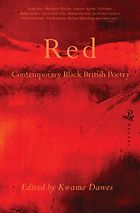
Well, I think some things have been happening. There are lots of poetry readings and literature festivals all over the place. There are poems on the underground and poems on the radio, and all these things make poetry more accessible to a wider audience. But our problem is still in whose poetry becomes accessible, so that’s what needs to be changed. Another book I’m going to talk about is Red: Contemporary Black British Poets, which has 80 black British poets in the anthology. If you ask the average person in the street how many black British poets they know, they might say four or five, but they wouldn’t necessarily come up with 80.
Is the poetry world a bit sexist? Is there any reason that new women poets are promoted in Making For Planet Alice?
Yes, I think there is sexism in the poetry world. There’s this idea that men write better poems than women and I think that still definitely exists. There are a few women poets that they make exceptions, that they change into one of the boys, as it were.
Is there any poet you want to pick from Planet Alice?
It’s a strong collection of very different voices. I think Lavinia Greenlaw is great, particularly ‘The Shape of Things’ and ‘Iron Lung’, and Sinéad Morrissey is fantastic. It was published in 1997 and it’s still exciting. The selection of the poems is pretty strong. Alice Oswald is unique and has a very natural and different voice. She’s wonderful at writing about nature and she takes huge risks. Her mountains poem is very good. Sarah Maguire is a poet that’s amazing and doesn’t get enough attention. She wrote ‘Spilt Milk’.
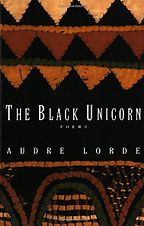
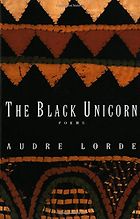
Moving on to a single collection: The Black Unicorn by Audre Lorde.
I first came across The Black Unicorn in the 1980s. The poems are unified and I really like single collections where there’s some sort of connection rather than 40 disparate poems. This book has an incredible unity. I think it’s the most achieved of all of her poetry collections, and it’s a book I’ve had throughout my life.
Was she a mentor?
Yes, I met her. I worked for the publishers who published her and she stayed with me for a week when she came over for a feminist book fair in 1983. She was really lovely, really warm. A lot of people were scared of her, but I wasn’t, even though she was very outspoken. I loved the way she wrote and talked about silence and the way she used the Dahomey woman and African mythology in her poetry. I found that really inspiring.
I loved how she created characters out of people. She has a poem called ‘Harriet’: ‘Harriet, Harriet, what do we call ourselves now our mother has gone?’ There are all sorts of lines that are really involved and she’s got a poem about being 14. She’s able to move in and out of a range of voices. A lot of her poems are political, like ‘Afterimages’. There are poems where she has been outraged at racism or at some dreadful thing that’s happened. But on the whole I like her quieter poems and her lyrical poems even more.
Were you influenced by her?
Yes, definitely. She liked that I was Scottish and said, ‘You know, you can be black and Scottish, you don’t have to choose.’ I was in my early 20s and that seemed quite liberating. I was annoyed at not having cottoned on to being black, so I was rejecting the Scottish side of myself, and she was saying no, embrace all your contradictions. And that was very good advice to get at that age. She also read my poems and commented on them.
She did an interview with Spare Rib and they sent her a cheque which she sent back to them, telling them to donate it to the magazine. They were annoyed by this, so she sent it to me and I was pregnant at the time with my son, who’s now 22. She told me to open a bank account for my son and her £60 opened my boy’s bank account.
That American chutzpah and confidence is so refreshing.
Yes, it is. It’s lovely.
Tell me more about Red: Contemporary Black British Poetry.
I think this is a very exciting book. It’s very refreshing and interesting that the poems are around the colour red rather than addressing race. It feels like a moved-on anthology. And it’s surprising what poems have come out just taking randomly the colour red as opposed to blue or black or green. Red diamonds, red running shoes, the infinity of red, roses, blood, seeing red. All sorts of interesting poems.
There are poets in here whose work I know really well, like Fred D’Aguiar. And there are poets whose work I’m only slightly familiar with or whose prose I know, but poetry I didn’t know, like Tishani Doshi. Bernardine Evaristo, whose work I’ve known for a while, is in here with a poem called ‘Revenge’. It’s probably one of my favourite poems in the whole book. There are poems by a writer I only met for the first time the other night. He’s called Nii Ayikwei Parks and his poems and his voice I found really great. But there’s so much talent in here, it’s just really exciting to find all of this talent collected in the one book. It’s been ordered alphabetically and that seems to work as well.
Has the spotlight shone strongly enough on black British poets?
I think that black British poets haven’t quite broken through in the way some black British novelists have and that still has got to happen. So I hope books like this will make a difference.
Why do you think black novelists have been favoured over poets?
Poetry itself is a marginalised art form and then within the poetry world you get poets that are further marginalised, and it’s two things rather than one. I think there is a racism out there that thinks of black people as being good performance poets but not good page poets. That kind of attitude has dogged the work of a lot of black writers in this country. In America you do have senior figures like Maya Angelou and Alice Walker – major, major figures – and they have more of a sense of a history with Langston Hughes. Americans know what it’s like to have a senior figure occupy that space. And in Britain it’s not quite the same. There are people like Derek Walcott but they’re not based here. There aren’t poets here who have been given that stature.
I
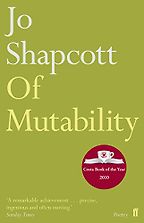
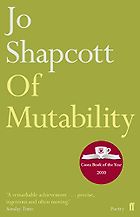
see your final choice is Jo Shapcott’s Of Mutability. Why is that?
I think this is Shapcott’s finest book so far. I think the experience of having had cancer has brought a new vulnerability to her poetry, but also a new strength, and there are really enlivening poems in here that make you see the world differently. It’s about having come through cancer, having realised your cells are different in your body and being so glad to be alive. There are so many celebratory poems in here, even poems that look at boldness in a different way.
If the task of the poet is to make you see old things in a fresh way, or to look at one thing and to compare it to another, to achieve a particular clarity through comparison and metaphor and image, then that’s what Shapcott does in this collection. One poem, which is really brilliant, begins with the line, ‘Can the bold lie? The nature of the skin says not’. She’s just got a quirky and interesting take on everything. A lot of these poems are influenced by the art of Helen Chadwick, and the writer, poet and artist Julia Darling who died of breast cancer at 48. So there’s a sense of guiding spirits in this book. But it’s not airy-fairy, it’s quite tough.
Interview by Rebecca Slack
Five Books aims to keep its book recommendations and interviews up to date. If you are the interviewee and would like to update your choice of books (or even just what you say about them) please email us at [email protected]
Five Books interviews are expensive to produce. If you've enjoyed this interview, please support us by donating a small amount.