What got you interested in military history?
Originally I did my work—and I still do a lot of my work—on the history of international relations and, specifically, British foreign policy. But I moved into military history because I started teaching general European history and felt that the standard accounts offered of military history within it were weak and inadequate. I was also troubled by the extent to which military history and war itself tend to be underplayed. Although people, including myself, don’t like war, it is a terrible mistake to assume that it doesn’t often have a highly significant role in history. And this attempt to almost align it out, which I think one can see in the changing preferences in history courses, was in my view deeply mistaken.
What kinds of things do you think it can teach people?
I think first of all it can teach people unpredictability and discontinuity, which is tremendously important. Whatever one’s political persuasion, one of the great problems with history is that people of the left, right and centre believe in inevitability, which is generally of their own values. And one of the interesting things about war is that when two powers go to war, both sides think they can win and invariably at least one of them is wrong. In fact, generally, both of them are wrong because neither of them get out of the war what they want.
To that extent war and military history represent the revenge of the contingent on the determinist. They represent the revenge of the short term on the long term and I think that is very important because the way we think about it is often overly dependent on some kind of inevitability.
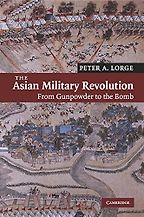
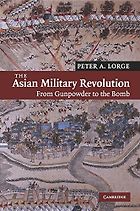
Tell me about your first book, The Asian Military Revolution: From Gunpowder to the Bomb by Peter Lorge.
This is a book that I think is really important, especially as we are in a new millennium and also need to be thinking about a history that makes sense in terms of where the majority of the world’s population live. We need to think about a history that makes sense, in particular, in terms of looking at the relationship between East and South Asia on the one hand and the West on the other, in which it is not simply the case that the West are making the advances in terms of technology and in terms of interpretative analysis.
And what I think is very impressive about Lorge, who is an expert on China, is not just that he argues the importance of what goes on in East and South Asia and does so in a clear and concise fashion. But also that he takes the pretty established analytical concept of the military revolution and takes it out of the hands of the West, where it is located, and says, ‘Actually, no. The military revolution is an Asian one and the West borrowed it and copied it.’ I think that is intellectually very interesting. You don’t have to agree with every detail, and obviously in a book which is as concise as his, there are areas which could have been and should have been expanded on.
Get the weekly Five Books newsletter
But I think the intellectual range is impressive and I am a firm believer that books are most valuable when they challenge the way that you think: so they take the established account, stand it on its head and see what happens. It is interesting that Lorge is an American and that kind of broad synoptic study is very much lacking in the British intellectual tradition at the present moment.
Why do you think that is?
I think we have the suffocating grasp of Oxford and Cambridge, both of which I have to say I have been to. But, I am afraid to say, in general there is a lack of engagement with broad themes. There is too much specialisation which leads to what I think of as telephone kiosk history, or writing in which you can fit everyone in the world interested in the subject into a telephone kiosk.
Although these specialists are often very good in their field they are not using the opportunity to say there are 61 million people in Britain, there’s an Anglo sphere of hundreds of millions, there is a world population of billions – what can we actually say that is valuable and useful to a wider constituency? I think a lot of academics are lacking a sense of public awareness in that respect, which I find deeply disturbing.
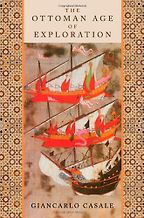
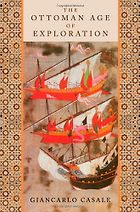
Next on your list is The Ottoman Age of Exploration by Giancarlo Casale.
This is a new book that argues that the Ottoman Empire had a maritime interest in the Indian Ocean which we have underrated. We have found it overly easy to think about the Ottomans in terms of a land empire, which they obviously were, but they were also an important maritime power and we ought to be using that to re-examine our standard assumptions about the West, after the 15th century, being the only source of maritime power until you get the Japanese borrowing Western technology and ideas at the end 19th century.
It is a very interesting book, although I don’t think he always demonstrates his points as well as one might like, but on the other hand it’s not easy to do research in Ottoman archives and, by the nature of things, if one is writing on a broad range like him there is only so much data that one can actually produce. What is great about this book, and the fact that it was published by a mainstream publisher, is that it shows that there is this willingness to engage in the wider world.
I think this book and my first choice show that the standard military narratives are set by Western assumptions and these books aim to show a different side. The traditional view is that the rest of the world is struggling to catch up with the West in military terms and this is actually historically inaccurate. Historians need to think about the present impact of their work and rethink the history of war. That in turn will help them rethink what is going on in the present day and hopefully into the future.
If you look at what happened in Iraq after the invasion in 2003, and what is going on now in Afghanistan, there is this issue of two very different narratives of military history coming into confrontation. The standard narrative, which is that of regular forces, high technology and Western assumptions, confronts another narrative in which non-Western forces display values and practices which do not conform and do not try to conform to those established in the West. If Western powers wish to use force sensibly, they have to be aware that other people aren’t necessarily going to fight the kind of wars they want.
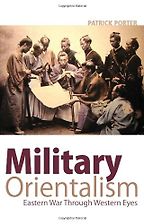
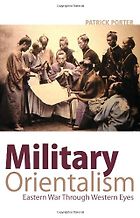
Your next choice is Patrick Porter’s Military Orientalism: Eastern War through Western Eyes.
Patrick Porter has written this very interesting book in which he has tried to look at the role of culture in military history and in particular the argument that there are fixed national cultures and that this can or can’t lead to particular outcomes. And what he is actually saying is that we mustn’t push the cultural interpretation too far. I found that particularly interesting because reading his book made me think maybe I have been pushing it too far in some of the works I have been producing.
Of course his major target is a much easier and softer target, which is the military historian Victor Davis Hanson’s rather teleological and self-congratulatory accounts of American military culture. But I think Porter raises a broader issue, which is when we think of long-term cultural assumptions we use terms like Oriental culture, Asian culture, the culture of the Middle East etc, and he wants to know how far are we actually creating a kind of ethno-genesis, a kind of long-term account for what is often in fact very short term?
Although Porter doesn’t bring this out, there has been some good work recently by military historians on China, arguing that the classic account of Chinese strategic culture, which is that it centred on Confucianism and was not expansionist, isn’t actually right. It is true for some periods of Chinese history but not always. For example, in the 18th century the Chinese were extraordinarily expansionist and Confucianism scarcely explains the views that they were following. I think that this revaluation of Chinese history is very exciting because what it does is to take us back to the role of the short term and of the immediate. That is important because it gives us agency.
In other words, if you take a view that cultures determine what goes on, you have replaced one form of determinism, socio-economic determinism, with another form of determinism, cultural determinism. And what you have done if you do that is to say essentially that everything else is just short term. What I think is much more exciting is the argument that yes, of course, there are long-term continuities. For example, it is not going to rain very heavily in the Sahara next year. There are long-term geographical continuities, and there are long-term cultural impulses, but at the same time you can see major changes occurring that reflect the agency of individuals. An obvious example is the complete change in the position of women in British and Western public culture in the last 100 years, as something that was not culturally determined by what had happened prior to that.
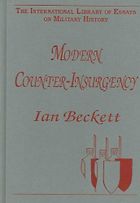
Your next book, Modern Counter-Insurgency by Ian Beckett is about unconventional war tactics.
Ian Beckett is a British scholar and an older scholar compared to the others, and I think what one has got here is a very mature approach, in which what he is essentially saying is that it is not always the case that insurgency warfare succeeds or doesn’t succeed, and it is not always the case that counter-insurgency warfare succeeds or doesn’t succeed. In other words, one has to do the hard work of looking at why in particular circumstances you get given outcomes.
I think in a way that is one of the great values of history. Historians don’t own the past. There are other subjects, such as political science and sociology, which look at the past. And they have their strengths and can be very exciting. But one of their weaknesses is that they are overly prone to present a clear-cut model that explains everything. And what I rather like are books that are open to long-term big issues. The Beckett book covers the last quarter millennium, which is good because he doesn’t just cover one insurgency or do a comparison of two. But at the same time he is referring repeatedly to the specific, whether that be the country or the groups of individuals. And I think that is very important.
I would invite anyone thinking about history, who is told that such and such an outcome is inevitable, to look back at the last 30 or 40 years of their own country and think about different outcomes. What would have been the history of Britain if we hadn’t had North Sea oil? These questions are important because history takes on its value if it can encourage you not just to look at the past but also to think carefully about the present and the future.
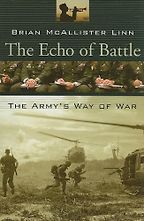
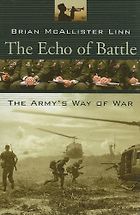
Your final book is The Echo of Battle: The Army’s Way of War by Brian McAllister Linn.
I think The Echo of Battle takes us to the world’s leading military power. It is looking at the United States and it reminds us that institutional cultures play a role and it reminds us that America is not, as it were, set in stone. There are actually complex issues within the United Sates – regulars against the militia, and expansionists against people who are much more cautious.
The book covers a few hundred years so it gives us a range and specificity, which is what, in my view, one should try to offer. But the two values are in a way opposed and I find this when I try to write. You try to write clearly but that is hard because you are also trying to write in a qualificatory fashion. You are trying to give a balance between the two halves and to show people there are different views, which sometimes makes for clumsy prose. The longer you work on a subject, the harder it is to explain exactly what happened and why.
Get the weekly Five Books newsletter
I think this is a general problem with books. It tends to be the case with history that the weakest books are often the easiest ones to read. They are like television history – sit quietly and Simon or David will tell you the answers. This kind of approach, which gives you one answer, is the one which is terribly popular. Books that tell you the answers sell very well, but they are, although not invariably, conceptually unsophisticated and intellectually suspect. In practical terms history is something where we cannot recover the experiment. We cannot know exactly what happened. The one thing we do know is that whatever we are writing now other historians, who hopefully will be of equal merit, will come along and do just as much research but will reach completely different conclusions! And that is good because people should not be writing in the sense that they know the answer.
Whenever I see a book that says on the cover that this is the definitive answer to this question I think this isn’t a good history book. Instead, what one needs to do is to embrace a humane scepticism, which is both valuable to the subject but also a culturally important point, and not just for our culture but on a global scale.
Five Books aims to keep its book recommendations and interviews up to date. If you are the interviewee and would like to update your choice of books (or even just what you say about them) please email us at editor@fivebooks.com
Five Books interviews are expensive to produce. If you've enjoyed this interview, please support us by donating a small amount.