So far all our other interviews on Five Books have been about conventional printed books. What we haven’t talked about, yet, is books that are either written directly for the internet and are authored by it, or are affected profoundly by the internet. Is that what we are going to do?
We’re talking about digital textuality and what happens to literature when it interfaces with the prospect of the digital – of digital technology and digital culture. And we’re talking about readers who are becoming literate, and perhaps even more literate, on the screen rather than on the page.
When you say ‘literate’, do you mean ‘literary’, or that they’re actually learning how to read on the net?
That is, I think, the question that I’m interested in…the division between those faculties is really interesting. I’ve been invited to talk on panels about ‘new literacies’, and certainly literacy is quite different from ‘literariness’, because people are just reading in different ways online. Rather than engaging with a single book and a single author for a sustained amount of time, people are reading in the kind of Web 2.0 social networking ways that I think Lev’s interview was bringing up: they’re reading hypertextually across web pages, and they’re also producing their own content. But the question of the literary is really the question that I’m most interested in, because I’m approaching this from a literature background first, rather than, say, a computer programming background.
I’m looking at the recommendations that you’ve made here, and you’ve divided them into categories – that which is born digital and that which is influenced by digital technology. Shall we talk about the digital literature first? Why are people tempted to write in this way rather than writing on paper?
Born digital describes works that are created with a computer and are meant to be read on the computer. They’re not works that you print out. The computational aspect of the work is part of its aesthetic and its reception. So born digital, as you can see, can encompass a wide variety of genres and works. And then, on the question of why now, why people are writing digital literature now… Actually, the field has origins beyond the current moment. Unsurprisingly, when humans create a new technology, any kind of reading or writing technology, they find ways to use it for artistic purposes. Electronic literature is generally acknowledged as having a 20-year or so history, going back to Michael Joyce’s afternoon: a story [1987], but its origins can be pushed further back to ASCII art, early chatbots like ELIZA, and other computer-mediated forms of art.
And obviously, in order for something to take off, as a sort of literary phenomenon, it has to be recognised as a literary phenomenon. And who really is the audience for this sort of literature so far?
Well, there’s an interesting situation going on wherein literary critics are intimately involved in producing the literary phenomenon that is the field of digital literature.
And beyond the academy – is it variegating at all, the audience? I mean are there different sorts of people being drawn into this?
There are. It’s certainly not located in the academy. And neither are the artists. And neither is it located in one place in the world. It’s an international phenomenon, happening in different languages, as you can imagine. It’s the internet, so anyone who has access can create and publish their stuff. And works go viral, in terms of what people are reading and who becomes popular. Moreover, the question of genre becomes more complicated, because some of these works are considered film or art more than literature.
For example Young-hae Chang Heavy Industries ’s work. Their website contains a lot of different works, and all of them, I think, are wonderful. That’s the site that I go to when I need to show people what I mean by digital literature.
I spent some time on that site. And it is amazing. In fact I was just reading ‘North Korean Cunnilingus’, which is hilarious. As you say, it’s kind of a misnomer, really, to call it ‘writing’, because it combines several different media. So it’s very internet-specific, and more than that, it’s incredibly exciting. So, can you describe briefly what it’s doing?
Well, first, it’s collaboration between two writers. And that’s something that is perhaps not internet-specific but certainly supported by the web. Collaboration is now more understood as being associated with the internet than with print-based conceptions of a single author. But what’s wonderful about their work is that it’s both sophisticated and simple. It’s both shocking and completely approachable. It’s fun and, as you spend time with it, also really elevated in terms of its intertextuality and the kinds of political and aesthetic statements it’s making. So what it’s doing is creating this multi-modal literary artwork in which text cannot be separated from the image of text, or from sound, or from movement. It creates a performance – a textual performance – online that challenges the ways in which we describe and understand what we mean by ‘literature’.
As a result it’s, in a way, quite hard to talk about in terms of content.
I think that that’s true, because you can describe – and I’m sure you can imagine, this is my conundrum – you can try to describe digital literature, and Young-hae Chang’s work in particular, using thousands of words. But it becomes so much clearer when you just look at it for three seconds. You understand the implications such work has for thinking about literature and certainly for reading it, writing about it, or teaching it.
Young-hae Chang sort of reminded me of early Communist propaganda. Very blockish and energetic, very industrial, very simple. It’s very surreal, actually, in many ways. And then another one that you’ve drawn our attention to, Twelve Blue, is much more conventionally text-based, it seemed to me. Incredibly beautifully written.
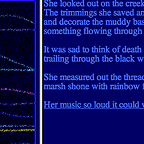
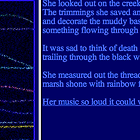
Twelve Blue is by Michael Joyce, who is the author of afternoon , called ‘the grandfather of hypertext’. He’s a master of the form and is truly just a beautiful writer. And you can see the influence of that other Joyce – James Joyce: the writing flows. And the play with puns, visual and verbal, as in the kinds of sea metaphors that are taken up in the blue text. I read it years ago, and I was hooked; indeed, it was with this piece that I decided to focus in this field. I started reading the novel in the late afternoon and realised at around midnight that I had completely lost all sense of time and was immersed in a work on screen. I dove into this digital work about the sea. It’s so beautiful. But also so simple. It’s just a hypertext – it’s just text on screen in which there are lexias, meaning it’s a nonlinear narrative comprised of chunks of text connected by links that demand reader interaction to produce the plot. So you and I could read Twelve Blue in completely different orders. When you’re teaching it, you’re aware that some of the students have seen certain screens and some haven’t. It requires a very different understanding of what it means to read, close read, or even finish reading a work. It is a great work in terms of its content, because it’s one that uses its form, as good literature should, to create beautiful content. There are full-blown characters here and a deftly intertwined plot. You can forget, as I did, the fact that you’re clicking through windows onscreen to access a disorienting hypertext and just be lost in the story. That’s why I selected it – because I think it exemplifies the hypertext genre. And it’s available online for people to see. And it is really just beautiful. Hypertext actually has been around a long time. Think Tristram Shandy , or Nabokov’s Pale Fire , or – later, much later – David Foster Wallace’s Infinite Jest : these kinds of works rely on footnotes to move the reader in a nonlinear fashion through the text. These can also be considered hypertexts – or at least proto-hypertexts. But hypertext became identified as the first genre of electronic literature because when the internet went public, it was text-based and based on hyperlinks. The hypertext period became associated with the larger category of digital literature, but it is really and more rightly defined as the first generation of electronic literature.
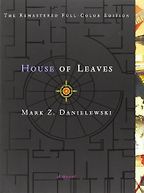
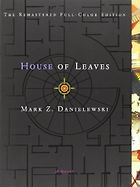
Let’s go on and talk now about the print novels that you have chosen that have been influenced by digital technology. And the first of these is Mark Danielewski’s House of Leaves. This was among the first, wasn’t it – and became a huge success. What do you think was so appealing about it?
I think it’s a print novel that presents a multimedia sensibility in a high literary art form. I think it appeals to people who read for entertainment but also to literary critics and teachers, readers of Derrida and deconstruction – people who have read the works that are alluded to in its pages. It’s a highly intellectual and literary text. So it spans readerships in a way that few novels, and certainly few contemporary novels, do. And it is also, of course, really fascinating in terms of its form, its print body. It re-mediates cinema and the internet, and it beautifully exploits the possibilities of the print page. So there’s a lot there for a lot of people.
So in what respects does it require digital textuality at all?
Well it doesn’t. It’s a big paperbound book! But I see this novel as residing in a network of other media forms. So there’s an accompanying website published at the same time as the novel (the House of Leaves bulletin board is a massive website that continues to receive thousands of hits and discussions in their forum, which is amazing for a literary print book published nine years ago); and then there’s another print book that was also published simultaneously that contains and expands upon the epistolary section between the protagonist and his mother. And the most interesting aspect to me is the musical album by the author’s sister, the recording artist Poe. She produced an album that accompanied the novel, called Haunted. If you listen to the music and lyrics in conjunction with the novel you hear that there’s a kind of cross-traffic of narrative and clues going on. So I’ve argued (in an article) that some explanations for the enigmas within the novel are contained or illuminated in the music. So it’s not that this is a digital novel, but it does in some way live within this multimedia universe, a network connected via the internet.
It seems from what you’re saying that it’s also a novel about narrative spaces. Conventionally, I suppose, one often forgets one is reading at all, whereas when a narrative changes in terms of its media or in terms of the way it’s presented, then you’re forced to remember that what you’re reading is an artefact. So does this mean that House of Leaves and books like it are inherently sceptical works? Works that encourage one to stand back a little and read, as it were, more knowingly?
I think it can be read both ways and I think that’s why it’s such a successful novel. There are some people who read it and get absolutely absorbed in the layers of storytelling and mediation that are happening in it. But there are other people, who, as you rightly point out, are absolutely aware of the meta-level questions it raises. This is a work that, like some of the digital works I selected, are interested in being self-reflexive, in looking at the space they inhabit, not only in terms of their print and digital media, but in terms of the larger cultural spaces and value systems that literature inhabits in the contemporary world. This isn’t just about plot or characters but also about reading and about how reading has always been dependent on various technologies.
Look, we’ve talked about the form of these stories, but what I really want to ask is – are they fun to read?
House of Leaves is really fun to read. It’s an addictive text. Some people don’t get interested, but if you’re game, this is a book that can rule your universe for a good few weeks – and terrify you. Even though it’s highly mediated, as we’ve discussed, it starts to seep into your own personal world. It directly addresses the reader on the first page, stating ‘This is not for you’; so you end up not knowing what’s real and what’s not. Indeed, my husband started reading it when I was out of town and he had to put it in a drawer and hide it because he got so frightened of it. It’s really fun.
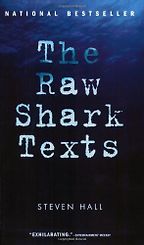
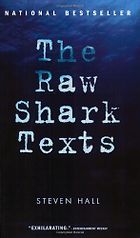
Does House of Leaves have any rivals as a cult book? You’ve put down The Raw Shark Texts by Steven Hall, which I assume is a play on the ‘Rorschach Test’. Has Hall’s book achieved anything like the same success?
It’s definitely a popular book and seems inspired by House of Leaves . I don’t think it’s as sophisticated or as ambitious, but it is interesting and very fun – so that people who like House of Leaves will also like The Raw Shark Texts . You know, yesterday I actually received an e-mail from Steven Hall, the author. He’d seen something on the net about a talk I’d given on The Raw Shark Texts at an academic conference, and he was interested to hear what I had to say about his novel, to read my talk! And you know, that would only happen in the digital age. I mean, it’s not as though an academic conference would usually catch the eye of an emergent, popular writer, particularly, and this is really ironic, a conference titled ‘Bookishness in the Digital Age’!
Well it sounds like he’s hungry for feedback.
The novel is supposedly going to be turned into a movie, so it obviously struck a popular chord. Unlike House of Leaves , which went viral (and whose author refused movie deals for the book), The Raw Shark Texts seems to have had a sophisticated multimedia marketing campaign framing it from the beginning. For example, one of the teasers on YouTube is a short but very polished clip of Tilda Swinton reading an excerpt from the novel in her incredibly calm and terrifying voice. So the novel was released already envisaging itself as a mass market, multimedia phenomenon.
Would you say that’s because it is fundamentally different to House of Leaves or do you think it can do that because people are already getting more used to this kind of book?
I would say the latter. I would say that both books rely on readers’ multimedia literacy as a means of producing their own literariness. And this takes us back to our initial discussion of literacy versus the literary in the digital realm. When House of Leaves came out, the idea that it could be connected to the net, that you could discuss it on line, that people were beginning to research on Wikipedia what was and wasn’t true in this book, was pretty new and exciting, and that was part of the adventure of reading the 700-page novel. But The Raw Shark Texts seems to be addressing a different kind of readership, one that has evolved since House of Leaves ’s publication in 2000. I think there’s been a change in the way that people read and a change in what they expect to read even just over the last decade.
A very short development time indeed. But do you think this is exponential? Do you think that we’re looking at something more than a new genre here?
A radically new form of literacy? Absolutely. I think that people are reading in different ways. And I think the place to look to see these changes is the location where conventional print literature and digital literature meet. That’s where these works live – House of Leaves , The Raw Shark Texts , and digital literature too – at the interstices.
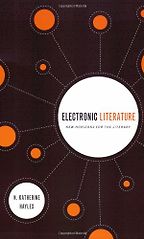
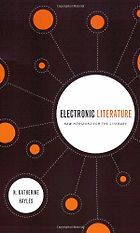
Do you have something to say, just to round up, about your third category, which is your criticism and theory category? You’ve recommended Katherine Hayles’s Electronic Literature. What is she saying that you haven’t said already?
Well Katherine Hayes is a major shaper of this field, and I think this book is a valuable addition because it’s an introduction, a primer to what digital literature is and how it can be incorporated into the kind of conversation we’re having here. There’s a lot of work to be done in the criticism of this emergent field: to explain not only the link between print and digital media but also the link between contemporary and older works, literary forms and reading practices. As a critic, I’m not only interested in the new works for the sake of their newness but also for what this new literature can expose about what was previously normal, canonical, and valuable, both in terms of literature and literacy.
So you think that this is going to give us a new way of reading the past?
Yes I do, exactly.
Five Books aims to keep its book recommendations and interviews up to date. If you are the interviewee and would like to update your choice of books (or even just what you say about them) please email us at editor@fivebooks.com
Five Books interviews are expensive to produce. If you've enjoyed this interview, please support us by donating a small amount.