Short stories dive right into the middle of the matter and there's nothing about them that's inessential, argues American writer Jim Shepard. He chooses five of his favourite short story collections, from the 1980s through to the 21st century.
You’ve compared writing short stories to guerrilla warfare. Please explain.
In guerrilla warfare you get in fast, do what’s necessary and get out. As opposed to the more massed forms of warfare, which entail elaborate strategies and entire armies. The analogy is meant to illuminate the relative alacrity and economy with which short stories operate, as opposed to novels, where it sometimes feels like there’s a lot of groundwork that must be laid before you get to the main body of the narrative.
The New York Times recently saluted you as “master of the historical short story”. You teach creative writing. Why don’t you follow the classic dictum to “write what you know”?
I’m always looking to expand what I know. I’m always looking to get to know the world better. I’m always looking to expand the scope of my empathetic imagination. I think that’s part of why we get into the arts in the first place. And I also think that writing about other things, if you’re doing so in the right way, is a great way of tricking yourself into writing about stuff you most care about. It can be a back door into difficult emotions. Especially if you’re a guy, you might have difficulty dealing with particularly vexed emotions to begin with. And particularly vexed emotions are the sort that power literature. Not many of us like to sit down and say: Well, what’s really eating at me now?
It’s certainly not my term. Critics are always looking for some way to help book buyers and readers put you in one category or another. What I think critics mean by historical fiction is fiction that takes, as some part of its subject matter, history as we understand it. To me, it’s not an oxymoron because, as any historian will tell you, history itself is a contested narrative. In any given historical situation, there’s a lot that we can’t know and there’s also a lot that people disagree about, so there is a lot of room within which fiction writers can manoeuvre.
It seems to me that people read fiction and history for different reasons. Do historical short stories promise the pleasures of both in one bite?
They do feed the hunger that readers have for nonfiction in fiction. When I first started reading literary fiction, I was struck by how much I was learning – not only about the human heart, which is traditionally what literature is supposed to be about, but also about how the world worked and the way the world was. So when I read Ernest Hemingway’s short story “Big Two-Hearted River”, I felt I was learning not only about Nick Adams’s interior but also about fly fishing. And when I read War and Peace, I felt that I was learning not only about the emotional intricacies of the central characters, but also about the Napoleonic Wars in Russia.
The sense that you get of encountering the world in a more intimate and visceral way is one of the main pleasures that fiction can deliver. History very often has to step back and say: This is our best guess as to what really happened, and what it was like. Fiction can completely commit, and convey at least one person’s vision of what it was like to be immersed in important incidents in history.
Before we get into Matters of Life and Death, can you sketch a short history of the short story in the post-World War II era?
I’m not sure I can. What I can tell you is that when I started writing short stories, in the 1970s, people would often say: “Well that’s wonderful, but you’re going to need to do a novel.” In the 60s and 70s, you’d even find yourself needing to explain why Flannery O’Connor was a major figure. That really did change in the 80s with the advent of writers who specialised in short stories, like Mary Robison and Raymond Carver. I think they permanently transformed the literary scene. Around the time that Matters of Life and Death came out, in 1983, the short story was heading into its heyday in terms of literary prestige. People were finally starting to believe that somebody who wrote mainly or only short stories could be the equal of a novelist.
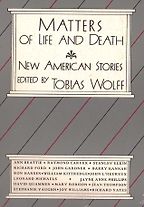
OK, let’s engage with Matters of Life and Death. This anthology of assorted authors is now nearly 30 years old. Who is in it? And why is it more worth reading than other anthologies?
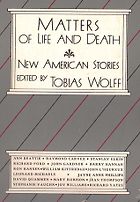
Since anthologies are such a common way in which readers encounter great stories, I thought I should suggest at least one anthology. And since so many books that I love are out of print, I also wanted to select one out-of-print book to represent them all.
Toby Wolff’s Matters of Life and Death was a hugely influential anthology in the early 80s, when America was just turning away from the fabulism of the 60s and 70s, writers like Barth and Barthelme, and towards a renewed commitment to naturalism. As such, it has all of the central figures in that movement and it also has some of the very best stories by those people – people like Raymond Carver, Richard Ford, Joy Williams and Mary Robison. It also has wonderful stories by John Gardner, Barry Hannah, Ron Hansen and Leonard Michaels. Much more than most anthologies, it’s a snapshot of the very best storywriters of an entire decade.
Sounds great, but I think I might still prefer You’ve Got to Read This, the 1990s anthology you edited with Ron Hansen. Please tell us what made that project unique.
Ron Hansen and I did what career counselors suggest: Find a thing you do anyway and find a way to make it pay. In our case, we realised while standing around at writers’ conferences like Bread Loaf that we didn’t often talk about each other’s work, since that could get awkward, and that we didn’t often talk about business, since that could get so depressing. Usually, what we did was pick each other’s brains for stories that we admired and thought other people should read. If you’re standing there with Tim O’Brien you can’t just keep saying to him, “I love your work”. At some point, you need to discuss something different. We often turned to the question, “If I could read just one story, what should I read?”
So we came up with the idea of an anthology where we asked a number of writers we admired to pick a story that they love and introduce it. What’s wonderful about the anthology was that some writers chose works that they thought everyone on earth needed to read. So Sue Miller chose Flannery O’Connor’s “A Good Man is Hard to Find”. And others, like Charlie Baxter, just said, “Well, I’m not going to choose somebody that everyone knows about, I’m going to choose someone that nobody knows about.” So he chose Lars Gustafsson’s “Greatness Strikes Where it Pleases”. And we ended up with a nice balance between canonical stories and woefully neglected stories.
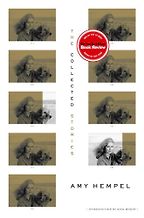
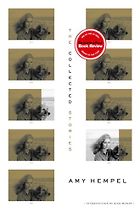
Let’s move on to Collected Stories by Amy Hempel, one of the stars of the short story’s heyday.
This is one of the two collections that I chose because I thought that they were inescapably influential when it comes to contemporary American writing.
Amy has a way of offhandedly rendering dire emotional states. She’s always been breathtakingly tender and funny. The offhandedness combines with the tenderness to produce fiction that’s both dispassionate and compassionate, and I find that a rare and wonderful combination. Amy is considered a minimalist but I think that it would be more accurate to say that she’s a master of emotional indirection. There is a huge tension in her work, and in her protagonists, between guarding information and needing to release it. And one of the strategies her protagonists always choose is to talk about somebody else as a secret way of talking about themselves.
She often writes about characters confronting trauma and the possibilities and limitations of recovery. As one character puts it, “Just because you’ve stopped sinking doesn’t mean you’re not still underwater”. Consolation and responsibility are her big subjects. There’s a line in one of her stories that I think could be in any of her stories. One of her characters says to another: “Can we take each other in?” That’s Amy in a nutshell.
She addresses matters very close to home. Joan Didion famously wrote about nonfiction, “Writers are always selling somebody out”. Are fiction writers always selling somebody out too?
The fiction writers I admire the most are indicting themselves and their surrogates at least as much as they’re indicting anybody else. I don’t think of fiction as a chance to settle scores and I don’t think that the writers that I’ve cited do either.
You and Hempel co-edited an anthology of poetry by writers primarily identified with the short story. Do you find that poems require the same talent for distillation as short stories?
They do. They probably require more. Poems and short stories are in some way more similar than short stories and novels. Stories, even long short stories, rely a huge amount on what’s unstated and what’s implied. Novels tend to be more comprehensive. Most short stories, even traditional short stories, leave you forced to imagine what will follow. Traditional novels tend to tie everything up. But the anthology you’re referring to, Unleashed: Poems by Writers’ Dogs, was just a playful undertaking.
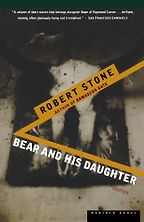
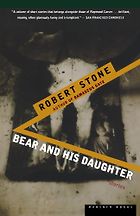
Unlike Hempel, your next author is better known for novels, particularly his National Book Award-winning Dog Soldiers. Please tell us about Robert Stone and Bear and His Daughter.
I chose Bear and His Daughter because, although Stone is better known for his novels, this collection contains some of the best things he’s ever done. Nobody writes as well as Stone does about primal psychological states like terror and rapture and dread. It may be that that particular combination of states is what’s best suited for confronting our 21st century.
There’s a story in Bear and His Daughter called “Helping”, which is one of the greatest stories of the last 30 years or so. It’s about an alcoholic social worker who is contriving to get his hands on a drink and pitch himself off the wagon. One of the amazing things about the story is the way it undermines what I call the tyranny of the epiphany. The epiphany is usually understood to be that Joycean moment of illumination in stories when the protagonist and the reader, or maybe just the reader, understand something more about the world. Stone’s stories understand the tyranny of that device, and the limitations of the assumption that an enhanced level of self-awareness is inherently liberating. In other words, the idea that once we realise we’re doing something self-destructive or stupid we won’t do it again. We all know from the rubble of our own lives that’s not always the case.
Stone is great at writing about characters who are intricately self-aware and yet geniuses at self-destruction. He’s also great on the difficulty of bringing common sense and common decency to bear on things. And he’s easily one of our best writers when it comes to how the personal and the political intertwine in America. He never forgets that personal acts have political ramifications, and that’s a very valuable thing for us to keep in mind right around now.
You’re discussing how Stone’s gifts as a novelist translate in the short story format and it makes me wonder how you decide whether to cultivate the germ of an idea into a novel, novella or short story? You’ve done all three.
When I’m working on something, I’m so happy if it’s not entirely inert that I don’t dwell on whether it will be a novel, novella or short story. As the shape of the thing takes form, I start to envision how long it will be, and lately that usually means not more than 40 pages. That’s when I realise that – yet again – I’ve come up with something that’s not going to put any food on my children’s table.
For me, a short story might take four or five months and a novel might take two or three years. That’s a very big difference in terms of a time commitment. I’ve been doing a lot more stories lately and I don’t know if a factor is being at a teaching-intensive place like Williams, where if you’re working on a novel it’s always being interrupted. Or if it’s because I’m imagining myself into very strange characters and I’m thinking: I can spend five months with this narrator but I don’t think I could take it any longer.
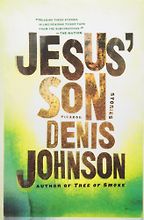
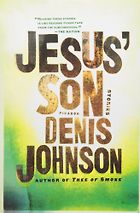
Let’s move on to a collection of 11 stories with a common narrator, Jesus’ Son by Denis Johnson. Tell us about it.
This is the other inescapably influential collection I was referring to earlier. If you talk to contemporary American writers, this is one of the collections that will keep coming up as something that everybody has read and almost everybody has admired.
What I love about Denis’s fiction, particularly Jesus’ Son, is the way it’s populated by people who are marginal by almost any measurable standard. His characters are like truants from life. They keep exposing themselves and we find their psychological nakedness both affecting and appalling. We can’t believe that a human being is this un-self-aware or this self-destructive. I love the way his characters, particularly in Jesus’ Son, are always caught between the person they wish they could be and the person they know they are. He has a spectacular gift for de-familiarising our world through his characters’ heightened perceptions. The poet Stephen Dobyns once said his language is like “a man on tall stilts strapped to roller skates on the slippery dance floor of an ocean liner ploughing through typhoon-ridden seas”.
If all 11 stories are written in the voice of a common narrator, the ultimate unreliable narrator, why isn’t this a novel? Surely Johnson’s editors pushed him to call it one for marketing purposes.
It’s been called both. I think it’s neither fish nor fowl. As a novel, it’s quite episodic and feels suspiciously like a bunch of stories. As a group of stories, it’s the same basic set of characters, so in that sense it feels like a novel. Ultimately, I call it a set of linked stories because at least two of the episodes within the 11 could stand independently as masterpieces of the short story form.
Johnson writes novels, plays and poetry. Do you feel all creative writing is part of a single art form?
Novels, short stories and poems are very much part of the same form. The writer goes into a room accompanied only by their imagination and comes out with something. The reader then does the same thing. Plays seem to me somewhat different in that they’re inevitably collaborative. So you’re writing something that’s meant to activate the imaginations of a number of other people, who then transform what you’ve written by performing it. I don’t think that what’s actually on a page in a David Mamet play is remotely the same as seeing a David Mamet play produced.
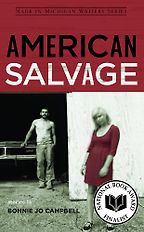
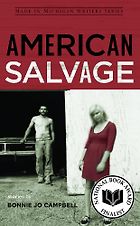
Let’s conclude with Bonnie Jo Campbell. She was little known before American Salvage was published. What is new and noteworthy about these 14 stories from rural Michigan?
I thought I should choose at least one new writer. I chose her not just for her subject. Others have written about the Rust Belt before. But I hadn’t come across anyone writing about the rural underclass in a while who has her observational eye or, more importantly, who has her ability to respect that world and simultaneously acknowledge its absurdities.
Like Amy Hempel, she has an amazing ability to be clear-eyed and compassionate about her characters at the same time. It’s very good that she has those qualities because she explores how awful it can be when you combine socioeconomic deprivation with dysfunctional family dynamics. Given her subject matter, it’s all the more important that she manages to avoid melodrama. Her characters are always failing each other because of the pressure they’re under, but at the same time, they often show emotional courage through small gestures and the support they provide for each other.
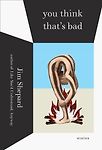
Your story collections, on the surface, are quite the opposite of American Salvage. They transport readers to radically different times and environments from the ones in which they’re reading, such as 15th-century France and a New Guinea jungle, to cite two examples from You Think That’s Bad. Although the title seems to suggest a classic clipped collection, your stories are sui generis. What coheres them?
My stories aren’t all about distant times and places. There’s one story in this new collection, called “Boys Town”, that’s about the contemporary underclass – people who can’t quite tell whether they’ve let themselves down or whether their country’s let them down. Having said that, you’re right that my stories do range all over the place. Part of what coheres them is their emotional centres. The same person is writing them, so the same person is coming back to some of the same obsessions – obsessions that show up in the stories across centuries and across continents.
One of my obsessions, for example, is complicity with power that is being ill-used. I’m also interested in the ethical costs of passivity – with what happens when, as Edmund Burke put it, good people do nothing. Reviewers are also starting to catch onto the thematic and emotional links that draw my stories together. They used to just say: These stories are all so different. But now, having seen a few collections, they say: These stories are all so different… and yet there are similarities.
Finally, in this era of ever-shortening attention spans, do you have any hope that short stories are due for a renaissance? After all, they’re the perfect length for a break between checking Twitter and Facebook.
Publishers have been hoping for that for a while. It’s hard to understand why short stories don’t catch on, given that they seem to be suited to our frenetic modern lifestyle. I wonder whether that’s partially because readers feel that if they’re going to invest their imagination, they really want it to pay off in terms of time. They think: If I’m going to get invested in a world, I don’t want that world to go away so quickly. They want a trilogy or an 800-page novel.
Part of it also might be the mostly unfounded suspicion that short stories are like homework, that they’re closer to poetry than a novel. When you tell readers to read a poem, I think their impulse is often to think: Am I going to understand this? Nobody feels like picking up something for pleasure that will make them feel stupid. So maybe there is a little wariness about short stories, a little worry that they’ll be oblique and unsatisfyingly open-ended. But those are just theories. I don’t think anyone has an answer for why short stories aren’t doing better.
And why should people read short stories?
For the reason that people read any kind of literature. Short stories at their best show us how we live and why we live the way we live. If you want to learn about the world, and about how other people operate, and about your own inner life, short stories are as good a way as any of getting started.
So how do you sell short stories to the Twitter generation?
There is nothing about short stories that’s inessential. There is no dithering or throat-clearing in short stories. They dive right into the middle of the matter. Everything in a well-built short story is doing two or three things at once. That kind of density is very, very cool. It means you can get in and get out very, very fast. As I say, they’re like guerrilla warfare in that way.
Five Books aims to keep its book recommendations and interviews up to date. If you are the interviewee and would like to update your choice of books (or even just what you say about them) please email us at editor@fivebooks.com
Five Books interviews are expensive to produce. If you've enjoyed this interview, please support us by donating a small amount.
Jim Shepard
Jim Shepard was called a “master of the historical short story” by The New York Times. His short fiction has appeared in The New Yorker, Harper’s, McSweeney’s and the Best American Short Stories series. He’s won the Pushcart Prize, the Story Prize, and an American Library Association award. Shepard teaches fiction writing at Williams College. His latest story collection is You Think That’s Bad
Jim Shepard was called a “master of the historical short story” by The New York Times. His short fiction has appeared in The New Yorker, Harper’s, McSweeney’s and the Best American Short Stories series. He’s won the Pushcart Prize, the Story Prize, and an American Library Association award. Shepard teaches fiction writing at Williams College. His latest story collection is You Think That’s Bad