The Research Fellow in Earth System Science at the British National Oceanography discusses Climate Change and promotes the use of geo-engineering to remove carbon from the atmosphere
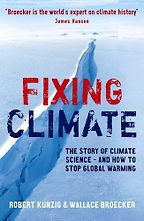
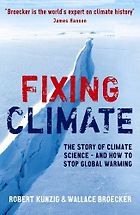
Let’s start with your first book, Fixing Climate: The Story of Climate Science – and How to Stop Global Warming by Robert Kunzig and Wallace S Broecker.
One of the reasons for picking this book is that Wally Broecker is my guru. He has been a friend for nearly 40 years and is a big influence on my life. This book is partly the story of his scientific development through the years, starting from a geochemist working in a lab to being one of the most influential people working in the world on oceanography and climate change. I think Robert Kunzig did most of the actual writing based on talking to and following Wally while he was doing his work.
And what kind of hope does he offer for the climate crisis?
What he is saying is that we could and should remove carbon dioxide from the atmosphere, having put it there without realising what the consequences would be. He suggests (credibly in my view) that it is possible to remove it and that we need to find ways of doing that in order to restore the climate to something closer to a natural state.
In the context of climate change there are two main things that science can help us to do which are reflected in the books I have chosen. One is what you might call Plan A, which is how to find low carbon sources of energy and reduce our energy consumption, and the other is Plan B, the geoengineering idea to intervene directly to modify climate if we can’t achieve enough with Plan A.
But does he have any ideas about how he thinks it can be done?
Yes, because a colleague of his is someone called Klaus Lackner who is developing a rather clever method for removing CO2 from the air without using too much energy. There are lots of different ways of removing CO2, but the trick is finding a way to do it in a closed cycle, without using more energy than you generated in the first place, and so doing more harm than good in the process.
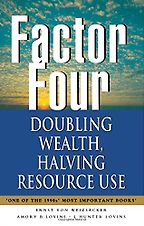
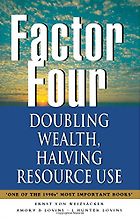
Your next book is Factor Four: Doubling Wealth, Halving Resource Use by Ernst von Weizsacker, Amory B Lovins and L Hunter Lovins.
This is an inspirational book written quite some years back. It was really saying that we don’t have to go back to living in stone caves and wearing hair shirts in order to sort this problem. If we use our intelligence we could achieve this factor four, which is expressed as doubling wealth and halving resources. And that is quite an appealing message.
Amory Lovins was one of the best known environmentalists and at the time most of them were saying that we must do less of this and less of that. But he was saying that if we use technology intelligently we don’t have to be poor again. We could still maintain the lifestyle to which we all aspire.
And do you think that is just wishful thinking?
There is some wishful thinking in the book I am sure. But it is possible. The main problem is the carbon dioxide issue is a lot bigger than a factor of four. I have a lecture that I give on climate change which suggests that it is a factor of 40, which is a derivation from the title of this book. What I mean by that is that we need to reduce carbon dioxide emissions by about 75 per cent by the end of the century or maybe a bit sooner.
At the same time the world’s population is probably going to double which makes it worse. And the developing world is liable to use more energy rather than less. If the bulk of the developing world only comes up to the level of Europe (let alone North America) that is another factor of five.
So I multiply four by two, then by five, and come up with 40 as the amount by which we have to reduce the amount of carbon we use to produce one unit of GDP. So factor four gets us some of the way but not all of it.
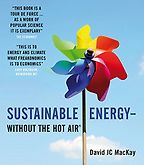
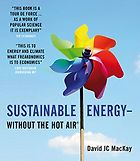
Your next book, Sustainable Energy – Without the Hot Air, by David J C MacKay, is called ‘the must-have book for anyone who is seriously interested in energy policy’. Is that the case?
Well, this is a very interesting book by a very interesting person. David Mackay was a professor of physics at Cambridge, but also the chief scientific advisor at the Department of Energy and Climate Change, so he was very influential. Before he had that appointment he wrote this book, which really tries to put things in context. He does very simple, back-of-the-envelope sums, as to how much energy could we get from bio-fuels, how much energy could we get from wind power, how much land would it take? He looks at all these scenarios that you hear talked about, and his conclusion is that they can make a significant contribution but it is basically not going to solve the problem. We are probably going to need additional things like carbon capture and nuclear energy to help fill the gap.
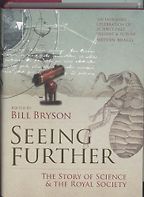
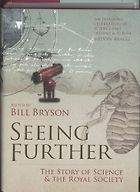
How about Seeing Further: the Story of Science and the Royal Society?
This was published to celebrate 350 years of the Royal Society. It is edited by Bill Bryson but made up of articles by all sorts of interesting people like Richard Dawkins and Steve Jones. It’s a set of essays on key issues which have arisen during the history of the Royal Society.
There is one essay I particularly like by Simon Schaffer. He is talking about the development of lightning conductors by Benjamin Franklin in the 18th century. His definition of ‘Promethean science’, as an experimental enterprise that mixes a vaulting ambition to safeguard humanity against a major threat with the troubling hazards of following this science’s recipes, sounds to me exactly like where we are with geoengineering at the moment. That is to say, something bold and dangerous that might well go wrong.
When they were dealing with lightning conductors there was the suggestion that, instead of protecting you, some of the lightening conductors could attract the lightning to you, and cause fires where they wouldn’t otherwise have been. It’s a fascinating story about how the Royal Society dealt with the inquiry. It was a big problem for the government because they wanted to protect their stores of gunpowder. So all these issues that we think are modern were in fact already around in the 18th century. It was unsatisfactory and messy just as things are today.
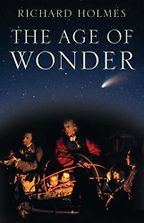
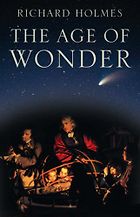
Your last book is The Age of Wonder: How the Romantic Generation Discovered the Beauty and Terror of Science, by Richard Holmes.
The reason for picking this is that it is a sort of cross-cultural book. Richard Holmes is a very eminent biographer. He has written biographies of several of the Romantic poets including Shelley and Coleridge. And I was intrigued when I saw this book by him sitting in our bookshop, because I didn’t know that he was particularly interested in science. His book is all about how, even in the age of Romanticism, science was an important part of culture. And it was, as the title suggests, both beautiful and offering much but also terrifying.
In those days it was considered completely normal to be interested in the arts but also to do scientific experiments. There was no contradiction there. Nowadays we have gone through this whole two cultures thing and many people think there is a massive divide, which I don’t think there is. And do you think it would be helpful today if people were happy to embrace different disciplines and there weren’t such divisions between science and art? Indeed I do, and as part of the 350-year celebrations the Royal Society and Tate Modern invited three artists to work with three scientists on different aspects of climate change and then to have a workshop on what they can do with the subject.
Some people would say that the whole idea of science saving us from the whole mess of climate change is a bit of a cop-out because we should be helping ourselves. I would say, yes, don’t bank on science alone. What is clear is that there is no free lunch, and almost everything we do has consequences of some sort or another. And there are still some things that ordinary people could and should do, and one of the most important things is to waste less.
But on the other hand I don’t think there is any reason to despair. Most of us who are working in this field alternate between optimism and despair on a fairly regular cycle. And people often say, ‘Are we headed for a catastrophe? What do you think?’ The answer is, I think we are in for a bumpy ride but I think there is a lot that we can do about it to make it less bumpy, and we could and should get on with them while we still have time. I don’t agree with the extreme environmentalists who say that all technological solutions should immediately be treated with suspicion. It isn’t science that has got us here. The first people who started burning coal weren’t scientists. They were just ordinary people trying things out. Essentially it’s just people who are responsible for the situation we are in. I do think that science played a part and science can also play a part in solving it, but we need other people as well.
February 16, 2010
Five Books aims to keep its book recommendations and interviews up to date. If you are the interviewee and would like to update your choice of books (or even just what you say about them) please email us at [email protected]
Five Books interviews are expensive to produce. If you've enjoyed this interview, please support us by donating a small amount.
John Shepherd
John Shepherd is a Professorial Research Fellow in Earth System Science in the National Oceanography Centre, University of Southampton, UK. His current research interests include the natural variability of the climate system on long timescales. He has extensive experience of international scientific assessments and advice in the controversial areas of fisheries management, radioactive waste disposal and climate change, and has recently taken a particular interest in the interaction between science and public policy. He was elected a Fellow of the Royal Society in 1999, participated in the Royal Society study on Ocean Acidification, published in 2005, and chaired the study on Geoengineering the Climate, published in 2009.
John Shepherd is a Professorial Research Fellow in Earth System Science in the National Oceanography Centre, University of Southampton, UK. His current research interests include the natural variability of the climate system on long timescales. He has extensive experience of international scientific assessments and advice in the controversial areas of fisheries management, radioactive waste disposal and climate change, and has recently taken a particular interest in the interaction between science and public policy. He was elected a Fellow of the Royal Society in 1999, participated in the Royal Society study on Ocean Acidification, published in 2005, and chaired the study on Geoengineering the Climate, published in 2009.